

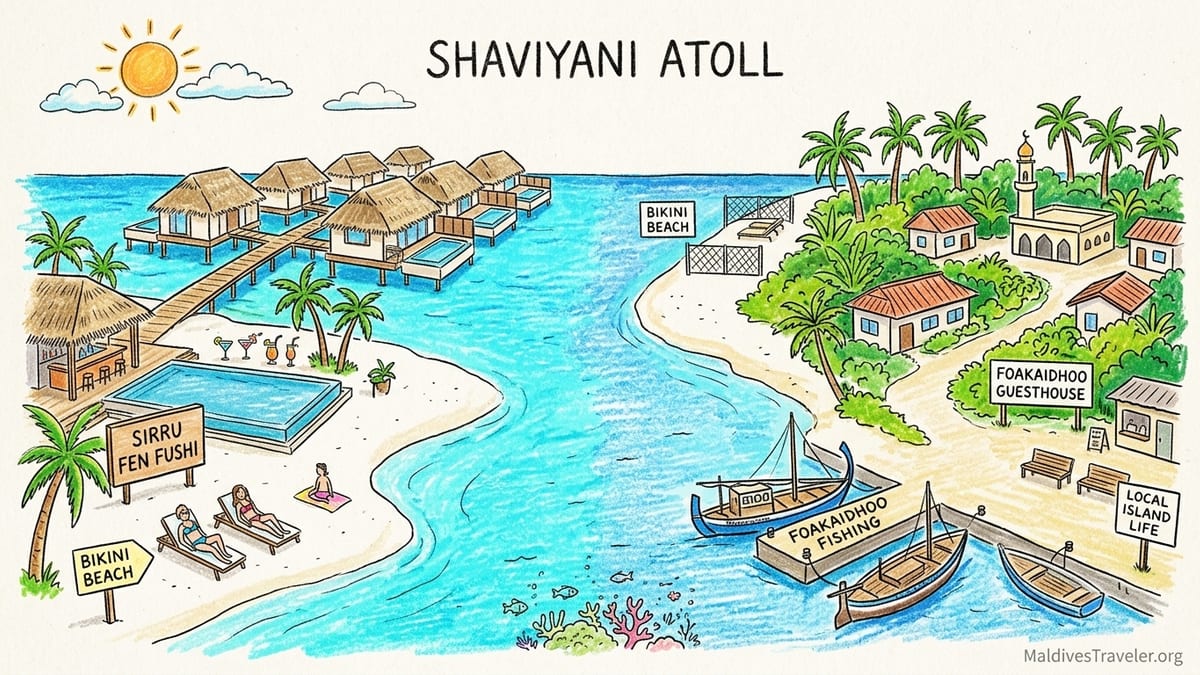
I split my time in Shaviyani Atoll between a private-island resort and an inhabited local island, and the contrast shaped how I now think about “the Maldives.” The real choice here is not north versus south Shaviyani, but whether you want the smooth, all-in-one resort bubble or the slower, community-based rhythm of a local island like Foakaidhoo. Both gave me bright lagoon water and powdery sand, but almost everything else felt different: how I spent money, where and what I ate, when I could swim or snorkel, and how much of Maldivian life I was actually seeing.
Understanding Shaviyani Atoll: Two Very Different Maldive Experiences
Shaviyani Atoll sits in the northern half of the Maldives, a wide scatter of reef-fringed islands that, on a map, looks almost empty. In reality it is split between inhabited islands such as Foakaidhoo, Funadhoo and Goidhoo, and a handful of private islands leased for high-end resorts, including Sirru Fen Fushi Private Lagoon Resort and JW Marriott Maldives on Vagaru. The water and reefs bind them together, but the way you experience the atoll depends far more on whether you stay on a resort island or a local island than on which reef name is printed on the nautical chart.
For this trip I booked four nights at Sirru Fen Fushi, the rebranded property that previously operated as Fairmont Maldives Sirru Fen Fushi, followed by five nights on an inhabited island, Foakaidhoo, staying at a small guesthouse and then one night at a homestay. Sirru Fen Fushi sits in a huge lagoon with beach and overwater villas, accessed primarily by a 55-minute seaplane flight from Malé with Trans Maldivian Airways, a pattern common to both Shaviyani resorts. My days there revolved around the resort schedule. On Foakaidhoo, by contrast, my alarm clock was the island mosque and the sound of fishing dhonis leaving before sunrise.
Shaviyani still feels less developed for tourism than central atolls. Official tourism lists only two resort islands here, while local islands have grown gradually into the guesthouse era, with places like Handhuvaru Maldives on Milandhoo and budget homestays on Foakaidhoo and Goidhoo specialising in community-oriented stays. That split allowed me to compare not a theoretical idea of “local Maldives” with “five-star Maldives,” but the reality of both, back to back, in the same atoll.
Throughout this article I distinguish clearly between what I experienced directly and what I confirmed later through research. When I mention my bill at Sirru Fen Fushi or the speedboat timetable to Foakaidhoo, that comes from receipts and conversations during my stay. When I talk about broader rules, like the nationwide alcohol regulations or current registered guesthouses in Shaviyani, I rely on guidance from the Maldives tourism authorities and recent practical guides rather than guesswork.
Accommodation: Villas, Guesthouses and the Feel of “Home”
At Sirru Fen Fushi my base was a beach villa with a private pool on the western side of the island. The villa opened directly to the lagoon, with a high privacy fence between neighbours and dense planting that hid other villas from view. It was the classic Maldivian postcard: four-poster bed, indoor-outdoor bathroom, and a plunge pool that caught sunset light. Housekeeping passed twice a day. When I stepped outside my door, I was still within the resort’s orbit. My options were other villas, restaurants, the main pool and spa, and the jetty where dive boats departed.
The resort’s accommodation is spread between beach, jungle and overwater villas, a pattern typical of high-end properties in Shaviyani. Overwater units sit in long jetties over the lagoon, popular with honeymooners who want ladder access straight into the sea. Jungle villas are wrapped in vegetation, quieter and shadier, though you walk to the beach rather than waking up on it. Prices move accordingly. On my dates, entry-level villas at Sirru Fen Fushi were pricing online in the region of 900 to 1,200 US dollars per night including taxes for two adults, with private pool beach villas higher, depending on season and promotions. That aligns with rate bands I saw from other travellers comparing JW Marriott Maldives on Vagaru, where points redemptions coexist with similar cash rates.
On Foakaidhoo the scale flipped. I first checked into a small guesthouse that faced a sandy lane, not the beach. The room was simple but air conditioned, with a double bed, private bathroom and a small terrace. The owner’s family lived in the house behind. Breakfast was included and cooked in the same kitchen the family used. The nightly rate, booked directly, converted to just under 70 dollars for two people including breakfast and local-style taxes. When I moved to a homestay closer to the island’s main bikini beach, the room cost was even lower for basic fan-cooled accommodation with shared facilities.
Across Shaviyani’s local islands, online platforms show guesthouse rates ranging roughly from 40 to 120 dollars per night for a double room, depending on how new the property is, whether meals are included and how close it sits to the island’s tourist beach. That matches what I saw on Foakaidhoo, where a newer homestay near Kollavaani beach advertised modern rooms and sea views at a premium over older family-run places further inland. The trade-off is comfort and amenities. No infinity pools, no pillow menus. Instead you get a clean room, home cooking and a host who is also the person arranging your fishing trip.
Beaches, Dress Codes and Alcohol Rules
The sand on both islands was the same bright white. What changed between Sirru Fen Fushi and Foakaidhoo was what I could do on the beach and what I could drink afterwards. At the resort, every shoreline is effectively a tourist beach. I could swim in a bikini anywhere, walk back to my villa with a towel, and order a glass of wine with lunch moments later. Evening cocktails were poured at the bar that fronts the island’s long infinity pool, and the wine list easily ran into several pages, with prices often between 16 and 30 dollars for a glass of imported wine and more for signature cocktails.
On Foakaidhoo, the Maldives’ national rules were very present in daily life. Alcohol cannot be sold or consumed on inhabited local islands, and bringing it yourself is also prohibited. These rules are enforced through both law and social norms, reinforced by government guidance and international safety notes that clearly state alcoholic drinks are only available on resort islands, liveaboards and similar licensed facilities. My guesthouse made this plain at check-in, asking guests not to bring duty-free bottles and explaining that they would be confiscated at the airport if discovered.
Beachwear is also regulated informally through custom and more formally through local bylaws. On Foakaidhoo, my host walked me to the island’s designated “bikini beach,” a screened-off section of shore at Kollavaani where tourists can swim in Western swimwear without offending local sensibilities. Outside that stretch, including in the village and along other coasts, I was expected to cover shoulders and knees. Long, light clothing worked fine, but it did mean planning ahead if I wanted to wander from the bikini beach to the harbour or mosque area.
From a traveller’s perspective this creates a clear divide. If your idea of the Maldives includes sunset drinks and walking in swimwear from villa to bar, that exists only in the resort bubble or on licensed vessels anchored off local islands. On Foakaidhoo the sunset ritual was drinking black tea with locals on the harbour wall, watching fishing boats unload their catch. The lack of alcohol did not make evenings dull, but it did change their flavour completely, in both literal and cultural terms.
Food and Restaurants: Buffets, Bistros and Home Kitchens
One of the starkest differences between my two stays was culinary. At Sirru Fen Fushi I counted three main restaurants, plus in-villa dining and themed nights. Breakfast was a sprawling buffet with live cooking stations, pastries, fresh fruit and made-to-order eggs. Lunch at the poolside restaurant meant tuna tartare or gourmet burgers, and dinner could be a multi-course tasting menu at the fine-dining outlet or a themed seafood buffet down by the beach. The resort’s menus quoted prices in US dollars, and it was easy to charge everything to the room without thinking too hard about the totals.
By checkout the food and drink bill had become a significant line item. Over four days, two people, eating breakfast included with the room and then a mix of a la carte lunches and dinners plus a few drinks, we spent just over 900 dollars on food and beverages. That average of about 110 dollars per person per day is consistent with cost calculators many Maldives specialists use for five-star properties when alcohol is involved. It is possible to trim that by avoiding alcohol, eating from bar menus and skipping premium items, but the structure still revolves around resort pricing.
On Foakaidhoo my meals were simpler and far cheaper but more tightly matched to local life. Breakfast at the guesthouse was roshi flatbread with tuna curry or mashuni, a mix of fresh tuna, coconut and onion, served with hot tea. Lunch might be whatever the family was cooking, often fish again, with rice and fried vegetables. When the owner’s cousin brought in a good reef-fish catch, we turned it into a grill night in the courtyard. I contributed around 10 to 15 dollars per person for these home-cooked spreads, and afternoon snacks at small island cafes came to just a few dollars each time.
The catch is choice. Foakaidhoo does not have rows of tourist restaurants. I counted two simple cafes and a couple of corner shops selling instant noodles and biscuits. For variety beyond Maldivian home cooking, my host suggested a day trip to Funadhoo, the atoll capital, where there are more cafes and a government-run canteen. On local islands like Goidhoo and Milandhoo, guesthouses increasingly advertise “international” dishes, but ingredient availability depends on supply boats and what can realistically be stored. If you have particular dietary needs, advance discussion with your host is essential, whereas at the resort the default assumption is that gluten-free bread and almond milk will always appear.
Privacy, Atmosphere and Local Interaction
Resort privacy in Shaviyani is engineered. My villa at Sirru Fen Fushi felt secluded by design. High walls shielded the pool deck from neighbours, foliage blocked lines of sight from the beach, and villa density was low enough that I could float in my pool without seeing another guest. On the beach, I could usually walk several minutes before passing anyone else, helped by the fact that a significant portion of the coastline fronts villas rather than public areas. When I wanted interaction I went to the bar or dive centre, but it was optional.
Staff interaction, meanwhile, was trained and polished. My villa host checked in via messaging, dinner servers remembered our preferences by the second night, and activity staff were outgoing in a friendly but professional way. These encounters were genuine within the context of hospitality work, but I was always a guest in a well-oiled tourism machine. Even cultural elements were curated, whether in the form of bodu beru drumming performances or handicraft demonstrations in scheduled slots.
On Foakaidhoo privacy meant something different. Inside my guesthouse room I had my own space, but as soon as I stepped into the sandy lane I was part of a community. Children shouted hello, elders watched from joali benches, and neighbours quickly figured out who I was staying with. My first afternoon I joined my host’s relatives at the harbour, drinking black tea and eating short eats from the local café. Our conversation hopped between fishing conditions, island politics and football. That kind of unscripted interaction is almost impossible at a resort, where local staff rarely talk about their own lives in depth while on duty.
The trade-off is that you become visible too. On a local island it is harder to switch anonymously between “tourist mode” and “private mode.” Dress codes apply outside guesthouse compounds, and carrying yourself respectfully matters. The payoff, if you want it, is a deeper sense of place. During my stay I was invited to a family home for afternoon tea, watched evening futsal matches by the school, and discussed coral bleaching with a teacher who also served on the island council. Those conversations changed how I thought about tourism’s impact on Shaviyani far more than any brochure copy could.
Snorkeling, Diving and Excursions
Snorkeling and diving in Shaviyani are excellent by Maldivian standards, but where and how you access the water differs a lot between a resort like Sirru Fen Fushi and a local island such as Foakaidhoo. At the resort, I had a defined house reef zone marked by buoys, reachable from a short walk along the beach or directly from overwater villas. The resort’s dive centre ran daily boat trips to outer reefs and channels, with full equipment rental, professional guides and set prices. A typical two-dive boat trip cost around 160 to 200 dollars per person plus tax and gear rental, slightly higher for more remote or special sites.
The resort marketed its house reef as a selling point, and in my experience it was healthy in parts, with the usual post-bleaching patchwork of coral. I saw turtles on almost every second snorkel, plenty of reef fish and occasional eagle rays. Safety infrastructure was clear: lifejackets, radios with the boat crew, and staff gently steering less confident swimmers away from strong currents. Excursions like dolphin cruises and sandbank picnics were polished and priced accordingly, often starting around 100 dollars per person and rising sharply for private charters or gourmet setups.
On Foakaidhoo, reef access was more improvisational but ultimately more varied. There is no manicured house reef with lifeguard flags. Instead, my guesthouse arranged a small boat to reef edges they knew well, usually a 10 to 20 minute ride away. For a half-day snorkeling trip with gear for two people, including a stop at a sandbank, I paid the equivalent of 60 dollars total. There was no glossy briefing room, but the skipper and guide knew the currents intimately, and we often had entire reefs to ourselves, sharing the water only with the occasional local spear fisherman.
Fishing excursions also felt distinct. At the resort, “sunset fishing” was a gentle, tourist-friendly outing with hand lines from a large dhoni, drinks and snacks included. On Foakaidhoo I joined an actual night fishing run with local men targeting reef fish for market. That meant leaving after evening prayers, baiting hooks shoulder to shoulder, and helping haul in lines under a single deck light. My contribution was paying for extra fuel and bringing snacks rather than a labelled excursion fee. The catch came back to the island and ended up in our curry the next day. It was messy, occasionally uncomfortable, and unforgettable.
Transfers and On-the-Ground Logistics
Getting to Shaviyani is often the first big cost shock for resort guests. Both Sirru Fen Fushi and JW Marriott Maldives rely primarily on a 55-minute seaplane transfer from Malé’s seaplane terminal. The resort handles bookings through operators like Trans Maldivian Airways and bundles it into your reservation. On my visit, the return seaplane transfer charge was quoted at around 650 dollars per adult, including taxes and fuel surcharges. The seaplane flies only in daylight hours, so arrival and departure times at Malé have to be planned accordingly, and you may spend a few hours in a lounge waiting for your slot.
By contrast, reaching Foakaidhoo involved a patchwork of public and private options but cost a fraction of the seaplane. First I took a domestic flight from Malé to Hanimaadhoo in a neighbouring atoll, booked directly through the local airline for under 200 dollars return. From there, my guesthouse arranged a seat on a scheduled speedboat that runs between Funadhoo, Foakaidhoo and other islands, operated by a company that advertises routes like Malé to Foakaidhoo and Funadhoo to Foakaidhoo. One-way fares on these boats were in the region of 25 to 40 dollars depending on route and operator.
There is also an atoll ferry service under the public RTL network connecting Shaviyani’s islands, including Foakaidhoo, with Funadhoo and sometimes beyond. Schedules can change and services are slower, but tickets purchased at the ferry terminal are very inexpensive by international standards, often under 10 dollars for multi-hour legs. My longest RTL ride in Shaviyani, from Funadhoo to Goidhoo during a side trip, took around three hours on a bench seat, watching flying fish and talking to islanders who were commuting for school or medical visits.
Planning is essential on the local side. Boats can be cancelled for weather, and last-minute changes mostly work if you are flexible. At a resort the logistics disappear into your booking confirmation. At Sirru Fen Fushi someone simply met me at arrivals in Malé, walked me to the seaplane check-in and later guided me to the resort lounge. At the end of my stay, the same chain ran in reverse. On Foakaidhoo I was the one queuing at counters, messaging my host to confirm whether the speedboat was on time, and thinking through what a missed connection would mean.
Money, Total Trip Cost and Hidden Extras
When I add up what I actually spent, the cost difference between the two styles of stay is stark. Four nights at Sirru Fen Fushi for two people, including villa, taxes, transfers and on-island spending but excluding international flights, came to just over 5,000 dollars. The main components were the villa itself, the seaplane transfers at roughly 1,300 dollars for two adults, food and drink at about 900 dollars, and Green Tax at 6 dollars per person per night as mandated for resort accommodation. Extras included a couple of excursions and a modest spa treatment.
The five nights on Foakaidhoo, by comparison, cost just under 900 dollars for two people, including domestic flights, speedboat transfers, accommodation, most meals, a snorkeling trip and one shared fishing expedition. Guesthouse and homestay nights averaged around 60 dollars including breakfast, Green Tax was 3 dollars per person per night, and meals rarely exceeded 15 dollars per person even when we ate a lot. The biggest single outgoing was the domestic flight segment linking Malé and Hanimaadhoo, which is still far cheaper than a seaplane.
There are hidden extras on both sides. At the resort, service charges and taxes add around 20 to 25 percent to almost every bill, and bottled water, premium coffees and small snacks add up quickly. At a local island guesthouse, you have to factor in cash for tips, occasional private boat hire if public transport schedules do not align with your plans, and possibly buying modest clothing that fits dress expectations if you arrive unprepared. Travel insurance that covers remote locations is wise in both cases.
When evaluating cost, the key is to look beyond nightly room rates. A couple paying 1,000 dollars per night for a villa might reasonably spend another 400 to 600 dollars per day on food, drinks, excursions and taxes without feeling extravagant. On a local island, a couple paying 70 dollars per night may add only 60 to 100 dollars per day for everything else. Over a week the gap can easily reach several thousand dollars, money that for some travellers is worth spending for convenience and indulgence, and for others is better redirected into a longer stay or a second destination.
The Takeaway
After splitting my time between Sirru Fen Fushi and Foakaidhoo, the decision about where to stay in Shaviyani Atoll feels less like a question of geography and more like choosing between two philosophies of travel. A private resort island condenses the Maldives into a single, carefully managed canvas. You trade money for ease, privacy and a wide menu of comforts, from seaplanes that meet your flight to staff who know your breakfast order by day two. The sea and sky are always in view, and you can arrange everything from a sandbank dinner to a spa treatment without touching your wallet until checkout.
A local island stay, by contrast, stretches the Maldives back out into a lived-in place. You gain community encounters, fishing boats at dawn, evening tea on harbour walls and the chance to hear how people in Shaviyani talk about reef health, fuel costs and schooling. You give up alcohol, high-end restaurants and the ability to walk in swimwear from bed to bar. Logistics take more thought, and you have to be comfortable respecting local norms. What you save financially is often matched by what you gain in understanding, if you value that kind of travel.
For many travellers the answer is not binary. One model that worked well for me, and for others I met along the way, was to start on a resort island for three or four nights, decompress, and then move to a local island in the same atoll for another stretch. In Shaviyani that might mean combining Sirru Fen Fushi or JW Marriott with Foakaidhoo, Goidhoo or Milandhoo, using domestic flights and speedboats instead of backtracking to Malé between every move. That way you taste both the iconic overwater-villa image and the slower, more grounded reality of Maldivian island life.
Ultimately the choice comes down to what you want your memories to be. If you close your eyes and picture the trip months later, do you see the glow of your private pool at sunset, champagne in hand, with staff quietly arranging dinner behind the scenes? Or do you hear the call to prayer drifting across an island while you drink sweet tea with new friends, knowing that your snorkel guide today is the same person who taught your host’s kids yesterday? Shaviyani Atoll contains both stories. Your job is simply to choose which one to step into, or to give yourself enough time to live both.
FAQ
Q1. Can I drink alcohol on local islands in Shaviyani Atoll like Foakaidhoo?
Alcohol cannot legally be sold or consumed on inhabited local islands, including Foakaidhoo, and you are not allowed to bring your own. If a guesthouse mentions access to alcohol, it usually means arranging a visit to a licensed vessel or resort offshore, which involves extra cost and logistics.
Q2. How much should I budget per day for a resort stay in Shaviyani?
Based on my stay at Sirru Fen Fushi, a realistic starting point for two people is around 900 to 1,200 US dollars per night for an entry villa, plus roughly 200 to 300 dollars per day for food and non-alcoholic drinks and more if you plan to order alcohol or take frequent excursions, along with seaplane transfers that can add over 600 dollars per person return.
Q3. What does a day on a local island like Foakaidhoo actually look like?
My typical Foakaidhoo day started with a simple Maldivian breakfast at the guesthouse, followed by a morning snorkel or sandbank trip arranged by my host, a home-cooked lunch, a hot afternoon spent reading in the shade or exploring the village, and evenings drinking tea at the harbour, watching fishing boats come in and sometimes joining a family dinner.
Q4. Is snorkeling better at the resort or on a local island?
At the resort I had easy, structured access to a house reef with clear entry points and safety support, plus professionally guided boat trips. Around Foakaidhoo the snorkeling felt wilder and more flexible, with my guesthouse arranging small-boat trips to different reefs. I saw comparable marine life in both, but the local island outings were cheaper and more personal, while the resort offered more polished infrastructure.
Q5. How complicated is it to reach Foakaidhoo compared with a resort like Sirru Fen Fushi?
Getting to Sirru Fen Fushi was straightforward because the resort managed everything, from meeting me in Malé to placing me on a 55-minute seaplane. Reaching Foakaidhoo involved buying a domestic flight to a regional airport, then coordinating speedboats or ferries with my host. It required more messaging and flexibility but cost significantly less overall.
Q6. Will I offend locals if I wear swimwear outside the bikini beach on a local island?
Yes, wearing typical Western swimwear outside the designated bikini beach areas on local islands is considered disrespectful. On Foakaidhoo I covered shoulders and knees in the village and used the screened bikini beach for swimming, which my hosts appreciated and which made interactions around the island noticeably warmer.
Q7. Are local island guesthouses in Shaviyani safe and regulated?
The guesthouses I stayed in and researched were licensed by the national tourism authorities, subject to basic safety and accommodation standards. On Foakaidhoo my guesthouse kept guest registration records, had fire extinguishers and clear emergency contacts, and I felt comfortable leaving valuables in the room, using the same precautions I would anywhere else.
Q8. How does the Green Tax differ between resorts and local islands?
The Maldives applies a Green Tax on tourist stays. At the time of my visit it was 6 US dollars per person per night at resort islands like Sirru Fen Fushi and 3 US dollars per person per night at guesthouses and similar accommodations on local islands, which quietly increases your nightly cost, especially at resorts.
Q9. Can I split my stay between a resort and a local island in Shaviyani?
Yes, and I recommend it if your budget and schedule allow. I spent four nights at Sirru Fen Fushi and five on Foakaidhoo, using domestic flights and boats instead of returning to Malé between each move, which gave me both the resort experience and genuine time in a local community.
Q10. Who should choose a resort and who should choose a local island stay?
If you prioritise privacy, seamless logistics, high-end dining and having everything on one small island, a private resort such as Sirru Fen Fushi or JW Marriott Maldives will suit you. If you are comfortable with modest dress codes, simpler accommodation and more hands-on planning in exchange for lower costs and deeper local interaction, a guesthouse stay on islands like Foakaidhoo, Goidhoo or Milandhoo will be more rewarding.