


Shaviyani Atoll in the far north of the Maldives is not a casual choice. By the time you have committed to the extra flight beyond Malé and accepted a seaplane bill that Visit Maldives and resort materials place at roughly 55 minutes and around 192 kilometers from Velana International Airport, with JW Marriott currently quoting about 665 US dollars per adult for shared roundtrip transfers, you are already in “this has to be worth it” territory. On two different trips I made that long hop north, once to JW Marriott Maldives Resort & Spa on Vagaru Island and once to what was then Fairmont Maldives Sirru Fen Fushi, now operating independently as Sirru Fen Fushi Private Lagoon Resort. I have not stayed since Sirru Fen Fushi left the Fairmont brand in 2024, so everything I describe there is clearly marked as researched when it relies on more recent sources rather than my own stay. With that in mind, here is how the two resorts really compare when you factor in villa design, privacy, beaches, snorkeling and diving, food, family facilities, transfers and value.
Author perspective and how each stay actually felt
My time at JW Marriott Maldives was a six night stay in a Sunrise Overwater Pool Villa booked on Marriott points. The first impression came even before landing, when the seaplane banked over Vagaru and I saw a tight ring of villas around a compact, almost perfectly circular lagoon. Once checked in, I remember barefoot staff walking me along a timber jetty, the smell of hot wood and sea salt in the afternoon sun, and being handed a coconut on my villa deck as my luggage appeared without fuss. From that point onward it felt like a slick, well oiled luxury beach club with Maldivian touches threaded through a recognizably international brand style.
At Sirru Fen Fushi my stay was shorter, four nights in a Beach Pool Villa on the sunrise side when it still carried Fairmont branding. I arrived in the late afternoon, with the famous 200 meter main pool glittering like a runway across the island from one shore to the other. My first walk from villa to pool took me past dense, almost jungle like foliage that hid neighboring decks so completely that I heard other guests long before I saw them. The lagoon felt wilder, and even on that first evening snorkel I noticed stronger currents and deeper water a few fin kicks from shore compared with the comparatively sheltered, almost pool like lagoon at JW Marriott.
Because Sirru Fen Fushi changed management and name in 2024, anything that relates to current programming or pricing there, such as the launch of the Sirru Residences or how the Sustainability Lab is run today, is based on research rather than direct experience. However, core elements such as the island geometry, house reef position, lagoon depth, and general villa layout are essentially unchanged, so comparisons that focus on geography, reef character and privacy still reflect what you are likely to experience now.
Villa design, privacy and the feel of your “home base”
At JW Marriott, the overwater villas felt almost yacht like inside, with a lot of polished wood, high ceilings and a carefully staged “Instagram ready” bathtub directly framed against the sea. My Sunrise Overwater Pool Villa had a long deck with a decent sized pool, netted loungers over the water, and a ladder that dropped into a sandy lagoon rather than a steep reef. It was visually spectacular at dawn, when the sun came up directly opposite the bed, but privacy depended very much on where on the ring you were. When I floated in the pool I could see into several neighboring decks at oblique angles and, judging by my own line of sight, knew they could probably see me too if they looked up from their books. It never felt intrusive, yet it was not the “nobody else exists” level of seclusion some honeymooners look for.
The beach villas at JW Marriott, which I toured but did not sleep in, are set back among palms with short sandy paths to the water. The planting is clever, but Vagaru is a relatively small, circular island and you are rarely more than a short buggy ride from the main pool, spa or restaurants. That compactness suits families and anyone who dislikes long humid walks, but it inherently caps how remote any single villa can feel. On the plus side, indoor and outdoor spaces are luxurious, with big shaded daybeds, outdoor showers and those same picture perfect bathrooms that many travelers shortlist the property for.
My Beach Pool Villa at Sirru Fen Fushi felt more like a private beach house. The interior was lighter, with more white and sand tones, and the flow from bedroom to terrace to pool and finally to the wide strip of beach felt very natural. Dense vegetation between villas meant that when I sat on the deck I only saw green on either side and a broad sweep of ocean in front. During my stay I walked the sunrise side several times and repeatedly noted how many villas had their own little “slice” of shore, with trees positioned to break lines of sight from neighbors. More recent resort descriptions as a Private Lagoon Resort highlight this same feature, emphasizing how each room seems to have its own piece of beachfront even as the island as a whole is quite long.
Overwater villas at Sirru Fen Fushi extend in long jetties towards the house reef, and when I snorkeled off a friend’s overwater deck the water was immediately deep enough that standing would not have been possible, matching later diver and snorkeler reports that the lagoon here drops off more quickly. Privacy from villa to villa is better than at many Maldivian resorts because of spacing and the angle of the decks, but you are still aware of people using the stairs or swimming in front of adjacent villas. If maximum visual seclusion from all neighbors is your priority, a well positioned beach villa on the sunrise side remains the safest choice.
Beach, lagoon character and how easy the snorkeling really is
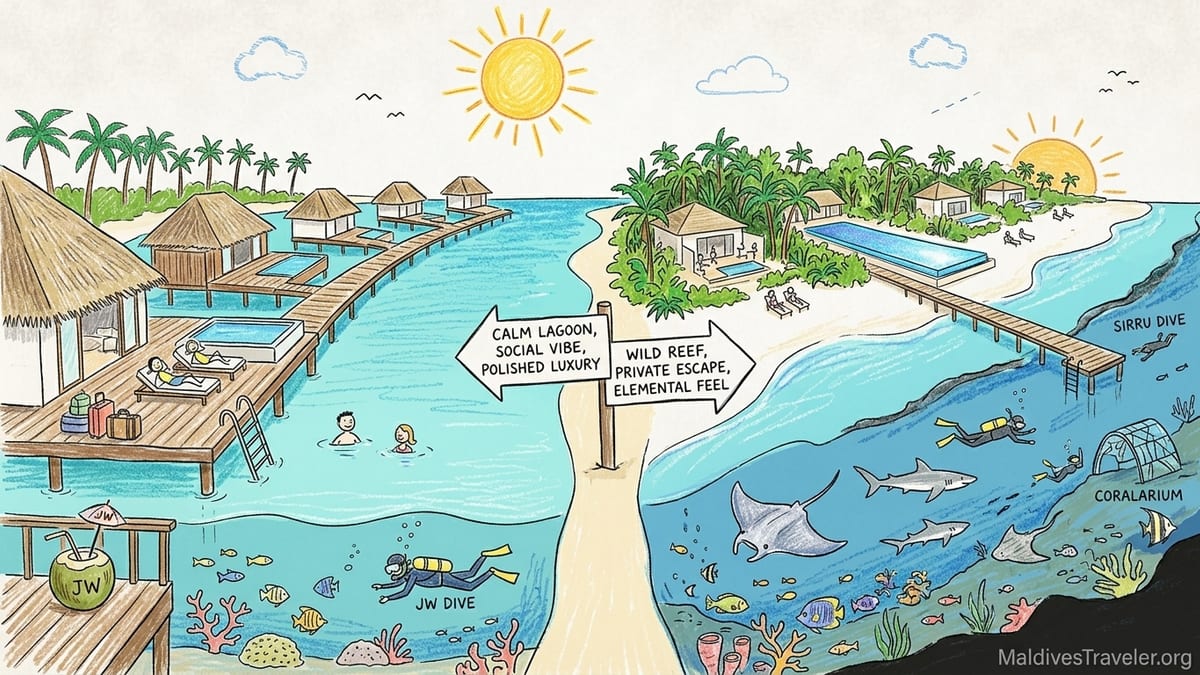
One of the most tangible differences between the two islands is how the water behaves. JW Marriott’s circular island sits in a lagoon that feels almost like a giant shallow swimming pool. In my overwater villa I could walk down the ladder and stand on soft sand in chest deep water at low tide, with very gentle current. The beach that wraps around the island is mostly soft white sand with only occasional coral rubble. It is perfect for small children who want to splash nearshore, for adults who prefer to float in calm water without worrying about drop offs, and for sunset strolls where you barely need to look at your feet.
Sorru Fen Fushi’s lagoon is visually stunning, with a broad, pale turquoise expanse on the western, sunset side and a more reef oriented sunrise side where the island faces the house reef and outer atoll edge. When I first walked into the water in front of my villa I noticed that within a short swim the sandy bottom gave way to scattered coral heads and then to a darker line of reef, with water already too deep to stand. At higher tide, waves broke further out, and even medium strength swimmers needed to pay attention to currents. More recent diver and snorkeler accounts underline this, describing a long, nine kilometer stretch of reef with stronger currents, deeper water and an abundance of larger marine life, from reef sharks to rays.
For easy, off the beach snorkeling JW Marriott is fair but not outstanding. I found patches of coral with small reef fish and the occasional turtle near some overwater villas, but large sections of the lagoon are sand with only low coral growth. If your dream is to step off your deck into a dense coral garden teeming with life, you may feel underwhelmed. Sirru Fen Fushi, in contrast, is built around its house reef. My own snorkeling sessions on the sunrise side brought encounters with turtles, blacktip reef sharks and swarms of schooling fish, and dive center staff at the time repeatedly highlighted a manta cleaning station on the house reef reached by boat. Post rebranding materials continue to market this reef and cleaning station heavily, suggesting that it remains a primary draw.
For beginners or less confident swimmers, the very qualities that make Sirru Fen Fushi’s reef thrilling can be intimidating. On one guided snorkel I joined, two guests cut their session short after realizing that they could not comfortably stand anywhere and that the depth below them felt more like open ocean than a sheltered lagoon. If you are bringing children or new snorkelers and want them to be able to stand and adjust masks in waist deep water right off the villa, JW Marriott is more forgiving. If you prioritize a sense of wildness and are happy to join organized outings led by guides who understand the local currents, Sirru Fen Fushi wins decisively.
Dive offering and underwater experiences
Shaviyani Atoll sits far enough north that it sees fewer day trip boats from Malé and has a reputation among divers for less trafficked sites. At JW Marriott, I completed a pair of fun dives and one afternoon house reef dive. The dive center operation was polished, with modern equipment, clear briefings and conservative profiles typical of a branded resort. The sites we visited were pretty, with healthy hard coral in places and the usual Maldivian cast of characters such as blue striped snappers, fusiliers, napoleons and reef sharks. However, nothing I saw there surpassed what I have experienced in more southerly atolls, and currents on both my boat dives were modest. It was an enjoyable, safe introduction to Maldives diving rather than a destination that hardcore divers would rank at the top of their life lists.
My diving at Sirru Fen Fushi felt more distinctive. One morning dive along the outer reef wall brought sustained encounters with eagle rays and multiple turtles, and we ended the dive drifting over a manta cleaning station where two mantas circled for several minutes. House material produced since the resort became Sirru Fen Fushi Private Lagoon Resort continues to market this same cleaning station and talks about the nine kilometer reef as one of the longest and richest in the region. Combined with comments from visiting instructors and underwater photographers in the years since my stay, a reasonably consistent picture emerges of an island that genuinely deserves a place on a diver’s shortlist, particularly for manta encounters during the right season.
For guests focused on dive training or racking up a large number of dives, the choice is nuanced. JW Marriott’s operation, embedded in a global brand environment, will feel familiar to those who have dived with other big hotel chains. It suits travelers who want to mix a few dives into a broader program of spa time, kids club and restaurant hopping. Sirru Fen Fushi offers a more dive centric feel, both because of the proximity of quality sites and because the very shape of the island and reef means that the underwater world feels ever present. You wake up and hear waves breaking on the outer reef, you snorkel above deep blue where the drop off lies just offshore, and you pass the dive boat moored off the sunrise side each time you walk to breakfast. For a trip where diving is the central purpose, I would personally lean toward Sirru Fen Fushi.
Dining, atmosphere and how each resort treats couples versus families
On paper, both resorts offer a familiar Maldives mix of buffet or semi buffet main restaurant plus a cluster of specialty venues. In practice, the dining atmosphere is quite different. At JW Marriott, meals felt like social events in a compact, lively village. The breakfast buffet at Aailaa was expansive, with an excellent bakery section and barista quality coffee, and it was busy most mornings with families and couples moving between indoor seating and the terrace. The signature Thai restaurant Kaashi, set partly in a treehouse structure, quickly became my favorite dinner spot, not only for the food but for its elevated view across the island and lagoon. There is also an overwater Japanese restaurant, Hashi, where I paid noticeably high, though not unexpected, prices for sushi and teppanyaki, and an Italian by the main pool that became a default lunch option.
JW Marriott’s bar scene gravitates around the pool and the adults only overwater bar, where sunset cocktails are framed by the classic Maldivian view of water villas and open ocean. Music volume was moderate during my stay, and while there was a clear focus on creating Instagram ready moments, I never felt the property tipped into loud party resort territory. Children are very much present, especially in school holiday periods, but families tend to cluster around the kids club, splash areas and shallow sections of the lagoon, leaving adults to gravitate to quieter corners.
At Sirru Fen Fushi, the dining experience during my stay was quieter and more spaced out. The main restaurant sat near the central pool, with a mix of buffet and à la carte, and one of my enduring memories is eating grilled reef fish under dimly lit palms while the 200 meter pool glowed gently nearby. Specialty venues tended to be smaller and more intimate. More recent descriptions of the resort as a Private Lagoon property highlight destination dining, including the use of the Coralarium, the semi submerged art installation on the reef, as a backdrop for private dinners. The overall mood even back then was slightly more reserved than at JW Marriott, with fewer young children and more couples or small groups of friends.
For couples, especially those on honeymoon, the choice again hinges on personality. JW Marriott offers more restaurant variety and a slightly higher energy level, with date night options like rooftop Thai dining and stylish cocktail bars. Sirru Fen Fushi trades some of that choice for a quieter, more elemental atmosphere centered on sea, sky and sand, with the long pool and the reef providing a constant visual anchor. On my trip, evenings there often ended with a slow walk along the beach under very dark skies, thanks to the absence of neighboring islands and resulting lack of light pollution, which felt distinctly different from the more resort village ambience at JW Marriott.
Family facilities, kids clubs and practicalities for group travel
JW Marriott makes no secret of its family friendly credentials, and that showed throughout my stay. I saw many multi generational groups and young families, and the kids club complex was one of the most substantial I have encountered in the Maldives, with indoor play areas, outdoor splash zones and organized activities running through the day. Beaches near family clusters had shallow, calm water and easy buggy access, and staff seemed practiced in handling special meal timings and preferences for children. The resort’s compact, circular layout meant that even with small kids in tow you were never more than a few minutes from your villa to the main pool, restaurants or reception.
For a concrete example, one family I spoke to by the pool had two children under ten. They described a rhythm where mornings were spent at the kids club while parents dived or visited the spa, followed by all four of them meeting at the Italian restaurant for pizza and then a late afternoon of sandcastle building on the beach. They chose JW Marriott specifically because they felt that a more spread out, reef focused island would be harder to manage with their children’s swimming abilities and attention spans.
Sirru Fen Fushi, in contrast, felt more oriented to older children and teens during my stay. There was a kids club and family activities, but the sense I had, echoed by later family trip reports, was that the deeper water and reef focused activities skewed things toward confident swimmers and children who already enjoy snorkeling, diving or water sports. A parent I met on the sunrise side described taking their teenager to the Sustainability Lab to learn about recycling and coral restoration, followed by snorkeling at the Coralarium and a late afternoon paddleboard session. For them, the draw was not playgrounds or splash pads but the ability to share more adult adventures in a relatively wild marine environment.
If your Maldives trip revolves around young children who want safe shallows, supervised play and short walks, JW Marriott is the easier recommendation. If your “family” trip involves older kids, adult siblings or friends who want some independence and are excited by the idea of deeper water, stronger currents and real reef encounters, Sirru Fen Fushi offers a richer canvas.
Transfers, costs and overall value for money
Both resorts require a substantial additional investment once you land in Malé. Sirru Fen Fushi’s seaplane ride is widely described as around 55 minutes from Velana International Airport, and JW Marriott’s official information puts Vagaru roughly 192 kilometers from Velana, with shared roundtrip transfers currently priced at about 665 US dollars per adult. In practice, by the time you add taxes and charges, the seaplane bill for a couple can easily rival or exceed your international airfare into the Maldives, a reality reinforced by many traveler reports that remark on how the seaplane costs can amount to a quarter or more of the total trip budget.
On my JW Marriott stay, the transfer cost was bundled into the total when using Marriott points, which softened the psychological blow even though I was effectively still paying via cash components and taxes. Food and beverage, however, made the resort’s true cost very clear. Simple lunches at the Italian restaurant routinely approached three figures in US dollars for two people when including drinks, and specialty dinners with wine at Kaashi or Hashi often ended up higher still. A later guest I spoke with online mentioned paying the equivalent of several dozen US dollars for a single coffee and chocolate service, which aligned with my impression that à la carte prices there sit firmly in “aspirational luxury” territory.
At Sirru Fen Fushi, my memories and subsequent research suggest that prices are also firmly upscale but can feel slightly less aggressively marked up day to day, particularly on set menus and meal plans. The resort has historically offered half board and full board options that, while not cheap, provide more predictable budgeting, something I appreciated as a diver doing multiple boat trips. Diving itself at both resorts is priced within the general Maldives norm for high end properties, meaning that serious dive focused stays are never going to be inexpensive.
In value terms, JW Marriott delivers a polished, brand consistent experience with very high service levels, strong family facilities and a visually iconic lagoon, but you pay heavily for food, drink and extras. Sirru Fen Fushi delivers a more distinctive reef and a greater sense of remoteness, plus touches like the Coralarium and Sustainability Lab, but also asks you to accept slightly rougher edges in logistics and, now that it operates independently, perhaps less predictable loyalty perks. Neither is a “bargain” by any conventional standard. The real question is whether you value calm lagoon luxury and convenience more, or wild reef encounters and space between you and the rest of the world.
Which resort I would choose for different types of trips
For a honeymoon, my choice would tilt slightly toward Sirru Fen Fushi, specifically in a well located sunrise Beach Pool Villa. The combination of deeper blues, the long main pool cutting across the island, the ability to walk straight from your deck to a relatively empty strip of beach, and evenings spent under very dark, star rich skies feels more like the archetypal “secret island” experience couples often imagine. Add in destination dining options near the Coralarium and the sense that there is little else around you in the atoll, and it edges ahead of JW Marriott for that once in a lifetime romantic escape, provided the couple are comfortable swimmers and not overly anxious about currents.
For a family trip, particularly with young children, I would choose JW Marriott without hesitation. The compact layout, calm shallow lagoon, oversized kids club and abundance of family friendly dining all work together. Parents can relax knowing that little ones have soft sand and gentle water to play in, and that moving from villa to breakfast to pool to bed does not require long walks or reliance on buggies. Even for multi generational groups with grandparents in tow, the easier navigation and predictable brand service culture at JW Marriott make logistics simpler.
For a diving focused stay, Sirru Fen Fushi is my clear preference. The longer house reef, proximity to a manta cleaning station, and general feeling of immersion in a wilder seascape made my dives there stand out compared with those from JW Marriott on Vagaru. I would still happily dive at JW Marriott if circumstances placed me there, but if I am planning a trip where the main purpose is to log memorable dives with rays, sharks and a sense of scale along the reef, I book Sirru Fen Fushi first.
For maximum seclusion, I would again look to Sirru Fen Fushi, but I would be careful in villa selection. Not all beach villas are equally private, and some sections of the overwater jetty get more passing foot and boat traffic than others. A sunrise side Beach Pool Villa with dense screening foliage offered the best combination of visual privacy and access to the more dramatic reef. At JW Marriott, despite excellent design and high comfort, the intrinsic compactness of the island and the circular lagoon mean that you are almost always aware of the wider resort community, which is part of its charm for many guests but makes it less ideal if your goal is to feel like castaways.
The Takeaway
JW Marriott Maldives and Sirru Fen Fushi share a broad map reference in the remote Shaviyani Atoll and a reliance on long, expensive seaplane transfers, but once you step onto the jetty they diverge in feel and focus. JW Marriott is your polished, high energy Maldivian village, wrapped around a gentle lagoon and backed by the reassurance of a global brand and a deeply family friendly infrastructure. Sirru Fen Fushi is your “secret water island,” stretched along a serious house reef where the ocean feels wilder, the skies darker at night and your villa more insulated from resort bustle.
Neither resort is the objective winner for every traveler. Instead, each is the right choice for certain types of trips. If you imagine the Maldives as a place to gently float in warm, still water with a cocktail, send your kids to a world class kids club and hop between specialty restaurants each night, then the circular shores of Vagaru at JW Marriott will match that vision well. If you imagine it as a remote outpost at the edge of a vast reef, where mantas circle cleaning stations, turtles graze below your fins and you can walk a long beach without seeing more than a handful of other guests, then Sirru Fen Fushi comes far closer.
Having experienced both, I would personally return to JW Marriott with my extended family or with friends who value comfort and ease over underwater drama. I would return to Sirru Fen Fushi when I crave that slightly rawer edge of the Indian Ocean and want my days to revolve around the tides, the reef and the quiet rhythm of an island that still feels, in many respects, like a true escape.
FAQ
Q1. Is the seaplane transfer time very different between JW Marriott and Sirru Fen Fushi?
Both require a substantial seaplane flight north from Malé, with Sirru Fen Fushi often described as around 55 minutes and JW Marriott typically close to an hour, so in practice the time difference is minor.
Q2. How much should I budget for seaplane transfers to JW Marriott or Sirru Fen Fushi?
JW Marriott’s official information currently prices shared roundtrip seaplane transfers at about 665 US dollars per adult before taxes, and Sirru Fen Fushi is in a similar high range, so a couple can easily spend four figures on transfers alone.
Q3. Which resort has better off the beach snorkeling for beginners?
JW Marriott has a calmer, shallower lagoon where you can stand in many areas, making it friendlier for beginners, while Sirru Fen Fushi’s house reef is richer but in deeper water with stronger currents that suit confident swimmers.
Q4. Is JW Marriott or Sirru Fen Fushi better for serious divers?
Both offer professional dive operations, but Sirru Fen Fushi’s longer house reef, manta cleaning station and proximity to deeper outer reef walls make it the stronger choice for dive focused travelers.
Q5. Are overwater villas at either resort suitable for young children?
Policies change, but many Maldivian resorts restrict overwater villas for younger children for safety reasons, so families with small kids often book beach villas at JW Marriott or Sirru Fen Fushi and should confirm current age rules before reserving.
Q6. How do food and beverage prices compare between the two resorts?
Both price meals and drinks in the high luxury range, with JW Marriott often feeling a little more expensive on à la carte orders, while Sirru Fen Fushi’s structured meal plans can make daily costs easier to predict.
Q7. Which resort offers more privacy for honeymooners?
While both have private pool villas, a well located sunrise Beach Pool Villa at Sirru Fen Fushi usually offers more visual seclusion thanks to dense planting and a longer, less crowded beachfront.
Q8. Is either resort walkable, or will I rely on buggies all the time?
JW Marriott’s compact circular island is very walkable, especially for families and older guests, whereas Sirru Fen Fushi is longer and more linear, so you may use buggies more often to move between villa, restaurants and dive center.
Q9. How strong is the family focus at JW Marriott compared to Sirru Fen Fushi?
JW Marriott places a clear emphasis on families, with a large kids club and many child friendly facilities, while Sirru Fen Fushi feels more geared to couples, divers and families with older, confident swimming children.
Q10. If I want one resort that balances relaxation, reef life and good food, which should I pick?
If you lean slightly more toward calm water and variety of dining, JW Marriott is the safer all round choice, while if reef life and a sense of remoteness are higher priorities, Sirru Fen Fushi offers a more distinctive balance.