


There is a point on the ferry from Malé to Shaviyani Atoll when the Maldives you recognise from glossy brochures falls away. The overwater villas and curated palm trees remain somewhere on the horizon, but the boat keeps going, deeper into the northern atolls, until it pulls alongside a long, low strip of green called Foakaidhoo. Stepping off the ferry here is not an arrival at a resort. It is arrival in a village. My stay on Foakaidhoo was a deliberate decision to see the other side of Shaviyani Atoll, and what I learned there has permanently changed how I think about travel in the Maldives.
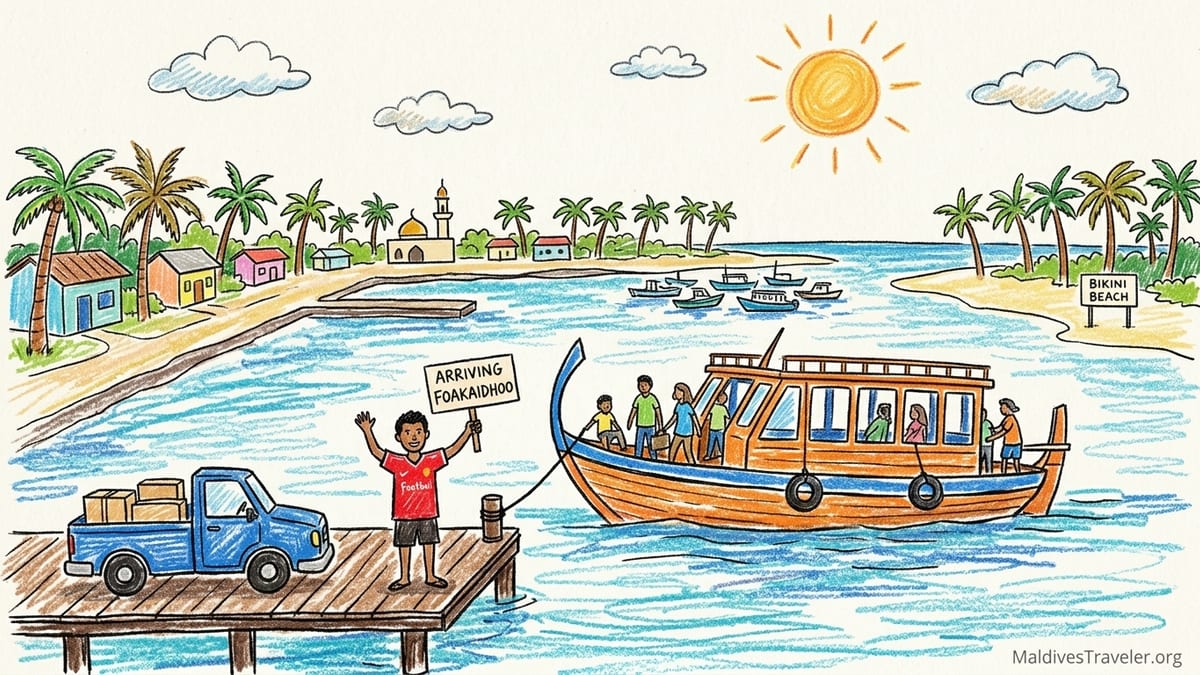
Arriving in Foakaidhoo: Crossing an Invisible Border
The journey to Foakaidhoo sets the tone for everything that follows. Rather than a speedboat charter connected to a resort’s private lounge, I boarded a scheduled speedboat from Malé’s local harbour shared by atoll residents, schoolchildren and a handful of workers heading back to Shaviyani. Foakaidhoo lies roughly 240 kilometres north of the capital, and depending on sea conditions the trip can take around five hours by a combination of speedboat and regional transfers. The boats run on fixed days and times, and the schedule feels designed first for locals and only second for visitors, something that becomes clear the moment the captain detours to drop cargo on another island.
As we approached Foakaidhoo, there were no welcome drums or waiting buggies. Instead, a teenager in a football jersey caught the mooring line, a small pickup truck shuttled boxes of groceries, and my host waved from the jetty in flip-flops, holding a handwritten sign with my name. That small detail captured the essence of the stay: informal, personal and integrated into everyday life. Travel here required accepting that I was entering someone’s home island, not a self-contained leisure product.
Checking in at the guesthouse took less than five minutes. There was no lobby bar or turn-down service, only a shaded courtyard, a few rooms opening onto a tiled hallway, and a long dining table where guests and family ate together. It was immediately clear that whatever I had not organised in advance, I would be working out on island time, in conversation with people whose days did not revolve around me.
Staying in a Guesthouse, Not a Resort
Foakaidhoo’s tourism infrastructure is still emerging. There are only a small number of licensed guesthouse rooms on the island, so the experience is intimate by necessity. My room was simple and functional: a double bed with a mosquito net, a private bathroom with a hot-water shower, air conditioning, and a window facing a narrow sandy lane. The furniture was built more for durability than design, and the strongest decoration was the soundscape drifting in from outside, where children cycled past and neighbours called to one another over boundary walls.
Prices and inclusions change as local tourism develops, but when I visited in 2026, nightly rates discussed with hosts and regional operators were broadly comparable to other northern atoll guesthouses, usually sitting in the mid-range of Maldivian local-island stays rather than in the budget bracket. I arranged a half-board plan directly with my guesthouse so that breakfast and dinner were included, leaving lunch flexible in case I was out on the reef or visiting a sandbank. There was no printed room service menu, no minibar with global brands, and no glossy folder of spa options. What there was instead was direct conversation. If I needed something, I asked, and someone would usually find a way.
The trade-off for this simplicity is that you also encounter the practical limits. Power cuts, while infrequent, can happen. Internet speeds vary with the network and time of day, and there were evenings when I could not upload more than a photo or two. Laundry happened on the line rather than through an express service. Coming from the frictionless environment of a resort, which exists specifically to mask these realities, the adjustment took a day. After that, it stopped feeling like a compromise and began feeling like an honest expression of where I was.
Dressing Respectfully and Navigating Beach Access
Foakaidhoo is a Muslim community island, and that shapes how visitors need to think about clothing and beach time. On the main streets and public areas, residents dress modestly, with men in shorts and t-shirts or sarongs, and many women wearing hijab and long dresses. As a foreign guest, I quickly realised that walking around in resort-style swimwear would have been out of place. I lived in loose linen trousers, knee-length shorts, t-shirts that covered shoulders, and airy dresses paired with a light scarf when entering more conservative spaces or passing the mosque during prayer times.
Beach access exists, but it is not the unlimited, anywhere-you-like version you have on a resort island. Local regulations for inhabited islands restrict swimwear to designated “bikini beach” areas, and while Foakaidhoo does have a stretch of shoreline set aside for tourists, it is more modest in scale than the sweeping beaches of private atolls. The sand here felt less curated, with bits of coral, driftwood and fishing gear reminding me that this shore also supports livelihoods, not just leisure. When I wanted an open horizon and fewer reminders of village life, my hosts arranged boat trips to nearby sandbanks and uninhabited islets where wearing a swimsuit felt both legal and culturally comfortable.
For women travellers in particular, having this clarity around where bikinis were acceptable made it easier to relax. On the boat, I wore a long-sleeve rash guard and shorts over my swimwear while we loaded gear at the harbour, then changed or stripped layers once we reached the sandbank. After a few days, this rhythm of covering up near the village and relaxing dress codes offshore felt natural. Respecting local expectations cost me very little, and it created space for conversations with residents who appreciated that I had made the effort.
Living With Island Rhythms: Mosques, Meals and Shops
Foakaidhoo wakes and sleeps to the call of the mosque. The first azan drifted into my room just before dawn, a reminder that I was sharing sound space with everyone on the island. Throughout the day, the calls punctuated whatever I was doing, whether that was drinking tea at a café, resting after snorkelling, or sitting on the harbour wall at sunset. During prayer times, the streets thinned as men walked toward the mosque and shops temporarily closed their doors. Rather than treating this as an interruption, I began using it as a natural way to structure my own day, planning excursions in the quieter mid-morning or late afternoon slots.
Meals were rooted firmly in Dhivehi home cooking rather than international buffet standards. Breakfast at the guesthouse meant hedhikaa, the much-loved Maldivian short eats, such as bajiya stuffed with tuna and coconut, or roshi flatbreads served with mashuni salad made from smoked tuna, grated coconut, onion and chilli. Sweet black tea appeared with almost every plate, poured into simple glasses rather than branded mugs. Lunch, when I was on the island, often came from small cafés or takeaways near the harbour, where staff happily pointed me toward the day’s curry pots and grilled fish trays.
Shops were functional rather than atmospheric. There were a handful of corner stores selling staples like rice, eggs, tinned tuna, biscuits, instant noodles and soft drinks, alongside mobile phone top-ups and basic toiletries. If I wanted a specific imported snack or high-end sunscreen brand, I had to bring it from Malé. This is not a place for café-hopping or souvenir shopping, and that realisation was oddly liberating. With fewer distractions tied to spending, it became natural to value time and interactions instead.
Fishing, Boats and the Working Waterfront
Foakaidhoo’s identity is tied to the sea more visibly than any resort island I have visited. The waterfront is not a manicured arrival jetty, but a working harbour lined with colourful dhonis and dinghies, each fitted out for reef fishing, supply runs or inter-island transport. Early in the morning, I watched crews heading out with bait boxes and handlines, not for the benefit of tourists but because the island’s economy still leans heavily on the catch.
Tourism operators now collaborate with local fishermen to offer visitors a glimpse of this world through traditional fishing trips. One evening, I joined a small group arranged through my guesthouse and the Visit Foakaidhoo team. We pushed off from the harbour just before sunset on a wooden dhoni whose deck had seen decades of work. There were no polished champagne flutes or beanbags, only upturned crates to sit on and a pile of handlines coiled neatly beside a bucket of bait. The captain showed us how to drop the line, feel for the faintest tug and pull with a short, sharp motion. When someone landed a medium-sized reef fish, the crew smiled in quiet approval but did not turn it into a performance.
Back on the island, that same fish appeared on the dinner table, charred over coconut husk coals and served with rice, lime and a chilli-onion sambal. It was a direct chain from work to plate rather than an abstract “sea-to-table” concept. The harbour is also where much of the informal social life happens: teenagers practising football tricks, elders sitting on joali loungers sharing stories, and children jumping repeatedly off the pier into a section of lagoon that felt more like a communal swimming pool than a postcard beach.
Reefs, Sandbanks and the Quiet Joy of Everyday Snorkelling
Shaviyani Atoll sits far enough from the country’s tourism core that many of its reefs remain under lighter pressure, and Foakaidhoo’s surrounding waters are rich for those willing to explore without expecting the infrastructure of a resort dive centre. My guesthouse worked with local boat owners to arrange half-day trips to nearby reefs, sandbanks and uninhabited islands. Prices varied with fuel costs and group size, but the structure was straightforward: pay in cash at the end, after returning to the harbour, with a rough idea agreed in advance on the jetty.
The coral gardens we visited were not pristine in the untouched sense; bleaching events have affected the Maldives widely. Yet there were still sections of branching coral and bommies that pulsed with life. On one snorkel drift, I followed a green turtle along the edge of the reef, staying just far enough back not to disturb it as it glided between shafts of light. Schools of fusiliers flashed in silver and yellow, and occasionally a curious batfish hovered at the edge of visibility. None of this was staged. There was no underwater photographer, no safety speedboat hovering at a set distance. The crew watched carefully from the dhoni, but mostly they left us to the quiet work of discovering the reef at our own pace.
Sandbank excursions were another highlight. About 20 to 40 minutes by boat from Foakaidhoo, low-tide banks rise just high enough from the water to host a makeshift day camp. Stepping onto one felt like arriving inside the resort advertisements that first pulled the Maldives into global imagination, but with the crucial difference that we brought everything with us, and took everything home. The crew rigged a simple shade using a tarpaulin and poles, set up a portable grill, and left us free to swim, snorkel and walk the rim of the bank until the tide began to creep back in. It was as close to solitude as I have felt in the Maldives, punctured only by the occasional laughter drifting across from the boat.
Conversations, Coir Rope and Learning to Adapt
What ultimately distinguished Foakaidhoo from any resort stay was not just the setting but the quality of my interactions with residents. Because visitors remain relatively few, almost every encounter felt unscripted. A schoolteacher I met at the harbour invited me to see the island’s football ground, proud that Foakaidhoo has a club competing at national level. A woman who ran a small shop explained how her family balanced incomes between fishing, public sector jobs and the emerging opportunities in guesthouse tourism.
One afternoon, I joined a demonstration of coir rope making, arranged not as a staged “cultural show” but as a practical session with two older women who still use the rope in their households. We sat in the shade of a breadfruit tree as they soaked coconut husks, teased out the fibres and twisted them into strands with quick, practised movements. When they invited me to try, my first attempts were clumsy, and the rope unravelled. They laughed, corrected my grip, and showed me how to roll the fibres against my thigh with more pressure. In that moment, the island’s craft heritage felt less like a museum exhibit and more like a living skill passing from one pair of hands to another.
Adapting to Foakaidhoo required more than wardrobe changes. I had to adjust my expectations of time and control. Boat trips were confirmed verbally the night before, subject to the weather and the availability of a captain. Meals did not always appear at exact hours, but they were plentiful when they did. The internet could not support heavy remote work demands, which meant I had to let some emails wait until I was back in Malé. Above all, I needed to remember that I was a guest in a working community where weddings, funerals, school exams and council meetings mattered far more than my desire to watch one more sunset from a boat.
The Takeaway
Staying on Foakaidhoo is not for every Maldives visitor, and that is precisely its value. If your dream trip centres on unlimited cocktails, overwater villas and a spa menu that travels with you from country to country, a private island resort will meet those needs with polished efficiency. Foakaidhoo, by contrast, asks more of you. It asks for patience with ferries that run on local logic, for willingness to cover your shoulders and knees in public spaces, and for acceptance that not every moment will be arranged for your enjoyment.
In return, Foakaidhoo offers something that is increasingly rare in a world of curated experiences. It offers the chance to understand how Maldivians live with the sea when tourists are not watching, to hear the pre-dawn call of the mosque mingle with the sound of outboard engines heading for the reef, and to sit on a harbour wall at dusk knowing that the fish on your plate was landed by someone you watched working that morning. It lets you see that an atoll is more than its resorts, that communities like Foakaidhoo are the beating heart that keeps the Maldives real beneath the surface of the postcards.
For travellers willing to listen rather than direct, to adapt rather than demand, Foakaidhoo becomes more than a destination. It becomes a relationship, one in which both guest and host remain quietly aware that this is an experiment in sharing space and opportunity. Walking back to the jetty on my last morning, dodging bicycles and greeting familiar faces with “Assalaamu alaikum,” I realised that the most memorable part of my stay was not the colour of the water, but the feeling that, for a few days, I had stepped into the everyday rhythm of an island that has always been here, long before the world discovered the word “Maldives.”
FAQ
Q1. Is Foakaidhoo suitable for a first-time visitor to the Maldives?
Foakaidhoo can work for a first-time visitor who is comfortable with a low-key, community-focused stay and is not expecting resort-style facilities. If you value cultural immersion, enjoy simple guesthouses and do not mind limited dining and entertainment options, it can be a rewarding introduction. If you mainly want luxury amenities and all-inclusive services, it is better to start with a resort and save Foakaidhoo for a future trip.
Q2. How do I actually get to Foakaidhoo from Malé?
Access involves a combination of domestic transfers and local boats, which your chosen guesthouse or local operator should help you coordinate. Typically, visitors first reach the atoll’s main transport hub or nearby islands by domestic flight or scheduled speedboat, then continue by regional ferry or chartered boat to Foakaidhoo. Schedules can change with weather and demand, so it is important to confirm exact timings directly with your host shortly before travelling.
Q3. What should I pack that I might not think of for a resort stay?
Beyond standard tropical clothing, bring modest outfits that cover shoulders and knees for walking around the village, including light long-sleeve tops and loose trousers or skirts. A good reef-safe sunscreen, hat and rash guard are very useful because there are fewer shops stocking specialist products. Consider packing any specific snacks, medications or toiletries you rely on, as local stores carry only basic brands and limited variety.
Q4. Can I wear a bikini on Foakaidhoo’s beaches?
On inhabited islands like Foakaidhoo, swimwear is generally restricted to designated tourist or “bikini” beach areas and offshore sandbanks or uninhabited islands. You should dress modestly when walking through the village and at the harbour, then change or remove extra layers once you are inside the approved beach zone or out on a boat excursion. Your guesthouse can point you to the correct areas and advise on current local expectations.
Q5. Are there ATMs, pharmacies and medical facilities on the island?
Services on Foakaidhoo are limited compared with resort islands or Malé. It is wise to carry enough Maldivian rufiyaa or agreed foreign currency in cash to cover your stay, and to bring essential medications with you. Minor health issues can usually be handled locally or in nearby islands with clinics, but anything serious may require evacuation to larger medical facilities in the atoll’s main centre or in Malé, so comprehensive travel insurance is strongly recommended.
Q6. What kind of excursions are realistically available from Foakaidhoo?
Current local tourism offerings include traditional handline fishing trips with local crews, half-day snorkelling excursions to surrounding reefs, sandbank visits, simple island-hopping within Shaviyani Atoll and cultural activities such as coir-rope making demonstrations. These are usually arranged on demand through your guesthouse or community-based operators, often with flexible itineraries depending on tides, weather and boat availability.
Q7. How reliable is the internet if I need to work remotely?
Mobile data and guesthouse Wi-Fi on Foakaidhoo can support general browsing and messaging, but connections are less stable than in urban centres and may slow noticeably in the evenings. Uploading large files, joining high-quality video calls or doing bandwidth-heavy remote work can be frustrating. If staying connected for work is critical, it is safer to plan only light tasks while on the island and handle more demanding commitments before or after your visit.
Q8. Is Foakaidhoo appropriate for families with children?
Foakaidhoo can be a positive experience for families who are comfortable with simple accommodation and limited formal entertainment. Children often enjoy the safe, car-free sandy streets, boat rides and shallow lagoon areas under supervision. However, there are no kids’ clubs, lifeguards, or resort-style activity programmes, so parents need to be hands-on and mindful of cultural norms, particularly around clothing and behaviour near the mosque and village centre.
Q9. How easy is it to interact with local residents as a visitor?
Residents of Foakaidhoo are generally welcoming and curious about visitors, and many speak at least some English, especially younger people. Respectful greetings, learning a few words of Dhivehi and being willing to chat informally at the harbour, shops or cafés go a long way. Organised activities such as fishing trips or craft demonstrations often open the door to deeper conversations, but it is important to remember that people are going about their daily lives and not every moment is a photo opportunity.
Q10. What are the main challenges travellers should be prepared for on Foakaidhoo?
The main challenges include limited transport schedules, which require flexibility in arrival and departure planning, and a modest level of tourist infrastructure compared with more developed islands. You should be ready for simple guesthouse facilities, fewer food and shopping choices, intermittent internet quality and the need to adapt to local customs around dress and behaviour. Travellers who arrive with realistic expectations and a willingness to adjust usually find that these constraints are outweighed by the depth and authenticity of the experience.