


From a seaplane window Shaviyani Atoll looks like a necklace of turquoise bowls, each one seemingly perfect for snorkeling. PADI materials describe the atoll as a mix of sheltered lagoons and more exposed channels, yet glossy resort brochures tend to blur those differences into one dreamy promise. This article pulls away from the marketing language and focuses instead on what house reefs in Shaviyani have actually been like from the water, drawing on detailed, recent snorkel reports to describe real entry points, swim distances, coral conditions, visibility and marine life, along with how easy or challenging the water felt for different confidence levels.
Reading the Water in Shaviyani Atoll
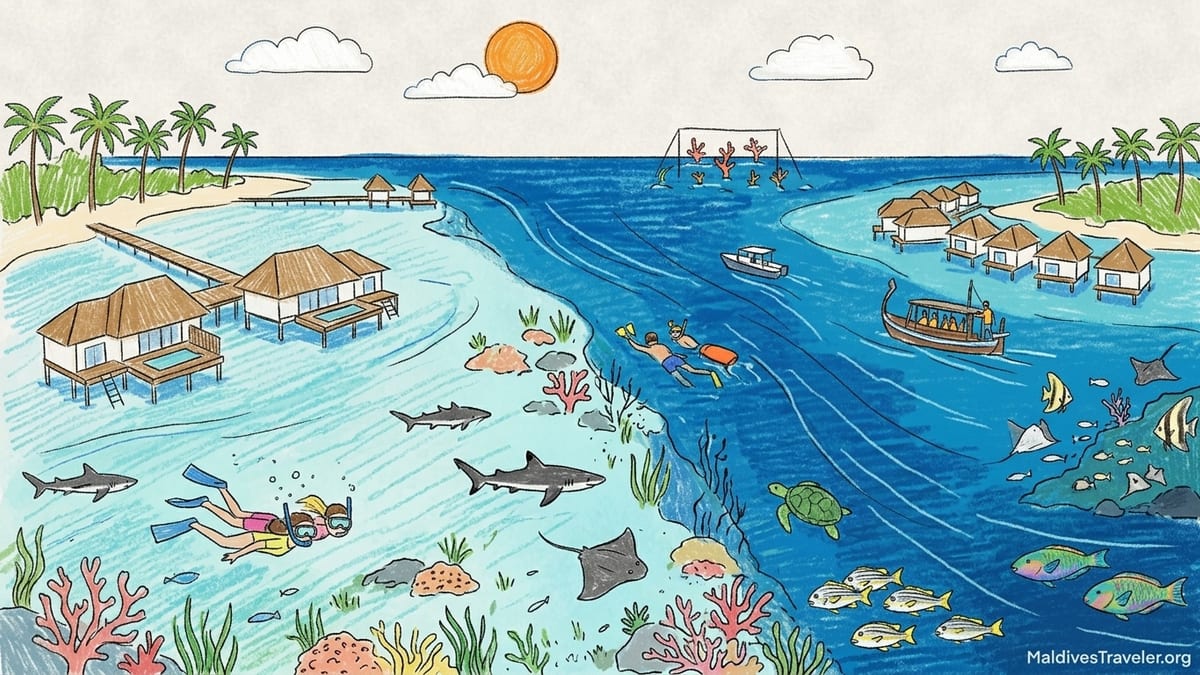
Shaviyani sits in the northern part of the Maldives, away from the busiest resort clusters, with islands fringing a deep central basin and ocean channels biting into the outer rim. That geography matters once you are in the water. Inside the lagoon, you can expect broad sandy shelves and gentler currents, while on the outer edges the reef drops away more abruptly and channels can funnel surprisingly strong flow. This combination is why training agencies describe Shaviyani as offering both sheltered lagoon environments and more exposed channel sites. For a snorkeler, that translates into some genuinely easy house-reef entries and some areas that feel much closer to a diver’s playground than a casual swim.
On the resort islands that dominate Shaviyani today, house reefs are not uniform rings of coral. Sections facing the atoll interior often have a very gradual slope and scattered coral gardens that sit in 1.5 to 3 meters of water. Outer faces toward the open ocean tend to offer a clearer drop-off, typically around 7 to 10 meters at the visible edge, with deeper blue water beyond. Currents are variable and linked to monsoon seasons, but recent guest reports from 2024 to 2026 repeatedly describe “manageable drift” on the more protected sunrise or lagoon-facing sides and “strong pull” in some channel-facing spots during outgoing tides. The result is that in Shaviyani you can have kindergarten-easy snorkeling off one stretch of beach and far more demanding conditions half an island away.
It is also important to set expectations about coral. Like much of the Maldives, Shaviyani’s reefs have been affected by bleaching events, but they are not lifeless rock. Recent reviews and resort marine center updates talk about patchy but improving hard coral cover, especially around restoration frames and on outer slopes where currents bring cooler, nutrient-rich water. Staghorn and table coral colonies are returning in places, but you still swim over areas of dead rubble between brighter patches. Fish life, on the other hand, remains rich, which is why many snorkelers leave feeling satisfied even when the coral landscape looks like a work in progress.
Fairmont Maldives Sirru Fen Fushi: Long Reef, Gentle Entries
Fairmont Maldives Sirru Fen Fushi, now operating under the Sirru Fen Fushi name, sits in a vast lagoon on Shaviyani’s eastern side and is often described by returning snorkelers as having one of the longest house reefs in the region. The reef runs roughly parallel to the sunrise side of the island and along the line of water villas, which means many guests enter the water either from their villa ladder or from the beach near the main jetty and then swim out toward the drop-off. Firsthand accounts from 2023 through early 2026 describe a straightforward surface swim of about 50 to 100 meters over clear sand and scattered coral blocks before you reach the more continuous reef edge, with depth increasing from waist deep at the shoreline to three or four meters over the reef flat.
Once you reach the drop, the bottom begins to fall away more decisively. Reports from experienced snorkelers who logged daily sessions at Sirru Fen Fushi describe the top of the slope in roughly 5 to 7 meters of water, deepening to an estimated 15 to 20 meters where the light starts to fade into darker blue. For surface swimmers this means you often have a “birds-eye view” of the bigger life below rather than nose-to-coral proximity. Multiple trip reports mention seeing blacktip reef sharks cruising several meters beneath them, and turtles gliding along the slope. On calm days visibility is frequently described as 20 meters or better, especially on the sunrise side, with slightly milkier conditions when wind blows across the lagoon and kicks up fine sand.
The question many readers have is how easy the water feels here. Snorkelers who visited in both the southwest and northeast monsoon seasons describe the sunrise side, from the mid-point of the water-villa jetty toward the Azure restaurant area, as comparatively calm, even when winds blew from the west. They talk about being able to drift in either direction without feeling pushed off the reef, and about currents that could be managed by a reasonably fit swimmer comfortable in open water. Current tends to pick up more strongly nearer any channel-like gaps in the reef and closer to the outer corners of the island. Those same reports emphasize that less confident swimmers stuck to the inner half of the reef flat, stayed within the band of 2 to 4 meters depth and still enjoyed plenty of fish life without needing to challenge the edge.
Marine life sightings at Sirru Fen Fushi’s house reef have been consistently positive in the last couple of years. Guests writing detailed snorkel logs mention multiple turtle encounters on single sessions, regular juvenile blacktip and whitetip reef sharks, stingrays resting in sand patches, and schooling sweetlips, parrotfish and triggering reef species. There are also frequent mentions of dolphins passing the outer reef, usually spotted from the surface or from the deck rather than close in while snorkeling. Coral health is still mixed, with clear signs of bleaching in shallow spots, but also pockets of vibrant hard coral, especially near the Coralarium art installation and coral restoration areas. The overall impression from returning snorkelers is that while this is not a pristine “wall of coral,” it is an engaging, fish-rich environment that repays slow exploration.
Beach Entry vs Boat at Sirru Fen Fushi
One of the advantages repeatedly highlighted at Sirru Fen Fushi is that you can reach satisfying snorkeling directly from your villa or from the beach without a long, fin-heavy swim. For families in sunrise beach villas, parents often report walking straight out from the sand, wading through knee-deep water for a few steps, and then floating over a shallow lagoon section where children can look down at schools of damselfish and butterflyfish before the adults kick further to the reef edge. The resort has placed small wave breakers and uses natural sandbars to create calmer pockets in front of some villas, making it easier for beginners to float and look without being lifted onto coral heads.
Several travelers in 2024 and 2025 who self-identify as “average swimmers” note that they snorkeled every day from the sunrise side without using fins, wearing only a mask, snorkel and the life jackets provided in villas. They describe staying within 50 meters of shore and being able to stand on sand when they wanted a break. More experienced snorkelers who wanted to work along larger sections of the 9-kilometer reef tended to use fins and sometimes a surface buoy or float for visibility. These guests commonly entered from the middle of the water-villa jetty, swam out to the drop-off in a few minutes and then drifted along the reef, exiting at another jetty or a marked beach point. For them, a full exploration session of 60 to 90 minutes would cover several hundred meters of reef without feeling repetitive.
Boat snorkeling, usually organized by the resort’s marine center, targets outer pinnacles and channel edges beyond easy swimming distance. Guests who joined these trips commonly paid the equivalent of around 90 to 140 US dollars per person for two-stop excursions, with the exact price depending on duration and group size. They report stronger currents and often better coral structure, including more densely packed hard coral gardens and larger fish schools. One returning guest who enjoyed the house reef almost daily still rated the boat trip to an outer thila as the visual highlight of the stay, particularly for the chance to see eagle rays and larger trevallies circling in midwater. That said, almost all of these same snorkelers felt that if they had skipped the boat entirely, the from-the-beach experience would still have justified the trip, which suggests that Sirru Fen Fushi is one of the more rewarding house-reef resorts in Shaviyani for people who prefer to manage their own snorkeling schedule.
In terms of required confidence level, most recent feedback places shore snorkeling at Sirru Fen Fushi in the “accessible to cautious intermediates” category. First-timers who are not fully relaxed in open water seem to do better staying very close to shore with a life jacket or pool noodle, ideally during guided sessions or when wind is low. More exposed corners and channel-proximate sections feel noticeably livelier and are better left to confident swimmers who are used to reading waves and current lines. The resort’s guides offer orientation snorkels on the house reef, which can be a good way to understand safe entry and exit routes before heading out alone.
JW Marriott Maldives: House Reef Versus Outer Sites
On Vagaru Island, JW Marriott Maldives Resort & Spa presents a slightly different configuration. This resort is encircled by shallow lagoon sections and a reef edge that sits further out from shore in some directions than at Sirru Fen Fushi. Early guest feedback after its opening and more recent comments from divers and snorkelers who stayed for extended periods suggest that the house reef is pleasant rather than spectacular from the beach, with coral recovery ongoing and many snorkelers focusing more on fish life and the general blue-water experience than on dense coral gardens.
Swimmers entering from beach villas usually walk across a short band of sand and seagrass before reaching deeper water, then kick out for roughly 80 to 150 meters to find more continuous reef. That distance can vary by tide and by exact villa location, and some guests mention preferring entry from the water-villa jetties where ladders drop you into slightly deeper water closer to the slope. Depth at the reef edge is similar to much of Shaviyani, with about 4 to 6 meters at the top of the slope, deepening vertically beyond that. Visibility is reported as good in settled weather, often clear enough to watch reef sharks and larger fish several meters below, but can drop when wind piles across the lagoon or after storms.
Dive-focused travelers who have spent 10 or more days at JW Marriott in Shaviyani describe the house reef as “fun and full of life” but acknowledge that much of the most impressive coral is found at sites reached by boat. On the house reef you can expect regular sightings of small reef sharks, stingrays and schools of reef fish, especially around coral restoration structures and sections where current brushes the outer edge. At night, torches pick up lobsters, moray eels and hunting lionfish close to the slope. However, people who have also stayed at islands in atolls with famously strong house reefs admit that JW’s shoreline snorkeling feels more relaxed and less intense in terms of topography.
Boat snorkeling and diving are therefore a central part of the in-water experience at JW Marriott. The resort promotes coral restoration journeys where guests join marine biologists to plant fragments on frames and then snorkel over the area, learning how different species recover. Divers and snorkelers alike also join scheduled trips to outer channel sites where visibility can be excellent and larger pelagics like eagle rays are seen more frequently. Here, currents can be brisk, and excursions usually come with clear safety briefings and sometimes a requirement that participants are comfortable in moderate swell. Prices detailed by the resort and recent guest bills place many guided snorkel trips in a similar range to Sirru Fen Fushi, often around 100 to 150 US dollars per person for multi-stop half-day experiences.
How Easy Is “Easy” Snorkeling in Shaviyani?
Across Shaviyani Atoll, sheltered lagoon sides of resort islands tend to provide the easiest entry points for new snorkelers or those who want very gentle conditions. On these faces, water is typically knee to chest deep for a long way off the beach, and you might be able to float above sand and occasional coral lumps within 20 meters of shore. Currents are often barely noticeable on calm days, and waves break on the outer reef before any remaining chop rolls into the lagoon. These are the spots where you will see children practicing with masks and snorkels, adults floating in life jackets and resort guides taking small groups for first-time sessions.
Even on these easy sides, there are practical considerations. Midday sun can make the surface glare intense, so many regular snorkelers recommend entering in the early morning or late afternoon when the angle of light both reduces strain on your eyes and beams more clearly through the water. Rash guards or thin wetsuits protect against sunburn and jellyfish stings, and some resorts require life jackets for beginners during guided tours. If you stay over the inner lagoon area and do not push out to the reef edge, depth usually remains under three meters, meaning you can stand in places, although it is important to avoid stepping on any coral.
In contrast, the more exposed channel edges and outer corners of islands in Shaviyani can feel very different. Here, current can be strong enough on certain tides that even competent swimmers notice a steady sideways push. Waves may stand up higher and there might be visible lines of chop or slicks of foam that reveal where water is moving out of the lagoon. PADI literature on the Maldives emphasizes that channel sites are best suited to confident snorkelers and divers who are comfortable with drift conditions, and this matches the reports from Shaviyani where some guests mentioned abandoning planned snorkels after noticing unexpectedly strong pull along corner sections.
Because of these contrasts, many resorts in Shaviyani split their house-reef briefings into “calm side” and “lively side,” and guides often recommend that anyone unsure of their ability stick to the clearly marked, lagoon-facing entries. On islands like Sirru Fen Fushi, where the sunrise side is both relatively sheltered and has direct access to the drop-off, this gives beginners a chance to experience a genuine reef edge without having to tackle the rougher channel areas on the far corners. It is an arrangement that makes Shaviyani a good compromise for mixed-ability groups, provided people respect their limits and do not equate every pretty turquoise patch with easy swimming.
Gear, Safety and Confidence in Shaviyani Waters
Most resort islands in Shaviyani supply basic snorkeling gear as part of the room rate or for a modest daily fee, usually under the equivalent of 20 US dollars per person per day when charged separately. Guests at Sirru Fen Fushi, for example, repeatedly mention being issued complimentary masks, snorkels and fins, along with life jackets that they could wear into the sea. While in-house equipment is convenient, frequent snorkelers often prefer to bring their own well-fitting masks and snorkels to avoid leaks and ensure comfort during longer sessions. Travel fins, which are slightly shorter and softer than full-size models, are popular because they pack easily but still provide enough propulsion to counter mild currents.
Flotation gear plays a significant role in how enjoyable and safe snorkeling feels, especially for those without strong swimming backgrounds. Life jackets, inflatable snorkel vests and simple pool noodles are common sights on Shaviyani’s house reefs. People who report feeling anxious in open water often describe their confidence increasing once they have a dedicated flotation aid, which allows them to focus on what they are seeing instead of on every small change in water movement. Guides typically encourage guests not to dive down from flotation devices, both to avoid kicking coral and because many vests are not designed for repeated submerging.
For more experienced snorkelers, a surface marker buoy or a bright tow float can be useful in Shaviyani. These inflatable floats, attached by a short line to the swimmer, increase visibility to boats and jet skis and provide a resting point during longer drifts. While boat traffic around house reefs in Shaviyani is generally limited and controlled by resort policies, there are still service vessels and excursion boats moving outside the mooring lines. Wearing vivid rash guards or hoods, as well as towing a float, makes it easier for staff to keep track of snorkelers, particularly when visibility dips below its usual clarity after a squall.
Ultimately, confidence level should determine not just how far from shore you go, but also which parts of the reef you attempt. Swimmers who are comfortable in choppy water, used to clearing snorkels after waves and happy to manage mild currents tend to explore the full arc of a house reef, timing their entries around tides and sometimes accepting that they will drift and then walk back along the beach. Those who feel uneasy once they cannot stand should think of Shaviyani’s reefs as layered zones and remain in the inner band where their feet can still touch sand if needed. This inner zone can still deliver encounters with turtles and rays when they cruise shallow, so staying closer to shore does not automatically mean missing all of the action.
Boat Excursions: When Leaving the House Reef Makes Sense
Boat-based snorkeling in Shaviyani typically targets channel mouths, isolated pinnacles known locally as thilas and newer coral restoration sites sited away from daily resort traffic. Operators across the atoll advertise outings that last from 90 minutes to half a day, often combining two distinct snorkel stops. Prices from 2023 to 2026 cluster in the range of roughly 80 to 150 US dollars per person for resort-run trips, with private charters costing more. These excursions are where many travelers report their encounters with larger pelagic species, such as eagle rays gliding in formation or larger schools of batfish hanging in midwater.
The trade-off is that conditions at these sites are rarely as forgiving as a sheltered house-reef corner. Guides on Shaviyani boats usually conduct quick swim tests at the start of the trip and, if currents are strong, they organize drifts where the boat follows the group and picks them up downstream. Snorkelers are expected to be at ease floating in deep blue water without a clear sense of the bottom, to stay calm if visibility changes and to manage slightly choppier surface states than inside resort lagoons. Life jackets or snorkel vests are typically compulsory, and fins are non-negotiable for safety.
For guests staying on islands where the house reef is more about relaxed lagoon exploration than dramatic drop-offs, these boat trips can feel like graduating to a different level of snorkeling intensity. On Shaviyani resorts that already have a strong, easily reachable reef edge, such as Sirru Fen Fushi, the decision becomes more about variety than necessity. Reviews from frequent snorkelers who spent a week or more in the atoll suggest a pattern: several days of self-guided house-reef snorkeling interspersed with one or two boat days to outer sites. That balance keeps costs under control while still giving access to the wilder side of the atoll’s marine life.
Travelers planning a stay in Shaviyani should consider their own priorities and comfort before committing to multiple excursions. If your main goal is to float peacefully over coral gardens and watch reef fish at leisure, a house-reef-focused resort with easy entry may meet your needs almost entirely. If you are drawn to the possibility of encountering larger animals or seeing more dramatic underwater landscapes shaped by currents, budgeting for at least one boat trip is likely to be worthwhile. In all cases, factor in recovery time between intense sessions, since long drifts in moving water can be surprisingly tiring even for fit swimmers.
The Takeaway
From the water, Shaviyani Atoll’s snorkeling reality feels nuanced rather than uniformly picture-perfect. On its better house-reef islands, such as Sirru Fen Fushi, you can slip into the sea from a villa ladder or soft sunrise sand, swim a comfortable 50 to 100 meters and be hovering over a living reef edge where turtles graze and juvenile sharks patrol. Currents on these sides are usually gentle enough for any confident swimmer in fins and a life jacket, and visibility on calm days can stretch far enough that the reef slope fades into mid-blue.
On other islands, including parts of JW Marriott’s Vagaru, the house reef sits further out and demands a longer swim, with coral cover that is still rebounding. Fish life remains engaging, but those who have experienced very strong house reefs elsewhere sometimes describe the snorkeling here as more about the soothing experience of being in clear tropical water than about overwhelming coral density. In all cases, the more exposed channel faces around Shaviyani are a different proposition, best explored with guides and only by snorkelers who are completely at ease in deeper, moving water.
For most travelers, snorkeling directly from the beach in Shaviyani can be satisfying, especially if you choose a resort where recent guests talk in detail about daily turtle and reef-shark encounters without needing a boat. Boat excursions add a different dimension, opening up more dramatic terrain and a higher chance of seeing larger rays or bigger fish schools, but they are not mandatory for everyone. Approach the atoll with clear eyes and realistic expectations about coral recovery, respect the difference between sheltered lagoons and active channels, and match your ambitions to your confidence level. Do that, and Shaviyani’s house reefs can deliver exactly what so many travelers hope for when they picture the Maldives: long, unhurried hours drifting above a living, quietly recovering sea.
FAQ
Q1. Is snorkeling from the beach in Shaviyani Atoll enough, or do I really need boat trips?
For many visitors, especially at resorts with stronger house reefs like Sirru Fen Fushi, snorkeling from the beach or villa provides plenty of variety and regular encounters with turtles, reef sharks and rays. Boat trips add access to more dramatic channel and pinnacle sites but are best treated as an optional upgrade rather than a requirement for a rewarding experience.
Q2. How far do I usually have to swim to reach the reef edge from shore?
On lagoon-facing sides of Shaviyani islands with good house reefs, the swim from beach to drop-off is often in the range of 50 to 100 meters. On some resorts where the reef sits further out, you may need to cover 100 to 150 meters or enter from a jetty ladder to shorten the distance.
Q3. What are currents like around Shaviyani’s house reefs?
Inside the lagoon and along sheltered sunrise sides, currents are often mild and manageable for confident swimmers, especially at slack tide. Around outer corners and channel mouths, water movement can be significantly stronger, with drift conditions better suited to experienced snorkelers or those accompanied by guides on boat-supported sessions.
Q4. Has coral bleaching ruined snorkeling in Shaviyani Atoll?
Bleaching has affected coral cover, and you will see areas of dead or damaged reef, especially in very shallow water. However, many house-reef sections now show mixed but improving coral growth, with healthy patches of staghorn and table corals returning, and fish life remains abundant enough that most snorkelers still find sessions visually rewarding.
Q5. Do I need to be a strong swimmer to enjoy house-reef snorkeling here?
You do not need to be an athlete, but you should be comfortable floating in deep water, clearing a snorkel and swimming steadily for several minutes in a straight line. Less confident swimmers can still enjoy inner-lagoon areas with flotation gear and guidance, while stronger swimmers can safely explore longer stretches of the reef edge.
Q6. What snorkeling gear is provided by Shaviyani resorts, and what should I bring?
Most resorts supply masks, snorkels, fins and life jackets, often included in the room rate. Bringing your own well-fitting mask and snorkel can improve comfort, and many regular snorkelers also pack travel fins, a rash guard and a small tow float or surface marker buoy for added safety and visibility.
Q7. When is visibility best for snorkeling in Shaviyani Atoll?
Visibility is typically best on calm, sunny days when wind and swell are low, and many snorkelers favor early morning or late afternoon sessions. Heavy rain, wind shifts and choppy seas can temporarily reduce clarity, especially over sandy lagoon sections where fine particles get stirred up.
Q8. Are there real chances to see sharks, rays and turtles from the house reef?
Yes. Recent guest reports from Shaviyani resorts mention frequent sightings of small reef sharks, regular turtle encounters and occasional stingrays or eagle rays visible from the house reef. Larger pelagic species are more commonly encountered on boat excursions to channel and outer reef sites.
Q9. How much do guided snorkeling excursions cost in Shaviyani?
Prices vary by resort and itinerary, but many half-day guided snorkeling trips with two stops fall in the approximate range of 80 to 150 US dollars per person. Private charters, specialty wildlife trips and combined snorkel-dive outings usually cost more.
Q10. What safety practices should snorkelers follow on Shaviyani’s reefs?
Key practices include listening to resort briefings, staying within marked snorkeling zones, using flotation if you are not fully confident, avoiding contact with coral, and not pushing into channel or corner areas when currents look strong. Snorkeling with a buddy, wearing bright clothing and informing staff of your plans further increases safety on the water.