


There is a moment on the 55 minute seaplane ride to Sirru Fen Fushi when the atolls thin out and the ocean takes on a deep, endless blue. It is the kind of view that people book the Maldives for, and it sets expectations very high for what awaits on this private "Secret Water Island" in Shaviyani Atoll. I stayed at Sirru Fen Fushi after its recent rebranding from Fairmont, and what follows is what my private island stay was really like, from the logistics of the transfer to the reality of the lagoon, reef, food, service and the parts that did not quite live up to the price tag.
Arriving In The Middle Of The Indian Ocean
My experience of Sirru Fen Fushi began in the domestic terminal area at Velana International Airport in Malé, where the resort maintains a small counter among the seaplane operators. After clearing immigration and customs, I handed my luggage tags and passports to the resort representative, who weighed both checked baggage and hand luggage for the seaplane weight limits. The bags were tagged for the resort and disappeared onto a trolley, not to be seen again until my villa a few hours later.
From there I was driven in a shared van to the seaplane terminal, roughly a ten minute ride along the edge of the runway. Sirru Fen Fushi uses Trans Maldivian Airways, the country’s dominant seaplane operator, which serves Gaakoshinbi in Shaviyani Atoll. The resort quotes the transfer as approximately 55 minutes by seaplane, and that matched my experience within a few minutes, with wheels-up to water-landing taking just under an hour including a brief holding pattern over the lagoon.
Waiting time in Malé can vary because seaplane schedules are confirmed only on the day of travel and must operate in daylight. In my case, arriving mid-morning, I waited about 90 minutes in a basic but air-conditioned seaplane lounge before boarding. There was water, coffee and a few packaged snacks, but this was not a plush private lounge experience. Families with small children and couples bound for different islands all boarded together when our flight was finally called.
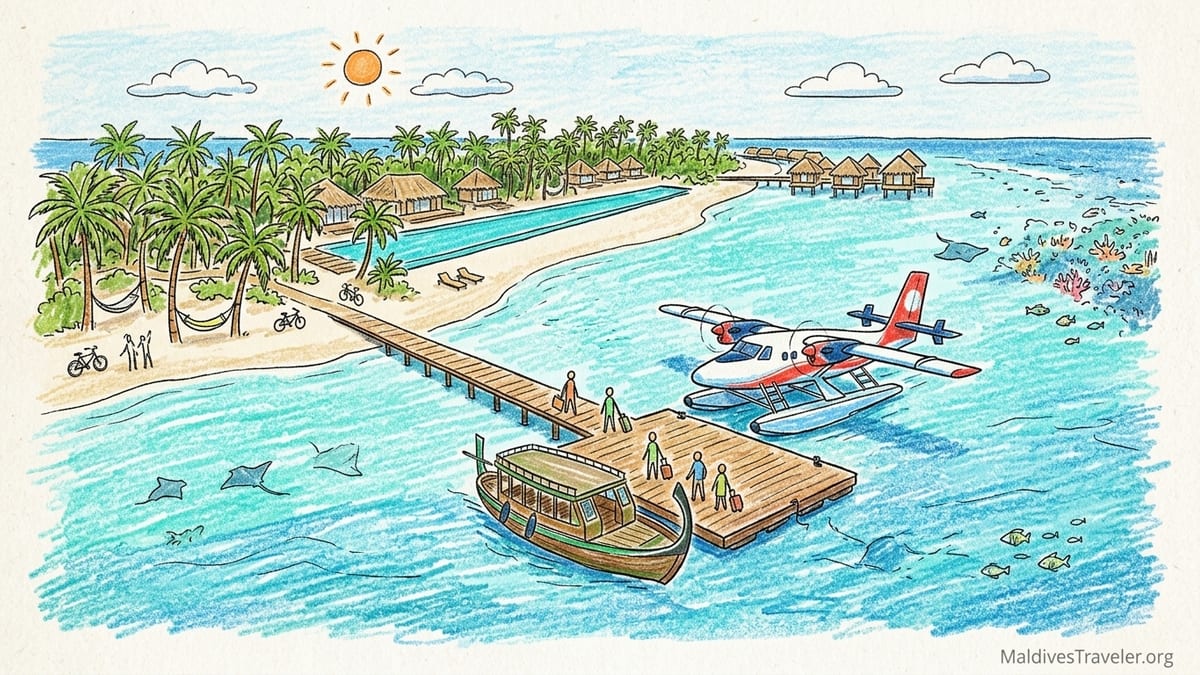
The flight itself was worth lingering over. The Twin Otter climbed low over North Malé Atoll, then headed north-west as the resorts thinned out and the reef formations became more intricate. On a clear day the experience justifies a window seat: sandbanks like white brushstrokes, reef shelves in impossible tones of turquoise, and eventually the long, pale streak of one of the Maldives’ largest resort lagoons coming into view. The pilot performed a gentle arc over Sirru Fen Fushi, giving a full view of the island, the straight line of the 200 metre main pool and the overwater villas extending into the lagoon, before setting the pontoons down beside a floating platform just off the island.
First Impressions Of A “Secret Water Island”
From the seaplane pontoon, a dhoni-style launch covered the final two or three minutes to the island’s arrival jetty. The first impression at ground level is of space. Sirru Fen Fushi sits within about 16 hectares of land but is surrounded by one of the largest resort lagoons in the Maldives, and you feel that breadth immediately. The jetty runs over shallows so clear that rays and small reef fish are visible even in midday glare.
Check-in took place at an open-sided lobby with sandy floors and high thatch, more barefoot bohemian than glossy marble. My villa host, introduced simply by first name, handled registration on a low table with a cool towel and a welcome drink. Passports were scanned, credit card pre-authorization taken and return seaplane details confirmed. The process felt calm and unhurried, a contrast to the bustle of Malé, although it still took close to 25 minutes before I was in the buggy and heading towards my villa.
Sirru Fen Fushi’s architecture carries traces of its Fairmont era but the independent branding is now prominent, from new signage to a stronger focus on sustainability, including its much-publicised Sustainability Lab, which recycles resort plastics into usable objects. The layout remains all-villa, strung along both sunrise and sunset sides of the island, with tented jungle villas hidden in the interior. From the first ride along the sandy main path, what struck me most was the density of vegetation. Mature palms and sea almond trees are used intentionally to create screens between villas, so even at full occupancy you rarely glimpse more than a roofline and a sliver of infinity pool through the green.
That lushness is one of the resort’s assets, but it does come with a minor drawback. Paths can feel dim under the canopy after sunset, and although bicycles are provided, I found myself walking more often than cycling at night to avoid roots and soft sand patches. For guests used to very manicured islands with paved paths and strong lighting, this slightly wilder aesthetic will either feel charmingly authentic or a touch inconvenient.
The Beach Sunrise Villa: Home On The Sand
For this stay I booked a Beach Sunrise Villa, one of the lead-in categories and, in my view, the sweet spot between privacy, direct reef access and cost. These villas are tucked just behind the tree line on the sunrise side with sandy pathways leading from the main path to each gate. Once inside the gate, the villa opens into a courtyard with a private plunge pool facing the beach, a daybed pavilion and fringes of hibiscus and pandanus providing shelter from neighbours.
Inside, the design is contemporary Maldivian, with high ceilings, white walls, pale timber finishes and generous use of glass towards the sea. A sliding door opens directly from the king bed to the terrace, so you wake to a strip of sand and the line of the lagoon. The bathroom is semi-open, with an outdoor shower, large freestanding bathtub and twin vanities. Storage is ample, with a walk-in wardrobe that easily swallowed two large suitcases.
The beach itself in front of my villa was powder-fine and surprisingly wide. At low tide I measured roughly 15 to 20 metres from the vegetation line to the first lapping water, with the gradient shallow enough that you could walk out 30 to 40 metres and still be only waist deep. This made it particularly friendly for less confident swimmers and for families with younger children. The resort had placed a pair of loungers on the sand along with a hammock between two palms, and for most of the stay that stretch of beach was used only by me and, on one morning, a jogger passing at the waterline.
Where the villa slightly disappointed was in some of the finishing details. While overall condition was good, I noticed a few signs of the island’s age: minor rust at the base of some outdoor fittings, a drawer that did not close quite flush and some scratches on the wooden deck. These did not affect functionality, but at this price point many guests will be comparing Sirru Fen Fushi to ultra-polished properties where every surface looks newly installed.
Beach, Lagoon Depth And The House Reef
Sirru Fen Fushi’s lagoon is its defining feature. From the beach in front of the sunrise villas, the water remains shallow and sandy for a long distance before transitioning to patch reefs and eventually the drop-off of the 9 kilometre house reef that curves around the island. At high tide, I found it comfortable to swim straight out from the villa and, within five to eight minutes, reach areas with enough coral structure to see colourful reef fish, rays and the occasional small shark.
For proper snorkeling, the best access to the reef was via marked channels closer to the water villas and near Azure restaurant. The resort’s dive and water sports centre offers complimentary snorkeling gear and can point out entry and exit points. Joining a guided house reef snorkel on my second day, we were taken by boat a short distance to the outer edge of the reef, then allowed to drift with the current along coral fields where turtles, schools of sweetlips, parrotfish and blacktip reef sharks were all present. The coral health was mixed, with areas of clear recovery alongside sections still showing bleaching scars, which is typical across much of the Maldives after recent warming events.
Lagoon depth is an important consideration for overwater villas. During my stay, I swam around the sunrise water villas and found the water under the villa decks deep enough for safe jumps even at lower tides, though the very shallow sandbanks extend between some villas and the main reef. For guests who want immediate, deep water, the outermost villas are preferable. From the beach villas, you sacrifice the ladder-into-the-sea fantasy but gain the advantage of being able to wade gradually and choose your depth, which I appreciated when returning from long snorkels and simply wanting a cooling float close to shore.
One subtle disappointment was the amount of seagrass in some parts of the lagoon. The resort allows seagrass to grow naturally for environmental reasons, which is commendable, but this can mean that at certain tides there is more floating plant material and slightly less of the postcard-clear water that some visitors imagine. If you are fixated on utterly seagrass-free shallows, you may find this visually less pristine, although the tradeoff is richer habitat for turtles and juvenile fish.
The Island-Long Pool And Everyday Island Life
Running across the spine of the island from the arrival side towards the horizon is what Sirru Fen Fushi calls the Maldives’ longest infinity pool, stretching about 200 metres. In practice it feels like three pools in one, with different moods along its length. Near the main restaurant and bar at the beach end, there is more activity: children playing, couples ordering drinks from the bar, music at low volume. As you walk further along, the pool becomes progressively quieter until, near the far end, I often had entire sections to myself.
The pool is visually impressive, acting almost like a man-made extension of the natural lagoon, but it is not heated, so early morning dips can feel brisk in cloudier weather. I appreciated the lap-friendly design and used it as a substitute for open-water training when currents on the reef side were stronger. Service around the pool was attentive without being overbearing, with staff circulating regularly to offer water and take drink or snack orders. Sun loungers were plentiful when I visited, which meant no sense of competition for prime spots.
Around the pool and main hub, daily island life plays out at an unhurried pace. Guests drift between Raha Market for meals, the pool, the beach and the water sports centre, with buggies occasionally whisking families to and from the kids club. The atmosphere was decidedly relaxed rather than hyper-glamorous. I saw families with children of various ages, honeymoon couples and a few multigenerational groups, suggesting the resort is positioning itself as a broad-appeal luxury choice rather than an adults-only hideaway.
If there was one aspect that punctured the illusion of complete seclusion here, it was the occasional seaplane passing overhead on its way to more northerly atolls. These flights are a reality across the Maldives and the noise is fleeting, but if your image of solitude is absolute silence, those brief interruptions may stand out, especially around midday when plane activity peaks.
Dining: Hits, Misses And Real Costs
Visit Maldives notes that Sirru Fen Fushi offers multiple dining options, and during my stay I managed to sample the main ones. Raha Market functions as the all-day buffet restaurant and anchors the food experience. Breakfast here was a genuine highlight, with live stations for eggs and waffles, a strong spread of tropical fruit, Maldivian dishes like mas huni and curries, a decent pastry selection and proper espresso-based coffee. Mornings felt generous and unhurried, and staff were quick to learn my coffee preferences by the second day.
Lunch at Raha was more functional, with a buffet leaning into salads, grills and pastas. It was convenient if you were by the pool, but not particularly memorable. In the evening, the restaurant switched to themed buffets. Quality was generally good, with fresh grilled fish and a variety of international dishes, but at times the food felt more like a well-executed resort buffet than a culinary destination. Those with extensive Maldives experience who are used to strong à la carte concepts may find Raha competent but not exciting.
Azure, the beachfront seafood restaurant, provided the most refined meal of the stay. Dining on a wooden deck semi-perched over the sea with low lighting and the sound of the waves felt appropriately Maldivian-luxurious. A grilled reef fish, simply prepared with local spices and served with charred vegetables, stood out, as did a dessert built around coconut and tropical fruit. Prices reflected the setting and imported wine list; mains were broadly in line with other five star Maldivian resorts, and a three course dinner with a glass of wine could easily run to a significant sum for two. Without inventing specific numbers, it is fair to say that anyone budgeting for Sirru Fen Fushi should plan for high daily food and beverage spend unless booking an inclusive meal plan.
There is also a Japanese-inspired outlet and casual poolside options for lighter bites and drinks. Room service was efficient but carried a noticeable surcharge on top of already premium menu prices. One disappointment was the limited availability of certain advertised specialty items on quieter nights, when the resort seemed to consolidate effort into the main outlets. It did not impact basic dining, but for guests planning a specific meal, advance reservations and flexibility are advisable.
Service, Privacy And How Isolated It Really Feels
Service at Sirru Fen Fushi operates on a villa host model, with one staff member serving as your main point of contact for restaurant bookings, excursions and small requests. My host was proactive about messaging each morning via the resort’s communication system, checking whether I wanted to change snorkel times due to wind shifts or adjust dinner reservations. When I mentioned in passing that I preferred still water over sparkling, the minibar was quietly adjusted the next day without further prompting.
Across the resort, staff interactions tended to be warm and genuine rather than choreographed. Housekeeping worked invisibly in the late morning and again at turndown, and I rarely if ever returned to find them still inside the villa. Privacy was excellent in the Beach Sunrise Villa category, thanks largely to the careful planting and spacing of units. Outside, I could spend an afternoon on my plunge pool deck without seeing another guest walk past the beachfront, which contributed significantly to the feeling of escape.
The island’s isolation is another question. Shaviyani Atoll is further from Malé than many resort-dense atolls, and from most vantage points on Sirru Fen Fushi you do not see other islands or resort lights at night, only the broad curve of ocean and the faint glow of your own jetty. On clear nights the Milky Way was obvious, and sound carried only from the occasional gecko, rustling palm fronds and the sea. In that sense, it felt genuinely remote, more so than some properties closer to the capital.
Where service fell short was in a few small operational lapses. On one day, my snorkeling excursion was delayed nearly 40 minutes without clear explanation, apparently due to boat scheduling issues. Another time, a buggy requested for a spa appointment did not arrive, prompting a brisk walk instead. These are minor annoyances rather than serious failures, but when you are paying premium rates they stand out more sharply, particularly for guests used to ultra-luxury brands with near-flawless logistics.
Water Activities, Spa And Family Facilities
Visit Maldives lists snorkeling, diving, water sports, surfing, excursions, spa services, family accommodation and a kids club among Sirru Fen Fushi’s facilities, and on the ground these are very much part of daily life. The dive and water sports centre is a hive of quiet activity each morning. Free non-motorised options such as kayaks and paddleboards are available, useful for exploring the calm lagoon interior or simply drifting over schools of fish in clear water.
For divers, the resort works with instructors to access sites in Shaviyani Atoll, which is less saturated with boats than some of the more famous southern atolls. During my stay, divers reported frequent encounters with turtles and reef sharks, with occasional manta sightings depending on the season and plankton conditions. Snorkeling excursions included the house reef, nearby coral gardens and a trip to the Coralarium, the underwater art gallery that also functions as a coral regeneration project. Swimming among sculptures now encrusted with marine life was one of the more distinctive experiences of the trip.
At Arufen Spa, the resort’s wellness hub, I booked a 60 minute massage and later browsed the treatment menu, which includes options like IV drip therapy and branded wellness experiences alongside more traditional massages and facials. The spa compound is set back from the beach in a garden of frangipani and water features, and treatment rooms exude the standard polished-wood-and-stone aesthetic of high-end Maldivian spas. My therapist was skilled and attentive, adjusting pressure promptly when asked, and post-treatment relaxation in an open-sided pavilion with tea felt genuinely restorative after sun and saltwater.
Families are notably well catered for. The kids club, bright and open, spills into outdoor play areas with sand, slides and shaded nooks. During my visit, children were painting, building sandcastles and heading out on supervised mini-excursions around the island. Multibedroom villas and interconnecting options give families flexibility, and the presence of a dedicated kids pool section and child-friendly menus throughout the resort reinforces its positioning as a family-capable luxury property rather than a couples-only enclave.
Value, Disappointments And What Justified The Price
Even by Maldivian standards, Sirru Fen Fushi sits in the bracket where nightly rates, especially in peak season, are a serious financial commitment. The obvious question is what, in practice, justifies the price once you factor in not only the villa cost but also the seaplane transfers and on-island expenses. For me, three elements stood out in the resort’s favour: the scale and beauty of the lagoon and reef, the privacy afforded by the villa layouts and planting, and the relatively raw sense of isolation that Shaviyani Atoll still offers compared with more built-up atolls.
Being able to walk straight from my villa terrace, across a broad, uncrowded beach and into water that quickly revealed a variety of marine life felt like a privilege. The long pool, while a headline feature, was less important than the simple ability to snorkel daily without crowds or boat traffic and to do so from a house reef that, in places, still shows significant colour and life. The Sustainability Lab and Coralarium add a dimension for guests who care about marine conservation and want to feel that their stay supports restoration as well as indulgence.
Balancing that, there are areas where the resort does not quite reach the level implied by its most aspirational marketing. As mentioned, some villa wear and tear is visible, and while this is understandable in a harsh marine environment, it will disappoint guests expecting a just-opened feel. Service is warm but not always razor-sharp; small delays and communication gaps appeared a few times across a relatively short stay. Dining, although solid and occasionally excellent, does not consistently deliver the kind of culinary fireworks that some ultra-luxury competitors in the Maldives now use as a differentiator.
Whether Sirru Fen Fushi represents good value will depend heavily on how much you personally weight reef access, space and seclusion over ultra-slick hardware and Michelin-level cuisine. If your priority is to feel far from anywhere, swim daily in a vast lagoon, have genuine privacy in your villa and let children run barefoot between sea and kids club while you alternate between spa and reef, then much of the cost is indeed reflected in the experience. If, on the other hand, your benchmarks are immaculate new-build design and restaurant experiences that genuinely rival major city fine dining, you may find the price more difficult to reconcile with the reality on the ground.
The Takeaway
Staying at Sirru Fen Fushi in Shaviyani Atoll felt like stepping onto a private, water-ringed world where the line between lagoon, pool and open ocean is often hard to define. The 55 minute seaplane journey from Malé is more than a transfer; it is a scenic decompression chamber that eases you from airport stress into island time. On arrival, the expanse of the lagoon, the length of the pool and the relative absence of neighbouring islands combine to create a powerful sense of distance from everyday life.
My Beach Sunrise Villa provided the kind of barefoot-luxury base that many travellers imagine when they first picture the Maldives: sand underfoot, a path through palms to the sea, a private plunge pool and enough space to disconnect from the world. The beach quality, lagoon depth and ready access to the house reef all lived up to the promise of a “Secret Water Island,” especially for someone who measures a resort as much by its marine life as by its thread count.
At the same time, the stay was not without its imperfections. Minor maintenance niggles, occasional service lapses and dining that, while pleasant, did not always match the most cutting-edge competitors, reminded me that even high-end Maldivian resorts are not uniform in execution. These are important realities to hold onto when weighing up the substantial investment required for a stay here.
In the end, what justified the price for me was not any single wow moment but the cumulative effect of days structured around the sea: early swims in a quiet lagoon, long snorkels along a living reef, afternoons reading in near-silence on a private patch of sand and evenings walking back along dimly lit paths under a sky thick with stars. If that is the kind of luxury you seek, Sirru Fen Fushi’s combination of vast lagoon, strong reef, privacy and family-friendly facilities make it a compelling, if not flawless, contender in a crowded Maldivian field.
FAQ
Q1. How long is the seaplane transfer from Malé to Sirru Fen Fushi and what is it like in practice?
The seaplane journey takes around 55 minutes of actual flying time, plus variable waiting at the seaplane terminal. You check in with the resort representative at Velana International Airport, are transferred to the separate seaplane terminal, wait in an air-conditioned lounge until your flight is called, then board a small Twin Otter aircraft for a scenic low-altitude flight over the atolls, landing on the water near the island before a short boat ride to the jetty.
Q2. Which villa type is best for reef access at Sirru Fen Fushi?
For a balance of privacy and easy reef access, Beach Sunrise Villas on the sunrise side are a strong choice, as you can wade out from your front beach and be over coral patches within minutes. Overwater villas offer ladders straight into deeper sections of the lagoon, but many guests still choose to swim or take a boat to the outer house reef for the best snorkeling.
Q3. How deep is the lagoon and is it suitable for non-swimmers or children?
In front of the beach villas, the lagoon is very shallow and gently sloping, often allowing you to walk out 30 to 40 metres while still in waist deep water at normal tides. This makes it well suited to cautious swimmers and families with children, though supervision is still essential and conditions can change with wind and tide.
Q4. What is the house reef like for snorkeling and diving?
The house reef at Sirru Fen Fushi is long and accessible, with sections that show healthy coral growth and abundant marine life including reef fish, turtles and small sharks. Some areas still display signs of past bleaching, but guided snorkel and dive trips can take you to the most vibrant stretches, and the overall quality is strong by Maldivian resort standards.
Q5. How private do the villas feel?
Villas are spaced out and screened by dense planting, particularly on the beach side, so you rarely see neighbours from your terrace or plunge pool. While the beach itself is not private property, guest numbers are low enough that it often feels like your own strip of sand, especially away from the main facilities.
Q6. Is the resort suitable for families with children?
Yes, the resort is set up for families, with multi-bedroom villa options, a dedicated kids club with indoor and outdoor play areas, child-friendly pools and menus, and calm lagoon waters for supervised play. Families were very visible during my stay, and the island layout allows children to explore without being constantly near vehicles or heavy boat traffic.
Q7. How expensive is food and drink at Sirru Fen Fushi?
Food and drink are priced in line with upscale Maldivian resort norms, which means significantly above typical city hotel levels once you factor in the island setting and import costs. Buffet breakfasts felt generous, while dinners at specialty restaurants, particularly with alcohol, can add substantially to your daily spend, so it is wise to budget accordingly or consider meal plans if available.
Q8. What water activities are available besides snorkeling and diving?
The resort offers complimentary non-motorised activities such as kayaks and paddleboards, as well as paid options like motorised water sports, boat excursions to nearby reefs and sandbanks, dolphin cruises and visits to the Coralarium underwater art installation. Availability can vary with weather and season, so checking the daily activity schedule is advisable.
Q9. How isolated does the island feel from other resorts and local islands?
Sirru Fen Fushi sits in Shaviyani Atoll, which is relatively sparsely developed, so from most points on the island you do not see neighbouring resorts or significant light pollution at night. Occasional seaplane traffic passes overhead during the day, but overall the feeling is of genuine remoteness compared with islands closer to Malé.
Q10. Would Sirru Fen Fushi suit someone visiting the Maldives for the first time?
For a first visit, Sirru Fen Fushi offers many of the archetypal Maldivian elements in one place: a long lagoon, strong house reef, private villas with pools, a dramatic seaplane arrival and a mix of relaxation and activities. It is a premium choice, so expectations around cost need to be realistic, but for travellers who value space, water-focused days and a family-capable environment, it can be a very satisfying introduction to the country.