


Shaviyani Atoll, in the quieter northern reaches of the Maldives, remains one of the country’s most selective corners for high-end escapes. It has only a small handful of resorts, but two names dominate almost every search right now: JW Marriott Maldives Resort & Spa on Vagaru, and Sirru Fen Fushi – Private Lagoon Resort on Gaakoshibee. Both are reached by roughly 55-minute seaplane flights from Malé, both offer private pools in every villa, and both promise serious barefoot luxury. Based on detailed research and the kinds of details I look for when choosing my own Maldivian stays, here is how they genuinely compare.
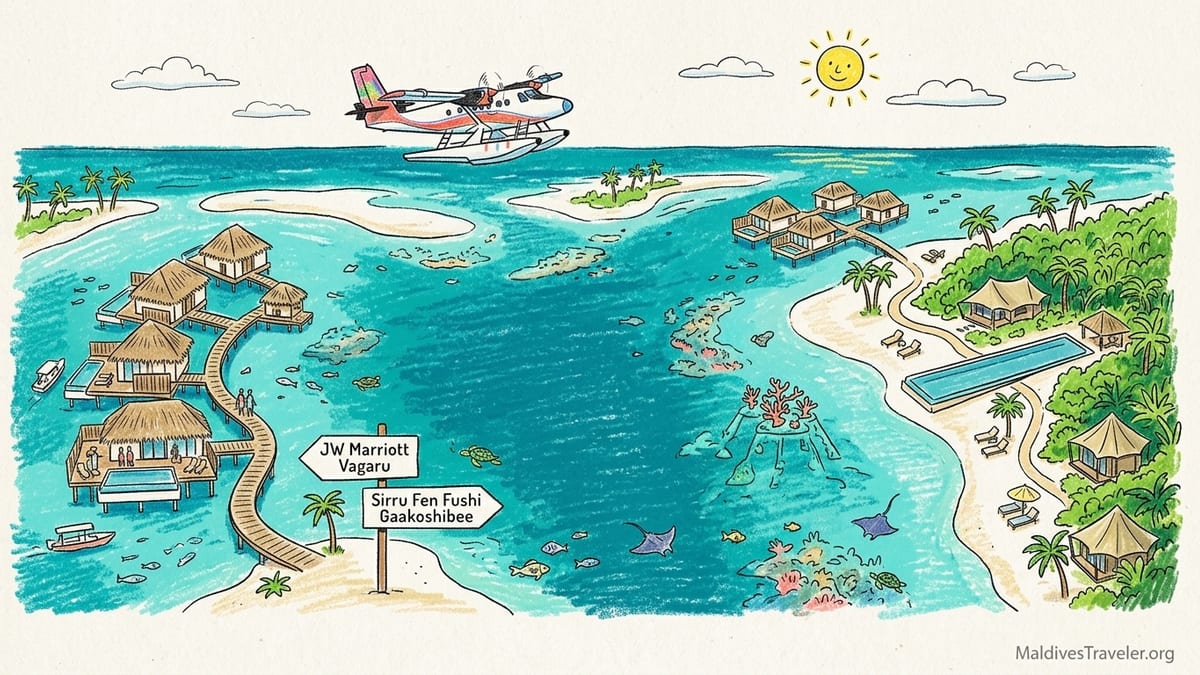
Understanding Shaviyani Atoll and How You Get There
Shaviyani Atoll sits north of Malé and has developed a reputation for “quality over quantity” in luxury tourism, with only a short list of high-end resorts instead of a ring of crowded islands. JW Marriott Maldives Resort & Spa on Vagaru and Sirru Fen Fushi – Private Lagoon Resort on Gaakoshibee are its two anchor luxury properties, both positioned amid broad turquoise lagoons and good access to outer-reef dive sites. For travelers, this means you are choosing between two self-contained islands rather than a large cluster of neighboring resorts, which already tilts the experience toward privacy and quiet.
Reaching either resort involves a seaplane transfer from Malé’s Velana International Airport. Current resort and tour operator fact sheets describe the flight time as approximately 55 minutes for both Vagaru and Gaakoshibee, depending on routing and weather. In practice, you should allow extra time for check-in at the seaplane terminal and potential stops to drop guests at other islands. Most travelers report paying several hundred US dollars per person for these roundtrip transfers, with invoices for JW Marriott often showing four-figure total costs for families once taxes and fuel surcharges are added. It is an expensive but visually spectacular part of the trip, with low-altitude views of the atolls and sandbanks that many guests describe as a highlight in itself.
The transfer experience at this level usually starts the moment you clear customs in Malé. Guests are typically met by resort staff, escorted to an air-conditioned lounge while waiting for the seaplane slot, and then boarded directly from the dock. JW Marriott, operating under a major international brand, leans into that polished, scripted welcome: cold towels, refreshments, and clear briefings. Sirru Fen Fushi, now an independent Leading Hotels of the World member after its previous Fairmont branding, tends to be framed as slightly more low-key and boutique in style, though still firmly in luxury territory.
If you are choosing between the two, consider whether you value the familiarity and loyalty benefits of a big brand like Marriott, or the slightly more individual character of an independently run island. Both deliver similar flight times and comparable seaplane logistics, but your early impressions and expectations may be shaped by this difference.
Villa Types and How Private They Really Feel
On paper, both resorts sound similar: all-villa accommodation, each with a private pool, either on the beach or perched over the lagoon. The differences reveal themselves when you look closely at layout, density and how exposed you might feel on your deck. JW Marriott has around 60 villas, split between beach pool villas and overwater pool villas, including duplex configurations and larger multi-bedroom options. Sirru Fen Fushi is a larger all-villa island with around 120 units, mixing beach villas, overwater villas and tented jungle villas hidden in the foliage.
At JW Marriott, privacy is generally strong, especially in the Beach Pool Villas where high vegetation and thoughtful angling of pools help screen you from neighbors. Many travelers highlight the feeling of having “your own mini resort” once you step onto your deck, with private pools that are long enough to swim more than a couple of strokes. Overwater villas enjoy excellent ocean views, but as at many Maldivian resorts, privacy depends on the exact orientation. Sunrise and sunset categories can face open sea, but there are rows where neighboring decks are within line of sight and where kayakers or paddleboarders might drift past. If absolute seclusion on the deck is a priority, it is worth asking the resort or a specialist agent to request end-of-pontoon or more sheltered positions, and being prepared to pay a premium for these.
Sirru Fen Fushi’s portfolio includes some of the most spread-out villas in Shaviyani. Beach villas have generous frontage and direct access to a wide, soft-sand shoreline. Overwater villas step out into the resort’s very large lagoon, with many units spaced far enough that you do not feel directly overlooked from your neighbors’ pools. The stand-out for privacy, however, is the safari-style tented villa concept hidden in the jungle interior. These are designed as luxurious “glamping” pavilions with private pools screened by vegetation. For couples or honeymooners who prefer dappled shade and a sense of being tucked away, they offer a different kind of seclusion than the classic overwater postcard, and they exist precisely because the island is large enough to support separate beach, lagoon and jungle experiences.
On the question of whether the premium feels justified, both resorts are priced in the upper bracket of Maldivian luxury. Recent contracting rates and public offers show entry-level villas in the high season frequently running well above 1,000 US dollars per night before taxes and transfers, with Sirru Fen Fushi often listing between roughly 1,400 and 3,200 US dollars per night depending on season and villa type. JW Marriott’s pricing can vary widely due to Marriott Bonvoy points redemptions and package inclusions, but cash rates for pool villas are comparable once you account for service charges and GST. In that context, the feeling of privacy created by thoughtful layout and individual pools is a major part of what you are paying for. Travelers who choose carefully located villas at either property usually come away feeling that this aspect of the premium has been delivered.
Beach, Lagoon and House Reef: Which Island Wins for Water?
Shaviyani Atoll is known for broad lagoons and relatively uncrowded outer reefs. Sirru Fen Fushi stands out for the scale of its lagoon and reef system. The resort sits on what is marketed as a nine-kilometre house reef that is accessible directly from the beach. Divers and snorkelers describe long sections of coral and fish life that you can reach by swimming out from shore or by taking short boat rides to different entries along the same reef structure. This gives the island a strong reputation with underwater enthusiasts, particularly those who enjoy repeat snorkel sessions without daily boat excursions.
The lagoon at Sirru Fen Fushi is also exceptionally large by Maldivian standards, which allows for that classic shallow-turquoise panorama, sandbars at low tide and space for stand-up paddleboarding and kayaking without feeling hemmed in by neighboring islands. One of the most distinctive features is the art-driven Coralarium installation in the lagoon, an underwater sculpture and coral regeneration space that you can reach by snorkeling trips. For families and first-time Maldivian visitors, combining a gentle lagoon with easy access to a long house reef can make the premium feel very tangible every time you step into the water.
JW Marriott’s setting on Vagaru also offers a beautiful lagoon and beachscape, with soft sand and clear shallows that photograph exactly as you would hope. However, frequent traveler reports suggest that while the snorkeling is pleasant and there is marine life on the surrounding reef, it does not rank among the most dramatic house reefs in the country. Guests who prioritize world-class snorkeling sometimes describe it as “decent rather than spectacular,” especially when compared with more reef-focused islands in other atolls. For many visitors, particularly families with younger children who prefer calm, shallow water and pool time, this is not a disadvantage. But if your Maldivian dream revolves around stepping off the beach into a dense coral garden, Sirru Fen Fushi currently has the stronger reputation.
Both resorts maintain beaches that are regularly groomed, and both deal with the inevitable Maldivian realities of seasonal currents and localized sand erosion. In practice, this means certain villa rows might have wider beach in some months than others, and the staff may adjust sun loungers or plant new vegetation to stabilize the shore. When you book, it is worth asking which side of each island currently has the best balance of beach width and calm water for your travel dates.
Pools, Layout and The Atmosphere On Island
At this level of resort, private pools are standard in every villa at both JW Marriott and Sirru Fen Fushi. The differences appear in the shared pools and how the islands are organized. Sirru Fen Fushi is home to one of the longest resort pools in the Maldives, a striking 200-metre rectangle that runs almost the length of the island’s main axis. Visually, it is dramatic: a strip of blue mirroring the lagoon, lined with sunbeds and creating a natural promenade between beach and restaurants. From a practical perspective, this gives guests a sense of space even when the resort is busy, since swimmers and loungers are spread out along an elongated pool rather than gathered around a compact rectangle.
JW Marriott’s common pools are smaller in scale but integrated into the family-friendly heart of the island. There is a main pool zone near some of the key dining venues and a separate children’s pool near the signature kids’ club, which features an eye-catching, 13-metre long pirate ship structure. Many families end up using their villa pools for most daytime dips, dipping into the main pool area around lunch or sunset to combine swimming with dining and drinks.
The overall atmosphere differs too. Sirru Fen Fushi presents itself as a calm, design-led hideaway. Architectural details include an all-bamboo bar structure created by Balinese artisans without man-made construction materials, which gives the central areas a sculptural, organic look. The resort’s relatively large land area means quiet pockets exist even when occupancy is high. JW Marriott, while still firmly in the five-star, honeymoon-capable bracket, leans more into a polished but relaxed resort energy. With only around 60 villas, the island feels intimate, but the brand’s family positioning and active kids’ club mean that on many school holiday dates, the soundtrack is more likely to include children playing around the pool and on the beach.
If you want an island where you can drift from a long statement pool to tucked-away corners of beach and reef with a sense of grown-up seclusion, Sirru Fen Fushi is the better fit. If you like the idea of a compact island where your children quickly learn the paths between villa, kids’ club and restaurants, JW Marriott’s layout and atmosphere may feel more natural.
Dining, Bars and Whether the Food Justifies the Rates
Food is a significant part of the bill in the Maldives, especially once you factor in the mandatory service charges and taxes. JW Marriott, supported by Marriott’s culinary standards and supply chain, has developed a solid reputation for variety and quality. The resort offers multiple restaurants, including elevated pan-Asian, Italian and grill concepts, as well as a treetop Thai dining venue that many guests single out as a highlight. Breakfast, often included in packages or granted as a status benefit for Bonvoy elites, is frequently described as one of the most abundant and high-quality spreads that well-traveled guests have experienced, with live stations, fresh tropical fruits, and both Western and Asian options.
Real-world bills from recent visitors show that daily food and drink for a couple, without an all-inclusive plan, can easily reach several hundred US dollars if you have cocktails, a la carte dinners and occasional in-villa dining. Some travelers manage costs by booking half-board or all-inclusive packages where available, or by consciously alternating high-end dinners with simpler lunches. The key point is that while the quality often earns praise, the prices rarely feel “cheap” once you see them converted from Maldivian rufiyaa into US dollars.
Sirru Fen Fushi’s culinary offering reflects its independent, design-forward identity. The island features several dining venues, including fine-dining options, beachfront grills and in-villa experiences. Menus pair international dishes with locally inspired creations, and the resort has historically leaned into experiential elements such as destination dining and romantic setups along the long pool or on the beach. For many guests, the ability to combine lagoon and reef activities with long, slow meals and a solid wine list forms a core part of why they chose an all-villa island in the first place.
On value, feedback from guests tends to place both resorts in a similar bracket. A couple ordering a bottle of mid-range wine and three courses at a signature restaurant at either property can expect a bill that easily nudges toward the upper two hundreds of US dollars once charges are added. Whether it feels justified hinges on how much you use the dining variety and how much you care about presentation. Travelers who love strong buffet breakfasts, flexible kids’ menus and the safety of a global brand often lean toward JW Marriott. Those who prioritize atmospheric venues, design and perhaps more of a “Maldivian escape” feeling when dining under the stars may find Sirru Fen Fushi’s culinary set-up more compelling.
Service, Kids’ Facilities and Day-to-Day Ease
At this price point, both islands aim for attentive, personalized service. JW Marriott, as part of a global luxury brand, has established protocols around pre-arrival communication, dietary notes, and villa preferences. Many families appreciate the predictability: if you are used to Marriott’s approach elsewhere in the world, you will recognize the structure here. There are occasional mixed comments from guests who expected ultra-bespoke small-island hospitality and instead encountered moments that felt slightly more corporate or process-driven, but overall reviews highlight friendly staff, good spa treatments and well-run excursions such as dolphin cruises.
Where JW Marriott particularly stands out is family infrastructure. The Family by JW kids’ club is one of the most visually memorable in the Maldives, centered on a 13-metre long wooden pirate ship, children’s pool and tailored activity program. Reports from families describe children disappearing happily for hours of supervised activities while parents head to the spa or relax in their villas. Policies around the minimum age for staying in overwater villas are enforced for safety, so families with younger children are guided toward beach pool villas until the kids are older. This is an important practical detail to check before you lock in your dream overwater image.
Sirru Fen Fushi, although not marketed as a “kids’ resort” in the same energetic way, does cater to families. There is a kids’ club, family-friendly pools and a playground, and the wide lagoon with its shallow entries is ideal for younger swimmers under parental supervision. Families can also join snorkeling trips to the house reef, weather permitting. However, the overall tone skews a little more toward couples and design-conscious travelers, which can be exactly what multi-generational or older families want if they are looking for calm spaces as much as entertainment.
In terms of day-to-day ease, consider how you like to communicate with staff. Both resorts offer in-villa phones and usually some form of messaging or concierge-style contact for arranging housekeeping, buggy rides and restaurant bookings. English is widely spoken, and staff come from across the Maldives and further afield. Tipping remains discretionary but is common for butlers or villa hosts, spa therapists and waitstaff. You can factor small denomination US dollars or add gratuities to your room account at the end of your stay.
Dive Centres, Ocean Experiences and How Active You Can Be
Being in a relatively underdeveloped atoll gives both JW Marriott and Sirru Fen Fushi strong access to uncrowded dive and snorkel sites. Each island runs its own dive and watersports centre, staffed by qualified instructors and guides who know the local channels and reefs well. Standard offerings include PADI courses, guided reef dives, night dives, turtle and manta-focused trips in season, and introductory experiences for beginners who have never dived before.
Sirru Fen Fushi’s dive centre benefits from that extensive house reef and the presence of the Coralarium, which functions as both an underwater art gallery and a coral regeneration project. Guided snorkel trips here pair environmental education with a visually unusual setting, making it popular with both photographers and families with older children. The size of the lagoon also allows for a broad range of non-motorised watersports such as stand-up paddleboarding, kayaking and sailing, alongside motorised options like jet-skiing where permitted.
JW Marriott’s dive operations focus on the surrounding reefs of Shaviyani, with boat trips to sites where guests regularly see reef sharks, turtles and schools of tropical fish. Keen divers often appreciate the quieter nature of this atoll compared with some southern atolls that host clusters of resorts. Reports suggest that while coral recovery is ongoing in line with much of the Maldives, there are still rewarding sites within day-trip range. On the softer side of ocean experiences, the resort offers dolphin cruises, sunset sailing and sandbank picnics, which tend to receive strong feedback from couples and honeymooners.
Costs for diving and excursions at both islands are in line with Maldivian five-star norms, meaning certified divers can expect to pay per boat dive plus equipment rental if needed, and private excursions or sandbank dinners carry significant premiums. It is worth reviewing sample price lists that resorts often share on request before arrival, so there are no surprises when you sign up for activities after seeing that clear water from your deck.
Pricing, Packages and When the Premium Makes Sense
For both JW Marriott and Sirru Fen Fushi, the sticker shock often comes not just from the nightly villa rate but from the combined total of villa, food, drinks, seaplane transfers and activities. A couple staying a week in a mid-category pool villa at either resort can easily see a final bill that reaches well into the five figures in US dollars once all elements are tallied, especially in peak months such as late December to early January or key school holiday periods.
In terms of pure cash rates, Sirru Fen Fushi’s larger inventory and independent management give it some flexibility with offers. Public rate ranges suggest starting points that can be slightly lower than the ultra-iconic postcard-name islands in other atolls, especially in shoulder seasons, while still delivering long reefs and very large villas with private pools. JW Marriott, by contrast, can often be accessed through Marriott Bonvoy points redemptions or dynamic cash-and-points deals, which fundamentally change the value equation for loyalists. Travelers who redeem a substantial stash of points to cover villa nights sometimes find that the premium they pay for seaplane and food feels more acceptable, knowing the room itself did not cost full cash.
Where the premium feels most justified is when the resort’s particular strengths match your priorities. If you are a snorkeling-obsessed couple or a family with older children who spend hours in the water and care deeply about reef quality and long swim-throughs, Sirru Fen Fushi’s nine-kilometre house reef and Coralarium experiences provide daily, tangible value. If you are a Bonvoy member traveling with younger kids who will live at the pirate-ship kids’ club, enjoy big breakfasts and appreciate the safety net of a global brand’s service standards, JW Marriott’s layout and programming can feel well worth it, especially if you have mitigated room costs with points.
Either way, it is wise to budget realistically. Recent accounts from guests at comparable Maldivian resorts describe seaplane transfers for two adults and one child adding more than 1,500 US dollars to the bill, and food and drinks across a week adding a similar or larger amount again, depending on drinking habits. Going in with clear expectations that your “all-villa private island dream” includes these hidden lines will go a long way toward feeling that the splurge was warranted.
The Takeaway
Shaviyani Atoll will not be the cheapest corner of the Maldives you can choose. It is, however, one of the more focused if you are looking for high-end resorts framed by broad lagoons and access to relatively quiet reefs. JW Marriott Maldives Resort & Spa and Sirru Fen Fushi – Private Lagoon Resort are, in many ways, complementary options that answer slightly different versions of the “Maldives dream.”
JW Marriott excels as a polished, compact island with strong family infrastructure, a kids’ club that children remember, reliable food quality under a global brand and the possibility of leveraging hotel points to soften the blow. Its villas are large, well-equipped and private enough for most travelers, especially on the beach side, and the overall experience feels reassuringly structured from seaplane lounge to checkout.
Sirru Fen Fushi stands out for scale and setting. The nine-kilometre house reef, huge lagoon, 200-metre main pool and the choice between beach, overwater and jungle tented villas create an island that rewards exploration. The Coralarium and long pool walks provide a sense of place you do not easily confuse with other resorts. Dining feels atmospheric, the design has character, and the emphasis is on tranquil, barefoot luxury rather than brand recognition.
If I were returning to Shaviyani with a young family and a pocketful of loyalty points, JW Marriott would sit high on my shortlist. If I were planning a water-focused couples’ escape where the reef and a sense of space mattered most, Sirru Fen Fushi would probably edge ahead. Both are serious splurges, but approached with clear eyes and realistic budgets, they are the kind of Maldivian stays that can justify their premiums in memories made between villa, lagoon and reef.
FAQ
Q1. How long is the seaplane transfer from Malé to Shaviyani Atoll resorts?
The seaplane transfer to both JW Marriott Maldives Resort & Spa on Vagaru and Sirru Fen Fushi on Gaakoshibee is typically around 55 minutes each way, depending on routing and weather.
Q2. Which resort has the better house reef, JW Marriott or Sirru Fen Fushi?
Sirru Fen Fushi generally has the stronger reputation for its house reef, with a reef system promoted as stretching around nine kilometres and accessible from the beach, plus the Coralarium snorkel site.
Q3. Are all villas at JW Marriott and Sirru Fen Fushi equipped with private pools?
Yes. Both resorts offer all-villa accommodation, and current resort descriptions state that every villa category at each property includes a private pool, whether on the beach, over the water or in the jungle at Sirru Fen Fushi.
Q4. Which resort is better for families with younger children?
JW Marriott tends to suit younger families especially well, thanks to its Family by JW kids’ club with a pirate ship, dedicated children’s pool and strong breakfast and dining options, although Sirru Fen Fushi also has a kids’ club and family facilities.
Q5. Can children stay in overwater villas at these resorts?
Safety policies change over time, but many Maldivian resorts, including JW Marriott, restrict overwater villas for families with very young children, so it is important to check current age rules and be prepared to book a beach villa if required.
Q6. How expensive are food and drinks at these resorts?
Food and drinks at both islands are priced at the higher end of Maldivian five-star levels, and a couple can easily spend several hundred US dollars per day on meals and beverages if not on a meal plan.
Q7. Is it worth booking an all-inclusive or half-board package?
Many travelers find half-board or all-inclusive packages helpful in controlling overall costs, especially at Sirru Fen Fushi where long stays and active days can involve multiple meals and drinks; at JW Marriott, package value depends heavily on your eating and drinking habits.
Q8. Do both resorts offer good options for non-divers?
Yes. Beyond diving, both islands run snorkeling trips, dolphin cruises, spa treatments, sandbank picnics and non-motorised watersports, so non-divers have plenty to do between villa, beach and lagoon.
Q9. How far in advance should I book to get the best rates?
For peak periods such as festive season or major school holidays, booking many months ahead gives you the best chance of securing preferred villa types and promotional rates; shoulder seasons sometimes offer more flexible deals closer to arrival.
Q10. If I care most about privacy, which villa types should I consider?
For maximum privacy at JW Marriott, look at end-of-pontoon overwater villas or beach pool villas with dense vegetation, and at Sirru Fen Fushi consider beach villas with wide frontage or the jungle tented villas, which are designed for seclusion.