


Planning a dive or snorkel trip to Shaviyani Atoll is not just about picking a resort. In this remote northern corner of the Maldives, the monsoon pattern shapes everything you will actually experience on the water: the chop on the channel crossing, how often the rain interrupts your breakfast, whether your sunset dolphin cruise runs, and how many metres ahead you can see your buddy on a drift dive. This guide combines my own recent time in Shaviyani during the late northeast monsoon with up-to-date research on the rest of the year, to help you choose the best months for your priorities.
How the Seasons Work in Shaviyani Atoll
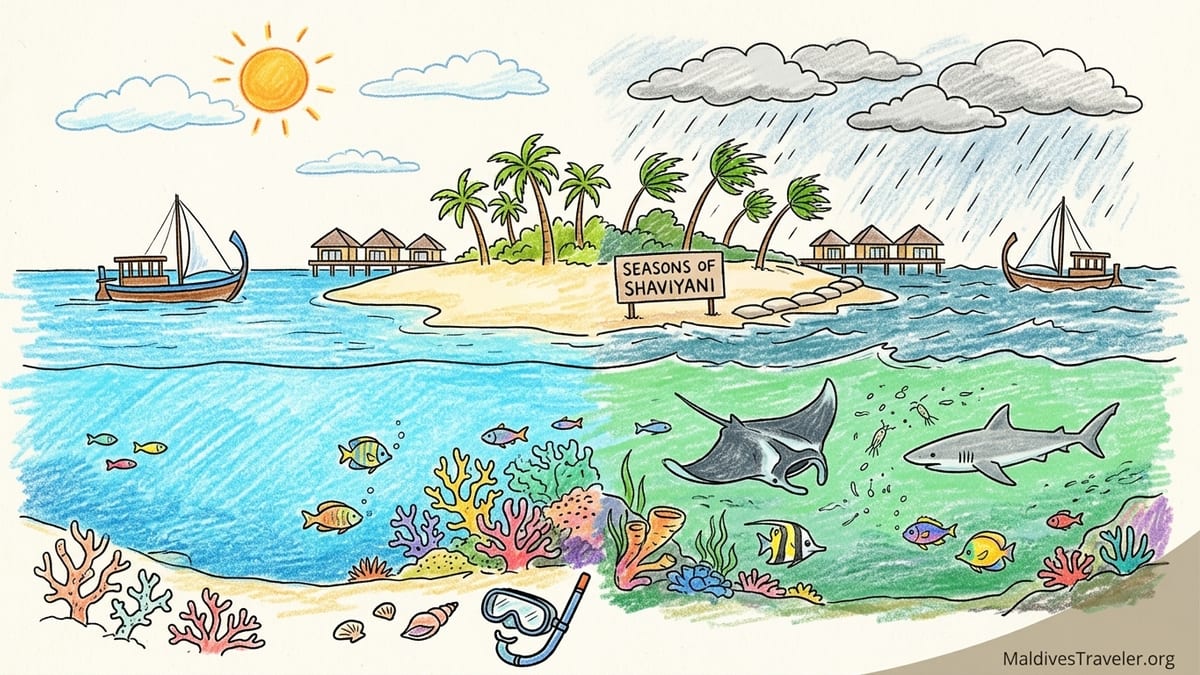
Shaviyani Atoll sits in the far north of the Maldives, part of the Miladhunmadulu group, and shares the same two-monsoon pattern that shapes conditions across the country. From roughly late November to April, the northeast monsoon brings drier weather, more sunshine and generally calmer seas. From May to October, the southwest monsoon pushes in moister air and stronger winds, with more frequent showers and a livelier sea state. Dive agencies and operators, including PADI, broadly identify November to April as the prime window for clear water and easier surface conditions, with underwater visibility often in the 20 to 30 metre range in the north.
It is important to treat those boundaries as tendencies, not hard lines. Climate data for the Maldives shows relatively uniform air temperatures around 28 degrees Celsius, high humidity between about 73 and 84 percent, and rainfall that can spike in almost any month, even in the so-called dry season. In Shaviyani I saw this in practice: one morning would be glassy with barely a ripple, the next would start with thick grey cloud and a 20-minute squall that had staff quickly moving cushions from the pool deck. The forecast might show rain icons for days, yet you still get long, bright windows that are ideal for diving.
Another crucial seasonal detail for divers is that the monsoon not only changes wind and rain but also current direction and plankton in the water. During the northeast monsoon, clear oceanic water often dominates the eastern sides of the atolls, bringing the best clarity for wide-angle photography and reef scenery. During the southwest monsoon, nutrient-rich water can reduce visibility but feed plankton blooms that attract mantas and other pelagic life. Shaviyani does not have the headline manta aggregations of Baa Atoll, but its channels and outer reefs still respond to the same forces.
When you look at glossy brochures, it is easy to think of the Maldives as a uniform, perfectly calm lagoon. In reality, the combination of monsoon, local wind and reef topography creates day-to-day variety. A three-kilometre speedboat transfer from a domestic airport like Hanimaadhoo up to a Shaviyani resort can be smooth in March and quite bumpy in late May, even if the air temperature is the same. Understanding these seasonal patterns will help you decide not only when to visit but also what kind of trip to book, whether that is a resort-based holiday focused on house reef snorkelling or a more intensive dive package.
My Firsthand Experience: Late Northeast Monsoon in Shaviyani
My own stay in Shaviyani Atoll was in late March, squarely in the tail of the northeast monsoon that PADI and local dive guides describe as the prime period for calm seas and high visibility. Over ten days I logged dives almost every day, along with daily snorkels on the house reef. Air temperatures hovered around 30 degrees Celsius in the afternoon, dropping to the high twenties at night, and the humidity was high but manageable with sea breezes. Most mornings started with sun or light cloud, then built towards a hotter, occasionally hazy midday.
Rain was short and intense rather than prolonged. Across those ten days, there were three notable showers. One came just after dawn and lasted around fifteen minutes, with big, warm drops and gusts that rattled palm fronds but did not raise much swell. Another hit mid-afternoon and lasted about half an hour. The most powerful arrived just before sunset on day seven, when a dark band of cloud moved quickly from the west and brought twenty to twenty-five minutes of heavy rain and stronger wind. None of these squalls cancelled dive trips. The resort’s dive centre simply delayed one two-tank outing by about thirty minutes to let the worst of the chop pass, and we still reached the channel site without discomfort.
Sea conditions for most of that stay were close to the Maldives ideal. On the eastern outer reef, where many of Shaviyani’s thilas and channels sit, the surface was often described by the guides as “slight.” On the ten to fifteen minute rides out in a classic Maldivian dhoni, there was a gentle up-and-down motion but almost no spray over the bow. On the longer transfer to a more distant channel, perhaps twenty-five minutes away, there was a bit more roll, yet guests could still sit comfortably on the open deck benches. The only noticeably bumpy ride was the morning after that pre-sunset squall, when a residual wind chop gave us a firmer slap for about ten minutes before we tucked behind the outer reef.
Underwater visibility in late March was excellent. On the clearest days, the dive computer recorded the seafloor at thirty metres from a safety stop at five metres, and the guides estimated visibility at around twenty-five to thirty metres on the eastern edge of the atoll. On slightly hazier days, especially closer to inner reefs, it was closer to eighteen to twenty metres, still very good for both macro spotting and wide-angle scenes. Snorkelling on the house reef, I could easily watch reef sharks and schooling fusiliers cruising at ten to twelve metres depth from the surface. Photographers on our boat were consistently shooting at low ISO settings and capturing bright, sharp scenes even without strobes on the upper parts of the reef.
Boat Rides, Excursions and Daily Logistics in Peak Season
For divers and snorkelers, peak-season comfort is about more than just underwater visibility. In Shaviyani during March, boat logistics were smooth. The resort’s dhoni left on time for both 8:30 a.m. and 2:30 p.m. departures, and there were very few last-minute changes. On one day when wind picked up unexpectedly around midday, the crew switched the second dive from a more exposed channel to a pinnacles site tucked a little deeper inside the atoll. That adjustment cut the surface chop on the ride and gave us calmer conditions for the safety stop while still delivering white-tip sharks and a big stingray on the sand.
Non-diving excursions fared similarly well. A sunset dolphin cruise left on schedule on four of the five nights it was offered during my stay. The only cancellation was the evening of that strong sunset squall, when the excursion team assessed the low visibility on the horizon and the lingering wind chop and opted to move guests to the following evening. Sandbank picnics and paddleboard rentals ran every day. On the house reef, ladders and entry points remained usable at all times, with only a mild surge on shallower ledges close to the reef crest during windier afternoons.
Humidity is often a concern for travellers not used to tropical climates. In late March, relative humidity in the northern Maldives typically sits around 75 to 80 percent, and that matched the feel on the ground. Walking the jetty between overwater villas and the main island, you could feel the heat build by late morning, but the consistent light breeze off the ocean kept it from becoming oppressive except in the most sheltered corners. On dive boats, the combination of wind and spray made surface intervals comfortable. The main practical adjustment was staying hydrated and making liberal use of the shaded upper deck between dives.
For planners, another advantage of the late northeast monsoon is the reliability of domestic flights and speedboat transfers, which are less likely to be disrupted by strong crosswinds or heavy storms. On my arrival into the northern domestic airport, the twenty-minute speedboat up to Shaviyani ran exactly on schedule, with only gentle rolling as we crossed open water gaps between reefs. For travellers with tight connections or limited time off work, this predictability is a strong argument for coming between January and early April if you can.
What Changes from May to October: Researched Insights
I have not personally stayed in Shaviyani during the southwest monsoon from May to October, so what follows is based on current reports from dive operators, climate data for the northern atolls and broader Maldives-wide patterns. During this period, the prevailing wind tends to swing around, seas in the open channels become livelier, and short, intense showers are more common. Operators in the region describe more days where they need to pick dive sites for shelter first and pelagic potential second, especially when there are a few days of consecutive wind.
In terms of underwater conditions, multiple Maldivian dive guides report that visibility in the wet season often drops somewhat, particularly on the windward side of an atoll, but still remains perfectly diveable. Figures in the range of fifteen to twenty metres are commonly quoted for the southwest monsoon, compared with twenty to thirty in the dry window. Because the Maldives has no major rivers feeding silt into the ocean, heavy rain itself does not usually cause the kind of brown, murky water that some other tropical destinations see after storms. Instead, changes come from current direction and plankton levels, which may make the water more green-blue and slightly “milky,” while feeding plankton-eating species.
Boat conditions from May to October are more variable. On calm days in June or September, videos from northern resorts show classic postcard scenes, with flat seas and slow-gliding dhonis. On windier days, speedboat rides from domestic airports can be significantly bumpier, and some operators warn that guests who are prone to seasickness might find deeper channel crossings uncomfortable. One practical adjustment is that resorts may cluster dives around closer sites when whitecaps build, to keep journey times down to ten or fifteen minutes and stay behind coral barriers that blunt the fetch of the wind.
On the positive side, the southwest monsoon often brings richer pelagic life and can mean lower prices. Across the Maldives, resorts in less famous atolls such as Shaviyani tend to drop nightly rates and dive packages outside the December to April high season. Examples from current booking engines show meaningful differences: a mid-range resort might charge several hundred US dollars less per night for a villa with half board in June than in February. Dive centres respond by running seasonal offers such as discounted ten-dive packages or complimentary nitrox for certified divers during the so-called low season, to compensate for the increased risk of a few choppy or rainy days.
Diving and Snorkelling Conditions Month by Month
From a diver’s perspective, the heart of the northeast monsoon, roughly January through March, is the sweet spot for Shaviyani. Reports from dive operators and broader Maldives diving guides show visibility on the eastern sides of northern atolls frequently reaching twenty to thirty metres in this period. Water temperatures hold around twenty-seven to twenty-nine degrees Celsius, so most divers are comfortable in a 3 mm shorty or full suit. Currents in the channels can still be powerful at any time of year, which is why many liveaboard routes in the Maldives recommend Advanced Open Water as a minimum, but the combination of calm surface, clear water and reliable sunshine makes this window ideal for wide-angle photography and drift dives.
April is a transition month. In years where the northeast pattern lingers, early April can feel very similar to March, with calm mornings and only slightly more frequent showers in the afternoon. In other years, wind direction starts to wobble earlier and brings more unstable weather. Divers in April often report visibility still in the twenty metre range on many days, but with more hazy days mixed in. For snorkelers, especially those focused on house reef exploration, this is still a strong month, as long as you are prepared for a higher chance of cloudy sunsets or an occasional excursion reschedule.
From May through August, the southwest monsoon sets in more convincingly. During this window, Shaviyani follows the pattern seen across the Maldives of more wind and a livelier sea state, balanced by richer nutrient flows and some excellent marine life encounters. Divers who visit the Maldives in May often mention slightly lower visibility but also exciting currents and more pelagic action, including grey reef and white-tip sharks deeper in the channels. July and August, in particular, are more likely to bring sequences of windy days and passing squalls, which can mean more cautious site selection by dive centres and occasional cancellations of non-essential surface-focused excursions like sandbank barbecues.
September and October act as a shoulder between the southwest and northeast monsoons. In recent years, travellers have increasingly targeted October as a value month across the Maldives, when prices are significantly below the December peak yet weather is often noticeably more settled than in July. Dive reports from this period describe a mix of conditions: some weeks still see wet, windy spells with rough crossings, while others have long stretches of sunshine and steadily improving clarity. For Shaviyani, October can be attractive for experienced divers happy to accept a little more weather risk in exchange for quieter boats and potentially livelier channels, but first-time visitors very focused on calm-sea comfort may prefer January through March.
Beach, Lagoon and House Reef: What You Actually See
From a non-diver’s perspective, the difference between seasons in Shaviyani often shows first on the beach and in the lagoon. In late March, the resort island I stayed on had broad, clean beaches on its eastern side, with soft white sand and a very gentle gradient into the water. Small ripples lapped the shore most of the time, and only once did I see modest surf breaking on the outer reef due to a brief wind spike. Sandbags and erosion control structures were minimal and easy to overlook in photos.
By contrast, resort managers describe that in the heart of the southwest monsoon, stronger onshore winds can nibble away at exposed beach sections. On some islands, sand is transported along the shoreline, leaving certain corners narrower for a few months before the pattern reverses. Guests visiting in July or August might notice more sandbags discreetly buried under loungers on the windward side, or see staff raking up debris washed ashore after a squally night. The leeward side of the island typically remains more sheltered and keeps its postcard look year round, which is why many resorts in the Maldives orient their premium villas and main swimming beaches towards the calmer lagoon.
House reef access is another key seasonal detail. In calm March conditions, I could snorkel directly from the beach through waist-deep turquoise water to the drop-off in five to ten minutes, with only a mild tug from the current along the reef edge. Entry and exit were easy on the designated channels, and visibility even in the very shallow water was good enough to watch juvenile blacktip reef sharks weaving between coral bommies. During the wet season, the same paths remain usable but snorkelers may feel more surge in the shallowest sections, and guides sometimes recommend time windows around slack tide for less confident swimmers.
Coral health in the northern atolls has been impacted by the same bleaching events that affected the wider Maldives, and it would be misleading to expect uniformly pristine reefs. In Shaviyani, I saw a mix of recovering hard coral patches, live soft corals and areas still dominated by rubble. Fish life, however, was abundant in both shallow and deeper water, with clouds of anthias, surgeonfish and schooling snapper. Seasonally, planktonier water during the southwest monsoon can make for more dramatic scenes of feeding fusiliers and jackfish in the mid-water column, even if the background reef looks slightly more muted in photographs.
Practical Planning Tips for Divers and Snorkelers
Choosing the best time to visit Shaviyani Atoll is essentially a question of your priorities. If your main goal is the highest chance of calm boat rides, bright sun and thirty metre visibility, target January to March and be prepared to pay high-season prices. This is when many resorts run their busiest dive schedules, with full-day three-dive outings and well-attended night dives. For underwater photographers, this window offers the best balance of clear water and predictable light, especially on the eastern reef slopes.
If you are more budget-conscious or curious about livelier pelagic encounters and can tolerate a few choppy days, consider the shoulder and wet-season months from May through October. Ask prospective resorts or liveaboards which sides of the atoll they focus on in this period, and how they adapt to changing winds. For instance, a dive centre might emphasise more inner-thila and lagoon-side sites when strong wind makes open channels uncomfortable. You can also ask directly how often, in their recent seasons, they have had to cancel all diving for a day due to weather, which will give you a realistic sense of risk.
For snorkelers who are not strong swimmers, the calmer northeast monsoon remains the more comfortable choice. House reef currents can be present year round, but in my March stay it was easy to plan a relaxed drift with a life jacket and simply exit at the next ladder along the jetty. In wetter months, you might still snorkel daily, but should be more flexible with timing and perhaps choose a resort that offers guided, boat-supported snorkel trips to sheltered lagoons when the main reef edge is choppy.
Regardless of season, remember that even the best forecasts for the Maldives paint in broad strokes. Different islands within the same atoll can see different weather in a single afternoon. It is common to see rain showers falling a few kilometres away while your own island stays dry. Plan your trip with a margin for this variability, emotionally and logistically, and treat a couple of grey, squally hours as part of the Indian Ocean atmosphere rather than a disaster.
The Takeaway
From my time in Shaviyani Atoll in late March, paired with current data and operator insights, a clear pattern emerges. The northeast monsoon from roughly December through April does deliver on its reputation for calmer seas, sunnier skies and excellent underwater visibility, often in the twenty to thirty metre range on the eastern reef edge. In this period, rain tends to arrive in short bursts rather than all-day downpours, boat rides stay comfortable, and most excursions, from dolphin cruises to house reef snorkels, run as planned.
The southwest monsoon from May to October brings more changeable conditions: a livelier wind, more frequent showers and slightly reduced visibility. Yet it also brings nutrient-rich water that can boost plankton and attract pelagic life. For divers willing to accept a bit more motion on the surface and a few rearranged plans, this season can be rewarding and more affordable. What you give up in postcard predictability, you may gain in dramatic skies, dynamic currents and potentially quieter dive sites.
If you are planning a once-in-a-decade Maldives trip and want to maximise your chances of classic conditions with minimal weather-related disruption, then January to March is the safest bet for Shaviyani. If you are a more flexible traveller, returning diver or budget seeker, then the edges of the southwest monsoon can also make sense, provided you choose your resort carefully and keep your expectations realistic. Either way, Shaviyani’s combination of outer reef channels, thilas and accessible house reefs means that, with thoughtful timing, it can deliver the quintessential Maldives underwater experience without the crowds of the central atolls.
FAQ
Q1. When is the absolute best month to visit Shaviyani Atoll for clear diving conditions?
For the highest likelihood of calm seas and excellent visibility in Shaviyani Atoll, February and March stand out, sitting in the heart of the northeast monsoon with frequent 20 to 30 metre underwater visibility on the eastern reef edge.
Q2. Is it worth visiting Shaviyani Atoll in the wet season from May to October?
Yes, the southwest monsoon can still offer good diving, with visibility often around 15 to 20 metres and richer plankton that may attract more pelagic life, though you should expect choppier boat rides, more showers and the possibility of some excursions being rescheduled.
Q3. How often are dive trips cancelled in Shaviyani due to weather?
In the late northeast monsoon period I experienced, no dive days were fully cancelled and only one departure was delayed by about 30 minutes after a squall; during the southwest monsoon, operators report occasional cancellations when wind and swell align, but complete write-off days remain relatively rare.
Q4. What wetsuit thickness do I need for diving in Shaviyani Atoll?
Water temperatures hover around 27 to 29 degrees Celsius most of the year, so many divers are comfortable in a 3 mm shorty or full suit, while those who get cold easily may prefer a 5 mm suit or an extra thermal layer for longer repetitive diving.
Q5. Are house reef snorkels safe for beginners year round?
Beginners can snorkel the house reef in most months, but the calmest and most predictable conditions are during the northeast monsoon; in the southwest monsoon, beginners should favour guided sessions and sheltered lagoon entries when wind and surge increase.
Q6. Does rain in the Maldives ruin underwater visibility?
Short tropical showers in the Maldives rarely ruin underwater visibility on their own, because there are no major rivers bringing silt, but shifts in current and plankton during the wet season can make the water more milky and reduce clarity compared with the dry months.
Q7. How does Shaviyani compare to central atolls for marine life?
Shaviyani offers abundant reef life, sharks and occasional pelagic encounters, but it is less famous for huge manta aggregations than atolls like Baa; in return, it tends to have fewer boats at popular sites and a more remote, less developed atmosphere.
Q8. Will strong currents be a problem for intermediate divers?
Certain channel and outer reef sites in Shaviyani can have strong currents in any season, so intermediate divers should be comfortable with negative entries, staying close to a guide and using a reef hook where allowed, while choosing easier inner-thila sites on days when they feel less confident.
Q9. Are prices significantly lower outside the December to April high season?
Yes, many Shaviyani resorts and dive centres reduce rates between May and October, and current examples show that accommodation and dive packages can be notably cheaper in June or September than in February, reflecting the higher weather risk.
Q10. If I can travel only once, should I prioritise visibility or pelagic activity?
If you want the classic Maldives postcard experience with bright sun and clear blue water for photography, prioritise the northeast monsoon; if you are a more experienced diver fascinated by big-fish encounters and do not mind some chop or slightly hazier water, the southwest monsoon shoulder months can be equally compelling.