


My journey to Shaviyani Atoll started the way almost every Maldivian trip does, by stepping off a widebody aircraft into the humid air at Velana International Airport near Malé. What makes Shaviyani different is what happens next. Whether you are headed to a private-island resort like JW Marriott Maldives Resort & Spa or planning to stay on a local island via Funadhoo, the combination of seaplanes, domestic flights and speedboats creates a transfer day that feels almost like a separate trip. Here is how my own transfers unfolded, what I learned about the logistics, and why the exact time your international flight lands in Malé can make or break your first day in paradise.
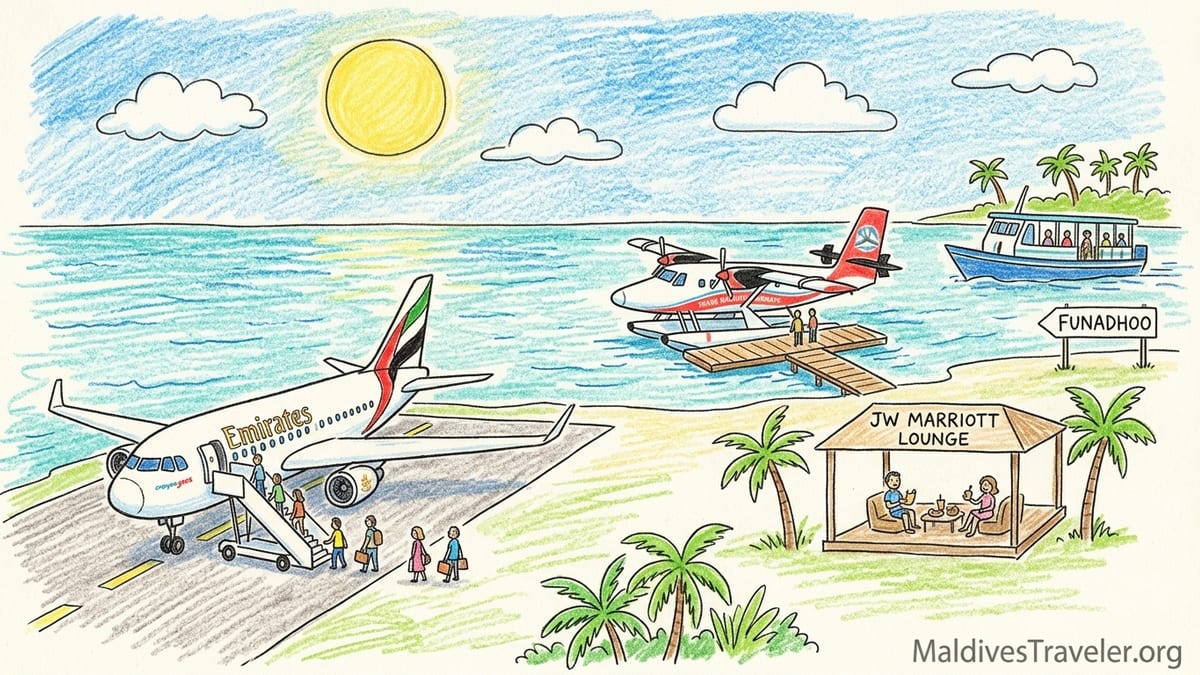
Arriving at Velana: First Steps into the Maldives
The story of getting to Shaviyani Atoll begins the moment the aircraft door opens at Velana International Airport, the main gateway to the Maldives just off the capital, Malé. After a long overnight flight from the Gulf, I walked down the jet bridge into the compact international arrivals area, already feeling the thick warmth and noticing a mix of honeymooners, dive groups and families all converging on the immigration hall. Although the airport serves millions of passengers a year, it feels more like a small regional hub than a giant Asian mega-airport, which makes the onward transfer process more manageable.
Immigration is the first checkpoint and, for most nationalities arriving as tourists, the process is straightforward. Queues move in waves, often synchronized with popular arrivals from Dubai, Doha, Singapore and Istanbul. On my visit, it took around 30 minutes to clear the line, helped by having my hotel confirmation and return ticket ready to show if asked. The officer stamped a 30-day visa on arrival into my passport with little small talk, and I stepped into the baggage claim area already thinking about the clock ticking toward my seaplane departure.
Baggage claim at Velana can be the first reality check after a business class flight. The belts are busy and multiple long-haul flights often unload at once. It is here that the first difference between resort seaplanes and domestic island flights starts to matter. Seaplane operators such as Trans Maldivian Airways impose strict checked baggage allowances that are lower than many international airlines, usually around 20 kilograms checked plus 5 kilograms hand luggage, with excess charged by the kilo. Knowing this in advance meant I was mentally prepared for the possibility of leaving a heavy suitcase in storage in Malé or paying a surcharge at the seaplane counter.
Once my bags arrived, I passed quickly through customs, where officers are mainly looking for restricted items such as alcohol and drones. The real handover in the journey happens just outside the sliding doors, where resort representatives and domestic airline desks take over from the airport itself. This is where a trip to Shaviyani either flows smoothly or starts to fray.
Meeting the Resort Representative and Reaching the Seaplane Terminal
As soon as I exited customs, a wall of signs came into view, each bearing the logo of a different resort. For guests headed to JW Marriott Maldives Resort & Spa on Vagaru Island in Shaviyani Atoll, this is where the experience turns highly curated. The resort sends a Welcome Ambassador to meet guests on arrival at Velana, and I saw staff in crisp uniforms holding the JW Marriott branding just beyond the barrier. After a quick introduction and confirmation of my name against their arrival list, the transfer machinery clicked into place.
My seaplane transfer to JW Marriott was arranged in advance as part of the booking. The resort currently charges a shared round-trip seaplane transfer of 665 US dollars per adult and 415 US dollars per child, including 17 percent GST, which must be factored into the overall trip budget. The representative escorted me to the Trans Maldivian Airways check in area, where we weighed all luggage, including hand carry. The agent reminded me of the standard allowance and noted that any excess might be charged at the airline’s prevailing per kilo rate, which can add up quickly for heavy camera gear or dive equipment.
After check in, the resort representative led me to a dedicated seaplane lounge used by JW Marriott guests. Located near the separate seaplane terminal on the other side of the runway, the lounge offers snacks, soft drinks, coffee and Wi Fi, along with showers for guests arriving from long flights. Reaching this terminal involves a short shuttle ride arranged by the seaplane operator or the resort, usually five to ten minutes depending on ramp activity. The contrast between the compact main terminal and the relaxed waterfront setting of the seaplane base makes it feel like the trip has shifted from travel mode to holiday mode.
Even in the comfort of the lounge, timing remains critical. JW Marriott advises that international arrival flights should land in Malé by 3 p.m. local time, and notes that its final seaplane normally operates within the daytime flying window, with typical departure times from the resort between early morning and late afternoon. Those constraints are linked to daylight rules and seaplane operations, and they shaped my entire decision about which international flight to book.
Why International Arrival Time Matters So Much
Before visiting Shaviyani, I had read about the 3 p.m. cut off for international arrivals and assumed it was merely a preference. Once on the ground, I realized it is a hard operational limit for most seaplane bound resorts. Seaplanes in the Maldives operate in visual flight conditions and typically fly only during daylight hours, with many operators scheduling flights roughly between sunrise and late afternoon. JW Marriott highlights that its final seaplane usually operates within this daytime window, which in practice means that if you land too late, there simply is not enough light left to position a seaplane, fly the 40 minute sector to the resort, and have the aircraft back before dusk.
On my own trip, I deliberately chose an Emirates flight that arrived around midday, leaving several hours of buffer for potential immigration delays, luggage issues or air traffic constraints. Other travelers in the lounge shared stories of cutting it closer. One couple whose flight had been scheduled to land at 2:30 p.m. ended up circling due to weather and touched down after 3:15 p.m., missing the last viable seaplane of the day. The resort arranged an overnight stay at a hotel near the airport, but their dream of waking up the first morning at their overwater villa was pushed back by 24 hours.
The timing issue is not unique to JW Marriott. Across the Maldives, many seaplane serviced resorts publish similar guidelines, often recommending arrivals before about 3:00 or 3:30 p.m. and departures from Malé later than 9:00 a.m. The outbound guideline exists because resorts must send guests on an early seaplane to connect with morning long-haul flights, and delays at dawn can cascade. For Shaviyani specifically, distance compounds the timing pressure. JW Marriott sits roughly 40 minutes by seaplane from Malé, and aircraft must load, fly, unload and return in daylight. Choosing an arrival flight that reaches Malé by late morning or early afternoon is not just more comfortable, it significantly reduces the risk of needing a surprise overnight in the city.
For travelers using the domestic route via Funadhoo Airport to reach local islands, international arrival time matters in a different but equally important way. Maldivian, the national airline, currently operates direct Malé to Funadhoo flights that take about one hour and tend to depart in the morning on specific days, such as 8:20 a.m. on several September 2026 dates. If your long haul flight lands mid afternoon, you will almost certainly miss the last domestic service of the day and may need to overnight in Malé or find a speedboat option, depending on your final island. In practice, anyone bound for Shaviyani by domestic flight should target an international arrival the evening before, then take a morning Maldivian flight to Funadhoo.
Luggage Rules, Check In and The Seaplane Flight to JW Marriott
Seaplane travel in the Maldives feels glamorous in photos, but the check in process is surprisingly functional. At the Trans Maldivian Airways counter, my bags were placed on a large scale one by one, along with my cabin bag. The agent noted the combined weight and compared it with the allowance already built into the resort’s transfer quote. For JW Marriott guests, the shared transfer charge typically includes the standard allowance, while any significant extra weight can incur additional fees payable at the airport. Because seaplanes operate with tight safety margins, these baggage limits are more rigid than those on a widebody jet.
What struck me most was how visible the logistics are. After check in, I watched from the lounge balcony as ground staff loaded luggage onto trolleys bound for each seaplane. Bags are tagged with resort names and flight numbers rather than conventional airline tags, and several flights share the same dock area. This is one reason resort representatives insist on escorting guests to the correct boarding gate; a mix up could send your suitcase toward another atoll entirely.
The flight itself to JW Marriott is an experience worth the cost for many travelers. We boarded a twin otter floatplane in bare feet, carrying shoes in hand as we climbed the metal steps from the floating pontoon. Inside, the cabin was compact, with roughly 15 seats in a 1 2 configuration. There is no air conditioning when the doors are open, only fans and the breeze through the cockpit windows, but once airborne, the temperature quickly becomes comfortable. Takeoff involves a brief taxi across the lagoon, a surge of propeller noise and a smooth lift off as the floats release from the water.
From the air, the route north to Shaviyani traces a chain of reefs, sandbanks and islands in varying shades of blue. The flight time of about 40 minutes passed quickly as we flew low enough to recognize resort jetties and sandbanks below. The pilots flew barefoot and with casual confidence, used to hopping from lagoon to lagoon several times a day. There was no inflight service or toilet, so any last minute needs had to be handled at the lounge, another reason a comfortable buffer between international arrival and seaplane departure makes the day easier.
Landing in Shaviyani and the Final Boat Ride
Approaching Shaviyani Atoll by seaplane gives a clear sense of how remote the region still feels. JW Marriott occupies Vagaru Island, surrounded by its own lagoon and reef, and the pilots brought the aircraft down in the ocean just outside the resort. The landing felt more like a firm splash than a normal runway touchdown. Within moments, the cabin door opened to reveal a floating jetty, where resort staff waited to welcome arriving guests.
At some resorts, arrivals step directly off the seaplane onto a fixed jetty connected to the island. At JW Marriott, a short floating platform and walkway created a gentle transition from aircraft to land. Luggage followed on a separate small boat, having been offloaded from the seaplane floats. Within fifteen minutes of shutting down the engines, I was standing in the open air lobby with a welcome drink in hand, while my bags were taken directly to the villa. The last segment of the journey was short but symbolic, a few minutes on a buggy that finally closed the loop from long haul flight to overwater deck.
For those traveling the domestic route into Shaviyani, the final leg looks different but carries the same island hopping logic. Maldivian’s direct flights from Malé to Funadhoo take around one hour and operate multiple times a week, often leaving in the morning. Funadhoo Airport, located on the atoll’s administrative capital island, is a small domestic facility with basic services. After landing, travelers transfer to local boats or speedboats arranged by guesthouses or island councils to reach surrounding inhabited islands such as Foakaidhoo or Feydhoo. Boat rides can range from 20 minutes to more than an hour depending on distance and sea conditions, and most are scheduled to connect with the domestic flights as closely as possible.
In both cases, the final boat transfer is where the Maldives shifts from transit hub to everyday life. On a resort speedboat, cold towels and bottled water appear alongside life jackets, and staff point out the house reef as you approach. On a local island boat from Funadhoo, plastic chairs, schoolchildren and grocery sacks share the deck space. Either way, by the time you step onto the jetty of your chosen island, you have moved through three or four distinct transport worlds in a single day.
Choosing Between Seaplane to JW Marriott and Domestic Flights to Funadhoo
Experiencing both a seaplane transfer to JW Marriott and a domestic hop to Funadhoo made the trade offs very clear. The seaplane option is designed for guests who want a seamless, high touch journey directly to a private island resort. The price of 665 US dollars round trip per adult and 415 US dollars per child, inclusive of tax, reflects the cost of operating floatplanes over ocean routes, as well as the convenience of coordinated meet and greet services, lounges and direct arrivals at the resort lagoon. For many honeymooners or once in a lifetime travelers, that cost is built into the overall resort budget, which can easily run to several thousand dollars for a multi night stay.
The domestic flight option via Funadhoo suits travelers with different priorities. Maldivian sells tickets on its Malé to Funadhoo route, with recent searches in September 2026 showing one way fares starting in the low to mid 100s of US dollars on certain dates, depending on demand. The one hour flight uses turboprop aircraft such as the ATR 72, taking off from the domestic terminal at Velana rather than the seaplane base. On arrival in Funadhoo, guests typically connect to scheduled ferries or chartered speedboats to reach local islands, where guesthouse nightly rates can be a fraction of resort prices.
There are also practical differences beyond cost. Seaplanes to JW Marriott usually operate during daylight and are scheduled by the resort in blocks, which means your exact departure time is often confirmed only the day before travel. Domestic flights to Funadhoo operate on published schedules several days a week, giving more fixed times but also less flexibility if you miss a flight. Seaplane luggage allowances are often stricter and more expensive for excess baggage than domestic ATR flights, where the limits are closer to conventional regional airline policies, although it is still wise to check exact rules on your ticket.
For some travelers, combining both modes can make sense. A traveler might spend a few nights at a luxury resort like JW Marriott, flying in and out by seaplane, then extend the trip with time on a local island reached via Funadhoo. That approach requires careful planning around flight days and connection times, and it underscores once again why paying close attention to the timing of your international arrival and departure is critical when your destination lies in a remote northern atoll.
The Takeaway
Getting to Shaviyani Atoll is more involved than simply landing in Malé and walking to a taxi stand, but that complexity is part of what keeps this northern region feeling remote and special. My own trip, split between a seaplane transfer to JW Marriott and a domestic flight to Funadhoo, highlighted how each mode of transport shapes the start and end of a Maldivian holiday. From immigration queues at Velana to weight checks at the seaplane terminal, from the 40 minute skim over turquoise reefs to the one hour hop to a small domestic runway, every step carries its own rhythm and small decisions.
The most important lesson I took away is that timing matters more here than in many other destinations. Booking an international flight that lands by early afternoon for seaplane resorts such as JW Marriott, which asks guests to arrive by 3 p.m. and operates its last seaplane within the daytime window, drastically reduces stress. Opting for an overnight stay in Malé before a morning domestic flight to Funadhoo can make a local island trip feel smooth instead of rushed. Accounting realistically for luggage limits and transfer costs from the outset avoids unwelcome surprises at check in or on the final bill.
Shaviyani rewards that bit of logistical care with quiet lagoons, uncrowded reefs and communities that still feel closely tied to traditional Maldivian life. Whether you step onto Vagaru’s jetty from a seaplane or onto a local island wharf from a diesel powered boat out of Funadhoo, the journey itself becomes part of the story you will tell later. Understanding how seaplanes, domestic flights and boats connect to your own arrival time is the key to making sure that story begins on a relaxed note rather than a rushed dash through the tropical heat.
FAQ
Q1. Why does JW Marriott Maldives require international arrivals to land by 3 p.m.?
The 3 p.m. guideline exists because seaplanes operate only during daylight hours and the resort is about 40 minutes from Malé by air. Arriving earlier ensures there is enough time to clear immigration, collect baggage, transfer to the seaplane terminal and still depart within the daytime flying window.
Q2. How much does the JW Marriott Maldives seaplane transfer cost?
The current shared round trip seaplane transfer for JW Marriott Maldives Resort & Spa is listed as 665 US dollars per adult and 415 US dollars per child up to 11 years old, with prices inclusive of 17 percent GST. These charges are usually added to the resort bill rather than paid separately at the airport.
Q3. What is the luggage allowance on Maldives seaplanes to Shaviyani Atoll?
Seaplane operators typically allow around 20 kilograms of checked baggage and about 5 kilograms of hand luggage per person, although exact limits can vary by carrier and contract. Excess baggage is usually charged by weight, so guests with heavy camera gear or dive equipment should confirm the current rules with their resort before travel.
Q4. How long is the seaplane flight from Malé to JW Marriott in Shaviyani Atoll?
The flight from the seaplane terminal near Malé to JW Marriott Maldives Resort & Spa on Vagaru Island generally takes about 40 minutes. The actual block time can vary slightly based on routing, weather and other stops, but the journey is typically under an hour from takeoff to splashdown.
Q5. What are the advantages of using a domestic flight to Funadhoo instead of a seaplane?
Choosing a domestic flight with Maldivian to Funadhoo can be more economical, especially for travelers headed to local island guesthouses. Tickets on the Malé Funadhoo route often cost significantly less than resort seaplane transfers, and the one hour flight operates with more conventional airline luggage policies. However, you will usually need an additional boat ride from Funadhoo to reach your final island.
Q6. How often do flights operate from Malé to Funadhoo Airport?
As of September 2026, Maldivian operates several direct flights per week between Malé and Funadhoo, with schedules showing morning departures around 8:20 a.m. on certain days and a flight time of about one hour. Exact frequencies and times can change, so travelers should check the latest timetable when planning their itinerary.
Q7. What happens if my international flight arrives in Malé after the last seaplane departure?
If your international flight lands after the seaplane operator’s cut off, the resort will typically arrange an overnight stay in or near Malé and book you onto the first available seaplane the next day. This can mean losing a night at the resort and paying for an extra hotel, which is why arriving before mid afternoon is strongly recommended.
Q8. Is there a big difference in comfort between seaplanes and domestic ATR flights?
Seaplanes in the Maldives use smaller twin otter aircraft with about 15 seats, no air conditioning on the ground and limited cabin space, but they offer spectacular low altitude views. Domestic ATR flights to Funadhoo use larger turboprops with standard airline seating, cabin crew and a more familiar regional flight feel. Both are safe and scenic, but the experience and noise levels are different.
Q9. Can I bring surfboards, diving gear or other oversized items to Shaviyani Atoll?
Oversized items like surfboards and dive gear are accepted on many domestic and seaplane flights, but they are subject to space and weight limitations. Travelers should notify their resort or Maldivian in advance about special equipment, expect possible excess baggage fees, and understand that on very full flights, large items may be delayed to a later service for safety reasons.
Q10. Should I plan to stay overnight in Malé before flying to Shaviyani Atoll?
Staying overnight in Malé can be a good idea if your international flight lands in the late afternoon or at night, or if you are connecting to a morning domestic flight to Funadhoo. An overnight stay removes the risk of missing the last seaplane or domestic departure and turns the first day into a more relaxed start to your time in Shaviyani.