

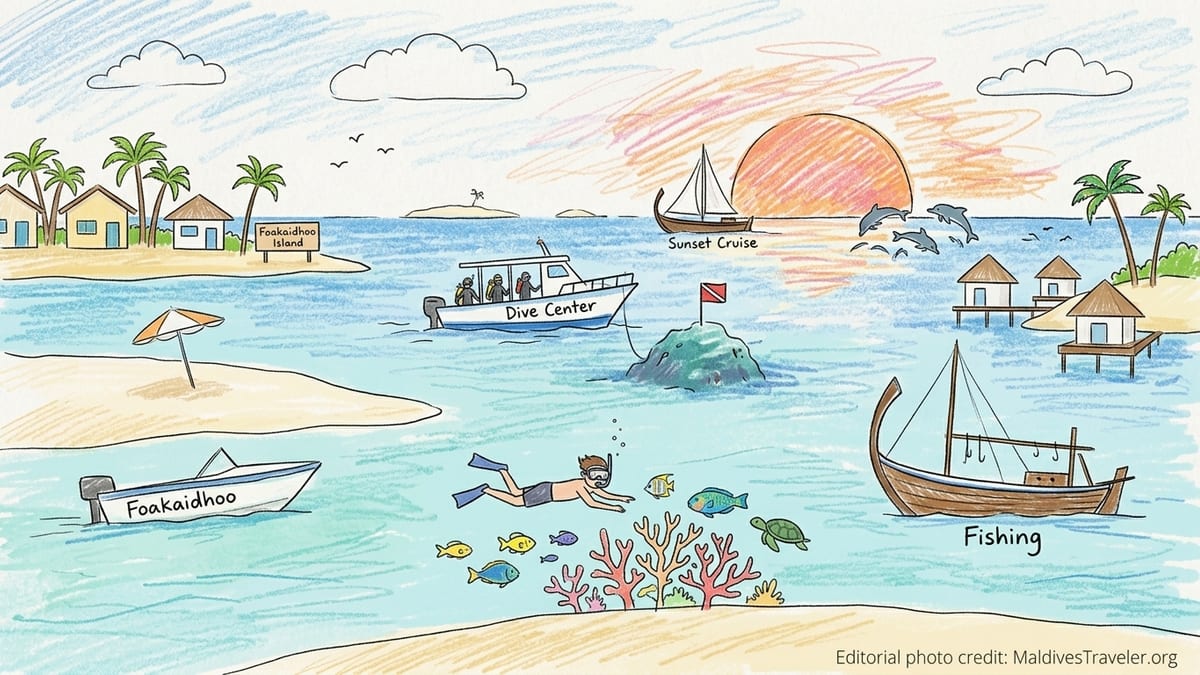
Shaviyani Atoll does not shout for attention the way some Maldivian hotspots do. It is quieter, a little harder to reach, and far less packaged. That is exactly why I chose it. Over two separate trips in 2024 and 2025, staying both at a high-end resort in the atoll and later on a local island guesthouse near Foakaidhoo, I tried the activities visitors most often ask about: snorkeling the house reef, joining boat dives, heading out on dolphin and sunset cruises, escaping to sandbanks, traditional fishing, paddleboarding, kayaking and visiting inhabited islands. What follows is not a list of what you might do in Shaviyani, but what I actually did, what it cost at the time, what I really saw and, most importantly, which experiences I would repeat without hesitation.
Snorkeling the House Reef
My first base in Shaviyani Atoll was a resort island with a clearly marked house reef drop-off about 30 to 60 metres from the beach, accessed from two wooden jetties. I booked the initial guided orientation snorkel through the resort dive and activity centre the evening before, simply by stopping at the desk after dinner and signing a waiver. The 90-minute guided session cost 65 to 80 US dollars per person in 2024, including snorkel, mask, fins and a short safety briefing in English. On my later stay at a local guesthouse, the house reef was a more informal affair: a shallow coral garden running along the lagoon edge, with free use of basic masks and fins and no extra guiding fee for a simple shore entry.
In terms of marine life, the resort house reef still showed some storm and heat damage, but there were healthy patches of branching and table coral, clouds of blue and yellow chromis, sergeant majors, damselfish and occasional parrotfish grinding loudly on the reef. I regularly saw small reef squid, hawkfish perched on coral heads, pufferfish, triggerfish and several types of wrasse. On one particularly calm morning in March, a school of around 30 batfish circled at the drop-off edge. Over six separate snorkel sessions I did not personally see manta rays or sharks on the house reef, even though the broader atoll is known to have both. One green turtle cruised past during an afternoon drift, but that was the only turtle sighting in my logged notes.
Equipment quality on the resort side was high: well-fitting silicone masks, open-heel fins with adjustable straps and optional shorty wetsuits for those who felt the water cool after an hour. The guides swam at a relaxed pace, regularly checking on weaker swimmers and carrying a bright orange surface buoy so the boat crew and lifeguards could track the group. At the local guesthouse, the gear was more basic. Some masks showed scratches and older straps, and fin sizes were limited. After my first swim I chose to use my own mask and snorkel but kept their fins. That said, the staff knew the currents well and advised me clearly about when not to go out, especially on days when the wind pushed waves straight onto the reef crest.
Would I repeat it? Absolutely, with some caveats. On the resort island I went back every single day, usually at first light or late afternoon when fish life felt more active and the sun was low enough to cut the glare. I would happily pay again for a first-day orientation, especially for less confident swimmers, but after that I preferred unguided swims. On the local island I would still snorkel the house reef again, but with realistic expectations: the coral is recovering rather than pristine, and the reward is more about quiet, slow time in the water than dramatic encounters. If you already own a good mask and snorkel, bring them; it meaningfully improves the experience.
Boat Diving in Shaviyani Atoll
I logged eight dives in Shaviyani Atoll across both trips, all arranged through resort and guesthouse-affiliated dive centres rather than an independent liveaboard. Booking was straightforward: I attended the resort’s daily dive briefing at 6 p.m., selected the next day’s two-tank boat, and had my certification checked and gear sized. Prices for certified divers in 2024 and early 2025 ran between 160 and 190 US dollars for a two-tank morning trip including tanks, weights, boat and guide, with rental BCD, regulator and wetsuit adding roughly 35 to 45 US dollars per day. At the local guesthouse, a smaller dive operation charged closer to 130 to 150 US dollars for a two-tank trip using a modest but well-kept dhoni.
Travel time to sites varied. Some channel dives and outer reefs were only 15 to 25 minutes from the resort jetty, while a few more remote thilas required 40 to 50 minutes of bumpy motoring in open water. My logbook notes visibility between 12 and 25 metres depending on tide and weather, with water temperatures around 28 to 29 degrees Celsius. Guides kept groups small, typically four divers per instructor or divemaster, and briefings covered currents, maximum depth, expected bottom time and the route relative to the reef profile sketched on a whiteboard. Safety felt taken seriously, with spare masks, oxygen kits and radios clearly visible on board.
The diving itself was mixed but memorable in places. On several outer reef dives I finned along steep walls decorated with soft corals, barrel sponges and sea whips, sharing the water with fusiliers, snappers, soldierfish, lionfish and the occasional Napoleon wrasse. Schools of blue-lined and yellow-back fusiliers flashed past in loose shoals. On one deeper section I watched a pair of eagle rays pass in the blue at a distance, too far for clear photography but unmistakable in shape. I did encounter a few white-tip reef sharks on a channel dive and one guitarfish resting on the sand at around 22 metres, but those were isolated sightings and not guaranteed. At several sites currents were mild and beginner-friendly, while one early-morning channel dive required solid control and quick descents.
Would I dive Shaviyani again? Yes, though I would frame it differently depending on the diver. For an experienced diver who has already visited more famous Maldivian atolls, Shaviyani feels quieter, less trafficked and in some cases more intact than heavily visited reefs, but it does not produce big animals on demand. My own best dives combined moderate current with clear visibility, resulting in busy cleaning stations for smaller fish and active reef life. I would happily repeat those sites, especially in March and November shoulder seasons, but only if I were already in the atoll. I would not cross the country purely for the diving alone when other atolls are better known for consistent pelagic encounters.
Dolphin Watching and Sunset Cruises
On my first stay I joined three different evening boat trips: two marketed as “Sunset Dolphin Cruise” and one as a simple “Sunset Cruise,” all booked through the resort’s activity desk. Signing up was as informal as adding my room number to a clipboard; payment went onto the final bill. Group sunset cruises on a shared dhoni cost about 80 to 110 US dollars per person for a two-hour outing, usually beginning between 5 and 5:30 p.m. depending on the time of year. A private speedboat trip, which I tried once with a friend, ran closer to 450 to 600 US dollars total for up to four people for two hours, including soft drinks, a fruit platter and a staff photographer.
Boat rides themselves were gentle, rarely more than 20 to 30 minutes from the island before slowing to scan for spinner dolphins. On two of the three trips we saw sizeable pods, perhaps 40 to 60 animals in scattered groups, riding the bow wave and occasionally spinning clear of the water in the golden light. On one cloudy evening we saw none at all, despite the crew zig-zagging across known travel routes. That empty outing underlined an important point: this is genuine wildlife watching, not a guaranteed show. When dolphins did appear, crews were respectful, keeping a modest distance, cutting engines intermittently and explaining in both English and Dhivehi why they would not chase the animals in tight circles.
Service on board tended to be relaxed and social. Guides poured soft drinks, pointed out distant islands and answered guests’ questions about life in Shaviyani and working seasons in tourism. Safety was basic but adequate: lifejackets stored under benches, a throw ring at the stern and a covered area for those wanting shade. Nobody tried to pressure guests into additional paid extras while on board, which I appreciated. On my local island trip, the guesthouse organised a smaller-scale sunset cruise in a wooden dhoni for about 45 to 60 US dollars per person with a minimum of four guests. There was no formal bar service, just bottled water and tea, but the slower pace and quiet made it my favourite of the four outings.
Would I do it again? Yes, especially from a local island, and with my expectations tuned. The best part for me was not actually seeing dolphins, though that was a highlight on two evenings, but watching the sky shift to deep oranges and reds with almost no other boats in sight. I would book only once or twice on a week-long stay rather than every night, accept that one trip might produce no wildlife at all, and choose the simplest option rather than the most expensive private charter unless I wanted privacy for a special occasion.
Sandbank Escapes and Reef Exploration from Foakaidhoo
My most memorable day in Shaviyani began on the jetty of a local island near Foakaidhoo, climbing into a small fibreglass speedboat just after 8:30 a.m. I had arranged the outing the previous afternoon at a modest office on the main street run by a locally owned excursion company that focuses on Foakaidhoo-area sandbanks, reef exploration and cultural trips. We agreed on a private six-hour trip visiting an offshore reef, a sandbank for lunch and a second shallow reef on the way back. The price we settled on for two people was 180 US dollars in total, including boat, fuel, snorkel gear, a simple barbecue lunch and drinking water, paid in cash on the day.
Our first stop, after about 25 minutes of fast but smooth travel across calm seas, was a patch reef rising from 18 metres to a shallow crest at around two metres. The guide, a Foakaidhoo local in his late twenties with excellent English, entered the water first to check current and visibility, then waved us in. The coral here felt more vibrant than many of the reefs close to resort islands. There were clusters of staghorn and table corals, sea cucumbers in the sand channels, curious butterflyfish pairs threading through the branches and a surprising number of small groupers. I remember a pair of clownfish guarding their anemone just below the wave-washed top, and a school of needlefish gliding near the surface in the sunlight.
By late morning we anchored at a sandbank that looked almost too archetypal to be real: a crescent of white sand barely above water level, with no vegetation, ringed by water shifting from pale milk-blue to deep cobalt as the depth dropped away. We were the only boat there for the first hour. While we snorkelled the shallow perimeter spotting juvenile reef fish, our guide and boat captain grilled marinated reef fish and prepared a simple spread of rice, salad and fresh fruit under a makeshift sunshade. There were no formal facilities, just a portable cooler and a trash bag which they took back to the island. The lack of infrastructure was part of the charm, though it does mean you need to bring reef-safe sunscreen, a hat and plenty of water.
Compared with resort-run sandbank picnics I have joined elsewhere in the Maldives at 200 to 300 US dollars per person, the Foakaidhoo trip felt both more affordable and more personal. The guiding style was quietly attentive: the crew pointed out shallow bommies worth snorkelling, warned us where currents tended to pull, and took a few casual photos on a phone when asked, but otherwise left us alone to explore and read under the sunshade. Would I repeat it? Without question. If I return to Shaviyani, I will prioritise at least one full day like this, ideally on a weekday when local families are less likely to be out for their own picnics.
Traditional Fishing Trips
Fishing in Shaviyani is not just an activity for visitors. On Foakaidhoo and neighbouring islands, it remains a core part of daily life, and that shows in how trips are run. I joined two very different excursions: a more polished “sunset handline fishing” trip arranged through the resort, and a far more local night outing from a guesthouse using a small open dhoni. Both were booked in person. The resort excursion was listed on a weekly activities schedule and priced at around 100 to 120 US dollars per person for a two-hour trip, including tackle and soft drinks. The local trip cost the equivalent of 35 to 45 US dollars per person, cash, with a minimum of four guests.
On the resort dhoni, we motored for about 30 minutes to a drop-off where the captain used sonar to locate baitfish schools. Each guest received a simple handline wrapped around a wooden block with a lead weight and two hooks baited with cut fish. The crew gave a quick demonstration: lower until the line slackens on the bottom, then reel up a metre and wait. Within minutes, someone hooked a small red snapper, and over the next hour several more came up along with a couple of groupers. The atmosphere was light, with crew helping unhook fish and offering to release undersized catches. At the end of the evening, the chef offered to grill our fish for dinner at no extra cooking charge.
The Foakaidhoo-based trip felt more raw and authentic. We left the island just before sunset in a working dhoni that still smelled faintly of diesel and old nets. The captain and his teenage nephew set us up with sturdier handlines and talked us through how they used to fish without electronic aids, reading the current and stars. Bait was prepared on board from smaller fish caught in a net earlier in the day. Over three hours we brought up several decent jobfish and emperors, and I watched as our hosts expertly bled and iced the keepers in a small cooler. Only one of the guests on my trip had never fished before, yet with patient guidance she landed the largest fish of the night to general cheers.
Would I repeat fishing in Shaviyani? Yes, especially the local version. I appreciated that both operations limited what was kept, returning smaller fish quickly and avoiding sensitive reef species where possible. For non-anglers, the experience is as much about being on the water, watching stars emerge and hearing stories about island life as it is about catching dinner. If you do not enjoy the idea of handling fish, the resort trip allows you to participate minimally while still soaking in the sunset views.
Kayaking and Paddleboarding the Lagoons
While the underwater world grabs most of the attention, some of my most relaxed hours in Shaviyani were spent not beneath the surface but skimming across it in a kayak or on a stand-up paddleboard. At the resort, non-motorised watersports such as single and double kayaks and basic SUP boards were complimentary for up to one hour per day, with additional hours charged around 20 to 30 US dollars. Booking was casual; I simply signed a waiver at the beach hut each morning, slipped on a buoyancy aid and carried the equipment to the waterline with the attendant’s help. On the local island, my guesthouse rented plastic sit-on-top kayaks for around 10 to 15 US dollars per hour, cash, from a small shack near the harbour.
Conditions varied with wind and tide. The most pleasant outings came between 7 and 9 a.m. when winds were gentle, the water glassy and the sun still low enough to make paddling comfortable. Pushing a kayak over clear sandbanks into deeper channels revealed stingrays resting on the bottom and occasional schools of tiny baitfish erupting at the surface. From a standing position on a paddleboard, I could trace the contours of coral heads beneath me without disturbing them. The resort had a clearly marked “no-go” zone over the most delicate coral patches, which staff explained during the briefing, and I was grateful for the guidance.
There is less formal guiding involved in these activities than in diving or snorkelling, but staff still played an important safety role. On one windier afternoon I watched an attendant firmly but gently advise a couple against taking a SUP too far beyond the sheltered side of the island, explaining how quickly offshore wind could carry them. At the local island, the owner of the kayak shack insisted we carry a phone in a dry bag and stay within sight of the harbour, which felt like a sensible boundary. I did not see anyone pushing stand-up paddleboard yoga classes or similar trends here; the tone was simple and practical.
Are kayaking and paddleboarding worth repeating in Shaviyani? For me, yes, as daily rituals rather than headline excursions. They offer a way to understand the shape of the lagoon and reefs that you later explore on snorkel or scuba. I would happily plan an hour of paddling most mornings on any future trip, factoring in hat, sunshirt and lots of drinking water. The costs are modest compared with boat-based activities, and the flexibility means you can abort quickly if weather shifts.
Visiting an Inhabited Island
My understanding of Shaviyani changed most on the days I stepped away from resort confines and spent time on inhabited islands. I joined one half-day organised “local island visit” through the resort and later arranged a full day on Foakaidhoo independently while staying at a guesthouse in the atoll. The resort excursion cost around 70 to 90 US dollars per person for a three-hour visit including boat transfers, a guide and a soft drink at a local café. The independently arranged day on Foakaidhoo, including return transport on a small speedboat and a hosted lunch at a local home, came to about 120 US dollars for two of us, paid directly to the local operator recommended by my guesthouse.
On the resort-organised trip, our group of eight arrived mid-morning at an island whose sandy streets were shaded by breadfruit and coconut palms. Our guide, a Shaviyani local working at the resort, walked us past the mosque, school and harbour, explaining how many residents commuted to resorts for seasonal work and how others fished or worked in small shops. We stopped at a family-owned souvenir stall selling handwoven mats and coconut-shell crafts. The conversation was friendly but a little formal, and although we appreciated the insight, I left wanting more time to sit and talk without watching the clock.
The independently arranged Foakaidhoo visit felt different. Our host met us at the jetty and brought us first to his family compound, where we shared sweet black tea and biscuits under a shaded veranda while neighbours dropped by to say hello. Later we walked the island slowly, with unscheduled stops at a boatyard where men were repairing a dhoni, at the local football field where children were practicing, and at the harbour where crates of fish were being unloaded. Lunch was a spread of simple Maldivian dishes cooked at home: grilled fish, roshi flatbreads, spicy tuna salad and banana blossom. We contributed by bringing fruit and sweets we had purchased beforehand in Malé, at our host’s suggestion.
These visits required more cultural awareness than resort life. Dress on inhabited islands is modest: shoulders and knees covered, and beachwear only on designated tourist beaches. Alcohol is not served. Friday schedules are different, with midday prayers and some shops closed. Being prepared for these realities made the experience much smoother. Would I repeat inhabited-island visits in Shaviyani? Definitely. If I were staying only on a resort I would still budget half a day for a local island trip. If based on an inhabited island already, I would use Foakaidhoo or similar communities as a starting point for deeper conversations about how tourism is changing the atoll and what visitors can contribute responsibly.
The Takeaway
Looking back over my time in Shaviyani Atoll, what stands out is not a single headline moment, but a pattern. The best experiences here were those that embraced the atoll’s quieter nature: house reef snorkels at dawn, sandbank days with nobody else in sight, low-key fishing trips with local crews and unhurried walks through inhabited islands where tourism is still woven gently into daily life. When I tried to force big-animal encounters or stack my schedule with high-priced boat tours, I enjoyed myself, but I could just as easily have been in a busier atoll.
If you come to Shaviyani expecting guaranteed manta rays, sharks or turtles on every outing, you risk disappointment. Those animals are present in the wider region, and you may well see them, but they were not reliable features of my own trips. What Shaviyani did give me, consistently, was space: space on boats, on beaches and in the water. I would repeat the house reef snorkeling, the Foakaidhoo sandbank days, the local-style fishing and the inhabited island visits in a heartbeat. I would also build in time for nothing at all beyond a kayak paddle at sunrise.
For travellers considering this atoll, the key is to choose a base that matches how you want to spend your days. Resort guests should ask in advance about house reef health, non-motorised watersports policies and access to local island visits. Those staying on inhabited islands like Foakaidhoo or nearby communities can work directly with local operators for reef trips, fishing and cultural experiences that keep more money in the community. In either case, treat Shaviyani less as a theme park and more as a quietly lived-in corner of the Maldives, and you are far more likely to leave wanting to return.
FAQ
Q1. Is Shaviyani Atoll a good choice for first-time visitors to the Maldives?
For a first Maldives trip, Shaviyani suits travellers who value quiet, natural settings and do not mind slightly longer transfers or fewer nightlife options. If you want busy beach bars and a long menu of daily excursions, other atolls may feel more convenient.
Q2. How did you actually book your activities in Shaviyani Atoll?
I booked resort-based activities like diving, sunset cruises and house reef orientation snorkels at the dive or activity desk the day before. On inhabited islands around Foakaidhoo I arranged sandbank trips, fishing and cultural visits directly with local operators or through my guesthouse, usually paying a deposit in cash.
Q3. What did you really pay for excursions such as sandbank trips and fishing?
On my trips between 2024 and 2025, half-day or six-hour private sandbank and reef excursions from near Foakaidhoo cost roughly 180 US dollars for two people including lunch, while resort sunset fishing ran around 100 to 120 US dollars per person and smaller local fishing trips cost closer to 35 to 45 US dollars per person.
Q4. Did you see manta rays, sharks or turtles on your Shaviyani snorkels and dives?
Across my logged dives and snorkels I saw a few white-tip reef sharks, one guitarfish, several eagle rays at a distance and a single green turtle on the house reef. These were welcome surprises rather than guaranteed sightings, so I would not plan a trip here solely around specific species.
Q5. How long were the typical boat rides for excursions in Shaviyani?
Most of my boat transfers to reefs, sandbanks and fishing spots took 20 to 40 minutes each way by speedboat or dhoni. The longest ride for more remote dive sites stretched to about 50 minutes, while shorter sunset cruises simply hugged nearby channels for two hours total.
Q6. What was the quality of guides and equipment like on your trips?
Resort-based guides were professionally trained, multilingual and careful with safety briefings, and their snorkel and dive gear was modern and well maintained. On local islands, equipment was more basic and sometimes older, but guides compensated with strong local knowledge of currents, reefs and weather.
Q7. Is it worth staying on a local island like Foakaidhoo instead of only at a resort?
For me, yes. Staying on or near Foakaidhoo gave access to more affordable reef trips, traditional fishing, sandbank lunches and genuine cultural time with local families. It felt less polished than a resort stay but added depth and context to my understanding of Shaviyani.
Q8. How should visitors dress and behave when visiting inhabited islands in Shaviyani?
On inhabited islands, shoulders and knees should be covered, especially away from designated tourist beaches, and beachwear is not appropriate in villages. Alcohol is not served, and Fridays follow a different rhythm around prayers. Walking slowly, asking before taking close-up photos and buying from small local businesses all help visits feel respectful.
Q9. When during the year would you personally choose to return to Shaviyani Atoll?
Based on my experiences, I would aim for shoulder months such as March or November, when seas were relatively calm, skies often clear and islands less busy than peak holiday weeks. Weather and visibility can still vary, but I found these periods good compromises between conditions and cost.
Q10. If you only had three days in Shaviyani, which activities would you repeat first?
With just three days, I would repeat a guided first snorkel then daily house reef swims, one full sandbank and reef day from near Foakaidhoo and either a sunset dolphin or fishing cruise, plus at least a few unstructured hours walking an inhabited island to understand how people actually live in the atoll.