


When most visitors to Lhaviyani Atoll talk about turtles, they mean a quick snorkel with a guide from a private resort. My day on Naifaru, visiting the locally run Atoll Marine Centre, felt very different. It was less about ticking off wildlife sightings and more about spending unhurried time with people who treat injured turtles, restore coral and quietly advocate for their island’s reef at a moment when land reclamation is reshaping the lagoon outside their door.
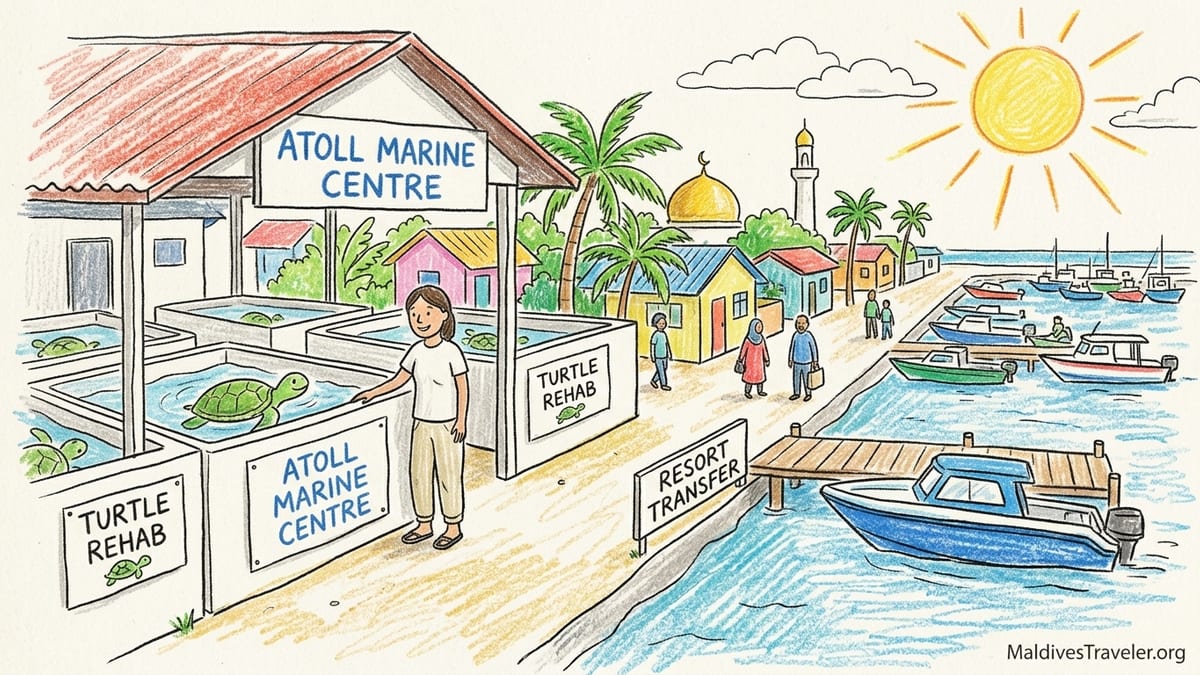
Arranging a Visit From a Resort in Lhaviyani Atoll
My visit began not with a brochure, but an email. I first heard about the Atoll Marine Centre (AMC) from a marine biologist at a well-known resort in Lhaviyani Atoll, who mentioned that “the turtle hospital on Naifaru” accepted pre-arranged visitors and volunteers. The centre is based on Naifaru, an inhabited island about 140 kilometres north of Malé. Rather than selling packaged “turtle encounters,” AMC asks visitors to get in touch directly or to come via a resort or guesthouse that already has a relationship with the project.
Two weeks before my trip, I contacted the centre via the address listed on its official information materials and explained that I would be staying at a resort in Lhaviyani. A staff member replied that they welcomed short educational visits provided we understood that it was a working rehabilitation facility, not an attraction. They asked for my preferred date, the number of people, and how I expected to reach Naifaru, then suggested a late-morning slot so we could sit down with staff after they had finished the morning turtle feeds and health checks.
My resort did not advertise excursions to Naifaru, so arranging transport was my responsibility. After a short conversation at the resort’s front office, the staff offered to help charter a local speedboat that already ran supply trips between the resort and Naifaru’s harbour. The cost was discussed clearly in advance in US dollars and Maldivian rufiyaa for a private return transfer, and AMC confirmed they did not take a commission. This separation between conservation work and transport felt important; the centre wanted us to arrive informed, not as anonymous passengers on a sightseeing circuit.
In the end, our plan was simple. We would leave the resort jetty mid-morning by speedboat, spend about three hours on Naifaru including two hours at the centre, and be back on the resort in time for a late lunch. It sounded, on paper, like an easy half-day out. I did not yet realize how stark the contrast would be between resort life and the tight-knit, coral-sand streets of a working Maldivian island.
Getting to Naifaru: From Lagoon Luxury to Working Harbour
The speedboat ride from the resort to Naifaru took just under thirty minutes across a glassy, pale-blue lagoon. On the resort, transfers are wrapped in cool towels and fruit skewers; on this crossing we shared the bench seats with crates of eggs, sacks of rice and a stack of cardboard boxes headed for Naifaru’s shops. The skipper, a Naifaru local, chatted with us in excellent English about ferry schedules and how he also runs shared transfers on other days for people coming in from Malé or nearby domestic airports.
Naifaru’s harbour could not be more different from a resort jetty. Instead of a reception pavilion, we arrived to the sound of motorbikes, the call to prayer floating from the mosque and the clatter of children heading home from school. The jetty was lined with fishing boats unloading tuna and reef fish into plastic tubs bound for the island’s market, and above the harbour wall we could see two- and three-storey buildings housing hardware stores, tailors and small offices. According to recent descriptions of Naifaru, more than a hundred shops and markets serve both the island’s residents and the wider atoll, and you feel that commerce the moment you step ashore.
Because Naifaru is an inhabited island in a Muslim country, modest dress matters. Before leaving the resort, we changed out of swimwear and resort kaftans into lightweight trousers and T-shirts that covered shoulders and knees. The team at AMC had gently reminded us of this in their emails, noting that Naifaru does not have a designated bikini beach and that volunteers and visitors alike are expected to swim and move around the island in conservative clothing. Walking from the harbour to the centre in the late-morning heat, I was grateful for long, loose cotton rather than heavy fabrics.
The walk itself took less than ten minutes along sandy streets edged with coral-stone boundary walls and pastel-painted houses. We passed a primary school, a football pitch and several small groceries with open-fronted shelves of rice, biscuits and cooking oil. It already felt a world away from the manicured resort paths, even though the lagoon lapping at Naifaru’s seawall belonged to the same atoll.
First Impressions of the Atoll Marine Centre
The Atoll Marine Centre is tucked a short stroll from what locals call Turtle Beach, in a low-key compound shaded by palms and salt-tolerant trees. There is no dramatic entrance sign, just a modest board with the centre’s name, hand-painted murals of turtles and reef fish on the surrounding walls, and a scattering of tanks and shade structures visible inside. When we arrived, a Maldivian coordinator and two international volunteers greeted us, asked us to sign in, and reiterated that the turtles were patients, not exhibits.
Before we saw any animals, we sat down at a simple outdoor table where one of the staff outlined what AMC actually does. The centre focuses on rescuing and rehabilitating injured sea turtles, especially juveniles and sub-adults caught in ghost gear or injured by boats. It also runs a coral restoration program and delivers marine education sessions for Naifaru’s schoolchildren and visiting youth groups. The staff explained that their work depends on local fishers calling when they find an entangled or floating turtle, and that they track each patient from arrival through to release where recovery is possible.
They were transparent about a major change since 2025. For years, AMC had operated a floating sea pen in the lagoon where recovered turtles could regain strength in a larger, more natural space before full release. In 2026, this floating rehabilitation pen was temporarily paused due to ongoing land reclamation around Naifaru. Dredging and infilling near the island altered currents and increased sediment in the water, making it unsuitable for a low-stress, semi-natural enclosure. For now, all patients are kept in onshore tanks under close observation until conditions improve or a new solution is approved.
This detail, mentioned almost in passing, drove home how quickly circumstances can change. Some older online mentions still talk about “AMC’s floating sea cage,” but standing in the compound looking at the tanks, it was clear that any responsible article or travel plan needed to reflect the current reality rather than a romanticised version of the past.
Meeting the Turtle Patients: Real Cases, Not Rescue Dramas
The heart of the visit was a slow circuit of the turtle tanks with one of the staff members, who introduced us to several patients by name and explained their histories. All of them were hawksbill or green turtles, species that still nest on some Maldivian islands and forage on the reefs around Lhaviyani Atoll. We were invited to stand back from the tank edges and avoid sudden movements, and touching the turtles was firmly off the table.
Many of the injuries we saw were linked to ghost gear: lost or discarded fishing nets and lines that continue to drift through the ocean. One juvenile hawksbill had arrived tangled so tightly that the fibrous strands had cut halfway through its front flipper. The staff talked us through how, on arrival, they had sedated the turtle with the support of a partner veterinarian, carefully removed the net, cleaned the wounds and started a regime of antibiotics and regular dressing changes. Over months, scar tissue had formed, and the turtle was now using the flipper again in the tank, though less powerfully than the uninjured side.
Another turtle showed the consequences of prolonged entanglement in a different way. Its shell was visibly misshapen where plastic ropes had cinched around the carapace as it grew, almost like a belt pulled tight around the midsection. The staff member explained that in such cases the challenge is not only healing the external injuries, but also assessing internal impacts. Compressed shells can alter lung space and affect buoyancy, making it harder for a turtle to dive or surface comfortably even after wounds have closed.
Buoyancy issues came up again and again. One sub-adult green turtle floated with the back half of its shell permanently higher in the water, unable to stay submerged without constant effort. The team described how this “bubble butt” profile can result from trapped air due to lung trauma after a boat strike or severe entanglement, or from gas build-up linked to infections. In the controlled environment of a tank they can manage feeding and monitor weight, but releasing such a turtle into the open ocean while it still struggled to dive could condemn it to starvation or increased risk of predation.
Not every story had a hopeful arc. Quietly, and without drama, the staff acknowledged that some turtles arrive too injured to survive, or do not respond to treatment despite months of work. Euthanasia, when used, is decided with veterinary partners and only when quality of life is judged to be irreversibly compromised. Hearing this, surrounded by the soft splash of flippers and the hum of filters, made the centre feel less like a feel-good attraction and more like the small, determined clinic it truly is.
Coral Restoration and the Impact of Land Reclamation
After the turtle tour, we walked with one of the team to a shaded area where coral fragments grew on metal frames and ropes. This was AMC’s coral restoration project, designed to give damaged reefs around Naifaru a chance to recover. The staff explained that they collect small fragments from healthy donor colonies or salvage broken pieces after storms, then attach them to frames placed back on the reef. Over time, the corals grow, fusing over the frame and creating three-dimensional habitat for fish and invertebrates.
In 2025, Naifaru’s lagoon became the site of a significant land reclamation project. Sediment from dredging and infilling has since clouded parts of the surrounding reef, including the area where some of AMC’s coral garden had been thriving. The team described diving after particularly intense dredging periods and finding fine particles settling over coral branches like dust on a bookshelf. If the smothering is heavy or prolonged, delicate coral polyps can suffocate and die, leaving behind bare, algae-covered skeletons.
The project’s response has been practical rather than confrontational. They have relocated some frames to slightly deeper, clearer patches and are experimenting with species that might better tolerate the new conditions. At the same time, they are documenting changes and sharing them with local authorities and school groups, using the coral garden as a living classroom to show how construction choices affect the reef that underpins Naifaru’s fisheries and tourism.
For a traveller used to resort marketing that celebrates “untouched lagoons,” it was sobering to see the other side of development. The same demand for land that supports growing populations and businesses on islands like Naifaru also strains the very ecosystems conservation groups are trying to heal. AMC sits squarely in the middle of that tension, treating individual turtles injured by human activity while watching the wider habitat around the island shift with each new barge and excavator.
Life on Naifaru: Streets, Shops and Everyday Island Rhythm
We spent about an hour after our time at the centre simply walking Naifaru’s streets before our boat back to the resort. The island is compact and densely populated, so everything feels close. Narrow sandy lanes radiate from the harbour, lined with breeze-block houses painted in soft blues, greens and yellows. Many homes have coral-stone boundary walls, remnants of older building styles, with bougainvillea or jasmine spilling over the top and children’s flip-flops lined up by the doors.
The main commercial street runs roughly parallel to the harbour and carries a surprising amount of activity for such a small island. There are hardware shops with stacked paint cans, phone shops advertising data packages, tailoring businesses displaying abayas and shirts, and several small groceries with crates of onions and coconuts on the pavement. Unlike resort boutiques, prices are marked in Maldivian rufiyaa, and most customers are locals doing their everyday shopping rather than tourists browsing for souvenirs.
We ducked into a simple café near the harbour for a late-morning snack: fish-filled pastries, black tea sweetened with condensed milk, and a plate of short eats known locally as hedhiikaa. Men in work overalls and young people in jeans and modest tops shared the small plastic tables. There was no alcohol on the menu, as is standard on inhabited islands, and the television in the corner alternated between a local news channel and a football match. It felt relaxed and neighbourly, a workday morning rather than a curated cultural show.
Dress, again, was a visible reminder that we were guests in a Muslim community. Women wore long dresses or abayas with headscarves; men favoured T-shirts and long shorts or trousers. As visitors we blended in reasonably well in our loose, covered clothing, and the smiles we received felt warm but not performative. It was your presence as a respectful outsider, not your wallet, that seemed to matter most in these brief interactions.
Donations, Fees and How Long to Stay at the Centre
Back at the Atoll Marine Centre, before we left, staff were open about how visiting fits into their financial picture. There was no fixed “entrance fee” in the sense of a ticket, but they requested a suggested donation for short visits, explaining that this helps cover food, filtration equipment and medical supplies for the turtles. The amount was modest compared with what resorts charge for a single snorkelling excursion, and payment was accepted in both Maldivian rufiyaa and major foreign currencies.
We spent just under two hours inside the centre itself: roughly thirty minutes in the introductory talk, an hour moving slowly between tanks and discussing individual cases, and a final twenty minutes asking questions about coral restoration, community education and volunteer opportunities. That felt like the minimum to gain more than a superficial impression. You could easily extend a visit if you have a deeper interest in marine biology or want to sit in on a school session, but even a carefully structured hour gives a meaningful glimpse into the work.
For travellers not staying in Lhaviyani resorts, another option is to base yourself in a Naifaru guesthouse and spend more time with the project, either as a day visitor or as a short-term volunteer through one of AMC’s partner programs. Staff stressed that any extended stay has to be arranged well in advance, with clear expectations about working hours, tasks, and modest dress both at the centre and around the island. A short holiday visit like ours is more limited in scope, but it still contributes financially and, perhaps more importantly, sends a signal to local decision-makers that visitors care about conservation work on inhabited islands too.
Before we left, the coordinator reminded us that conditions and policies can change from year to year. Land reclamation has already altered how they use the lagoon, and funding realities shape everything from how many tanks they can run to whether they can take in severe cases that require months of care. Their request was simple: anyone planning to visit should contact the centre close to their travel date and check the latest information, rather than rely on old blog posts or brochures.
Did the Experience Deepen the Resort Holiday?
On the speedboat back to the resort, our arms sprinkled with salt spray and the outlines of Naifaru shrinking behind us, it was hard not to compare the two worlds we had moved between in a single morning. At the resort, turtles appeared mostly as cheerful icons on dive-centre posters and as occasional silhouettes under paddleboards. On Naifaru, they felt like patients in a small rural clinic, each one a case study in how global problems like plastic pollution and unsustainable fishing nets touch down on a single reef.
The visit changed how the rest of the holiday felt. When we later joined a resort snorkelling trip and spotted a healthy hawksbill gliding over the coral, I found myself looking automatically for ghost gear and boat traffic, thinking about the compressed shells and buoyancy problems we had just seen. The lagoon views from our villa were still beautiful, but they no longer looked effortless. I now knew there were people up the atoll manually cleaning wounds on a turtle that had drifted in from someone else’s discarded net.
It also shifted my understanding of the Maldives beyond the resort bubble. Spending even a few hours walking Naifaru’s streets, buying tea in a local café and watching schoolchildren in uniforms dart past the harbour, highlighted the social fabric that exists behind the marketing images of overwater villas. It underscored that conservation work does not happen in isolation on a private island, but in the middle of real communities where decisions about fishing, waste and construction are made every day.
If your goal in visiting the Maldives is pure seclusion with minimal thought to what lies beyond the resort, a trip to Naifaru and AMC may feel confronting. If, however, you are curious about how this country actually lives with its reefs and how local people are working to protect them under imperfect conditions, the experience adds a layer of depth to a holiday that no amount of sunset cocktails can match.
How to Support the Centre Without Turning Wildlife Into Entertainment
One of the most valuable parts of our visit was the clear guidance on how guests can support the Atoll Marine Centre without treating recovering turtles as props. The staff encouraged financial donations, of course, but they paired that with behavioural requests. Visitors should limit noise, avoid flash photography and skip any insistence on “hands-on” interactions. The goal is to minimise stress for animals that are already compromised, not to engineer close encounters for social media.
They also suggested practical ways to help from outside the tanks. Resort guests can ask their accommodation teams about partnerships with conservation projects in the atoll and encourage more structured support. Divers and snorkellers can report injured or entangled turtles to AMC through their resort biologists or directly if contact details are available, providing photos and precise locations to assist rescues. Back home, travellers can share balanced stories about their visits, highlighting the realities of ghost gear injuries and habitat loss rather than just posting cute turtle photos.
Perhaps the most important contribution is respect. On Naifaru this means dressing modestly in village streets, asking before photographing people, and remembering that you are walking through someone’s neighbourhood, not a theme park. Supporting small island shops and cafés, even if only for a drink or snack, spreads the economic benefit of your visit more widely than a single donation envelope.
Finally, it helps to retain some humility about what a brief visit can and cannot do. A few hours at the Atoll Marine Centre will not solve the systemic issues that send injured turtles into their tanks, from regional fishing practices to global waste. It can, however, connect you to the people quietly working on those problems day after day and remind you that the Maldives is not just a string of luxury resorts, but a nation of islands whose future is tied to the health of the sea.
The Takeaway
Visiting the Atoll Marine Centre on Naifaru is not a standard excursion. There are no glossy brochures, no curated photo platforms and no guarantee of uplifting endings for the turtles you see. What you do find is a small, committed team working at the junction of conservation and community life, improvising around shifting realities like land reclamation and relying on a mix of local partnerships and visitor support to keep going.
For me, the few hours spent there were among the most meaningful of a Lhaviyani resort stay. They reframed the lagoon as a living, vulnerable system, not just a backdrop, and introduced Naifaru as a place in its own right rather than a dot on a transfer map. In a destination often sold as an escape from reality, the visit felt like the exact opposite: a gentle but clear encounter with the realities that underpin that escape.
If you decide to go, arrange your visit directly with the centre or through a resort or guesthouse that respects its conservation priorities. Confirm up-to-date details about visiting times, current projects and the status of facilities such as the floating rehabilitation area, which in 2026 remains paused because of nearby reclamation. Plan to dress modestly, move quietly and give as much as you take in conversation and attention.
Most of all, approach the turtles not as photo opportunities but as ambassadors for a wider story. Their scarred shells and uneven buoyancy trace the impacts of choices made far beyond Naifaru’s harbour. Listening to that story, even for an afternoon, is one of the most powerful gifts the Maldives can offer a traveller willing to step off the postcard and into the sand-dusted streets of a living island.
FAQ
Q1. Do I need to book my visit to the Atoll Marine Centre in advance?
Yes. The centre is a working rehabilitation facility with limited staff, so visits need to be arranged directly with them or via a resort or guesthouse that already collaborates with the project. Contact them shortly before your trip to confirm current visiting hours and what is possible during your stay.
Q2. How do I get to Naifaru from a resort in Lhaviyani Atoll?
Most visitors arrive by speedboat arranged through their resort or a local operator, using existing supply or transfer routes between Naifaru and nearby islands. Travel times within the atoll are usually under an hour, but schedules and prices vary, so discuss options with your resort or guesthouse in advance.
Q3. Can I visit the Atoll Marine Centre if I am staying on a local island instead of a resort?
Yes. Travellers based in Naifaru guesthouses or on neighbouring local islands can often visit more easily and may even join longer-term volunteer placements through partner organisations. You will still need to coordinate with the centre ahead of time to align your visit with their daily care routines.
Q4. Is there an entrance fee to see the turtles?
The centre generally suggests a donation for short educational visits rather than a fixed ticket price. The recommended amount is explained when you arrange your visit and goes directly toward food, filtration systems and medical care for the turtles and other conservation activities.
Q5. Can I touch or feed the turtles during my visit?
No. The turtles at the Atoll Marine Centre are patients under rehabilitation, so visitors are asked not to touch, feed or pose closely with them. Observing quietly from a respectful distance helps minimise stress and keeps the focus on welfare rather than entertainment.
Q6. What should I wear when visiting Naifaru and the centre?
Naifaru is an inhabited Muslim island with a conservative dress code in public areas. Both men and women should cover shoulders and at least to the knees in streets, shops and at the centre. Light, loose clothing is comfortable in the heat and shows respect for local norms.
Q7. Is the floating turtle rehabilitation pen still in use?
As of 2026, the centre’s floating rehabilitation area has been temporarily paused because of ongoing land reclamation around Naifaru, which has affected lagoon conditions. Turtles are currently cared for in onshore tanks until a safe, suitable alternative for larger pens is available.
Q8. How long should I plan to spend at the Atoll Marine Centre?
A focused educational visit typically lasts around one and a half to two hours, including an introduction, time at the turtle tanks and questions with staff. If you are deeply interested in marine conservation or staying locally, you might arrange longer or multiple visits by agreement with the team.
Q9. Can children visit the centre?
Yes, children are generally welcome if they are supervised and able to follow instructions about quiet behaviour and not touching the animals. The team often works with local schools, and a visit can be very educational, but parents should prepare children in advance for a hospital-like environment where some turtles have visible injuries.
Q10. Besides donating, how else can visitors support the centre and its work?
Visitors can support the Atoll Marine Centre by following its guidelines, sharing accurate information about issues like ghost gear and habitat loss, encouraging their resorts to collaborate with local conservation projects and reporting injured turtles they encounter through appropriate channels. Choosing reef-safe habits while snorkelling and diving and reducing plastic use at home also addresses some of the wider pressures that send turtles into rehabilitation in the first place.