


Nala Maldives by Jawakara has quietly become one of the most intriguing new openings in the Maldives. Reborn from the old Innahura resort and relaunched as a five-star property on 1 December 2025, it sits in Lhaviyani Atoll with just 80 villas and a firm age policy: guests must be 12 or older. A three-minute speedboat hop connects it to the larger, family-friendly Jawakara Islands across the lagoon, and marketing promises the best of both worlds: a calm, compact, adults-leaning island with shared access to extra restaurants, courts and kid-filled energy elsewhere. I went to see if that concept genuinely works in practice, and whether Nala earns a place alongside established Lhaviyani favorites like Komandoo and Hurawalhi.
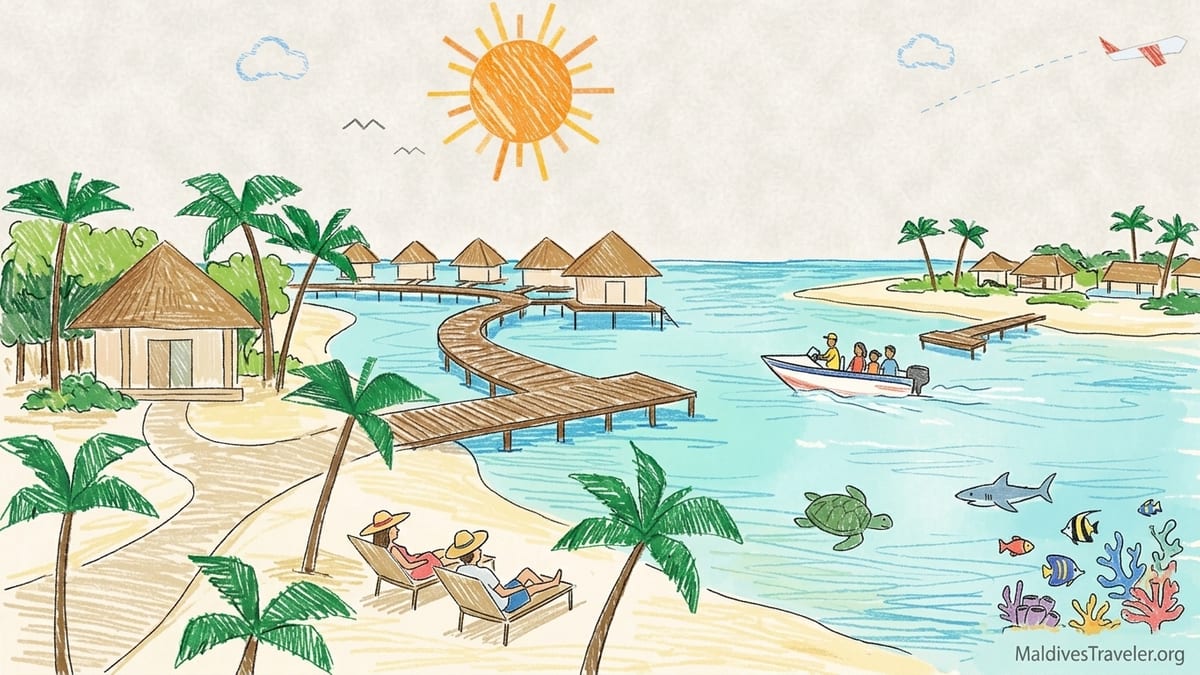
Setting the Scene: What Nala Maldives by Jawakara Actually Is
Nala Maldives by Jawakara occupies a ten-hectare island in Lhaviyani Atoll, about a 35-minute seaplane flight north of Malé. Operated by Crown & Champa Resorts, it is a full upgrade of the former Innahura property, not a brand-new island carved from scratch. Official material released in early 2026 confirms 80 one-bedroom villas and an adults-only designation for guests aged 12 and over, which puts it in an unusual middle ground between fully adults-only and classic family resorts.
On arrival, that hybrid identity is immediately visible. The jetty and welcome area feel contemporary and low-key rather than ultra-luxury, with light woods, sandy paths and palm shade that recall Crown & Champa’s other four and five star islands. The check-in team highlight two points before handing over the room key: first, the 12-plus rule and the expectation of a quiet environment, and second, the shared facilities with Jawakara Islands across the lagoon. The message is clear: you are not marooned on a tiny island with a single restaurant, but you also will not have children splashing in front of your villa at Nala.
During my stay, the resort was running an introductory rate that priced it distinctly below marquee Lhaviyani adults-only names. For example, third-party agents and packages for October and November 2026 showed four-night all inclusive deals including seaplane transfers and taxes from a little over 3,500 US dollars for two adults, whereas similar length stays at Hurawalhi or Komandoo for the same months typically came in several hundred to well over a thousand dollars higher for comparable board. That price gap is a crucial part of Nala’s value proposition, especially for travelers who want a newer product without going into top-tier spend.
The island itself feels compact and easily walkable. It takes roughly ten to fifteen minutes to stroll the circumference on sand paths, passing long sweeps of beach broken by jetties and a central hub where the pool, bar and main restaurant cluster together. Nala does not have the drama of some Maldivian islands with steep drop-offs or huge sandbanks, but its lagoon is pretty in soft turquoise tones, and on calm mornings the water can feel like glass, especially on the sunrise side where the overwater villas fan out.
Villas and Design: Fresh but Not a Trophy-Architect Island
Nala’s 80 villas are spread across beach and overwater categories, with a mix of sunrise and sunset orientations. The layout is standard Maldivian resort logic: beach villas tucked just behind the tree line with sandy backyard access to the lagoon, and a long jetty of water villas curving over the eastern side of the island. From the outside, the architecture is contemporary but unfussy, leaning more toward clean lines and pale woods than toward the sculptural “wow” factor that ultra-luxury resorts increasingly chase.
Inside, the design feels genuinely fresh compared with the older Innahura footprint. My beach villa had a high white ceiling, blond timber floors, woven rattan accents and a palette of soft mint and sand tones. A large sliding door opened to a shaded patio with loungers and a few steps down to the beach. The open-air bathroom kept the familiar Maldivian formula of an outdoor shower bordered by greenery, but the fixtures, tiles and lighting all looked newly installed rather than lightly refreshed. Storage was generous, with a proper wardrobe and shelving area large enough for two big suitcases, which matters if you are here for a week.
Technology and practical touches have been kept simple. There was good Wi-Fi coverage throughout the villa, USB charging on each side of the bed, and a quietly effective air conditioning system that never felt gusty. You do not get a tablet that controls every light or an elaborate sound system, but you also do not spend half your first night trying to turn off a hidden strip of led lighting. For many couples that is a positive, especially when the main draw is being outside on the deck or in the lagoon rather than inside watching films.
The overwater villas, which I toured but did not sleep in, add a little more romance at a premium. These sit on sturdy timber pylons above a shallow lagoon, and each has a private deck with steps into the water. They do not include private pools at entry-level, and the interiors largely mirror the beach villas with minor variations in layout. That means Nala cannot compete with the plunge-pool-over-the-ocean imagery that defines some Lhaviyani competitors, but it also explains why introductory pricing has been relatively restrained. If your priority is a modern, comfortable space that you can move between beach and reef quickly, Nala delivers, just without the “Instagram trophy villa” effect.
The 12+ Policy in Real Life: Quiet Island or Teen Hangout?
The question every adult traveler has about Nala is whether a 12-plus age limit feels meaningfully different from an 18-plus or 21-plus policy. Over the course of a five-night stay, the answer was nuanced. At no point did the island feel like a family resort. There was no kids club, no toddlers, no inflatable toys taking over the pool, and no early-evening high-chair congestion around the buffet. Most guests were couples in their late twenties to fifties, along with a handful of friend groups and a few multigenerational families traveling with older teens or university-age children.
Those teenagers were noticeable at times, particularly around the main pool in the mid-afternoon and on certain evenings when the resort arranged casual games or live music. A group of three teens spent one particularly hot afternoon playing loud water volleyball and ordering mocktails in a way that nudged the sound level higher than you would expect at a pure couples-only island. Yet even in those moments, the overall tone remained far closer to adult-focused than family-oriented. There were no screaming meltdowns, and quiet zones on the beach were easy to find by walking a short distance away from the main hub.
At night, the twelve-plus policy arguably worked in Nala’s favor. Dinner service never felt chaotic, and later-evening drinks at the bar leaned toward gentle conversation and acoustic sets rather than children running between tables. I spoke to one couple on their honeymoon who had considered Hurawalhi but picked Nala in part because they were traveling with a 17-year-old niece and wanted her included; they described the island as “adult in mood, without being stuffy.” On the other hand, one pair of repeat Maldives visitors told me they would still choose a strict 18-plus island next time because the threshold for occasional teenage noise is simply lower when every guest is an adult.
If you are highly sensitive to any presence of teenagers, Nala will not feel as cocooned as somewhere like Komandoo, which restricts guests to 18 and over. However, if you mainly want to avoid younger children and the infrastructure that comes with them, Nala strikes a middle path that may suit couples traveling with older teens or small groups of friends who prefer a calmer base but do not require absolute adults-only rules.
Boat Hops to Jawakara: Added Freedom or Daily Friction?
Nala’s defining twist is its connection to the larger Jawakara Islands resort across the lagoon. A small speedboat runs between the two jetties in around three minutes, and during my stay the schedule resembled a regular shuttle throughout the day, with the last return to Nala late in the evening. The transfer is complimentary for in-house guests. On paper, this opens up several extra restaurants, sports courts and family-focused facilities without diluting Nala’s quieter ambiance.
In practice, the boat connection was both a perk and, occasionally, a minor irritation. The positives show up quickly. On the second day, for example, I took the mid-morning shuttle, walked five minutes from the Jawakara jetty to its water sports center, and joined a group jet ski tour that Nala itself did not yet offer on its own activity schedule. Another evening, I booked dinner at one of Jawakara’s specialty restaurants and appreciated having a different menu and atmosphere after two nights at Nala’s main buffet plus one at its own specialty venue. The ability to change scenery, even for an hour or two, helped fend off small-island cabin fever.
However, the routine of timing your evening around a boat schedule is something you notice. If you are used to wander-from-villa-to-restaurant islands, having to wait ten or fifteen minutes for the next shuttle, or to keep an eye on the last departure back to Nala, feels like a small but real trade-off. On one windy afternoon, a squall rolled through just after sunset and the crossing became choppy enough that a few guests opted to skip their Jawakara dinner bookings and stay on Nala instead. The crew handled the conditions professionally, and at no point did it feel unsafe, but anyone prone to seasickness might tire of even short boat rides after a few days.
The boat link also subtly shapes the day rhythm. Because many of Jawakara’s family activities are concentrated in the late morning and afternoon, that is when you most frequently share the shuttle with excited children or groups heading for sports courts. Returning to Nala after those trips underlines the contrast: you step off the boat into quiet pathways and a bar where the soundtrack is more ambient beats than buzzing kids. Whether you perceive the connection as added freedom or daily friction will depend on how much you value variety over instant convenience.
Food, Drinks and Shared Facilities: Does the Sister Resort Really Expand Options?
On Nala itself, the food offering revolves around a main buffet restaurant and at least one à la carte option. During my stay, breakfast and most dinners were at the buffet, which rotated nightly themes such as Maldivian and Sri Lankan, Mediterranean, and Asian fusion. Quality was firmly in the “good four to five star” bracket: plenty of fresh salads, grilled fish, curries and a live pasta station, along with the usual pastry and dessert spread. Lunch could be taken either at the buffet or as lighter bar snacks by the pool, which was a pleasant way to avoid going fully indoors during the brightest hours.
The à la carte restaurant at Nala aimed for a more intimate atmosphere with a smaller menu featuring fresh seafood, steaks and some vegetarian dishes. On one evening I ordered tuna carpaccio followed by grilled reef fish with coconut lime sauce; both were well executed, with the kind of plating you would expect at a resort in this price band. That said, Nala is not trying to compete with destination-restaurant heavyweights that anchor some Maldivian islands. You do not come here for a once-in-a-lifetime underwater dinner or a Michelin-linked tasting menu. You come for solid, varied, competently cooked resort food.
Access to Jawakara broadens this picture. Counting both islands, you can reach multiple additional venues, including family-friendly buffets and specialty spots that skew more casual, such as beach grills and pizzerias. For couples, the most appealing options are often those that feel least like a family canteen: think open-air dinners with a view of the lagoon or quieter bars set slightly back from the main pool. On one night, I took the early-evening shuttle to Jawakara, had sundowners at its overwater bar while families migrated to dinner, and then caught a later boat back to Nala for a peaceful walk along the beach.
Sports and activities are where the shared facilities really become tangible. Nala itself has a compact gym, spa, and a modest schedule of yoga and fitness sessions, but if you want tennis courts, padel, futsal or a small golf setup, you need to take the boat to Jawakara. This arrangement makes sense from an operational perspective, consolidating high-maintenance infrastructure on the larger island, but it again means planning your day slightly more than you would on a stand-alone resort. For active couples who enjoy structured sports as much as snorkeling or lounging, the trade-off is often worth it, especially on longer stays where variety matters more.
Reef, Lagoon and Activities: How Nala Compares in the Water
Lhaviyani Atoll is known among repeat visitors for strong snorkeling and diving, and this is one area where Nala benefits from its geography but also reveals the limits of its inherited layout. The house reef is not directly off every stretch of beach. Instead, there are specific entry points where the lagoon shallows drop toward coral, and from there you can drift along sections with healthy hard coral, sea fans and a respectable mix of fish. Early-morning sessions brought sightings of turtles, reef sharks and larger schools of fusiliers, though big pelagic encounters are reserved for boat excursions.
Compared with Hurawalhi, which has built a reputation in part around its house reef quality, Nala’s drop-off feels a little less dramatic and less continuous, but still rewarding for intermediate snorkelers. Komandoo, another adults-only neighbor in Lhaviyani, offers easy access to a ring of coral around much of the island; Nala’s pattern of access points means you sometimes need to walk a few minutes along the beach to find the best entry. Once in the water, however, the experience is still recognisably Lhaviyani, with good visibility on calm days and enough life to keep keen snorkelers occupied for multiple days.
Dive operations at Nala tap into the atoll’s broader network of sites. During my stay, the dive center offered morning and afternoon boat dives to several known spots in the vicinity, some shared with other resorts’ boats. Highlights included channels where grey reef sharks and eagle rays can be seen, as well as coral gardens that are accessible to newer divers. The staff were professional, safety briefings were clear, and rental gear was in good condition. Prices for two-tank boat dives sat in line with other mid-range Maldivian operations, hovering around what you would expect across the country in 2026 for four and five star properties.
Back in the lagoon, non-motorized water sports such as kayaks and stand-up paddleboards were included in many board packages or available at modest extra cost, which made it easy to explore the sandbanks and shallows around the island. Motorized options, from jet skis to parasailing, tended to launch from Jawakara’s side to keep noise away from Nala’s quieter shorelines, another subtle advantage of the two-island arrangement. For travelers who prioritise a peaceful island core but do not want to forgo higher-energy activities entirely, this division works well.
Service, Atmosphere and Price: Stacking Nala Against Lhaviyani’s Adults-Focused Icons
Service at Nala reflects both its newness and its operator’s experience. Many staff have moved over from Crown & Champa’s existing portfolio, so the underlying training is sound, but there are still occasional teething moments where systems feel slightly in flux. During my visit, for instance, restaurant reservations between Nala and Jawakara were sometimes miscommunicated, leading to a short wait on one evening when the specialty venue across the lagoon had not received the updated guest list. The team resolved the issue quickly and offered a complimentary dessert course as an apology, yet it was a reminder that a resort in its first full year of operations is still smoothing edges.
Day to day, staff interactions were warm and informal rather than hyper-formal. Room attendants quickly learned my preferred cleaning times, bar staff remembered drink orders after a couple of days, and the front office were proactive about checking weather and seaplane schedules for onward connections. English was widely spoken, and a mix of Maldivian and international team members gave the resort a friendly, unpretentious feel that many guests will appreciate, particularly those slightly intimidated by ultra-luxury properties.
Atmosphere is where comparisons with Komandoo and Hurawalhi become unavoidable. Hurawalhi leans into its reputation as a five star adults-only showpiece, anchored by its famous underwater restaurant and a high staff-to-guest ratio, and that is reflected in rates that often climb well above Nala’s level. Komandoo, meanwhile, has long been a favourite among couples who value its small size, strong house reef and very consistent operations rather than headline-grabbing design. In current 2026 pricing, public rate snapshots suggest entry-level nights at Komandoo often land several hundred US dollars above Nala for similar seasons, especially once seaplane transfers and board are factored in.
Nala, in this context, plays the role of a younger sibling with a lower price of entry and slightly more flexible age policy. You sacrifice some of the absolute tranquility that comes with a stricter 18-plus rule, and you do not get marquee features like an underwater restaurant or private pools on every overwater villa. In return, you gain a fresh physical product, access to Jawakara’s additional facilities, and a softer impact on the budget, particularly in its introductory years. For many travelers, especially those on a first or second Maldives trip, that trade-off will feel very reasonable.
The Takeaway: Who Should Book Nala Now and Who Should Look Elsewhere
After several days testing Nala’s mix of adults-leaning calm and shared family facilities, the verdict comes down to expectations. This is not an ultra-luxury hideaway where you disappear into a private pool villa and rarely see other guests. It is a modern, thoughtfully updated five star resort whose 12-plus rule keeps the mood relatively grown-up, while its connection to Jawakara adds flexibility for dining and activities that many small islands cannot match.
You should consider booking Nala if you are a couple or small group that values a quiet base but likes the idea of optional energy nearby. For example, a pair celebrating an anniversary with a 15 or 17-year-old in tow will find Nala almost uniquely well suited. The teen can enjoy sports and livelier scenes at Jawakara during the day, while the adults retreat to a calmer bar and beach at Nala in the evening. First-time Maldives visitors who want good snorkeling, comfortable villas and fair pricing without the pressure of “once-in-a-lifetime” perfection will also find Nala a strong fit, especially while introductory offers remain competitive through 2026.
On the other hand, if your absolute priority is a consistently adults-only feel in every corner of the island, with no teenagers at the pool and no need to consult a boat timetable to reach extra restaurants or sports courts, then more established options remain stronger bets. Couples planning honeymoons or landmark anniversaries and willing to pay a premium for maximum seclusion and a more polished house reef experience may prefer Hurawalhi, while those who like a smaller island with a long track record and very stable operations might choose Komandoo.
Ultimately, Nala Maldives by Jawakara is worth considering if you are comfortable with its hybrid character. It is neither an all-out family playground nor a hushed, couples-only bubble. Instead, it is a smart, modern island where older teens are present but not dominant, where a three-minute boat ride opens up more choice rather than undermining the sense of escape, and where value for money, at least in these early years, comes out strongly in its favour. Go in with that understanding, and you are likely to leave with the sense that you found one of the more interesting new addresses in Lhaviyani Atoll.
FAQ
Q1. Is Nala Maldives by Jawakara truly adults-only if the age limit is 12 and above?
Guests at Nala must be at least 12 years old, which means there are no young children, toddlers or kids-club infrastructure on the island, but older teenagers are present, especially during school holidays.
Q2. How often does the boat run between Nala and Jawakara, and is it free?
A short speedboat shuttle connects the two islands in around three minutes, running regularly throughout the day and evening. During my stay it was complimentary for guests, though exact schedules may vary slightly by season.
Q3. Does taking a boat to Jawakara become annoying over a week-long stay?
It adds a small layer of planning, since you need to time activities and dinners around shuttle departures, but most guests I spoke to found the extra choice worthwhile, especially on stays of five nights or more.
Q4. How does Nala’s snorkeling compare with nearby adults-only resorts in Lhaviyani?
Nala offers good access to Lhaviyani’s marine life through designated reef entry points and dive trips, though the house reef feels a little less dramatic and continuous than at some long-standing adults-only islands such as Hurawalhi.
Q5. Are Nala’s villas new builds or refurbished units from the previous resort?
The island was extensively upgraded from its former Innahura incarnation, with villas reworked and refitted; the interiors feel fresh and contemporary, though the overall layout still reflects the original resort footprint.
Q6. Can I use all of Jawakara’s restaurants and sports facilities when staying at Nala?
As a Nala guest you can book and pay for meals at Jawakara’s restaurants and use shared sports and activity facilities such as tennis, padel or futsal, though some options carry supplements depending on your meal plan.
Q7. Is Nala good value compared with Komandoo or Hurawalhi in 2026?
Introductory packages and public rates in 2026 generally price Nala below both Komandoo and Hurawalhi for similar dates and board, which makes it attractive for travelers seeking a newer property at a more moderate spend.
Q8. What kind of traveler is likely to enjoy Nala the most?
Nala suits couples, small groups and families with older teens who want a calm, modern island with solid snorkeling, fair pricing and the option of more activity and dining choice across the lagoon rather than a single self-contained bubble.
Q9. Is Nala a good choice for a honeymoon or milestone anniversary?
It can be, particularly if you value a relaxed atmosphere over high-gloss luxury, but couples seeking the most romantic, strictly adults-only experience might still prefer a more established 18-plus resort in Lhaviyani.
Q10. When is the best time of year to visit Nala Maldives by Jawakara?
The drier months from roughly December to April usually bring calmer seas and more sunshine, which suit seaplane transfers and snorkeling, though pricing tends to be higher than during the wetter, more changeable off-season.