


I finally booked the underwater dinner that has been following me around Instagram for years: 5.8 Undersea Restaurant at Hurawalhi Maldives in Lhaviyani Atoll. Marketed as the world’s largest all-glass undersea restaurant and set 5.8 metres below the surface, it is one of the Maldives’ most recognisable attractions and a powerful reason people choose this atoll in the first place. I went in determined to treat it like any other serious restaurant, not just a backdrop for photos, and to come away with a clear answer to a simple question: was it actually worth the money?
How I Booked 5.8 Undersea Restaurant (And What I Paid)
I booked the evening dinner sitting at 5.8 Undersea Restaurant while staying at Hurawalhi Maldives in early October 2026. Hurawalhi runs two lunch seatings and one dinner sitting at 5.8, with a fixed tasting menu at each. Official festive brochures and current resort material put published prices at 250 US dollars per person for the five-course lunch and 315 US dollars per person for the seven-course dinner, before drinks but including basic water and service. I opted for dinner at 315 US dollars per person and added the optional wine pairing at 130 US dollars per person, which brought my total to 445 US dollars before the usual Maldivian taxes and service charges. That final bill for one adult came to a little over 520 US dollars once everything was added.
I booked six weeks in advance, directly through Hurawalhi’s reservations team, after noticing that several October dinners were already waitlisted. The resort treats 5.8 as a signature experience and seats only around 10 couples at a time inside the glass tunnel, so slots really do disappear. When I checked with staff on arrival, they mentioned that in high months such as December and January, dinner often fills two or three months ahead, especially for couples celebrating honeymoons or anniversaries.
Seats are pre-assigned before you arrive downstairs, but I requested a mid-room table during booking rather than the very front or very back. There are no true "bad" tables because the glass curves overhead so steeply that marine life passes above and along both sides, yet a central table gave me a panoramic view down the length of the reef. I confirmed my booking again at check-in, which is worth doing if you are only at Hurawalhi for a short stay.
From the resort’s perspective, 5.8 is priced in line with other headline underwater restaurants in the Maldives, where multi-course dinners frequently run between roughly 400 and 600 US dollars per person once taxes and wine are factored in. It is undeniably a splurge, even by Maldivian standards, and for most travellers it will be the single most expensive meal of their trip.
Arriving 5.8 Metres Below The Lagoon
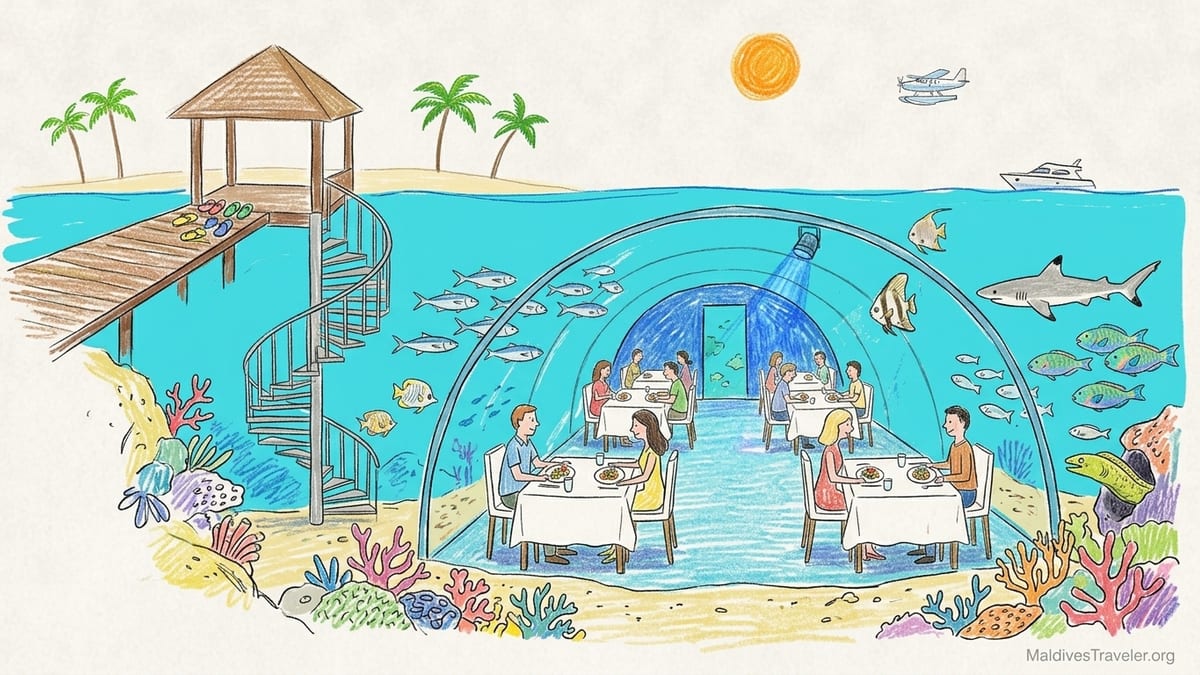
The evening began just before sunset at a small pavilion on Hurawalhi’s jetty, a short buggy ride from my villa. Shoes are left at the entrance, and from there a spiral-style wooden staircase of around 40 steps leads down to the restaurant level. Staff pause guests halfway down for a short safety and construction briefing, which doubles as a way to stagger arrivals so that everyone enters the glass tunnel in a calm, unhurried flow.
The room itself is compact: a glass arch resting on the sandy seabed at 5.8 metres below sea level, with a narrow central aisle and two rows of white-clothed tables facing outward toward the reef. The ceiling and side walls are all transparent, so there is no single "view wall". Instead, fish appear above, beside and almost below you. It feels more like sitting inside a clear capsule than looking through a single aquarium window.
At the dinner seating I attended, the restaurant hosted 9 occupied tables, mostly couples and one honeymooning pair celebrating with a private photographer who joined for the first course before leaving. With so few covers, ambient noise stayed low. The soundtrack was mostly the soft clink of cutlery and the faint hum of the air-conditioning. Service began with a glass of still or sparkling water and a detailed explanation of the seven-course tasting sequence, plus the optional wine pairing I had pre-booked.
From descending the staircase to finishing the petits fours, my meal lasted just under two and a half hours. There was no pressure to vacate the table quickly, and guests were allowed to linger for photographs between courses, which naturally lengthened the experience. If you plan a late-evening seaplane transfer the same night, you would need to allow at least three hours in total, including the short buggy ride back to your villa.
What The Underwater View Was Really Like At Dinner
I chose dinner fully aware that the much-debated question at 5.8 is whether lunch offers a better underwater show. The dinner sitting at the time of my visit began while there was still ambient daylight outside the glass. For the first 45 minutes, as the sun dipped behind the horizon, visibility was excellent. Shoals of silver fusiliers, parrotfish, and a handful of curious batfish cruised past the arch; a moray eel emerged from the reef rubble on the far side; and one blacktip reef shark performed a single slow pass slightly above ceiling level. The restaurant lighting is kept relatively low at this point so your eyes adjust to the outside world.
About an hour into dinner, the light level dropped quickly, and the underwater world shifted into a more intimate, almost theatre-like scene. Blue-toned external spotlights wash the reef immediately beside the restaurant, which keeps the nearest coral heads and sand patches clearly visible. Smaller reef fish continued to flicker around the lit area, but the feeling of vast lagoon depth you get in the late afternoon was noticeably reduced. There is still movement, but it becomes subtler and more reliant on artificial lighting rather than natural sunlight.
Based on both my own experience and conversations with staff, lunch is the better choice if your priority is maximum marine activity and colour. At midday, sunlight hits directly overhead, the water appears a bright turquoise and you see more of the vertical dimension of the reef, with rays, jacks and schools of fish moving through sunbeams at different depths. By contrast, the dinner I attended offered a dramatic transition from natural light to night, which was atmospheric but less biodiverse to the eye.
That said, dinner did not feel like sitting in a dark tunnel. The reef within a few metres of the glass remained clearly defined throughout the meal. The trade-off is between breadth and intensity of views. If you dream primarily of seeing the lagoon alive in full daylight colour, I would advise booking lunch. If you want a more romantic, candlelit mood and do not mind that much of the wider reef will be suggested rather than clearly visible by dessert, dinner still delivers a genuine underwater setting rather than a gimmicky tank.
Judging The Food: Would It Be Worth It Above Water?
For dinner, 5.8 serves a seven-course tasting menu that leans on modern European techniques with Maldivian and broader Asian ingredients: plenty of reef fish, tropical fruit, and spices alongside more classical luxury staples. During my visit the sequence ran from an amuse-bouche through cold and hot starters, fish and meat mains, a pre-dessert and a final plated dessert, followed by petits fours.
Highlights included a delicately cured local reef fish course balanced with lime and coconut, and a main of slow-cooked beef short rib that arrived lacquered in a glossy reduction and paired with a root vegetable purée. Both dishes demonstrated confident seasoning and accurate cooking temperatures, the sort you would expect from a well-rated fine-dining restaurant in a major city. A mid-menu shellfish course, however, felt more about presentation than flavour, with foams and gels that did little beyond echoing the sea-view metaphor already provided by the room.
The optional wine pairing added an extra dimension without overwhelming the food. The sommelier poured a sequence of mostly Old World wines that ranged from a crisp European white with the early seafood dishes to a structured red with the beef, finishing with a late-harvest style wine for dessert. Pours were generous enough that by the later courses I was glad not to have ordered additional cocktails. For guests who do not drink alcohol, staff were ready with alcohol-free pairing suggestions, although these carry a separate cost and were not included in my bill.
If this exact dinner were relocated above water, without the aquarium-like surroundings, I would still consider it a strong high-end hotel meal, but the price point would feel steep. The food quality sat roughly on par with a competent one-Michelin-star restaurant in Europe or North America, where a seven-course menu without wine often runs between 150 and 250 US dollars per person. At 315 US dollars plus 130 US dollars for the pairing, the gap between culinary value and overall ticket price is clearly filled by the room itself. Put simply, you are paying a premium not because it is the most technically accomplished food in the Maldives, but because you are eating it inside the ocean.
Service, Dress Code and How Intimate It Really Feels
Service at 5.8 mirrored the tone of the rest of Hurawalhi: polished, friendly and relaxed rather than stiff. Each course was presented with a brief explanation of key ingredients and techniques, but there was no pressure to remember every detail. Staff moved with the quiet choreography of a team used to working in a confined space, gliding down the central aisle and timing plates so that each table within a section began and ended courses together.
Dress expectations are smart-resort rather than black-tie. Hurawalhi as a whole operates with a “no formal jacket required” approach, and that extends to 5.8. On my dinner, men wore lightweight long trousers or tailored shorts with collared shirts; women wore sundresses, jumpsuits or elegant resort wear. Footwear is minimal because you arrive barefoot and remain that way downstairs. Anyone arriving in beachwear or swimwear would feel underdressed, but you certainly do not need a suit or evening gown.
As for intimacy, the first 20 minutes are dominated by the sheer novelty of the space: everyone takes photos, videos, and slow panoramic shots of the reef outside the glass. After that, the room settles. Conversations drop to a low murmur, couples turn inward, and the restaurant begins to feel more like a traditional fine-dining space that simply happens to be underwater. I did not experience it as a gimmick that quickly wore thin. However, by the time dessert arrived, the “wow” factor of the view had naturally softened into a gentle aquatic backdrop rather than a constant source of new surprises.
If you are someone who bores quickly once the initial spectacle fades, you might find that the second half of the meal feels less essential. For most couples around me, though, the undersea setting remained present enough to sustain the mood for the full two-plus hours, without needing constant excitement from passing sharks or rays.
Can Non-Hurawalhi Guests Realistically Dine At 5.8?
Hurawalhi positions 5.8 as an experience that is technically open to guests from other resorts as well as those staying on the island. The official information confirms that guests from nearby sister properties like Kuredu Island Resort and Komandoo Resort can book lunch or dinner at 5.8, usually with a supplement for the boat transfer. Travellers staying at other, unrelated resorts in Lhaviyani Atoll can also enquire, although in practice availability and transfer logistics vary considerably.
In reality, the easiest way to dine at 5.8 is still to stay at Hurawalhi itself. Guests already on the island can be slotted into cancellations more easily, and you avoid having to time a speedboat or seaplane around the meal. For sister-resort guests on Kuredu or Komandoo, transfers are relatively straightforward, typically by shared speedboat organised by the resorts’ common management. There is usually an extra charge for this, often quoted in the region of a few dozen US dollars to perhaps just under 100 US dollars per person, depending on distance and whether you are sharing the ride with other diners.
For guests at completely separate resorts in other atolls, arranging a dinner at 5.8 becomes more complicated. There are no regular "shuttle" services between resort islands in different atolls, so you or your hotel would need to charter a private boat or coordinate a customised transfer, which can be costly. Given that seaplane transfers to and from Hurawalhi already run to several hundred US dollars per person from Malé, attempting a day-trip solely for dinner frequently makes little financial sense unless 5.8 is the central purpose of your Maldives stay.
My practical recommendation is simple: if eating at 5.8 is non-negotiable for you, choose Hurawalhi or one of its sister properties as your base for at least part of your trip. Treat the underwater meal as one highlight within a broader stay, rather than as a stand-alone excursion layered awkwardly on top of another resort’s package.
Was It Worth It For Me, And Who Should Actually Spend The Money?
After paying more than 500 US dollars for a single dinner, it is fair to ask whether I walked back up those 41 steps feeling satisfied or slightly taken for a ride. For me personally, the experience landed in the "worth it once" category. The combination of an all-glass dining room genuinely submerged in a living reef, a well-executed seven-course tasting menu and warm, confident service added up to a night I will remember. I did not feel short-changed, but I also did not come away thinking that I had discovered one of the most extraordinary kitchens in the world.
From a value perspective, the premium you pay at 5.8 is almost entirely about place rather than plate. If you are the sort of traveller who would rather spend that same amount on an additional night in an overwater villa, a high-end dive trip, or a scenic seaplane excursion, you may well find more personal joy elsewhere. On the other hand, if dining experiences are your preferred form of indulgence, and you already had underwater restaurants on your wish list, 5.8 delivers a polished, photogenic and sensorially immersive interpretation of that idea.
The people who will get the most from 5.8 are honeymooners and anniversary couples building a single splurge into a longer stay; serious food-lovers who accept that they are paying a location premium; photographers keen on the combination of coral, glass and plated art; and travellers who have already ticked off many classic Maldivian experiences and are seeking something different. Families with very young children, budget-conscious travellers counting every extra charge, and those who feel claustrophobic in enclosed spaces may struggle to justify or enjoy the cost.
If I returned to Hurawalhi, I would book 5.8 again only under specific conditions. I would choose the lunch sitting rather than dinner, both to maximise daylight for photographs and to enjoy a more active reef display. I would likely skip the full wine pairing and instead order one or two glasses that I genuinely wanted with key courses, trimming the bill while still enjoying a special drink. The underwater restaurant is, in my view, best approached as a one-time, carefully chosen highlight rather than a repeat ritual on every visit.
FAQ
Q1. Is lunch or dinner better at 5.8 Undersea Restaurant for the underwater view?
Based on my own dinner experience and staff feedback, lunch usually offers a stronger underwater view. Midday sunlight penetrates more deeply, creating brighter colours and revealing more fish activity throughout the water column, whereas dinner begins with fading natural light and shifts to a more intimate reef scene lit by external spotlights.
Q2. How far in advance should I book 5.8, and can I request a specific table?
I booked my dinner six weeks in advance and found that several dates were already full. In busier months, two to three months’ lead time for dinner is sensible. You can request general preferences such as a central table during booking; while exact tables cannot be guaranteed, staff do their best to accommodate reasonable requests.
Q3. How much did the meal cost, and what is included in the price?
For my October 2026 dinner, the seven-course tasting menu was 315 US dollars per person, with an optional wine pairing at 130 US dollars per person. Basic still or sparkling water and service were included, but additional drinks and Maldivian taxes and service charges increased my final bill to just over 520 US dollars for one person.
Q4. What is the dress code at 5.8 Undersea Restaurant?
The dress code is smart-resort. Men typically wear long trousers or tailored shorts with a collared shirt; women opt for dresses, jumpsuits or elegant resort wear. You arrive and dine barefoot, and formal jackets, ties or evening gowns are not required, but beachwear and swimwear would feel out of place.
Q5. Can guests from other resorts in the Maldives book lunch or dinner at 5.8?
Yes, guests from Hurawalhi’s sister resorts such as Kuredu Island Resort and Komandoo Resort can book lunch or dinner at 5.8, usually with an extra charge for boat transfers. Travellers staying at unrelated resorts can sometimes arrange a visit, but transfers are more complex and expensive, so staying at Hurawalhi or a sister property is usually the most practical option.
Q6. How long does the meal last, and is there time to take photos?
My dinner lasted just under two and a half hours from descending the staircase to finishing petits fours. There was ample time between courses for photographs and slow walks along the glass, and staff encouraged guests to capture the experience early on before the room settled into a quieter dining rhythm.
Q7. Does the experience feel claustrophobic or unsafe underwater?
Although the restaurant is fully enclosed in glass and sits 5.8 metres below the surface, I did not find it claustrophobic. The high arched ceiling, clear views of the lagoon and steady, cool air-conditioning create a calm environment. Safety briefings are given on the way down, and the structure is built to international engineering standards, but travellers with acute fear of enclosed underwater spaces may still feel uneasy.
Q8. How does the food at 5.8 compare to other fine-dining restaurants?
The seven-course dinner I experienced was comparable in quality to a solid one-Michelin-star restaurant in a major city, with accurate cooking, thoughtful plating and a few standout courses. However, the price at 5.8 is higher than most similar meals on land because you are also paying for the unique underwater location and the limited number of seats.
Q9. Is 5.8 Undersea Restaurant suitable for children?
Hurawalhi is an adults-focused resort, and the atmosphere at 5.8 is quiet and romantic, especially at dinner. While policies can change and special family seatings may occasionally be offered, the standard experience is designed around adults and older teens, so families with younger children should check current age rules and consider whether their kids would enjoy a multi-course, two-hour tasting menu.
Q10. Who should prioritise spending money on 5.8, and who might skip it?
Travellers who love memorable dining experiences, honeymooners or couples celebrating major milestones, and underwater or photography enthusiasts will likely find 5.8 worth the splurge at least once. Those travelling on tighter budgets, guests who feel anxious in enclosed underwater spaces, or visitors who would rather allocate funds to extra nights, dive packages or other excursions may be happier skipping it and enjoying Hurawalhi’s other dining venues above the waterline.