


Lhaviyani Atoll feels remote and idyllic, but how you get there from Velana International Airport in Malé can significantly change the cost, comfort and practicality of your holiday. Transfers are not an afterthought in the Maldives. They are a major line on the bill, they follow strict operating rules, and they influence which international flights make sense to book. This guide explains the real-world logistics of reaching Lhaviyani, compares seaplanes with domestic flight and speedboat combinations, and sets out clear scenarios so you can choose the right option before you lock in nonrefundable flights or hotel rates.
Understanding Where Lhaviyani Atoll Is and Why Transfers Matter
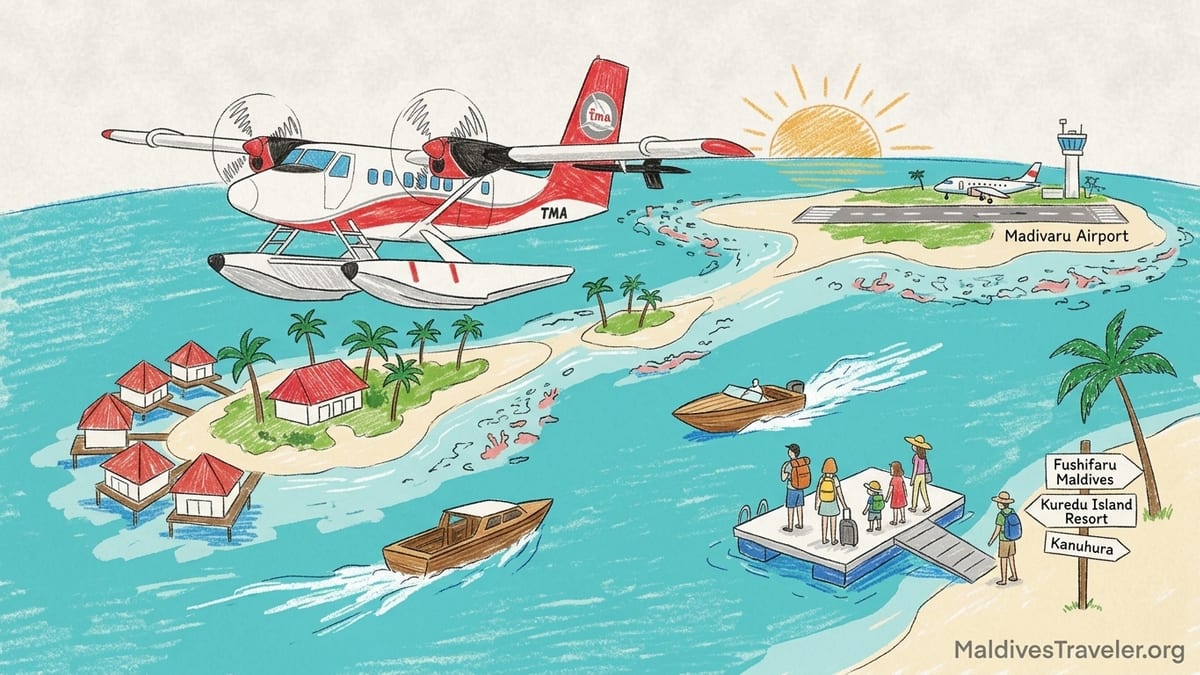
Lhaviyani Atoll lies roughly 140 to 150 kilometers north of Malé, far enough that a simple shared speedboat transfer from the international airport is not realistic for most resort guests. Instead, the atoll is primarily served by seaplanes operated by Trans Maldivian Airways from the dedicated seaplane terminal near Velana International Airport, with a growing role for domestic flights to Madivaru Airport inside Lhaviyani plus short speedboat hops to selected resorts. That distance is precisely why transfer arrangements can materially alter both the price and practicality of your trip.
For example, Fushifaru Maldives describes itself as 145 kilometers from Velana International Airport and sells the transfer as a 35 minute scenic seaplane flight. Kuredu Island Resort talks about a roughly 35 to 40 minute seaplane ride and notes that it is about 145 kilometers north of Malé. Six Senses Kanuhura quotes about 40 minutes by seaplane for the 149 to 150 kilometer route. Those numbers are useful when you compare options, because they show how long you will be in the air and how tightly your connections may need to run if you are arriving or departing late in the day.
Trans Maldivian Airways is the key player. It operates the largest seaplane fleet in the world and explicitly serves Lhaviyani Atoll through contracted resort transfers rather than public tickets. You never book TMA directly. Instead, when you reserve a resort such as Kuredu, Fushifaru or Six Senses Kanuhura, the property arranges your seaplane seats with TMA once you provide your international flight details. This is also how domestic plus speedboat combinations work. Resorts block seats on scheduled domestic flights to Madivaru Airport, then coordinate the pier-side speedboat hop to the island.
Because these arrangements are bundled by the resorts, policies can differ more than travelers expect. Six Senses Kanuhura currently publishes round trip seaplane transfer prices for adults and discounted rates for children. Kuredu has its own seaplane transfer policy document and also offers a domestic flight plus speedboat route in some seasons, subject to advance request. Fushifaru focuses only on seaplanes at time of writing. The point is that two resorts in the same atoll can give you very different schedules, costs and baggage rules, which is why you should always check transfer details at the booking stage, not at check-in.
Seaplanes to Lhaviyani: Experience, Schedules and Limits
Seaplanes are the signature way to reach Lhaviyani. From a traveler perspective, the experience is spectacular. You board a small Twin Otter aircraft from a floating platform at the seaplane terminal, often barefoot or in sandals. The flight is low and slow compared with a jet, with panoramic views of reefs, sandbanks and ring-shaped atolls. A 35 to 40 minute hop to Fushifaru, Kuredu or Six Senses Kanuhura easily ranks as one of the highlights of a Maldives trip, especially on a clear day when you can see the atoll layout and lagoon colors from above.
The trade-offs come from operating rules. Seaplanes in the Maldives fly under visual flight rules, which effectively means daylight only. Resorts serving Lhaviyani consistently quote operating windows from around 06:00 to late afternoon. Kuredu notes seaplane transfers during daylight hours, roughly 06:00 to 16:00, with the last services typically departing the seaplane terminal by about 17:00 depending on the season. Six Senses Kanuhura explains that seaplanes operate from sunrise to sunset and that schedules are arranged to match guests’ international arrival and departure times as far as possible.
Because there is no fixed timetable like a regular domestic airline, seaplane departure times are grouped according to when passengers from different resorts land in Malé. When you book a morning arrival into Velana International Airport, your resort will usually schedule you on a late morning or around midday seaplane. With an early afternoon arrival, you might fly around midafternoon. Late afternoon arrival is where seaplanes become risky, because operators must ensure that aircraft and crew can complete each leg and return to base before official sunset. Miss the last viable window and you will overnight near the airport at your own cost.
In practice, you should treat seaplanes as a semi charter service with schedules that are confirmed only one day before travel. Many resorts, including Kuredu and Fushifaru, ask guests to provide full international flight details at least 48 to 72 hours before arrival so they can request seats. You will not see your exact seaplane time when you first book your stay. Instead, you receive it closer to travel and final confirmation when you check in at the seaplane terminal. This flexibility is convenient when international flights are delayed, but it also means you must avoid tight onward connections in both directions.
Domestic Flight plus Speedboat: When It Applies in Lhaviyani
Domestic flights within the Maldives operate as regular scheduled services between Velana International Airport and regional airports such as Madivaru in Lhaviyani Atoll. From there, resorts arrange a speedboat hop to the island. In Lhaviyani, the clearest example is Six Senses Kanuhura, which explains that on request it can arrange a roughly 30 minute domestic flight to Lhaviyani Atoll followed by a 15 minute speedboat ride to the resort. This routing is not the default, because most guests still opt for the direct seaplane, but it becomes highly relevant for late arrivals or in seasons when seaplane capacity is tight.
Kuredu also references a domestic routing in its transfer policy, describing a service from Velana International Airport to Madivaru Airport and a short speedboat to the resort. Domestic transfers to Kuredu must be requested with the reservation at least seven days before arrival and are typically offered on dates where the domestic schedule aligns well with guest flows. These combinations are not yet as common as the classic Kuredu seaplane, but they are a genuine alternative in shoulder seasons or for travelers with flight timings that push against seaplane daylight limits.
It is important to note that domestic flights and seaplanes are often priced in the same broad range rather than one being decisively cheaper. Operators price them according to distance and demand, with resorts passing on bundled rates to guests. A domestic plus speedboat routing may be used to give more flexibility rather than to undercut the cost of a seaplane by a large margin. For example, some resorts offer combined packages that include transfers in promotional rates, while on other dates they quote separate adult and child fares that are similar between seaplane and domestic options.
If your chosen Lhaviyani resort does not explicitly advertise a domestic routing, assume that seaplane is the only realistic transfer unless the reservations team confirms otherwise. Fushifaru, for instance, currently frames its entire “Getting Here” section around the 35 minute seaplane, with airport hosts meeting guests, escorting them on a five minute bus ride to the TMA seaplane terminal and providing access to a lounge. There is no mention of a domestic flight for Fushifaru, so it would be misleading to plan on one without written confirmation from the resort.
Costs, Baggage Allowances and Child Pricing
Transfer costs to Lhaviyani can surprise travelers because they are charged per person and rarely included in the headline room rate. Six Senses Kanuhura currently publishes a round trip seaplane transfer of around 695 United States dollars per adult, with a reduced rate of about 419 dollars for children up to 11 years old, inclusive of taxes. That means a family of four can easily spend over 2,200 dollars on transfers alone before even reaching the villa. Promotions and bundled offers exist, but the baseline prices explain why comparing seaplane against domestic options and checking child discounts is essential at the booking stage.
Baggage allowances are equally important. Kuredu’s recent seaplane transfer policy sets a free allowance of 20 kilograms of checked luggage plus 5 kilograms of hand luggage per passenger on both seaplanes and related domestic legs. Any excess is charged per kilogram, and example figures around 5 United States dollars per kilogram plus local taxes have been quoted in resort documentation and third party guides. Six Senses Kanuhura and other high end resorts refer to a similar 25 kilogram combined allowance across checked and hand baggage on their contracted seaplanes, with items like surfboards or oversized photography gear accepted only on request and subject to space.
Families often overlook that infant policies differ from child fares. Fushifaru’s transfer terms explain that infants travel without their own seat and without a luggage allowance; if parents want a guaranteed seat or extra baggage, the infant may need to be ticketed at the child rate. At Six Senses Kanuhura, published transfer information focuses on adult and child rates, with children defined as 11 years or under, and infants often charged at a token rate or free when sharing a seat. Resorts update these details regularly, so exact ages and percentages can shift, but the underlying logic is stable. Children usually receive a reduced fare. Infants may not have luggage included unless they pay a higher category fare.
Because baggage is carried on small aircraft with tight weight limitations, seaplane operators in Lhaviyani sometimes prioritize passengers over luggage. Kuredu’s longer standing guest information sheets explain that if weight limits are reached, some luggage may be delayed and sent on a subsequent flight, particularly on days with high loads, strong headwinds or challenging weather. While it is rare on modern schedules, this remains a reason to pack essential medication, documents and a change of clothes in your cabin bag. Domestic jets are less likely to leave bags behind because they operate with higher payloads, but they still follow per person allowances, so overweight fees can still apply.
What to Expect at Malé: Terminals, Lounges and Waiting Time
Regardless of transfer type, your Lhaviyani journey begins at Velana International Airport. After clearing immigration and baggage claim, you step into the arrivals hall where resort representatives stand behind branded signs. For Fushifaru, airport hosts greet you with a “Fushifaru Maldives” placard and assist with luggage. Kuredu and Six Senses Kanuhura follow a similar pattern, with staff gathering your passports and domestic tickets where required and escorting you to the correct counter. This workflow is valuable after a long overnight flight, because you do not have to navigate seaplane or domestic check-in procedures alone.
If you are taking a seaplane, resort staff will usually place your luggage on carts and lead you to a shuttle bus that runs from the international terminal to the seaplane terminal in about five minutes. At the seaplane terminal, many Lhaviyani resorts share or rent branded lounges. Fushifaru mentions a seaplane lounge where guests can enjoy light refreshments and complimentary Wi-Fi while waiting for their 35 minute scenic flight. Six Senses Kanuhura offers its own lounge at the seaplane terminal, where staff share updated departure times and help families with young children settle in with drinks and snacks.
Waiting time can vary. On a smooth connection where your international flight arrives in the early morning, you might clear formalities and reach the seaplane lounge within an hour, then board your Lhaviyani seaplane within another hour. That kind of two hour door to door connection is common in high season when aircraft are turning quickly. On days with flight delays, heavy rain or strong winds, you might wait several hours while operators reshuffle flights. Resort policies make clear that seaplane schedules are “subject to change” based on weather and operational needs, and that guests should expect shared or multi stop flights that touch down at neighboring islands before reaching their final resort.
For domestic flights, the experience starts in the domestic terminal which is adjacent to the international hall, often within walking distance. Resort staff check you in on a scheduled flight to Madivaru Airport and then transfer you by speedboat upon arrival in Lhaviyani. There are fewer resort specific lounges on the domestic side compared with the seaplane terminal, but general seating, small cafes and basic services are available. Because domestic flights operate later into the evening than seaplanes, travelers landing in Malé after midafternoon may spend less time worrying about the sunset cutoff if they have prebooked a domestic connection.
Late Arrivals, Missed Connections and Why Transfers Are Rarely Included
The most common stress point for Lhaviyani transfers is a late international arrival into Malé. Seaplanes cannot fly after dark, and resorts such as Kuredu openly warn that guests arriving on flights that cannot connect to the last seaplane of the day will need to overnight near the airport. Some properties can move such guests onto a domestic flight to Madivaru plus speedboat if schedules permit, but this is not guaranteed and often comes with additional cost. Kuredu notes that rearrangement of a seaplane transfer due to delayed international flights can trigger an extra one way transfer fee, which highlights how important travel insurance and flexible tickets can be.
Real world examples illustrate this. Travelers booked on an international flight landing around 15:00 in Malé have reported that, in busy seasons, seaplane operators will sometimes hold a late afternoon seaplane a short time to wait for delayed baggage and passengers, particularly for resorts such as Kuredu that have chartered aircraft. At other times, especially in poor weather or near the end of the operating window, operators may decide that it is safer to reschedule the passenger for the next morning and accommodate them in a nearby airport hotel. The same resort may handle similar timings differently in different months, which is why you should not rely on anecdotal reports alone.
Another critical point is that resort rates in Lhaviyani almost never include transfer by default. Even at high end properties like Six Senses Kanuhura, where some promotional offers bundle seaplane transfers with half board and taxes, the standard published room rate typically excludes transport between the airport and the island. Guests see transfer charges added as a separate line to the final bill or collected in advance once international flights are confirmed. Families can be caught off guard when they add up four or five per person seaplane fares on top of an already expensive villa.
For this reason, you should treat transfer cost and feasibility as a core part of your resort decision. Ask for a written breakdown of return transfer costs for adults, children and infants. Confirm whether the quote is for seaplane or domestic plus speedboat. Check which option will be booked by default for your dates and whether a surcharge applies for last minute changes. Because resort policies change periodically and airline fuel price adjustments can filter through to transfer rates, what you read in older reviews may no longer reflect current pricing. A quick email exchange with reservations before you commit nonrefundable flights is always sensible.
Seaplane vs Domestic and Speedboat: Scenario Based Decisions
Different travelers will weigh the same options differently. To make the choice concrete, consider a couple arriving from Europe on a flight scheduled to land at Velana at 08:30. They are booked at Fushifaru, which only offers seaplane transfers. In this case, the straightforward answer is to book the seaplane. The arrival is early in the day, leaving a generous buffer to clear immigration, collect luggage, transfer to the TMA terminal and still board a mid to late morning flight. The couple can enjoy breakfast in the lounge and likely be on the island well before lunch, which maximizes their first day on the beach.
Now imagine a family with two young children booked at Kuredu, landing in Malé around 13:30. Kuredu’s seaplane transfer window typically runs through the midafternoon, with most flights to the resort departing between late morning and around 16:00. For this family, seaplane remains the default and probably the simplest choice. However, they should be prepared for a possible wait of one to three hours at the seaplane terminal if their assigned flight does not leave immediately. Parents might prioritize a resort with a comfortable lounge and clear child pricing, as well as pack snacks, entertainment and ear protection for children who may find seaplane noise overwhelming.
Consider a different case: a traveler arriving on a late afternoon long haul flight scheduled into Malé around 17:30, booked at Six Senses Kanuhura. A seaplane is no longer viable because of daylight limits. Here the domestic flight plus speedboat routing comes to the foreground. If Six Senses Kanuhura has a scheduled domestic connection to Madivaru plus a speedboat timed for that evening, the traveler can still reach the resort on the same night, albeit several hours after dark. If no such domestic seat is available, the resort will usually recommend overnighting near the airport and taking the next morning’s seaplane, something that should be factored into the budget and time off work.
For a honeymoon couple with flexible dates who want the smoothest arrival into Lhaviyani, the best approach is to pick international flights that land in Malé between 07:00 and 13:00 and depart after 11:00 on the return. These windows fit well with most seaplane and domestic schedules and reduce the risk of overnight delays. For the cheapest viable transfer, a budget conscious solo traveler might compare Lhaviyani with nearer atolls that offer speedboat only transfers, but if heart is set on Lhaviyani, the focus should be on a resort that occasionally runs promotions with transfers included, such as Six Senses Kanuhura packages that bundle seaplane transport with half board for two adults.
The Takeaway
Reaching Lhaviyani Atoll is part of the Maldives experience, but it is also a logistical exercise that can reshape your budget and itinerary if you do not plan ahead. Seaplanes provide the most iconic route, with roughly 35 to 40 minute flights from Malé to resorts like Fushifaru, Kuredu and Six Senses Kanuhura, but they operate only in daylight and carry strict baggage and scheduling rules. Domestic flights to Madivaru plus speedboat hops offer valuable backup options at selected properties, particularly for later arrivals, yet they must be requested and confirmed in advance, since not every resort in Lhaviyani uses them routinely.
The practical lesson for travelers is simple. Never assume that your hotel rate includes transport, never assume that late afternoon international arrivals will connect to a seaplane, and never ignore baggage limits. Before you finalize flights, ask your chosen resort for today’s transfer prices for adults, children and infants, the latest seaplane check-in times, and whether a domestic routing is available for your dates. With that information in hand, you can choose arrival and departure times that align with real-world transfer options and enjoy the turquoise views of Lhaviyani from the sky or sea without last minute surprises.
FAQ
Q1. Is seaplane always the best way to reach Lhaviyani Atoll?
Seaplane is the primary and most scenic option for many Lhaviyani resorts, but it is not automatically the best in every case. If you arrive in Malé between early morning and early afternoon and your resort only offers seaplanes, it is usually the smoothest route. However, if you land late in the day or your chosen resort, such as Six Senses Kanuhura or Kuredu, can arrange a domestic flight plus speedboat for your dates, that combination may be more practical because domestic flights operate later into the evening than seaplanes.
Q2. How early should my international flight arrive to safely catch a seaplane?
As a rule of thumb, aim for international flights that land in Malé no later than early afternoon, ideally between 07:00 and 13:00. Seaplanes typically operate from around 06:00 until late afternoon, and resorts such as Kuredu and Six Senses Kanuhura schedule transfers around your arrival time. Landing much after 15:00 can be risky, especially in seasons when sunset falls earlier or if immigration queues and baggage delays are long. Always ask your resort for its current latest recommended arrival time before booking flights.
Q3. What are the typical baggage limits on Lhaviyani seaplane transfers?
Most Lhaviyani seaplane transfers follow a total baggage allowance around 20 kilograms of checked luggage plus 5 kilograms of hand luggage per person, as published in Kuredu’s seaplane policy. Some resorts and operators quote a combined allowance of up to 25 kilograms. Excess baggage is charged per kilogram, and items such as surfboards or large camera cases may need prior approval. Because aircraft are small, seaplane operators occasionally delay some luggage to a later flight if weight limits are tight, so essential items should always be in your hand baggage.
Q4. Are resort transfer costs ever included in the room rate?
Standard room rates for Lhaviyani resorts almost never include transfers by default. Instead, resorts add return seaplane or domestic plus speedboat costs as a separate charge per person. High end properties like Six Senses Kanuhura sometimes sell promotional packages that bundle seaplane transfers with accommodation and meals, but these are exceptions that must be clearly stated in the offer. Unless your confirmation explicitly mentions that transfers are included, you should assume they will be billed separately.
Q5. How do child and infant prices work for Lhaviyani transfers?
Resorts usually offer reduced transfer fares for children and different rules for infants. For example, Six Senses Kanuhura publishes lower round trip seaplane rates for children up to 11 years old compared with adult prices. Fushifaru notes that infants can travel without a separate seat and without their own luggage allowance, but if you want a guaranteed seat or extra baggage, they may need to be booked at the child rate. Age bands and discounts vary by resort and can change, so always request up to date child and infant pricing in writing.
Q6. What happens if my international flight is delayed and I miss the last seaplane?
If a delay means you cannot reach the seaplane terminal in time for the last daylight departure, your resort may either arrange a domestic flight plus speedboat if available or rebook you on the first seaplane the following morning. Kuredu’s booking terms indicate that rearranging seaplane transfers because of delayed international flights can incur additional one way transfer fees. You should plan for the possibility of an unplanned overnight stay near the airport and make sure that your travel insurance covers missed connections.
Q7. How long does the journey from Malé to my Lhaviyani resort actually take?
Door to door travel varies by resort and transfer type. Fushifaru quotes a 35 minute seaplane flight from Velana International Airport, while Kuredu describes a roughly 35 to 40 minute seaplane journey. Six Senses Kanuhura estimates around 40 minutes by seaplane or a 30 minute domestic flight followed by a 15 minute speedboat. When you add immigration, baggage claim, the bus ride to the seaplane terminal or domestic check-in, and some waiting time, most travelers reach their resort one and a half to three hours after landing in Malé.
Q8. Are seaplanes suitable for young children or nervous flyers?
Seaplanes are noisy and can feel more basic than large jets, but many families report that children enjoy the views and the short flight time. Resorts like Kuredu advise parents to bring ear muffs or noise cancelling headphones for toddlers and babies because cabin noise can be intense. Nervous flyers may prefer to sit near the back away from the cockpit window views or, where available, choose a domestic jet plus speedboat routing, which feels more like a standard commercial flight and can be psychologically easier.
Q9. Can I choose between seaplane and domestic flight for any Lhaviyani resort?
No. Transfer options are tied to each resort’s agreements with operators. Some Lhaviyani resorts, such as Fushifaru, currently only advertise seaplane transfers. Others, like Six Senses Kanuhura and Kuredu, can offer both seaplanes and domestic flight plus speedboat combinations on certain dates. You cannot usually book a domestic flight independently and then hire a random speedboat to a private island resort. Always confirm with the resort which transfer modes are available and which one they will book for your stay.
Q10. How far in advance should I confirm my transfer details?
Most Lhaviyani resorts ask guests to provide full international flight details several days before arrival so they can secure seaplane or domestic seats. Fushifaru requests details at least 72 hours in advance, and Kuredu asks for domestic transfer requests at least seven days before arrival. Earlier is always better, especially in peak seasons when aircraft can fill quickly. Once your flights are ticketed, send the itinerary to the resort’s reservations team and check that you receive a written acknowledgment of your transfer arrangements.