


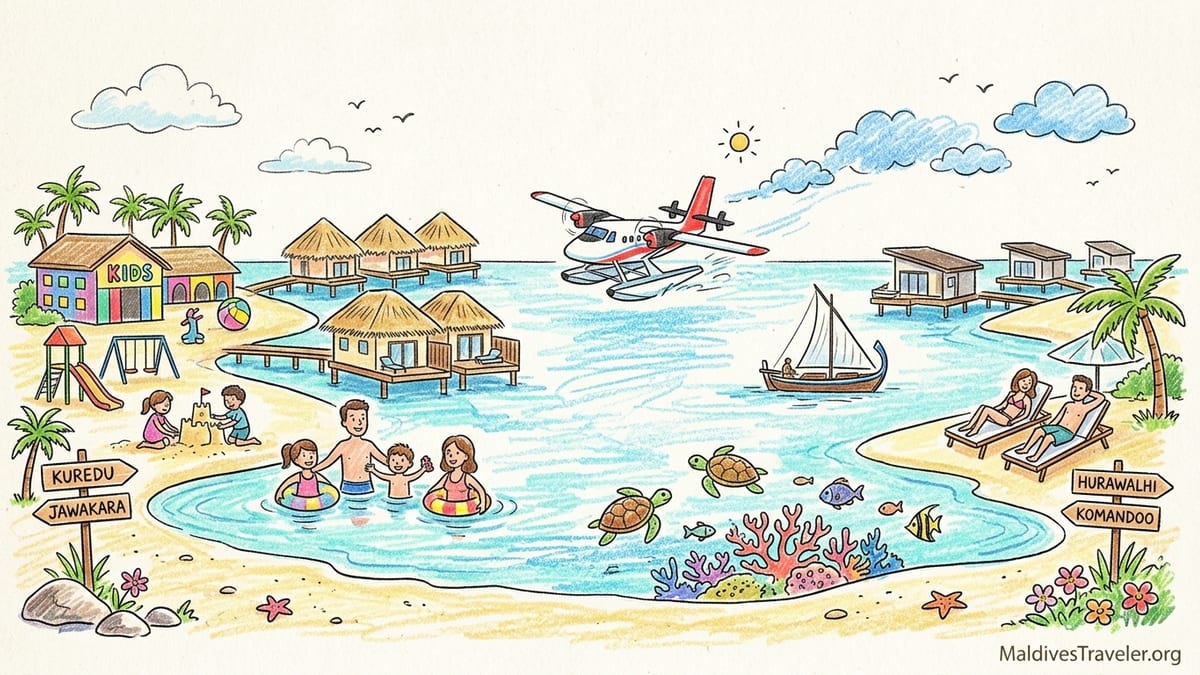
Lhaviyani Atoll has quietly become one of the Maldives’ most varied resort hubs, with everything from giant activity-packed islands like Kuredu to tiny ultra-luxury hideaways such as Kudadoo. On a single seaplane route you now find classic value all-inclusive resorts, serious dive bases, romantic adults-only retreats and polished family escapes from brands like Six Senses and Le Méridien. This guide looks beyond simple “most luxurious” rankings and instead compares the main Lhaviyani resorts by how travelers actually decide: budget, island size, transfer, villa styles, house reef, kids policies, dining, and overall value.
Why Lhaviyani Atoll Works So Well For Different Travelers
Lhaviyani lies north of Malé, reached by a seaplane flight of about 35 to 40 minutes from Velana International Airport. That transfer is shared by resorts including Kuredu, Hurawalhi, Komandoo, Kudadoo, Fushifaru, Cocoon, Atmosphere Kanifushi, Le Méridien Maldives, Six Senses Kanuhura, Jawakara and Nala Maldives, all spread across a relatively compact atoll. This concentration means you get unusually high resort choice without needing domestic flights or complex transfers, which is one reason repeat Maldives visitors often graduate to Lhaviyani.
The atoll has also built a strong reputation for diving and turtles. Channels at its eastern and northern edges bring in nutrient-rich water and pelagic life, while lagoons around islands such as Kuredu and Hurawalhi are known for regular turtle encounters and reef sharks. At the same time, newer properties from big hospitality brands have raised the level of comfort and design, so you can now choose between a more rustic barefoot resort like Komandoo and sleek villas at Le Méridien or Six Senses Kanuhura without leaving the atoll.
According to recent industry directories and regional guides published through 2025 and 2026, Lhaviyani now hosts around a dozen established resort islands, from huge 3‑kilometre Kuredu with roughly 389 rooms to tiny Kudadoo with just over a dozen residences. This spectrum creates fundamentally different holidays. A couple looking for quiet, adult-focused luxury will have a very different experience at Hurawalhi or Komandoo than a family booking Jawakara or Atmosphere Kanifushi, yet they all ride out on roughly the same seaplane route.
When comparing the resorts below, keep in mind that quoted prices are based on publicly available examples checked in October 2026 for low or shoulder season dates. Rates in the Maldives move quickly based on occupancy and promotions, so use them as realistic guidance rather than fixed promises, and always recheck when you are ready to book.
Best Overall Value: Kuredu, Cocoon and Fushifaru
For most travelers, the central question is not which resort is most luxurious, but which island delivers the best experience for the money. In Lhaviyani, the value conversation usually starts with Kuredu, Cocoon and Fushifaru. Kuredu is one of the Maldives’ largest islands at around 3 kilometres long, with nearly 400 rooms, multiple pools, separate adults-only zones and pitch-and-putt golf. Its scale means you get a choice of basic garden bungalows through to overwater villas, and frequent promotions. In mid-September 2026, sample online rates for two adults in a Garden Bungalow at Kuredu have been advertised from roughly 380 to 450 US dollars per night including breakfast, with simple all-inclusive upgrades pushing total nightly cost closer to the 550 to 650 dollar range depending on date and channel.
Cocoon Maldives on Ookolhufinolhu island offers a different style of value, with Italian-influenced interiors and a strong focus on all-inclusive. In recent 2026 listings, base rooms in shoulder season have started in the region of 450 to 550 US dollars per night for half board, with fully all-inclusive offers commonly found around 650 to 800 dollars for two adults. Guests often compare Cocoon with Kuredu by asking whether they prefer a quieter, design-centric island with one main beach perimeter or a large, distinctly zoned island with more internal transport and activity options.
Fushifaru, sitting on a smaller private island with a good house reef just offshore, tends to price slightly above Kuredu but under some of the big brands. Updated 2026 comparison tables from regional booking specialists have shown lead-in figures advertised around 400 to 500 US dollars per night plus tax for bed and breakfast outside peak season, with all-inclusive packages sometimes bringing the total to 650 to 850 dollars for two. For that, you get a compact island that feels easy to walk around, a high-quality lagoon for swimming, and strong feedback from divers about the nearby channel sites. For couples or small families who like to snorkel independently and do not need endless restaurant choice, Fushifaru often emerges as a sweet spot.
If you are watching budget closely, the real-world difference between these three can be just a few hundred dollars across a week, once you factor in drinks and excursions. The bigger consideration is island character. Kuredu suits active travelers who like choice and do not mind some bustle. Cocoon attracts guests who value interior design and a more contemporary vibe. Fushifaru is for those who want an intimate island feel with excellent snorkelling and are happy with fewer room categories.
Best Adults-Only and Honeymoon Choices: Hurawalhi, Komandoo and Kudadoo
For adults traveling without children, Lhaviyani’s twin adults-only stars are Hurawalhi and Komandoo, with Kudadoo as the ultra-luxury wildcard. Hurawalhi is officially a 15-plus resort and is best known for its contemporary villas, strong all-inclusive options and the famous 5.8 Undersea Restaurant, accessed via an additional fee. Updated 2026 hotel review aggregators quote starting prices in shoulder season from roughly 700 to 900 US dollars per night for two on a breakfast or half-board basis, with full all-inclusive packages usually taking total nightly spend into the 1,100 to 1,400 dollar range depending on inclusions.
Komandoo, also adults-only and located relatively close to Hurawalhi, offers a more intimate, traditionally Maldivian feel, with thatched roofs, extensive timber and a high repeat-guest rate. Its smaller size keeps walking distances short, and there is a strong focus on diving and relaxed evenings rather than nightlife. In 2026 low-season windows, sample online prices for two adults in a Beach Villa have appeared between 450 and 650 US dollars per night including breakfast, with well-priced all-inclusive upgrades. Couples often choose Komandoo over Hurawalhi when they want a more barefoot atmosphere and are comfortable with fewer bells and whistles.
Kudadoo sits in a completely different category. It is a tiny private island of around 15 to 17 overwater residences with an ultra-inclusive concept where spa treatments, diving, many excursions, and premium drinks are bundled into the nightly rate. Recent 2026 offers highlighted by specialist agencies have shown three-night stays for two in an Ocean Pool Residence pricing from roughly 9,800 to 11,000 US dollars including taxes and round-trip seaplane, which equates to just over 3,200 to 3,600 dollars per night. Separate public booking engines in October 2026 have displayed per-night rates from around 5,000 dollars for two on selected dates once mandatory fees are included. For honeymooners with a high budget who prefer a private butler, minimal guest numbers and no signing of bills, Kudadoo is arguably the strongest adults-only option in the atoll.
For honeymooners who do not want to spend Kudadoo money, Hurawalhi usually strikes the best balance between romance and rate. The villas feel modern, there is an overwater spa and sandbank picnics, and the resort can arrange private dinners without the island feeling sleepy. Komandoo works well for couples who intend to dive a lot or who enjoy meeting like-minded repeat guests at the bar. All three offer strong house reefs, but Hurawalhi often edges ahead on overall polish and Instagram-friendly touches.
Best for Families and Groups: Kuredu, Jawakara, Atmosphere Kanifushi and Nala
Family needs in the Maldives often revolve around kids’ clubs, shared villas or interconnecting rooms, shallow lagoons and manageable meal costs. In Lhaviyani, Kuredu has long been a go-to family island simply because of its size and facilities. With separate pool zones, football pitches, golf, watersports and varied evening entertainment, it absorbs children and teenagers easily. Many families choose Kuredu’s all-inclusive packages as a way to control costs, using buffet restaurants most nights and dipping into a la carte options occasionally. Because of the resort’s room count, you can often find family-suitable configurations such as two neighboring bungalows for under 1,000 US dollars per night total in shoulder periods when booked with early-bird discounts.
Jawakara Islands Maldives and its associated property Nala Maldives by Jawakara have built themselves specifically around families and groups. These newer all-inclusive resorts in Lhaviyani link two or more islands, with water villas, beach villas, kids’ clubs and multiple pools. Pricing through 2026 has positioned Jawakara below the major luxury flags but above the most basic three-star offerings, with some public promotions advertising family villas on all-inclusive from around 800 to 1,200 US dollars per night for two adults and two children in off-peak weeks. Jawakara’s appeal lies in generous all-inclusive inclusions and extensive sports facilities that resemble a small resort village.
Atmosphere Kanifushi, reached by the same seaplane route, is a more upscale all-inclusive option with long beaches, multiple dining venues and a reputation for reliable food. As of late 2026, sample advertised rates for entry-level villas on Atmosphere’s premium all-inclusive have often fallen between 900 and 1,400 US dollars per night for two adults, with children either free or discounted under specific ages. The value here is that essentially all meals, many drinks and a selection of excursions are prepaid, which can make budgeting easier for a family that intends to consume resort-priced cocktails and activities.
Nala Maldives, as part of the Jawakara concept in Lhaviyani, extends these family-friendly features, adding more villa inventory and room categories. If you are traveling as a multi-generational group that wants to book several neighboring beach villas and keep everyone on the same flat all-inclusive package, this cluster of resorts is worth close attention. Compared with more boutique islands like Komandoo or Hurawalhi, family properties such as Kuredu and Jawakara also offer more frequent organized activities, from football tournaments to water sports sessions suitable for older children.
Best House Reef, Diving and Turtle Encounters
Lhaviyani’s reputation among divers comes from a series of channels and outer-reef sites that deliver consistent currents and pelagic life. Dive operators in the atoll regularly highlight sites near Kuredu, Hurawalhi and Fushifaru for shark and turtle encounters, along with large schools of fish. For certified divers who want to pack in multiple two-tank trips across a week, resorts with established dive centers like Kuredu, Komandoo, Hurawalhi and Six Senses Kanuhura make planning simple, with daily boats and nitrox available at extra cost for those licensed.
For house reef snorkelling that you can access straight from the beach, Hurawalhi and Komandoo are often singled out. Recent 2026 guest reviews collected by specialist hotel analysis tools repeatedly mention turtles, reef sharks and vibrant coral bommies within a short swim of shore at Hurawalhi, and a similarly engaging reef at Komandoo. Fushifaru, positioned close to a channel, also scores highly for reef access, with some guests booking the resort specifically for snorkelling rather than diving. If your priority is to wake up, walk a short distance, and step into a reef with minimal boat time, these islands deserve top billing.
Kuredu, despite its size and somewhat busier lagoon, has an important turtle point close by and runs regular snorkel and dive trips that almost guarantee green turtle encounters in season. Dive operators based in Lhaviyani have for years marketed the atoll as one of the country’s most reliable areas for turtles, and guests at mid-range resorts like Kuredu and Fushifaru often return with photos of multiple turtles from a single outing. Serious divers may lean toward Hurawalhi or Six Senses Kanuhura for a slightly more boutique base, but there is no single “best” diving island in the atoll; rather, several strong options operated by experienced Maldivian dive teams.
If you intend to dive daily, compare dive package pricing as well as room rates. While Kudadoo’s all-inclusive concept includes diving and can make sense for very active divers with a high accommodation budget, most guests at other Lhaviyani resorts pay per dive or per package. Costs quoted in 2026 have generally ranged from roughly 70 to 120 US dollars per dive before gear rental and tax, with modest discounts for multi-dive packages booked on arrival.
Ultra-Luxury and Big-Name Brands: Six Senses Kanuhura and Le Méridien
At the luxury end of Lhaviyani’s spectrum, Six Senses Kanuhura and Le Méridien Maldives Resort & Spa bring international branding, refined spas and sophisticated design. Six Senses Kanuhura occupies Kanuhuraa island and its satellites, offering a combination of overwater and beach villas, some with multiple bedrooms. Transfer is via seaplane from Malé, with the resort’s official information confirming that flights operate in daylight hours only. Late-2026 reference rates for entry-level villas at Six Senses Kanuhura in shoulder season have typically started around 1,200 to 1,600 US dollars per night for two adults on a breakfast basis, before adding half-board or full-board supplements.
Le Méridien Maldives, located on Thilamaafushi and a connected smaller island, is part of the Marriott Bonvoy ecosystem, which is a significant consideration for travelers holding points or elite status. Recent 2026 rate snapshots from mainstream booking platforms suggest that base villas can sometimes be found from roughly 700 to 900 US dollars per night plus taxes in quieter periods, with seasonal peaks and festive dates considerably higher. The ability to redeem points or combine paid and award nights can materially change the calculation for frequent Marriott guests, effectively converting a stay that might have cost several thousand dollars into a more manageable bill plus mileage.
Both properties target guests who are comfortable paying separately for most extras, including meals and activities, rather than on a full all-inclusive basis. They lean into wellness, with substantial spa menus, sunrise and sunset yoga, and curated excursions. For travelers comparing them with all-inclusive options like Atmosphere Kanifushi or Kudadoo, the key question is whether you prefer a la carte freedom and brand consistency or the simplicity of a higher but more inclusive nightly rate. In practice, a couple staying seven nights at Six Senses Kanuhura or Le Méridien on breakfast only, and dining mostly on-site, may find their total bill comparable to or above an all-inclusive resort once food, drinks and activities are added.
In terms of beaches and aesthetics, Six Senses Kanuhura arguably offers some of the atoll’s most photogenic sandbanks and lagoon views, while Le Méridien’s split-island layout creates varied perspectives and some long stretches of powdery sand. Neither island has the “busy village” feeling of Kuredu; instead, they market privacy and stylish, contemporary spaces where the soundtrack is more wind and waves than organized evening shows.
Island Size, Transfers, Meal Plans and Nightlife Compared
Island size is often overlooked during booking, but in Lhaviyani it has a direct impact on your holiday style. Kuredu, with its almost 400 rooms and several kilometres of shoreline, functions like a small coastal town, with multiple jetties, golf carts and distinct neighbourhoods. Jawakara and Nala are also on the larger side for the Maldives, with multiple pools and long walks between some facilities. By contrast, Komandoo, Hurawalhi and Fushifaru are compact islands where you can circle the beach in under 20 minutes, and Kudadoo is so small and low-density that staff quickly know every guest by name.
Transfers to all these resorts rely on seaplanes, typically operated by Trans Maldivian Airways from a dedicated terminal near Malé. The flights are scenic but subject to daylight and weather conditions, which means arrivals in the late afternoon may require an overnight in Malé. Most resorts in the atoll package seaplane cost into their quotes, which as of 2026 often run between 350 and 600 US dollars per adult for the round trip once taxes are included, with reduced rates for children. When comparing resorts, check whether promotions you see online already include transfers, as that can adjust your true per-night cost by several hundred dollars for a couple.
Meal plans also differ sharply. Kuredu, Atmosphere Kanifushi, Jawakara, Nala, Cocoon and Fushifaru all lean heavily on all-inclusive or full-board options, with varying levels of included drinks and activities. Adults-only properties like Hurawalhi and Komandoo offer both standard and premium all-inclusive plans alongside half-board, allowing guests to pick based on their bar habits. Ultra-luxury Kudadoo effectively runs on a single comprehensive plan where almost everything is included, while Six Senses Kanuhura and Le Méridien tend to promote breakfast-based rates with optional dining packages. If you expect to consume several alcoholic drinks per day and prefer not to study menus too closely, mid to upper-tier all-inclusive resorts in Lhaviyani often provide more peace of mind.
Nightlife in the atoll is generally low-key compared with city destinations, but there are distinctions. Kuredu, Jawakara, Nala and Atmosphere Kanifushi have the liveliest scenes, with evening entertainment, music, and bars that stay open later. Cocoon also hosts occasional parties and live music. Adults-only Komandoo and Hurawalhi keep things calmer, more focused on cocktails and conversation, while Kudadoo, Six Senses Kanuhura and Le Méridien lean toward quiet bars and occasional acoustic sets rather than club-style nights. Travelers who want to be in bed by 10 p.m. may find larger family resorts noisier in central areas, whereas couples seeking ambience will appreciate islands like Hurawalhi that deliver atmosphere without turning into a beach club.
The Takeaway
Choosing the right Lhaviyani resort is less about finding a single “best” island and more about matching the resort’s personality, pricing and inclusions to your own travel style. A couple that values privacy, top-tier inclusions and does not mind a five-figure bill might find their perfect stay at Kudadoo, while a family looking for sports facilities, kids’ clubs and forgiving rates will gravitate to Kuredu, Jawakara, Nala or Atmosphere Kanifushi. Divers and snorkellers can be happy across the atoll but may prioritise Hurawalhi, Komandoo or Fushifaru for their house reefs and proximity to key channels.
Before booking, sketch out your realistic daily spending on drinks and excursions, how often you plan to dive or visit the spa, and how much you care about brand names versus barefoot character. Then compare several Lhaviyani options not just on their brochure rates, but on the total estimated cost for your dates once meal plans, transfers and likely extras are added. As of October 2026, examples show that a seven-night stay for two at a mid-range all-inclusive such as Kuredu or Fushifaru can land in the 5,000 to 7,000 US dollar bracket including seaplane and basic excursions, while ultra-luxury weeks at Kudadoo or Six Senses Kanuhura can easily exceed 20,000 dollars.
What unites the atoll’s resorts is the backdrop of turquoise channels, turtles, consistent seaplane access and a sense of being far from busier central atolls without adding long domestic flights. If you align your expectations and budget with the right island, Lhaviyani can deliver some of the Maldives’ most rewarding and repeatable holidays, whether you are on your first barefoot escape or planning a special-occasion splurge.
FAQ
Q1. How long is the seaplane flight from Malé to Lhaviyani Atoll resorts? The seaplane flight from Velana International Airport to most Lhaviyani resorts typically takes around 35 to 40 minutes, depending on routing and weather.
Q2. Which Lhaviyani resort is best if I am on a tighter budget? Kuredu, Cocoon and Fushifaru usually offer the most approachable entry-level rates, especially outside peak months, while still delivering strong beaches and good activity options.
Q3. Are there true adults-only resorts in Lhaviyani Atoll? Yes. Hurawalhi and Komandoo are adults-only, and Kudadoo caters almost entirely to couples and adult groups with an ultra-luxury, highly private set-up.
Q4. Which resorts in Lhaviyani have the strongest house reefs for snorkelling? Hurawalhi, Komandoo and Fushifaru are widely praised for house reef access close to shore, with regular sightings of turtles, reef sharks and abundant fish life.
Q5. What is the best Lhaviyani resort for families with young children? Kuredu, Jawakara, Nala Maldives and Atmosphere Kanifushi all run kids’ clubs, family-friendly pools and broad all-inclusive plans that help parents manage food and drink costs.
Q6. How expensive is an ultra-luxury stay at Kudadoo or Six Senses Kanuhura? In October 2026, sample public rates suggest many dates at Kudadoo run from around 5,000 US dollars per night for two, while Six Senses Kanuhura often starts around 1,200 to 1,600 dollars per night plus meals and tax.
Q7. Is all-inclusive worth it in Lhaviyani, or should I book breakfast only? If you enjoy cocktails, soft drinks and multiple courses each day, all-inclusive at resorts like Kuredu, Atmosphere Kanifushi or Jawakara typically works out cheaper than paying as you go, whereas light eaters may prefer breakfast-only at Le Méridien or Six Senses Kanuhura.
Q8. Do Lhaviyani resorts cater well to divers? Yes. Kuredu, Hurawalhi, Komandoo, Fushifaru and Six Senses Kanuhura all host established dive centres offering courses and daily boat trips to channel and outer-reef sites known for sharks, turtles and schooling fish.
Q9. Can I use hotel points at any Lhaviyani resort? Le Méridien Maldives is part of Marriott Bonvoy, so you can both earn and redeem points there. Other Lhaviyani properties generally operate outside the major global loyalty schemes.
Q10. When is the best time of year to visit Lhaviyani Atoll? The drier northeast monsoon from roughly December to April usually brings calmer seas and more sunshine, while May to November can be better value with more changeable weather and occasional rain.