


Lhaviyani Atoll has quietly become one of the Maldives’ most respected dive destinations, known less for overwater villas and more for sharks, shipwrecks and serious channel dives. With PADI listing dozens of mapped sites here and operators such as Prodivers reporting access to more than 60 dive spots across the atoll, this is the place many repeat Maldives divers choose when they want current-swept channels, photogenic wrecks and year-round big-fish encounters. This guide focuses on the sites that make Lhaviyani genuinely different, and explains how to match them to your experience level and dive goals.
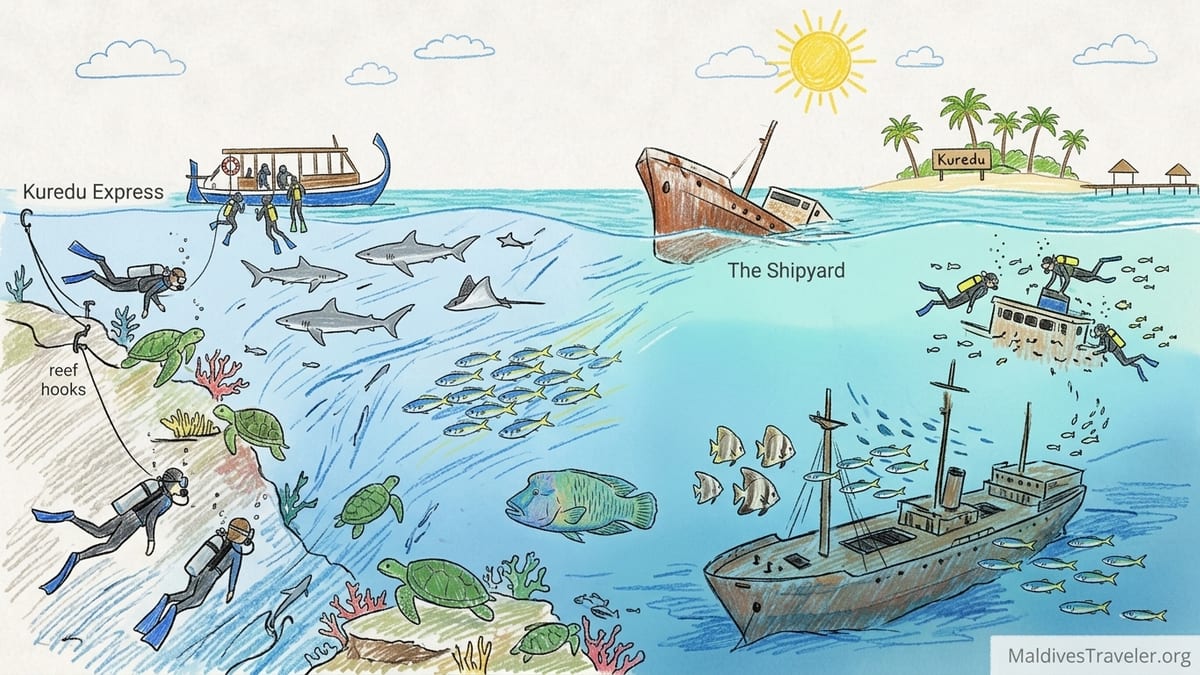
Kuredu Express: The High-Energy Heart of Lhaviyani
Kuredu Express, sometimes written as Kuredhdhoo Express or simply “the Express,” is the signature drift dive of Lhaviyani Atoll. The site forms part of Kuredu Kanduolhi, a protected channel between the outer reef and the lagoon that funnels tidal water in and out of the atoll. When the current is running, divers hook in along the lip of the channel and watch a parade of grey reef sharks, eagle rays, tuna and barracuda working the blue water, while Napoleon wrasse and green turtles cruise the reef itself. PADI’s own description of the site highlights this mix of pelagics and turtles, and most visiting dive boats place it firmly among the top dives in the Maldives for reliable shark action.
The reef structure at Kuredu Express starts shallow, around 5 to 7 metres near the plateau, and drops beyond recreational depths on the outer edge, giving dive leaders multiple profiles to work with. On a mild incoming current, advanced open-water divers might begin closer to 18 metres on the shoulder of the channel, then drift gradually shallower along the wall as the current carries them inside. On days when the flow is stronger, guides often plan a negative entry, asking divers to deflate fully and descend together as soon as they leave the boat, aiming straight for the agreed hook-in point before the water movement becomes too intense.
Conditions here vary dramatically with tide and monsoon, which is why the same site can feel almost like two different dives. On a relaxed, slackish morning with little movement, photographers may have time to compose shots of turtles resting on ledges or Napoleon wrasse posing against orange sea fans. On a spring tide with brisk incoming flow, the focus shifts to blue-water action: divers line the edge of the channel around 20 to 25 metres, clip in with reef hooks and watch dozens of grey reef sharks patrolling the current line. It is not unusual for Prodivers and other operators to adjust departure times from Kuredu, Komandoo or Hurawalhi specifically to catch the Express on a preferred phase of the tide.
Because of the currents and potential depth, Kuredu Express is not a beginner’s first open-ocean dive. Most centers on the atoll ask divers to hold at least Advanced Open Water, be comfortable with negative entries, and ideally be certified for nitrox. Using nitrox at around 28 to 32 percent oxygen extends no-decompression limits at the hook-in depth and adds a safety margin when you are relatively stationary watching the show. A typical boat ride from Kuredu Resort is about 10 to 20 minutes by dhoni, which keeps surface intervals convenient and makes it easy to repeat the dive on different tides over the course of a week-long stay.
The Shipyard: Twin Wrecks and Industrial Atmosphere
North of Kuredu and close to the fish-processing island of Felivaru lies one of the most distinctive wreck sites in the Maldives, known collectively as the Shipyard. Official tourism descriptions and operator briefings describe it as two cargo hulls lying in the same channel, one tilted so that its bow still breaks the surface and the other resting fully submerged at around 30 metres. The result is a rare double-wreck profile where divers can explore steel structures at both mid-range and deeper depths on the same dive, framed by schooling batfish, fusiliers and the occasional grey reef shark or eagle ray crossing the channel.
The shallower wreck, with its bow rising near the surface, is visible from the boat and immediately sets the mood as you back-roll or giant-stride into the water. Guides often descend along the superstructure around 8 to 12 metres, circling masts and railings that are now thick with sponges and hard corals. Photographers will find resident schools of snapper and batfish holding station against the current around protruding beams, and it is common to spot morays and lionfish using the metalwork as ambush cover. Because part of the hull is shallow, open-water divers with limited depth certification can still enjoy a satisfying profile here.
The second wreck lies deeper, with the main deck and cargo holds around 28 to 30 metres. Advanced divers on nitrox can drop down to this hull after a circuit of the upper wreck, finning through the channel water column and descending along the side plates. The scale becomes more apparent at depth, with collapsed structures creating overhangs and swim-throughs that are generally left to experienced wreck divers who are used to overhead environments. Many operators in Lhaviyani do not offer formal penetration at the Shipyard for safety reasons, but even staying on the outside gives a strong sense of industrial atmosphere, especially when visibility is slightly reduced and the steel looms out of the blue-green water.
The Shipyard can be a surprisingly technical-feeling dive because both hulls sit in a channel with appreciable current. On certain tides, divers may descend in the lee of the shallow wreck to avoid the strongest flow, then work gradually into the current to reach the deeper hull. Surface conditions can also feel busier than a sheltered reef, with small waves and wind chop reflecting off the tilted bow that juts out of the water. In practice, this means the site is generally recommended for confident divers who are comfortable maintaining buoyancy around metal structures and who can handle mid-water ascents without a fixed reef reference when they leave the wreck and deploy a surface marker buoy.
Fushifaru Thila and Kandu: Channel Drama and Protected Sharks
On the eastern side of Lhaviyani, Fushifaru Kandu and its adjacent pinnacle Fushifaru Thila have gained international attention among conservationists and experienced divers. Environmental assessments have highlighted the channel as a high-current hotspot for marine life, noting that the thila, or submerged reef, stands in the middle of the pass and acts as a gathering point for sharks and schooling fish. Dive reports describe grey reef sharks circling the current-swept corners, with leopard (zebra) sharks, stingrays and dense reef fish life sheltering in the lee of the structure.
For divers, the experience here is shaped almost entirely by the strength and direction of the tide. On an incoming current, boats typically drop on the ocean side of the thila and allow groups to drift down to a hook-in point around 20 to 25 metres, where they can watch sharks cruising the up-current edge and large trevallies hunting in the mid-water. On an outgoing tide, the dive may start closer to the inner side of the channel, with guides choosing more sheltered sections of the reef to avoid uncomfortable down-currents and to reduce air consumption. In both cases, staying close to the guide, monitoring your pressure frequently and following hand signals for hook-in and release are key to a safe, enjoyable dive.
Because Fushifaru involves both depth and strong current, most Lhaviyani operators treat it as a site for advanced drift divers. It is common to see groups limited to divers with at least 30 logged dives and experience in comparable channels elsewhere in the Maldives or in Indonesia. Nitrox is frequently recommended here as well, both for added bottom time and for a bit of extra physiological comfort on dives that often feature multi-level profiles, with a deeper hook-in phase followed by a slow ascent along the shallower reef back toward the lagoon.
Boat times to Fushifaru vary depending on which resort you base from. From Kuredu or Komandoo, typical dhoni rides are in the region of 30 to 50 minutes, while boats departing from islands closer to the eastern rim such as Fushifaru Resort itself can arrive in less than 15 minutes. This matters when you plan a week-long package, because longer rides can influence how many heavy-current dives you want in a single day. Many divers opt for a schedule that combines a morning channel dive at Fushifaru with an easier reef or cave dive in the afternoon.
Kuredu Caves and the Classic Turtle Dives
Not every highlight in Lhaviyani is about ripping current. Kuredu Caves, also known locally and in operator literature as Turtle Airport, is a gently sloping wall punctuated by overhangs and shallow caverns where green turtles rest and rise to the surface in a steady rhythm, like aircraft cycling through an airstrip. The site lies a short boat ride from Kuredu Island and has become a favorite for both newer divers and experienced photographers who want extended time with turtles against a textured reef backdrop.
The main cave and overhang system stretches between roughly 8 and 25 metres, which means dive leaders can tailor profiles easily. Entry-level divers and those completing advanced training courses often remain between 12 and 18 metres, drifting slowly along the wall and pausing near indentations where turtles typically wedge themselves for a nap. More experienced visitors may dip a little deeper to explore sand patches and boulder formations where stingrays, nurse sharks and schooling jacks sometimes gather. Although there can be gentle current, especially when the tide is moving along the atoll edge, Kuredu Caves is usually a relaxed, almost meditative dive.
Because the human appeal at this site is so strong, guides are careful to brief strict turtle etiquette. Divers are asked to keep a respectful distance, avoid blocking animals’ path to the surface and refrain from shining direct lights into resting turtles’ eyes. In practice, this results in better photographs: instead of close-up shots that feel intrusive, patient photographers can capture natural behavior such as turtles gliding overhead or sharing ledges with schools of fusiliers. Lens choices around 24 to 35 millimetres on a full-frame system work well for these mid-distance scenes, and strobes are useful for bringing out color under the overhangs.
Kuredu Caves is also a training ground for improving buoyancy and trim around ceilings and sloping rock faces. Many local instructors use the site for peak performance buoyancy workshops, asking students to hover motionless near the roof of a shallow overhang without touching rock or coral, or to practice finning techniques that minimize silt disturbance on sand patches. Even if you are already certified, considering a one-day buoyancy clinic here can pay dividends before you tackle the more demanding channel sites elsewhere in the atoll.
Choosing Dive Sites by Experience Level and Interest
With more than 60 named sites accessible from Kuredu, Komandoo, Hurawalhi, Fushifaru and other Lhaviyani resorts, planning a focused dive week benefits from thinking in terms of both experience level and personal interest. Beginners who have just completed Open Water certification or are finishing their last referral dives are usually introduced first to sheltered house reefs and calm outer walls. Kuredu’s own house reef, for example, offers easy entry, modest current and a reliable cast of reef fish with occasional turtles, making it ideal for orientation dives and the second confined-depth dive of Discover Scuba Diving programs.
For true novices and casual holiday divers, a realistic goal in Lhaviyani is to progress from these gentle reefs to moderate-depth sites like Kuredu Caves or calmer stretches of the outer wall near sites such as Miaruvani Thila. Operators typically schedule these as two-tank morning trips, with boat rides of 15 to 30 minutes and maximum depths within the standard 18-metre Open Water limit. This allows new divers to experience the clear water, soft corals and occasional turtles the atoll is known for without yet dealing with the stronger channel currents that define sites like Kuredu Express or Fushifaru Kandu.
Advanced drift divers, by contrast, usually build their itineraries around repeated visits to the main channels. Many experienced guests book 10 to 15-dive packages and specifically ask to alternate Kuredu Express, Fushifaru, Felivaru Kandu and other “sharky” passes with one or two easier dives for off-gassing and photo opportunities. Some operators now offer scooter-assisted dives to further-reaching channels for qualified guests who have additional training with diver propulsion vehicles. If you are in this category, bringing your own reef hook and confirming in advance that the center is comfortable guiding you on the most demanding sites is worthwhile.
Wreck-oriented divers may choose to prioritize the Shipyard and any other artificial reefs included on local schedules. While the twin hulls at Felivaru are the headliners, Lhaviyani’s long diving history means that smaller boats and structures have also been placed on certain reefs as fish aggregating devices or as training wrecks. Checking operator logs or speaking with staff at Prodivers, DivePoint or Aqua Dive & Watersports when you arrive will give you an up-to-date picture of which wrecks are in the best condition, what maximum depths to expect and whether nitrox is recommended or required for a given day’s plan.
CERTIFICATION, EQUIPMENT, NITROX AND SAFETY CONSIDERATIONS
Lhaviyani’s strongest selling point for serious divers is also the reason local centers insist on clear certification and experience requirements. Multiple sites in the atoll involve negative entries, mid-water ascents in current and bottom times near 30 metres, which collectively demand solid buoyancy control and situational awareness. If your logbook contains only a handful of dives in calm, shallow conditions, it is worth planning a skill-refresher or even an Advanced Open Water course during the early days of your trip before tackling the headline channels.
Most resort-based operations in Lhaviyani, such as Prodivers and other established centers, offer nitrox free of charge or for a modest daily supplement as an incentive for divers to use it on deeper and more repetitive profiles. For example, a 32 percent nitrox fill may be standard for planned 25 to 30-metre dives at Kuredu Express or the deeper Shipyard hull, with guides providing clear maximum operating depths and recommended profiles during the briefing. If you are not yet nitrox certified, obtaining this qualification before your trip allows you to take full advantage of the atoll’s dive menu without having to sit out certain dives or limit bottom time unnecessarily.
In terms of equipment, many visiting divers bring their own regulators, computers and sometimes BCDs, but rent wetsuits and additional gear locally. Water temperatures around Lhaviyani typically hover between 27 and 29 degrees Celsius for much of the year, so a 3 mm full suit or shorty is comfortable for most people, though those who run cold or plan three dives per day may prefer a 5 mm. Because currents are a defining feature of the atoll, a well-functioning DSMB and spool are strongly recommended. Some operators now require each buddy pair to deploy their own surface marker during channel ascents, especially when multiple boats are operating on the same site.
From a safety planning perspective, Lhaviyani is served by regional recompression facilities used by resorts across the northern atolls, but the distances involved still mean that early recognition and reporting of potential decompression illness is critical. Dive centers keep oxygen and first-aid equipment on their dhonis, and staff are trained in emergency protocols, but divers are strongly advised to carry insurance that covers boat evacuation and chamber treatment. Many experienced visitors also schedule one or two “light” diving days with only shallow reef dives or even a complete rest day during a longer stay, particularly after several intense channel dives in succession.
Currents, Seasons and How the Same Channel Changes Day by Day
Understanding current behavior is essential if you want to get the best from Lhaviyani’s dive sites. The atoll’s eastern barrier reef faces the dominant Northeast Monsoon at certain times of year, while the western side feels more of the Southwest Monsoon influence. On top of this seasonal pattern, local tides create daily cycles of incoming and outgoing water through passes such as Kuredu Kanduolhi and Fushifaru Kandu. This combination of monsoon and tide means that a channel like Kuredu Express can range from almost lake-calm on one visit to a full-on “express” ride on another, even within the same week.
For channel dives, guides tend to prefer clear incoming currents that push ocean water into the atoll, bringing better visibility and aggregating sharks on the outer lip. On these days, you might drop close to the ocean side, hook in facing the blue and enjoy 25 to 30 metres of visibility with schools of fusiliers and trevallies glowing in the sunlight. During outgoing currents, visibility can decrease as lagoon water flushed through the pass carries fine sand and plankton. Dive leaders may then choose hook-in points slightly higher on the reef or deeper in the channel where the water is clearer and the flow more manageable.
Seasonality also influences where operators run their daily boats. During the calmer months of the Northeast Monsoon, trips might concentrate on the eastern channels, maximizing shark encounters and schooling fish. When winds and seas shift with the Southwest Monsoon, certain outer-reef sites may become choppier on the surface, prompting a switch toward more sheltered inner reefs, thilas and leeward sides of islands. This is one reason why even repeat guests who return to Lhaviyani in different seasons can find familiar sites behaving in entirely new ways, from thermocline patterns to fish aggregations.
For visitors planning a dedicated dive holiday, the takeaway is that flexibility is more valuable than trying to lock in a rigid, pre-arranged list of sites. Work with the dive center’s schedule, ask which channels are performing well in the current conditions and be willing to repeat a favorite site on different tides. Many divers who stay a week at Kuredu or Komandoo end up diving Kuredu Express three or four times, each with a slightly different profile and feel, rather than insisting on a long tick-list of one-off visits.
The Takeaway
Lhaviyani Atoll has earned its reputation among experienced divers by offering far more than picture-postcard lagoons. Its identity is built around serious channel dives like Kuredu Express and Fushifaru Kandu, where currents bring in grey reef sharks, eagle rays and schooling pelagics on a scale that keeps specialists returning year after year. The twin Shipyard wrecks add character and depth variation, while gentler sites such as Kuredu Caves and the various thilas provide balance, training opportunities and world-class encounters with turtles and reef life.
For beginners, Lhaviyani can be the atoll where house-reef check dives evolve into confident explorations of caves and soft-current outer walls. For advanced drift divers and wreck enthusiasts, it is a compact playground of protected channels, industrial steel and long reef ridges that reward careful planning and a willingness to work with tides and monsoon patterns. Photographers find a rare mix of big animals in clear blue water and intimate scenes in overhangs and around wreck structures, all accessible from resorts that are set up to support multi-day dive programs with dedicated dhonis, nitrox and experienced local guides.
If you approach Lhaviyani with respect for its currents, realistic expectations about your own experience level and a flexible mindset about which sites to dive on which days, the atoll will repay you with some of the most memorable underwater hours available in the Maldives. Build your plans around a few anchors such as Kuredu Express, the Shipyard and Kuredu Caves, and then use operator logs and briefings once on island to add channels, thilas and house reefs that fit the week’s conditions. The result is a dive trip that feels curated to you, rooted in the specific strengths that make this sharky, wreck-strewn atoll stand out on the Maldivian map.
FAQ
Q1. What certification level do I need to dive Kuredu Express and the other main channels in Lhaviyani?
Most operators ask for Advanced Open Water or equivalent, with recent experience in currents. Some will accept Open Water divers with a significant number of logged dives in similar conditions, but negative entries, hook-in techniques and mid-water ascents mean that having the advanced card and being genuinely comfortable at 25 to 30 metres is strongly recommended.
Q2. Is Lhaviyani Atoll suitable for complete beginners or newly certified divers?
Yes, provided you choose your sites carefully with your dive center. Resorts such as Kuredu, Komandoo and Hurawalhi use calm house reefs and sheltered outer walls for check dives and early training, then gradually introduce easier sites like Kuredu Caves. You might not dive the strongest channels on your first trip, but you can still enjoy clear water, turtles and colorful reefs while building skills.
Q3. How long are the typical boat rides to the main dive sites from Kuredu and nearby resorts?
From Kuredu, classic sites such as Kuredu Express and Kuredu Caves are often within 10 to 20 minutes by dhoni, while more distant channels like Fushifaru Kandu may take 30 to 50 minutes depending on sea conditions. The Shipyard wrecks sit roughly in the same intermediate band, so most two-tank trips from the main resorts involve rides of under an hour each way.
Q4. Do I need nitrox for diving in Lhaviyani Atoll?
You can dive Lhaviyani on air, but nitrox significantly improves both safety margins and bottom time on the deeper sites that define the atoll. Because high-profile dives like Kuredu Express, Fushifaru and the deeper Shipyard wreck sections often hover around 25 to 30 metres, many centers either include nitrox in their packages or actively recommend it for certified divers.
Q5. What is the best time of year to visit Lhaviyani for diving?
Lhaviyani offers year-round diving, with generally warm water and regular shark sightings in all seasons. Conditions shift with the monsoons, affecting which side of the atoll has calmer seas and clearer water on a given month, but rather than one “perfect” season, you will find slightly different strengths at different times of year. Local operator logs on arrival will give the most accurate picture for your specific dates.
Q6. How strong are the currents, and will I be forced into very fast drifts?
Currents in Lhaviyani channels can be very strong on spring tides or particular monsoon phases, which is why guides tailor site choice and timing to the group’s comfort level. You will not be forced into a high-speed drift if you and your guide agree that conditions are beyond your experience. On many days, currents are moderate and allow for controlled hook-ins and scenic drifts rather than extreme “express” rides.
Q7. Are the Shipyard wrecks suitable for novice wreck divers?
The shallower of the two Shipyard wrecks is accessible to confident Open Water divers, since parts of the structure sit between roughly 8 and 18 metres. The deeper hull around 30 metres, particularly any overhead areas, is better reserved for advanced divers with good buoyancy and some wreck experience. Most centers limit or avoid penetration, focusing instead on safe external exploration.
Q8. What kind of marine life can I realistically expect to see in Lhaviyani?
Dive logs across recent seasons highlight regular encounters with grey reef sharks, eagle rays, green turtles, Napoleon wrasse, tuna and barracuda at channel sites like Kuredu Express. On reef and cave dives, divers report frequent green turtles, stingrays, schooling fusiliers and jacks, plus macro life such as nudibranchs and shrimps in overhangs and on wreck structures.
Q9. How many dives should I plan for a one-week stay focused on Lhaviyani’s highlights?
Many dedicated divers book packages of 10 to 15 dives for a seven-night stay, which allows multiple visits to Kuredu Express and Fushifaru Kandu, at least one or two dives at the Shipyard and several more relaxed reef or cave dives. This schedule balances time in strong currents with lighter days and still leaves space for topside relaxation.
Q10. Can non-divers or less experienced buddies still enjoy a trip centered on Lhaviyani’s dive scene?
Yes. While the atoll’s headline sites cater to serious divers, resorts such as Kuredu and Komandoo also offer snorkeling on house reefs, introductory Discover Scuba programs and gentle training dives. Mixed-experience groups often plan mornings around diving and afternoons around the resort, so keen divers can tackle channels while newer buddies build confidence on shallow reefs or relax on shore.