


Kuredu Island Resort in Lhaviyani Atoll is not the castaway sandbank many travelers picture when they first dream of the Maldives. Official figures put it at 389 rooms spread along roughly 3.5 kilometers of beach with 14 bars and restaurants, two spas, a golf course and one of the busiest dive and snorkel operations in the country. That scale makes Kuredu one of the largest private‑island resorts in the Maldives and raises a very fair question: does bigger actually make the experience better, or does it chip away at the tiny‑island fantasy many people fly halfway around the world to find?
Understanding Kuredu’s Size And Layout
Kuredu sits on Kuredhdhoo in Lhaviyani Atoll, about a 40 to 45 minute seaplane flight from Male with Trans Maldivian Airways. The resort markets itself around its scale, highlighting 3.5 kilometers of white sand, 389 rooms in 16 categories and 14 restaurants and bars, plus a golf course and two separate spas. That is closer to a small village than to the typical 60 to 90 villa Maldivian hideaway. For context, nearby adults‑only Komandoo in the same atoll runs around 65 villas, and Hurawalhi about 90, so staying at Kuredu inevitably feels more like being in a self‑contained island town than a tiny outpost.
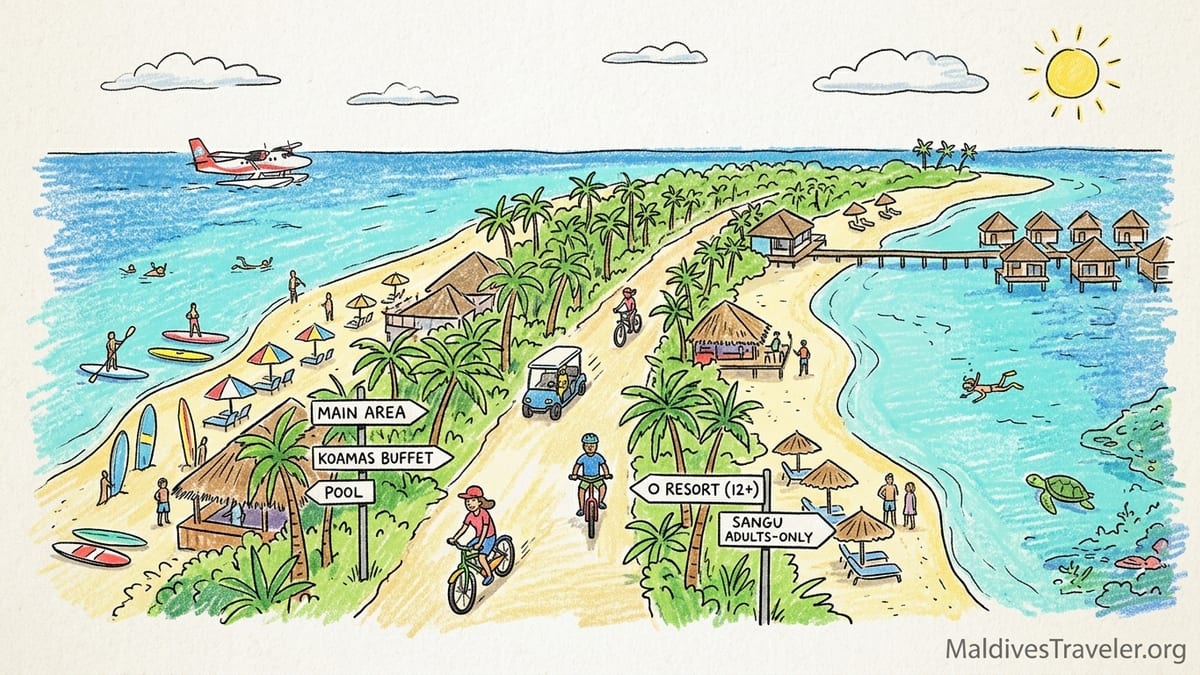
The resort is broadly divided into three accommodation zones that function almost like mini‑resorts on one island. The “main” area around the central Koamas buffet, reception and main pool accepts guests of all ages. The O Resort on one side of the island is designated for guests aged 12 and above, with its own O Restaurant, bar and infinity pool. On another tip of the island, the Sangu area is adults‑only, built around an overwater jetty of Sangu Water Villas, beach villas, a separate buffet restaurant and its own bar and pool. A detailed island map shows how these wings wrap around the lagoon and dictate which buffet restaurant and facilities each room category can primarily use.
Staying in the main Koamas zone, the first impression is how long the island feels underfoot. Walking from a mid‑island beach villa to Sangu at the far point, then around to the O side, quickly teaches you that Kuredu is not the sort of place you can cross in five minutes. The upside is variety: you get different views, sand conditions and moods along the way. The downside is that if you forget something in your room or want to bounce between zones in the midday heat, you notice the distance in a way you simply never would on a petite island with 60 rooms.
Operationally, the resort deals with its size through clear zoning and color‑coded meal entitlements rather than by pretending everything is shared equally. All‑inclusive packages, buffet access rules and bar availability change subtly between room types and zones, so the experience of Kuredu can feel very different depending on where you sleep. That is the single biggest thing first‑timers underestimate when they simply see “Kuredu Island Resort & Spa” in a brochure and click book.
Walking Distances, Bikes And Buggies
On paper, a 3.5‑kilometer beach sounds romantic. On day three, it can feel like a fitness retreat if you do not plan around the distances. From a mid‑island beach bungalow in the main Koamas area, it is roughly a 10 to 15 minute walk to either the far Sangu tip or the O Resort side at a leisurely pace, longer under intense midday sun. If you are used to tiny islands where everything is three minutes away, that difference is immediate. For some guests, particularly families with younger children or anyone with limited mobility, that can be tiring.
Kuredu tries to soften this with a mix of bicycles and shared buggies. Guests can arrange rental bikes, which quickly become the best way to turn the island’s length into an asset rather than a chore. Pedaling along the sandy paths at sunset, cutting between the beach and the interior coconut groves, feels closer to wandering a laid‑back tropical village than circling a compact resort. However, not everyone is comfortable riding on sand, and during very wet spells some patches of path can be soft or puddled. For anyone who does not want to cycle, the resort runs electric buggies on set loops that you can hop on from key points, although at busier times these can feel in demand rather than instantly available.
In practice, the people who suffer from Kuredu’s size are those who book without considering their daily routine. If you picture long, lazy afternoons at an adults‑only pool but book a standard room in the main area for the price, you may find yourself making that 15 minute walk each way to Sangu or O repeatedly. Conversely, couples who choose a Sangu Water Villa or an O Beach Villa often embrace the distances because they mostly stay in “their” wing and treat the rest of the island as optional variety.
If Kuredu was a small, circular sandbank, every villa would be close to everything by definition. Here, it is worth thinking of the resort as three overlapping neighborhoods and accepting that walking, cycling or waiting for a buggy is part of daily life. For some travelers who enjoy steps on the fitness tracker, that feels like a bonus. For others, it is a drag that erodes the sense of effortless barefoot escape.
Buffets, Bars And The Reality Of Sharing Space With Hundreds Of Guests
One of the most visible impacts of scale at Kuredu appears at meal times. Each accommodation zone is tied to a specific main restaurant for its included buffet: Koamas for most of the central rooms, O Restaurant for O Resort guests, and Sangu Restaurant for those in Sangu categories. That segmentation prevents all 389 rooms from funneling into one buffet hall, but you are still sharing breakfast and dinner with far more people than at a boutique Maldivian island.
In the main Koamas restaurant, peak breakfast and dinner time can look and sound more like a busy international beach hotel than a whisper‑quiet hideaway. Families move between live cooking stations, couples circle for free tables near the windows, and staff work hard to clear plates and reset cutlery at pace. The upside is choice: the scale allows the kitchen to put on multiple counters with different international options, Maldivian curries and a rotating set of grills or theme nights. The downside, particularly if you prefer slow, quiet meals, is that you are rarely far from the clatter of plates and the hum of conversation.
In contrast, the Sangu and O buffets feel more contained. With adults‑only or 12‑plus rules and fewer rooms feeding into each, those dining rooms come noticeably closer to the calmer, “private island” image many travelers hold. You still know you are in a resort, not a five‑table boutique lodge, but it is easier to find a quiet corner table and linger over coffee without feeling part of a crowd. That is a pattern repeated in the bars. The main pool bar and central bars can be lively and sometimes loud, especially on evenings with live music, quizzes or sports on screens. Sangu Bar and O Bar are calmer most nights, focusing more on sunsets and low‑key conversation.
On the money side, Kuredu’s scale feeds into its pitch as one of the better value options in Lhaviyani rather than a top‑tier luxury retreat. Publicly available package brochures for 2026 show that a week on an all‑inclusive or all‑inclusive‑plus plan at Kuredu can undercut smaller neighbors like Hurawalhi or Komandoo by several hundred to more than a thousand dollars for two adults in similar month‑of‑year windows, depending on flights and agency deals. That price gap exists because the resort can spread fixed costs like the seaplane transfer infrastructure, dive center and multiple kitchens over many more rooms. The trade‑off is that you share those savings with several hundred other guests at peak holiday times.
Beaches, House Reef And Snorkeling At Scale
Kuredu proudly advertises itself as home to one of the Maldives’ largest natural beaches, and when you walk the full 3.5 kilometer perimeter it is hard to argue with the impression. There are long arcs of powder‑soft sand on multiple sides of the island, broken occasionally by jetties, breakwaters and areas where erosion control work is more visible. Crucially, the character of the beach changes as you move. Some stretches in the Sangu and O areas offer classic wide Maldivian sand with clear lagoon water and minimal rubble underfoot. Other sections closer to infrastructure show more seawalls, sandbags or seasonal sand movement.
That variability is where Kuredu’s size can either delight or frustrate. On a small island, if the beach on your side is narrow or affected by seasonal currents, there is often little you can do beyond walking a short distance. At Kuredu, you can almost always walk or cycle to a broader, postcard‑perfect section within ten to twenty minutes at most. It feels more like choosing which side of a small town beach to use than being stuck with whatever is outside your villa. The resort’s marketing materials and map help by indicating the approximate position of villa types and the broad shape of the shoreline, so it is worth looking closely before choosing your room category.
Under the surface, Kuredu benefits from being in Lhaviyani Atoll, which has a reputation among divers for larger marine life and reliable house reefs. The resort’s own dive operation is large by Maldivian standards, running boats to sites like the famed Kuredu Express, known for frequent shark and turtle sightings. The house reef and inner lagoon hold a resident green turtle population and nurse sharks that regular guests and independent reviewers consistently mention. For many travelers, those encounters are a highlight that compensates for any loss of solitude on land.
However, size again shapes the feel. Organized snorkeling trips and beginner dives from a large resort can involve groups of a dozen or more people, rather than the two‑couple outings you might get from a boutique property with limited capacity. On calm days the lagoon in front of central bars can be busy with paddleboards, kayaks and swimmers. If your dream of the Maldives is dropping into an empty reef with no one else in sight, you are more likely to find that level of seclusion at smaller neighbors such as Komandoo, which sends fewer people on each boat by definition, or at higher‑end retreats that deliberately cap excursions.
Nightlife, Atmosphere And Who Your Neighbors Are
One of the things that most clearly sets Kuredu apart from smaller Lhaviyani resorts is its energy after dark. Where many Maldivian islands wind down to near silence by 10 p.m., Kuredu often keeps a gentle buzz going. The central bars host scheduled entertainment: live bands on some nights, DJs or themed evenings on others. There can be karaoke, quiz nights and occasional beach parties that draw a crowd. For guests who fear being bored after dinner on a tiny island, that liveliness is a selling point.
At the same time, the atmosphere is not uniform. In the main area, you feel the family‑friendly side of the resort, particularly during school holidays, when teens wander between the pool tables, younger children linger at mocktail bars and multi‑generation groups occupy large tables. In Sangu and O, with age limits in place, the mood is distinctly more adult. Couples sit on loungers watching the sun set behind the sandbank, small groups sip wine at the bar with soft background music. The ability to choose between the bustle of the center and the quieter wings on different evenings is one of the direct benefits of Kuredu’s scale.
That said, anyone whose benchmark for “Maldives atmosphere” is an adults‑only island with fewer than 100 villas should temper expectations. You will still see people in numbers walking along the main jetty after dinner, hear the hum of buggies and feel that you are sharing the island with several hundred fellow guests. For honeymooners who want to feel they have almost every view to themselves, resorts like Hurawalhi or Kudadoo market exactly that sense of intimacy, at considerably higher rates. Kuredu, by contrast, embraces being social. It is entirely possible to create a more private bubble in Sangu or O, but the default setting in the heart of the island is casual, friendly and busy rather than hushed.
Staff interaction reflects that character. At smaller resorts, it is common to get to know a handful of team members by name because you see them at almost every meal or at the same bar every night. At Kuredu, the service is generally warm and practiced, but the sheer number of guests means you are more one table among many. Some guests enjoy the sense of anonymity that brings; others miss more personalized touches. The resort tries to bridge that divide with repeat‑guest recognition, birthday treats and special mentions at events, but the mathematics of scale always shows through.
Room Zones, Restrictions And How Your Choice Changes The Experience
Kuredu’s three main zones are not marketing fluff. They meaningfully shape what you can access and how the resort feels. Staying in the main area, you are tied primarily to Koamas Restaurant for included buffet meals. You can drink at most bars around the island on an all‑inclusive plan, but Sangu Bar remains off‑limits for some room types, and eating at O or Sangu buffets usually incurs extra charges unless you have upgraded packages or move room category. That can come as a surprise to guests who assume that once they have paid for all‑inclusive, every restaurant and bar is automatically theirs.
By contrast, Sangu Water Villas, Sangu Jacuzzi Beach Villas and related categories have adults‑only access to Sangu Restaurant and Bar, as well as island‑wide bar access. O Beach Villas and other O‑area rooms feed into O Restaurant and Bar and benefit from the 12‑plus environment. In practical terms, this means three guests can all say “I stayed at Kuredu” but have very different stays. A family of four in a main‑area beach bungalow may rarely leave the central pool and Koamas buffet, embracing the fun and movement there. A honeymoon couple in Sangu Water Villa may spend most of their time on their deck, dropping straight into the lagoon, and only venture into the main zone for a change of scene.
This zoning can improve or damage the “tiny private island” fantasy depending on expectations. If you go in knowing you are effectively booking into a sub‑resort within a much larger island, the scale becomes a feature. You can enjoy a quieter adult wing while still having access to a choice of bars, sports facilities and dive trips that tiny islands cannot support. If you arrive expecting that every part of the island will feel secluded and that your all‑inclusive band will unlock everything, the posted signage about which restaurant is included for which room can feel jarring.
The financial structure ties into this. Brochures and resort documents show different color bands for all‑inclusive packages that quietly define which outlets are covered and where supplements apply. Higher categories and premium plans buy more flexibility, but they also push the total holiday price closer to that of smaller, more luxurious islands. That is where being honest with yourself about priorities helps. If you care most about meal variety, watersports and a lively social scene, paying for a better band at Kuredu might still offer excellent value. If what you truly want is silence and a short barefoot walk from every villa to every venue, you might be happier dropping some of those extras at a 65‑villa island.
Costs, Value And How Kuredu Compares Within Lhaviyani
For many travelers, Kuredu appears on the shortlist precisely because of cost. It often prices as one of the more affordable ways to reach Lhaviyani’s reefs with an all‑inclusive package, especially for families or couples looking at 7 to 10 night stays. Recent 2026 package comparisons from specialist agencies and Maldives‑focused magazines show weeklong all‑inclusive stays for two at Kuredu in shoulder seasons often coming in hundreds of dollars below equivalent dates at Hurawalhi or Komandoo, even before counting the difference in on‑island spending. Larger resorts simply have more room to offer occasional sales or value‑added deals around transfers or upgrades.
When you break down the “actual cost” of a week at Kuredu, it helps to think in layers. First is the base package: seaplane transfer, room and board on full board, all‑inclusive or all‑inclusive‑plus. Second are the on‑island choices that the resort’s scale makes tempting: extra a‑la‑carte dinners at specialty venues, rounds on the golf course, spa treatments across the two spas and a generous dive or snorkeling schedule. None of these are hidden, but the abundance of options means it is easier to say yes multiple times than it would be on a tiny island with one bar and one restaurant.
For example, a couple on a standard all‑inclusive plan who add two or three paid dinners at specialty restaurants, a couple of massages and a handful of boat excursions can see their end bill climb noticeably compared with sticking strictly to included buffets and house excursions. That is true at most Maldives resorts. The difference at Kuredu is that the temptation level is higher. You walk or cycle past many more venues in daily life, and evening entertainment, sports facilities and large dive operations keep presenting new ways to spend. Travelers who set a clear budget in advance and decide which extras matter to them generally come away feeling they squeezed strong value from the resort. Those who treat the island as an all‑you‑can‑do theme park sometimes find the final folio a reminder that even value‑oriented Maldives stays are still major trips.
Relative to other Lhaviyani options, the people who gain most from Kuredu’s price‑to‑scale equation are multi‑generation families, groups of friends and travelers who want a resort that can keep them busy for a week without repeating the same bar and restaurant every night. If you know you will dive frequently, play golf or tennis, join evening events and enjoy a more social scene, it can feel like you have bought into far more infrastructure than you would ever get on an intimate island at this price.
The Takeaway
So is Kuredu Island Resort worth it, given how far it sits from the classic image of a tiny Maldivian sandbank with a handful of villas? In many ways, the answer depends less on the island itself and more on what you secretly want from your first or next trip to the Maldives. Kuredu is honest about being large, busy and full of options. The Ministry of Tourism’s room listing and the resort’s own description of 3.5 kilometers of beach, 389 rooms, 14 restaurants and bars, two spas and golf do not hide the reality that this is effectively a self‑contained island town built on turquoise water.
If you are drawn to that variety, Kuredu can be a very smart choice. Couples who book into Sangu Water Villas or O Beach Villas and use their zone as a quiet base, but dip into the main island for specific restaurants, sports and more animated nightlife, often feel they got the best of both worlds: private corners when they want them and more going on than almost any smaller island could offer. Families who want kids to have space to roam, several pools to choose from and enough structured activities to avoid boredom, likewise, are often grateful that the island is large enough to absorb crowds without ever feeling squeezed on the sand.
On the other hand, travelers whose non‑negotiable dream is silence, short barefoot walks and the sense that they and a few dozen other guests have the reef almost entirely to themselves should think carefully. For those travelers, the scale that keeps Kuredu’s prices attractive and its facilities extensive is exactly what will stop it feeling like the Maldives of their imagination. Paying more for a genuinely small Lhaviyani resort such as Komandoo, or moving to a different atoll with similarly intimate properties, can deliver a closer match to that fantasy. In that context, Kuredu’s value proposition shifts: you are not buying solitude here; you are buying choice.
Put simply, Kuredu is worth it for guests who like the idea of a Maldivian island resort with the energy of a small seaside town, where you can choose between wings with different moods, walk or cycle long sandy paths and pick from multiple bars and restaurants each night. It is less suited to those whose heart is set on the feeling that there might be more palm trees than people on their island. Understanding that before you book is the key to making Kuredu’s unusually large scale work for you, rather than against your private‑island fantasy.
FAQ
Q1. Is Kuredu Island Resort too big to feel like a private island?
Kuredu feels more like a small, self‑contained beach town than a tiny sandbank. You can still find quiet corners, especially in Sangu and O zones, but you will always be aware that several hundred other guests share the island.
Q2. How long does it take to walk around Kuredu?
Walking the full 3.5 kilometer circumference at a relaxed pace typically takes 45 to 60 minutes, depending on how often you stop for photos or swims.
Q3. Do I need a bicycle at Kuredu?
You do not have to rent a bicycle, but many guests find bikes the most comfortable way to handle distances between zones, especially in the midday heat or for repeat trips to more distant bars and pools.
Q4. Which accommodation zone is best for couples?
For couples and honeymooners who want quieter surroundings, Sangu’s adults‑only villas or the 12‑plus O Beach Villas are usually the best fit, offering calmer pools and buffets plus easier access to sunset views.
Q5. Is Kuredu a good choice for families with children?
Yes. The main Koamas area is family‑friendly, with a lively main pool, broad beaches and plenty of activities. Parents need to factor in walking distances, but many families appreciate the variety and social atmosphere.
Q6. How does Kuredu compare in price to other Lhaviyani resorts?
Package comparisons for 2026 show Kuredu often undercutting smaller neighbors like Hurawalhi and Komandoo for weeklong all‑inclusive stays, particularly in shoulder seasons, while offering more on‑island facilities.
Q7. Will the buffets and bars feel crowded?
The central Koamas buffet and main bars can feel busy at peak times, especially when the resort is full. Sangu and O restaurants and bars are noticeably calmer due to age limits and fewer rooms feeding into them.
Q8. What is the snorkeling and diving like at Kuredu?
Kuredu benefits from Lhaviyani Atoll’s strong marine life, with a busy dive center, access to sites like Kuredu Express and a house reef known for turtles and nurse sharks, though excursions can involve larger groups.
Q9. Are all restaurants and bars included in the all‑inclusive plan?
Not automatically. Inclusions depend on your room category and all‑inclusive band, with specific buffet restaurants and some bars included and specialty venues or other buffets charging supplements.
Q10. Who should choose Kuredu, and who is better off at a smaller resort?
Kuredu suits guests who value variety, social energy and lower per‑night costs for a full‑service island. Travelers who prize intimacy, quiet and very short walks may be happier paying more for a smaller Lhaviyani resort like Komandoo.