


I went to Baa Atoll first, convinced that its UNESCO biosphere reserve status and the famous Hanifaru Bay mantas would make it the obvious northern Maldives choice. Then I spent a week in Lhaviyani, diving Kuredu Express, drifting past the Shipyard wrecks and counting green turtles off Kuredu’s beaches. By the time I flew back to Malé, the decision between the two atolls was no longer simple. Both had delivered very different versions of the Maldives, and which one I would choose now depends entirely on the kind of trip I am planning.
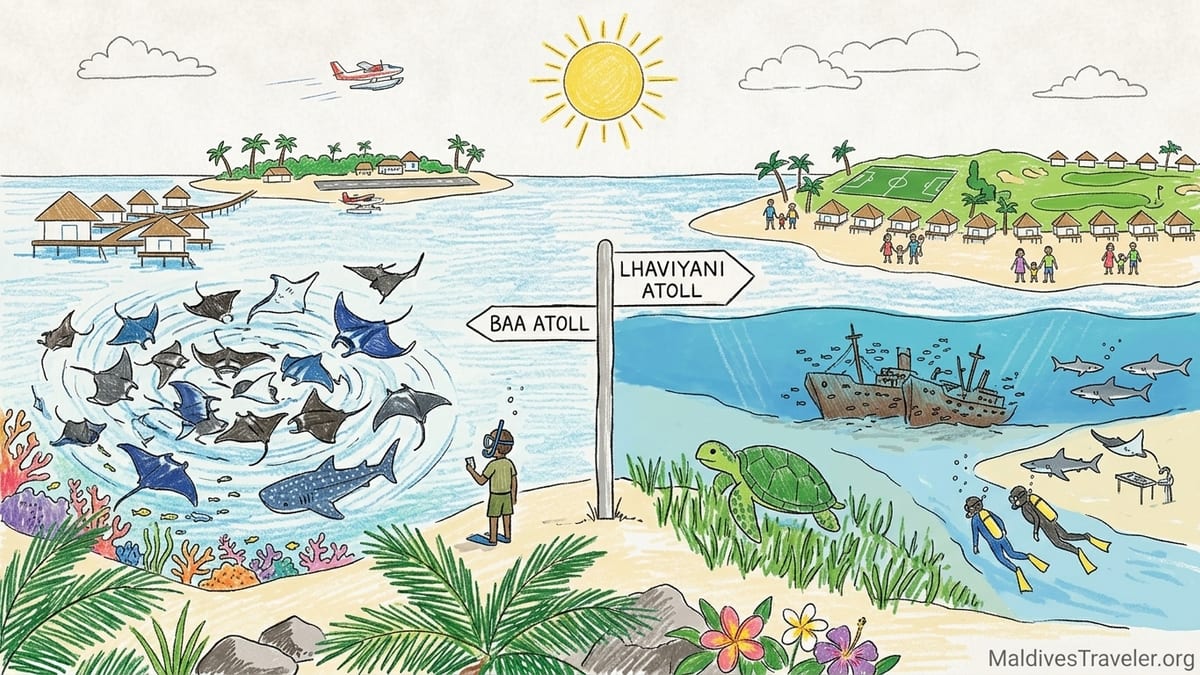
What I Expected From Baa and Lhaviyani Before I Went
On paper, Baa Atoll looked like the no-brainer. It is designated as a UNESCO Biosphere Reserve, and Hanifaru Bay within the atoll is one of the most famous seasonal manta aggregation sites in the world. Resort brochures promised “manta tornadoes” in a protected lagoon, and diving friends described Baa as the place where you go if you want the Maldives’ most iconic big-animal encounters in a relatively compact area. I expected serious marine protection, polished five-star resorts, and a slightly more exclusive, honeymoon-leaning atmosphere.
Lhaviyani Atoll, by contrast, had a very different reputation when I booked. Often called by its Dhivehi name Faadhippolhu, it is smaller, with 54 islands and just four inhabited ones, and is better known among divers than among general leisure travelers. The atoll kept coming up in conversations about channel diving, the Kuredu Express site, and the twin wrecks at the Shipyard, along with mentions of resident green turtles grazing the seagrass off Kuredu Island. I pictured a more easygoing, slightly less polished atoll with a spread of mid-range and upper-mid-range resorts.
I also assumed that logistics would favor Baa. Many marquee resorts such as Soneva Fushi and Amilla are used to handling complex itineraries and arranging seaplanes with their own lounges in Malé. I expected Lhaviyani to feel a little more out of the way and to depend more heavily on seaplanes that could be delayed by weather or daylight restrictions. In reality, transfer times and costs between the two atolls ended up being more comparable than I had imagined.
Finally, I expected that local-island access would be stronger in Baa, with its cluster of inhabited islands such as Dharavandhoo, Eydhafushi and Kamadhoo, where guesthouses have grown alongside the biosphere brand. Lhaviyani’s inhabited islands Naifaru, Hinnavaru, Kurendhoo and Olhuvelifushi receive relatively fewer visitors, and I imagined that stays there would be more limited to divers and repeat visitors than first-timers.
Where Baa Clearly Delivered More: Mantas, Biosphere Feel and Local-Island Choice
Baa’s defining advantage is hard to overstate. Hanifaru Bay sits within a legally protected marine area, with a dedicated conservation action plan and seasonal regulations on visitor numbers, entry times and interaction rules. When I visited in late August, the manta season was in full swing, with plankton-rich water drawing in dozens of animals at high tide on several days in a row. My most intense session involved around 40 mantas looping through the bay while at least two whale sharks ghosted along the edges. It was snorkeling only, strictly timed to about 45 minutes in the water, and monitored by rangers, but the density of animals in such a small sand-floored bay was unlike anything I experienced in Lhaviyani.
The wider biosphere designation is not just a badge. Baa’s reefs around Dharavandhoo, Dhigufaru and Donfan beyru felt carefully managed, with many resorts operating their own marine biology centers. At one Baa resort, the resident biologist hosted a nightly talk explaining coral restoration frames and manta ID catalogs linked to regional research initiatives. On dives, guides emphasized buoyancy control and “no-touch” policies, and the combination of schooling batfish, reef sharks and seasonal mantas made Baa feel like a living outdoor classroom for ocean lovers.
Baa also came out ahead in terms of local-island tourism and on-a-budget ways to tap into the biosphere. Dharavandhoo, which has its own domestic airport, has grown into a practical base for Hanifaru excursions, with guesthouses that can arrange manta trips at prices that are often half those charged by top-end private islands. Other islands such as Kamadhoo, Thulhaadhoo and Maalhos offer small guesthouses focused on snorkeling, sandbank picnics and cultural visits, giving Baa a richer portfolio for travelers who want to mix a few nights on a resort with a few on a local island.
Atmosphere-wise, Baa felt a bit more curated. Many of its best-known resorts occupy mid-size to large islands with manicured vegetation, overwater villa jetties curving into deep blue channels and lagoon sides reserved for families or quieter couples. The average nightly rate in Baa, particularly at Hanifaru-focused properties, tended to be higher than in Lhaviyani when checking mid-season dates, and the overall tone leaned more toward honeymooners, wellness retreats and high-end families who are comfortable paying premium rates for the biosphere halo.
Where Lhaviyani Surprised Me: Sharks, Turtles, Wrecks and Value
Lhaviyani’s biggest surprise was just how consistent the diving was. Kuredu Express, a sandy-bottomed channel dive at the atoll’s northeast edge, has a reputation that long predates social media. Drifting out along its terraces, watching grey reef sharks, eagle rays and big-eye trevally cruise in the current, I realized why it keeps appearing on lists of top Maldives sites. Several dives there delivered that classic channel feeling of hanging at the edge while life funnels past you, something I only found in a few Baa channels that still felt more dependent on timing and conditions.
The Shipyard was another highlight that Lhaviyani held over Baa. Two scuttled vessels sit just off an old industrial jetty, one hull still breaking the surface, creating an unusual two-wreck-in-one-dive profile. Descending along the superstructure, with glassfish swarming around the beams and fusiliers flashing over corals that have colonized the metal, felt like entering an underwater sculpture garden. Baa has interesting wrecks, but nothing that matches the combined visual drama and accessibility of these stacked ships in Lhaviyani.
At snorkel level, Lhaviyani quietly stole my heart through turtles. Kuredu’s lagoon has long been known for its resident green turtle population, which grazes on seagrass beds right off the beach. On some mornings I counted half a dozen turtles on a single 45-minute snorkel, surfacing near paddleboarders and beginners in rental masks. For families and new snorkelers, that kind of reliable, near-shore turtle encounter was much easier than the boat-based manta missions needed in Baa, and it felt less pressured and more open-ended.
Then there was the value proposition. Lhaviyani’s resort range spans classic all-inclusive islands such as Kuredu, intimate adults-only options like Komandoo and luxury all-inclusive retreats such as Kanuhura and Kudadoo. Looking at mid-season sample dates, nightly rates on several Lhaviyani islands were noticeably lower than Baa’s marquee biosphere resorts, sometimes by several hundred US dollars per night for comparable villa categories. That difference adds up quickly for a ten-night stay, especially for families booking two villas or a two-bedroom unit.
Manta Tourism vs Everyday Megafauna
Comparing manta experiences between the two atolls means comparing two different styles of wildlife encounter. In Baa, Hanifaru Bay is the main stage. Access is regulated, snorkeling is mandatory and dives are not allowed inside the bay itself. Trips usually leave from Dharavandhoo or nearby resorts in rigid inflatables or dhonis timed to the tide, and pricing from local islands can start in roughly the low hundreds of US dollars for a private boat or considerably less for shared excursions, depending on the operator and season. Success rates in peak season are high but never guaranteed; plankton and mantas do not read booking calendars.
In Lhaviyani, mantas are more part of the everyday atoll life. The atoll has a protected reef manta cleaning station visited by several resort dive centers, and channel dives occasionally produce passing mantas even out of the traditional southwest monsoon season. Sightings tend to be fewer animals at a time compared with Hanifaru Bay, but you are often on scuba, able to watch cleaning behavior at depth with fewer people in the water. On my Lhaviyani trip, I had three manta dives in a week without ever joining a dedicated manta-only excursion.
The emotional peak of a trip will differ depending on which style suits you. The frantic, almost overwhelming scene of dozens of mantas barrel-rolling around snorkelers in Hanifaru can feel like watching a wildlife documentary come alive, but it is compressed into a strict time slot with a crowd of boats waiting their turn. Lhaviyani’s mantas feel like a bonus folded into a broader pattern of sharks, turtles and reef life, woven into channel and cleaning-station dives that you would probably do anyway.
If I were planning a trip purely to maximize my chance of swimming with very large numbers of mantas in a single place, Baa would still be my choice, and I would time it for the traditional July to October period and stay near Dharavandhoo. If I wanted reliable encounters with a mix of megafauna over the course of a week’s diving, Lhaviyani’s channels and cleaning stations would be more appealing, with mantas as one part of a wider cast.
House Reefs, Wrecks and Everyday Snorkeling
House reefs matter more than many first-time visitors realize, especially if you plan to snorkel every day or want to avoid booking extra boat trips. In Baa, several high-end resorts are built around drop-off reefs where you can fin straight from the beach to coral walls dropping into blue water, with regular encounters with turtles, reef sharks and eagle rays. The best ones combine an inner, lagoon-side sandy area for children with a more exposed outer reef for confident swimmers. When I stayed in Baa, I could easily spend two hours a day just exploring the house reef at different tides.
Lhaviyani’s house reefs are more varied. Islands such as Komandoo and Hurawalhi offer accessible outer reefs with good coral growth and fish life, while larger islands like Kuredu have long lagoon sides that are friendlier to beginners but require a short swim to reach the more dramatic drop-offs. For some travelers, that is a plus: children can learn to snorkel in waist-deep, calm water before progressing to channels and reef edges by the end of the trip. Others may find that they need to join more boat trips to reach the most impressive coral.
The standout difference lies in wreck diving. Baa has a few small, resort-based artificial reefs and an interesting, deeper wreck or two, but Lhaviyani’s Shipyard and additional scuttled boats form a genuine underwater playground for wreck enthusiasts. Depths hover around recreational limits, and visibility is often clear enough to view an entire hull in one glance. Over a series of days, I found myself asking the dive center to alternate channel dives with wreck dives, something that Baa could not match without repeating the same sites.
For snorkelers who prioritize turtles over corals, Lhaviyani probably has the edge. I saw turtles daily around Kuredu and often from the jetty before even entering the water, while in Baa my turtle encounters were slightly more spread out between different reefs. For those who care more about varied coral topography and deeper walls, Baa’s house reefs felt more diverse overall.
Resort Choice, Transfers and Local-Island Opportunities
Both atolls are reached primarily by seaplane from Malé, with flight times generally between 25 and 40 minutes depending on the resort’s position within the atoll and any intermediate stops. Shared seaplane transfers across the Maldives typically cost several hundred US dollars per person for a round-trip, and both Baa and Lhaviyani largely sit in the band where seaplanes are used instead of speedboats. Timetables are limited to daylight hours, so early morning international departures sometimes require an overnight near the airport regardless of which atoll you choose.
In terms of resort styles, Baa leans slightly more toward high-end, design-led properties built around the biosphere narrative. Expect villas with private pools as standard, investment in wellness and sustainability programs, and multi-restaurant setups that encourage guests to stay on-island for most activities. Child-friendly facilities are abundant, but the ambiance still often feels tuned to couples who appreciate quiet decks and long degustation dinners.
Lhaviyani’s resort map is broader across price points. Kuredu Island Resort is almost a small town, with multiple pools, a golf course, football pitches and separate zones for families and adults. Komandoo is smaller and adults-only, attracting honeymooners who like the idea of a quiet island without children but at a lower price point than some of Baa’s five-star icons. Luxury-lovers can head to private-island concepts like Kudadoo, which build a high-end cocoon on top of the atoll’s strong diving foundation. This diversity made it easier to match friends and family with properties that fit their budgets without leaving the atoll.
Local-island opportunities are also distinct. In Baa, Dharavandhoo stands out as a practical hub with a domestic airport and several guesthouses that tap into Hanifaru excursions. Other islands such as Kamadhoo and Thulhaadhoo offer cultural immersion, crafts and access to nearby reefs, and the presence of multiple inhabited islands within the biosphere reserve creates a network of affordable stays that are connected by short boat rides.
Lhaviyani has fewer guesthouses overall, concentrated mainly on Naifaru, the atoll capital, and a handful on other inhabited islands such as Hinnavaru and Kurendhoo. Naifaru has local markets, government services and a small set of tourism businesses, including guesthouses and dive operators, but it receives a fraction of the independent travelers who head to Baa’s local islands. In practice, that meant that my Lhaviyani local-island visits felt more like excursions from resort bases than a separate, self-contained guesthouse stay. For some travelers, that low-key, less developed feel will be a plus; for others, the more established local-tourism ecosystem in Baa will be more convenient.
Families, Honeymoon Atmosphere and Overall Cost
Traveling first as a couple and later with a young niece, I felt the difference in family and honeymoon atmosphere between the atolls quite strongly. Baa’s flagship resorts understand families very well: kids’ clubs, shaded splash pools and family-friendly villa layouts are common. Yet because many of these properties also command high nightly rates and attract couples drawn by the biosphere story, public spaces remain surprisingly quiet. Long sandbanks, overwater villas and spa areas encourage that archetypal Maldives honeymoon image of two people walking alone at sunset.
Lhaviyani, on the other hand, felt more overtly sociable. On Kuredu’s main beach, families played beach volleyball alongside dive staff, and sunset bars filled with a mix of repeat guests, new divers comparing notes on the day’s channels and children running between tables. Komandoo and some smaller islands retain a romantic, adults-only feel, but the atoll as a whole came across as a place where mixed-age groups and dive clubs would be very comfortable.
Cost-wise, both atolls inherit the Maldives baseline of relatively high nightly rates and transfer fees compared with many beach destinations. Within that starting point, though, Lhaviyani generally offered more mid-range and upper-mid-range options, particularly when looking at all-inclusive packages that bundled meals, drinks and basic activities. Several Lhaviyani resorts priced their entry-level beach villas noticeably below comparable villas at Baa biosphere properties on the same set of random test dates, even after accounting for occasional discount offers and shoulder-season deals.
For honeymooners willing to splurge on a single, big-ticket trip, the cost difference may be acceptable given Baa’s biosphere prestige and manta focus. For families booking two rooms or for travelers planning longer stays of ten nights or more, Lhaviyani’s lower average rates and sociable resort layouts can deliver more days on the water for the same budget, particularly if you take advantage of long-stay discounts and all-inclusive deals.
Which Trip Type Suits Each Atoll
After back-to-back trips, I would not call an overall winner between Baa and Lhaviyani. Instead, I now think of each atoll as suiting distinct trip types. If I were planning a once-in-a-lifetime Maldives honeymoon with a strong focus on mantas and the idea of staying inside a UNESCO Biosphere Reserve, Baa would be my first choice. I would time the trip for the traditional manta season window, base myself either at a Hanifaru-access resort or on Dharavandhoo for part of the stay, and budget for higher nightly rates in exchange for the combination of marine protection, polished hospitality and that iconic Hanifaru Bay experience.
If I were organizing a dive-heavy trip with a group of friends, especially if some were Advanced divers keen on channels and wrecks, Lhaviyani would be the atoll I would book. Kuredu Express and the Shipyard provide reliable headline dives, house reefs cater to a range of abilities and the resident turtles and occasional mantas create variety between sharkier channels. The broader spread of resort price points also makes it easier to accommodate divers with different budgets without splitting the group across multiple atolls.
For a family trip with children who are just learning to snorkel, Lhaviyani has particular appeal. The waist-deep lagoons at big islands like Kuredu, the near-guaranteed green turtle sightings close to shore and the playful, community feel around sports pitches and informal sunset gatherings all help take the pressure off formal excursions. Parents can still schedule a few boat trips to channels or mantas, but much of the wildlife can be enjoyed from the house reef when it suits the family rhythm.
For repeat Maldives visitors who have already ticked off classic images of overwater villas and sandbanks and now want a deeper sense of place, Baa’s cluster of local islands within the biosphere reserve offers a gentle entry into mixed resort and guesthouse itineraries. You can spend a few nights on an inhabited island like Dharavandhoo, joining Hanifaru excursions from a community-run dive shop, then move to a resort without ever leaving the atoll’s protective umbrella.
The Takeaway
After experiencing both Baa and Lhaviyani firsthand, I would not frame the decision as a contest with a single winner. Baa stands out for its UNESCO designation, structured manta tourism and network of local islands tied to conservation and research. It delivers high-impact wildlife encounters and polished, often premium resorts that lean into the biosphere identity.
Lhaviyani, in contrast, wins on channel diving consistency, distinctive wrecks, easy turtle encounters and a broader spread of resort styles and price points. It feels like an atoll built around divers and sociable travelers, where mantas appear as part of a wider cast rather than as a single-ticket attraction.
For travelers choosing between the two, the decision comes down to which version of the Maldives you want right now. If your dream image involves floating in the middle of a protected bay as dozens of mantas sweep around you, framed by a strong conservation story, Baa is difficult to beat. If you imagine drifting past shark-filled channels, surfacing beside green turtles off a busy beach and sharing sunset drinks with a mix of families and divers, Lhaviyani may feel closer to your vision.
Both atolls reward return visits and careful timing. Neither will deliver the same experience twice, and in a country built on water and tides, that unpredictability is part of the appeal. The key is to map your own priorities to what each atoll does best, then let the plankton, currents and coral take care of the rest.
FAQ
Q1. Which atoll is better for seeing large numbers of manta rays in one place?
For dense manta aggregations in a compact area, Baa Atoll has the edge thanks to Hanifaru Bay, especially during the traditional July to October season when plankton blooms draw in large numbers of reef mantas.
Q2. Is Lhaviyani Atoll still good for manta encounters if I skip Baa?
Yes, Lhaviyani has a recognized manta cleaning station and seasonal sightings on channel and reef dives, but encounters tend to involve fewer animals at a time compared with the peak days inside Hanifaru Bay.
Q3. Where will I have a better chance of diving with sharks and exploring wrecks?
Lhaviyani generally offers stronger channel shark diving and more distinctive wreck sites, including the twin Shipyard wrecks, making it the better choice if channels and wrecks are your priority.
Q4. Which atoll is more suitable for a first-time Maldives honeymoon?
For a classic, high-end honeymoon with a focus on mantas and polished resorts, Baa Atoll is often the better fit, particularly if you can time your trip to the manta season and budget for higher nightly rates.
Q5. Which atoll works better for families with young children learning to snorkel?
Lhaviyani tends to suit families well thanks to its large, calm lagoons, easy access to turtles from the beach on islands like Kuredu and sociable resort layouts with plenty of informal activities.
Q6. Are seaplane transfer costs very different between Baa and Lhaviyani?
Seaplane transfers to both atolls generally fall in a similar price range per person for round-trips, and both are subject to daylight-only operations and potential weather-related delays, so cost and logistics are broadly comparable.
Q7. If I want to stay on a local island rather than a resort, which atoll is better?
Baa offers a more developed local-island tourism scene, particularly around Dharavandhoo and neighboring islands, while Lhaviyani has fewer guesthouses concentrated mainly on Naifaru and a small number of other inhabited islands.
Q8. Where will I find more mid-range and upper-mid-range resort options?
Lhaviyani generally has a broader spread of mid-range and upper-mid-range resorts, including large all-inclusive islands and smaller adults-only properties, giving more flexibility for travelers watching their budgets.
Q9. How should experienced divers choose between Baa and Lhaviyani?
Experienced divers who prioritize channels, sharks and wrecks often gravitate toward Lhaviyani, while those who want to combine solid reef diving with a strong focus on manta conservation and research may prefer Baa.
Q10. If I can only visit one atoll on a short trip, which should I pick?
If your main goal is to experience the UNESCO Biosphere Reserve and Hanifaru Bay, choose Baa; if you prefer varied diving, sociable resorts and strong value, Lhaviyani may be the smarter single-atoll choice.