


On paper, a family holiday to the Maldives looks effortless. Photos of smiling children in infinity pools and parents sipping coconuts under palms make it feel like an upscale version of a beach break in Spain. After a recent trip to Lhaviyani Atoll with my three children, aged 4, 8 and 12, I discovered that the reality is more complicated. Lhaviyani is an outstanding choice for families, with increasingly strong kid-focused resorts such as Kuredu, Six Senses Kanuhura and Jawakara. Yet the parts that glossy brochures gloss over are often the ones that define your experience, from the extra seaplane flight and baggage rules to what happens on day three of nonstop rain on a tiny island. This is what was genuinely harder, and easier, than I expected about doing Lhaviyani Atoll with kids.
The Hidden Challenge: Getting to Lhaviyani With Children
The single biggest shock of a family holiday to Lhaviyani Atoll is how long “arrival day” actually is. Most international flights from Europe land in Malé in the morning or early afternoon, but that is only the halfway point. To reach Lhaviyani, you add a seaplane or domestic flight plus speedboat. Resorts like Kuredu and Six Senses Kanuhura are typically a 35 to 40 minute seaplane ride from Malé’s Velana International Airport, and Jawakara runs on a similar pattern depending on your routing. That extra leg sounds romantic when you are booking, but after a 10-hour overnight flight with a four-year-old who has barely slept, it is another hurdle.
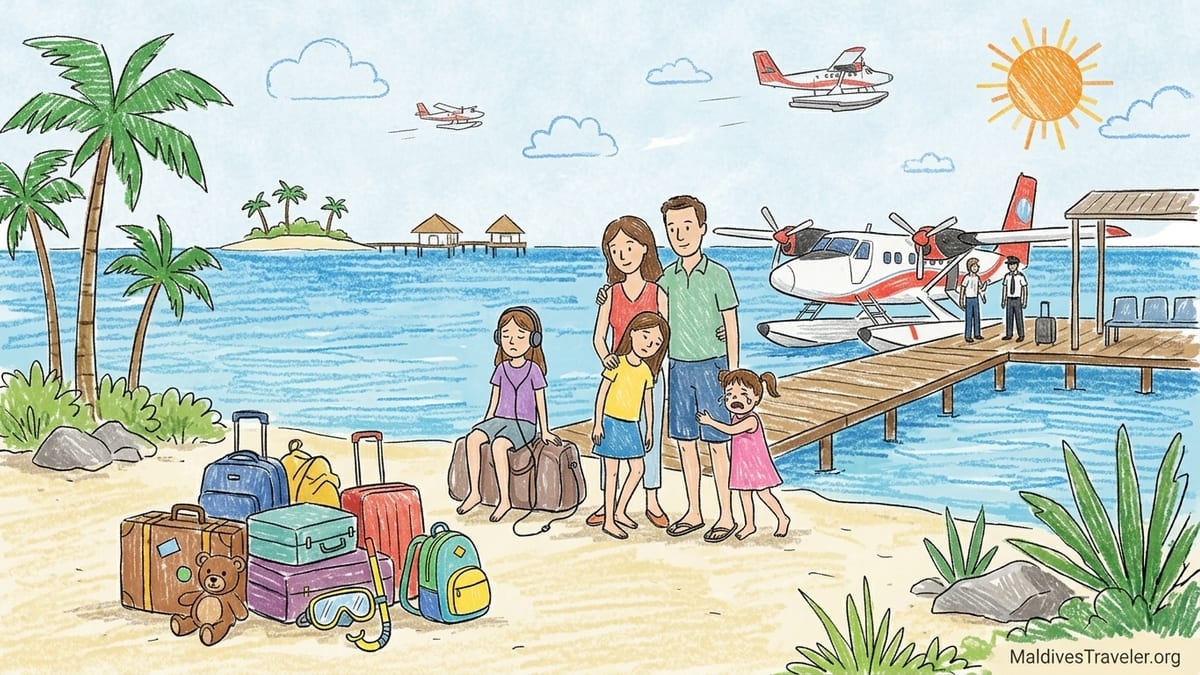
For us, the hardest moment came in the domestic seaplane terminal rather than on the aircraft. You often wait on comfortable sofas with soft drinks and Wi-Fi, but delays are common because seaplanes only operate in daylight and are batch-scheduled by demand and weather. With younger kids, a promised “40 minutes until boarding” that silently turns into 90 minutes is brutal. On our arrival, my eight-year-old zoned out against a backpack while my four-year-old became clingy and tearful, too wired to nap yet too tired to cope with one more ask to keep her shoes on.
Parents considering Lhaviyani should factor that your children may spend 16 to 20 hours in transit door to door, depending on connections. If you are coming from the United States, an east-coast family might fly overnight to the Gulf, have a layover, then a four-and-a-half hour hop to Malé, then the seaplane. It is doable, but it feels like a long-haul expedition rather than a two-step hop. I would not recommend tackling it with a baby and a toddler as your first big family trip abroad, unless you are very travel-hardened.
Age matters here. My 12-year-old coped surprisingly well, plugged into a podcast and fascinated by the seaplane. My eight-year-old oscillated between excitement and meltdown, while my four-year-old struggled most with the waiting. If your children are mostly under six, I would seriously weigh whether an atoll with a speedboat-only resort might be a softer first Maldives experience.
Baggage Allowances and Packing Stress
The other surprise is how the seaplane baggage rules, not your international airline, dictate what you pack. Operators such as Trans Maldivian Airways typically include an allowance of 20 kilograms of checked luggage plus 5 kilograms of hand luggage per paying passenger, with fairly steep per-kilo surcharges for extra weight. The exact figure can vary slightly between operators, but it usually sits around that 25 kilogram total. On a family booking, that sounds generous until you realise that snorkel gear, swim vests, nappies, beach toys and a few extra books or tablets all count against it.
We arrived at Malé with one suitcase per adult, one shared case for the three children and a carry-on bag that had swelled with airport snacks and spare clothes. At the seaplane check-in, everything went on the scale together. The staff were calm and used to families, but we still found ourselves hurriedly redistributing weight into the kids’ small backpacks to stay close to the included allowance. Standing in a warm, busy terminal repacking bags while a tired four-year-old clings to your leg is nobody’s idea of a luxury start to the holiday.
For Lhaviyani, packing light is not a minimalist virtue, it is a practical necessity. Resorts like Kuredu, Jawakara and Six Senses Kanuhura have laundry services, children’s menus and plenty of shared toys and inflatables available to borrow or buy. You really do not need multiple outfits per day for each child. Our 12-year-old lived in two swimsuits, two T-shirts and one sundress for dinners; our eight-year-old rotated three pairs of shorts and rash vests; our four-year-old had a few extra changes only because she still has the occasional spill. Once we stripped out “just-in-case” clothes and half the toys, we were well within the allowance.
The smarter approach is to focus your luggage on what is hard to replace: prescription medications, correctly sized sun protective clothing, favourite bedtime comforts, and perhaps your own children’s snorkel masks if they are nervous about rental gear. For everything else, it is easier to pay a little for resort laundry than to pay overweight baggage fees and manage unwieldy bags with kids in tow.
Transfers, Waiting and Managing Tired Kids
The mental image many parents have is of a seaplane taking off the moment you arrive. In reality, your resort arranges transfers based on your flight details, but exact timings are confirmed only a day before, and seaplanes operate from early morning until late afternoon. If your international flight is delayed and you land in Malé after about 3:30pm, you may miss same-day seaplane connections and face an unplanned overnight in Malé, which is nobody’s dream with small children.
Even when everything runs smoothly, there are multiple mini-waits. You wait for immigration. You wait for luggage. You wait while your resort representative walks you to a minibus that takes you to the seaplane terminal. You wait for check-in there. Then you wait in an air-conditioned lounge until your flight is called. Most lounges serving Lhaviyani resorts are comfortable, some with small play corners or colouring sheets, but very few have enough to entertain a four-year-old for more than 40 minutes. By the one-hour mark on our arrival, my youngest had explored every chair, every table bottom and every side of the glass windows.
Parents of older children, like my 12-year-old, will find this easier. She enjoyed watching the seaplanes landing and taking off, turning the wait into a kind of live documentary about island aviation. My eight-year-old was split: interested at first, then bored, then revived by snacks. If your children are under seven, come prepared with sticker books, downloaded shows and compact games that do not require much floor space. Consider splitting adult roles too: one parent handles check-in and bags, the other is in full-time entertainment mode.
The return journey is its own test. Seaplanes may be scheduled several hours before your international departure to allow for delays, which means leaving a sunny beach early to spend time in terminals. Our children found this more emotionally challenging than the outbound trip, because it feels like “wasting” precious holiday time. Framing the seaplane ride as a final adventure, and keeping one small “new” treat or game back for the journey home, helped ease that last-day drop.
Safety, Sun and Swimming Confidence on Tiny Islands
The image of children racing along an overwater villa deck looks enchanting. As a parent, standing on that same deck at 6:00am with jet-lagged children is a very different feeling. In Lhaviyani, resorts like Six Senses Kanuhura and Kuredu offer overwater villas, and Jawakara focuses more on beach and family villas. Most resorts accept children in overwater units, often with rules such as mandatory signed disclaimers and recommendations that children who stay in overwater villas can swim confidently.
We split our stay between a beach villa and a family overwater villa with pool. With our 12-year-old, who swims like a fish, the overwater part felt manageable. With the eight-year-old and especially the four-year-old, it meant a constant low-level hyper-alertness. Deck railings are solid but not childproof; gates to the sea steps exist in some villas but are not universal, and pool edges are open. We established firm rules on day one: no child was allowed onto the deck or near the pool without an adult, and the sliding doors stayed locked whenever we were not using the outdoor space. Even so, I slept more lightly than I ever have on a beach holiday.
If you are travelling with under-sixes or non-swimmers, a beach villa is significantly less stressful. Resorts such as Kuredu and Jawakara have dedicated family villas and two-bedroom beach options that open directly onto sand and shallow lagoon, which is a safer and more relaxed set-up. You still need to supervise near water, but you do not have the vertical drop from deck to sea that overwater villas create. Our four-year-old could build sandcastles a few metres from the shore while we sat on the deck steps and watched.
The sun is another area many brochures underplay. Lhaviyani lies just north of the equator and UV levels can be extremely high. Even in what locals consider mild conditions with some cloud, children can burn quickly, especially on the water where reflection intensifies exposure. We used long-sleeved UPF 50 rash vests and leggings for all three children, broad-brimmed hats and factor 50 sunscreen, and still limited the peak hours between about 11:00am and 3:00pm. On one overcast morning, I relaxed our routine and allowed the kids an extra hour in the lagoon without reapplying sunscreen; that evening, my eight-year-old had a faint but definite pinkness across the nose and shoulders.
Swimming confidence shapes almost every day in Lhaviyani. Shallow lagoons, like those off the family zones at Kuredu and Jawakara or in front of many beach villas at Six Senses Kanuhura, are a blessing. Our four-year-old pottered happily in knee-deep turquoise water chasing tiny fish, wearing a buoyancy vest. Our eight-year-old built confidence moving from waist-deep play to slightly deeper snorkelling alongside us. The 12-year-old spent long sessions exploring the house reef and dropped into a junior dive programme. If your children are not yet comfortable in water, consider starting swimming lessons months before your trip. It will transform how free you feel once you arrive.
Excursions, Age Restrictions and Medical Access
One of my biggest surprises was how many classic Maldives excursions have age limits that cut out younger kids. Many Lhaviyani resorts offer turtle snorkelling, manta ray trips in season, dolphin cruises, fishing, sandbank picnics and basic scuba experiences. Safety rules and insurance requirements mean that minimum ages are common. At family-focused resorts like Jawakara, for example, children as young as about eight can take part in dedicated child-oriented scuba or “Bubblemaker” style sessions in controlled conditions, but open-water dives and certain boat trips may have higher limits or require confident swimming.
Our 12-year-old was eligible for nearly everything, from guided reef snorkels to an introductory scuba dive with an instructor. Our eight-year-old could join the easier snorkelling trips but was excluded from longer reef excursions and any activity rated as more challenging. Our four-year-old was effectively limited to lagoon-based fun, glass-bottom boat rides and family-friendly dolphin cruises. She coped, but there were tears when big sister headed off to “swim with turtles” without her. If your children span a wide age range, as ours do, be realistic that you may spend part of the holiday in divide-and-conquer mode, with one adult doing higher-adrenaline activities with older kids while the other leans into sandcastles and kids club sessions.
Medical access is another under-discussed aspect. Lhaviyani is relatively well served compared to more remote atolls, and larger resorts often have a resident doctor or nurse and a first-aid room stocked for common holiday ailments. Ours handled a mild ear infection in our eight-year-old with calm efficiency: a quick examination, antibiotics from onsite stock, and follow-up checks. For more serious issues, however, evacuation back to Malé by speedboat or seaplane would be required, which is both time-consuming and expensive without good travel insurance. Families of children with chronic conditions or severe allergies should travel with a detailed medical kit, written summaries from home doctors and policies that explicitly cover medical evacuation.
Weather plays into this more than you might expect. Rough seas or heavy rain can delay transfers, complicating how fast you can reach more advanced care. While major incidents are rare, the psychological comfort of knowing you are properly insured and have medications to tide you over is worth more than yet another swimsuit in the suitcase.
When Paradise Rains: The Reality of Wet Days on an Island
The glossy imagery of Lhaviyani sells endless blue skies. In reality, even in drier months you can face several consecutive days of rain or at least heavy cloud and squalls. On a small island with no cars, no cinemas and limited indoor spaces, this can fundamentally change the feel of your family holiday. During our 10-night stay, we had three days of continuous grey with strong wind and intermittent downpours. The lagoon turned choppy, visibility dropped for snorkelling and boat excursions were cancelled for safety.
The first rainy day felt novel. The children splashed in warm puddles, did craft sessions in the kids club and declared the storm “exciting.” By the third, cabin fever was starting to bite. Our four-year-old, who thrives outdoors, grew snappier in confined spaces. The eight-year-old missed her daily snorkel and became restless. The 12-year-old retreated into a book and headphones. We cycled through board games, card tournaments, beach walks under umbrellas and every indoor kids club activity on the schedule.
Resorts differ in how robust their wet-weather programming is. Jawakara leans into its Jawa Kids and Teen Clubs, with cooking sessions, games and movie hours. Six Senses Kanuhura’s Grow With Six Senses concept layers in wellness, nature and creative activities that move easily indoors. Kuredu, with its larger size and multiple public areas, has more physical spaces to roam even when the sky is uncooperative. Before you book, it is worth asking the resort directly how often they run indoor kids club sessions, what age ranges they cover, and whether there are sheltered play spaces outside the formal club.
Age again shapes your experience. Our 12-year-old was content with a mix of reading, spa time with me and the occasional teen-focused event. The eight-year-old wavered but found her groove in arts and crafts workshops and baking sessions. The four-year-old needed more hands-on attention, rotating between the kids club playroom and “indoor beach” picnics on towels in the villa. If you are travelling in a shoulder or wetter season, it is worth packing a few backup indoor entertainments yourself, from lightweight Lego sets to drawing kits and a small Bluetooth speaker for dance parties.
What Turned Out Easier Than Expected
For all the challenges, several aspects of Lhaviyani with children were gloriously easy, and these are what will likely draw us back. The first is the sheer simplicity of car-free islands. Once you arrive on Kuredu, Jawakara or Six Senses Kanuhura, everything is within walking or buggy distance. There are no roads to cross, no traffic noise and almost no daily logistics. Our children could walk barefoot to breakfast, to the lagoon, to the kids club and back to the villa. The lack of cars allowed our eight-year-old and 12-year-old to roam short distances together, within agreed boundaries, building a sense of independence you rarely get at home.
The warm, shallow lagoons made daily life smoother than any pool complex I have experienced. Lhaviyani is known for clear, turquoise water and many resorts sit on wide lagoons protected by outer reefs. At Jawakara, our four-year-old could sit in water only up to her thighs ten metres from the shore, with virtually no current. At Kuredu, the main family areas front long sweeps of shallow water that felt like nature’s paddling pool. Our 12-year-old could snorkel just beyond, spotting parrotfish and rays, while we kept everyone in view from a shaded lounger.
Meal plans were another pleasant surprise. All three featured resorts run some form of half board, full board or all inclusive option, and several apply reduced prices or complimentary dining for younger children. Rather than obsessing over every ice cream, we chose a plan that covered buffet-style breakfast and dinner plus snacks and drinks in between at a set extra charge. This removed the mental math of every order and allowed the children to try local curries, fresh fish and new fruit without us worrying that three bites and a plate pushed away was a waste.
Kids clubs, particularly for our younger two, were more successful than we dared hope. At Jawakara, the Jawa Kids Club and Teen Club programmes leaned into the natural environment with marine-themed crafts, treasure hunts and beginner snorkelling practice in the shallows. Six Senses Kanuhura’s Grow With Six Senses concept used the kids club to introduce wellness and sustainability, from making mocktails with fresh herbs to learning about coral reefs. Kuredu’s family area programme ranged from football and beach games to simple Maldivian cultural introductions. Our four-year-old happily disappeared into the kids club for one or two sessions most days, while the eight-year-old dipped in and out depending on the activity. This gave us rare windows of adult time without feeling as if we had outsourced the entire holiday.
How Child Age Changes the Lhaviyani Experience
One of the consistent threads of our trip was how differently each child experienced the same island. Our four-year-old was rooted in the immediate: the texture of the sand, the novelty of geckos on the villa wall, the thrill of riding in a buggy. She cared little about house reefs or menus and a lot about nap timing, snacks and shaded corners. For parents of under-fives, your days will revolve around routines, naps and ensuring there are enough low-key, nearby diversions. A compact resort layout, a shaded kids pool and an indoor playroom matter more than the sophistication of dining or spa offerings.
Our eight-year-old bridged two worlds. She was old enough to snorkel in a life vest, join easy excursions and make friends in the kids club, but still young enough to tire early and get overwhelmed. She thrived on predictable rhythms: lagoon swim after breakfast, kids club session, lunch, afternoon rest, then early dinner. On days when we broke that pattern for a longer boat trip or late-night beach cinema, she became fragile the next day. For this age band, a medium-sized resort with plenty of choice but not too much walking, plus a strong kids club, hits the sweet spot.
The 12-year-old, entering early teen territory, experienced Lhaviyani almost like a soft adventure destination. She loved the sense of freedom, the ability to snorkel to the edge of the house reef with us, and the teen corners in clubs or lounges where she could play games or chat. Excursions were the highlight for her: turtle safaris, sunset cruises, beginner dives. She had the stamina for early seaplanes and late dinners as long as there was some say in the schedule. For families with pre-teens and teenagers, the key questions become about activity mix, Wi-Fi quality and subtle freedom rather than nap logistics.
Understanding where your children fall on this spectrum will help you select both resort and villa type. A family whose youngest is 10 will experience Lhaviyani as far easier and more flexible than one whose youngest is 3, even if they stay at the same property at the same time of year.
The Sweet Spot: Villa Type, Meal Plan and Resort Size for Families
After our trip, and speaking with other parents at Kuredu, Six Senses Kanuhura and Jawakara, a pattern emerged about what combination makes Lhaviyani feel easiest with kids. If budget allows, a two-bedroom beach or family villa on a medium-to-large island with strong kids and teen clubs, paired with a simple meal plan such as full board or a family-friendly all inclusive, removes many of the daily frictions.
On the accommodation front, the most relaxed families we met were in beach-based family villas. Kuredu’s two-bedroom beach villas and private pool family suites, Jawakara’s family villas on Mabin and Dheru, and the multi-bedroom beach retreats at Six Senses Kanuhura all share the same fundamental advantage: everyone sleeps under one roof, on land. Younger children can nap without you worrying about deck doors, and older ones can step straight onto the sand under your glance. Overwater villas can work beautifully for families whose youngest child is at least 8 and a confident swimmer, particularly in categories specifically designed as “family overwater villas,” but they demand more vigilance.
In terms of meal plans, I found full board or all inclusive to be the least cognitively demanding options for families in Lhaviyani. Once you accept that you are on a small island with resort pricing, it is a relief not to interrogate every juice or snack. At family-oriented resorts like Jawakara and Kuredu, buffet restaurants with live stations and dedicated children’s sections made it easy for our four-year-old to eat simply, the eight-year-old to experiment a little, and the 12-year-old to graze like a small adult. Half board can work well too if you are comfortable paying separately for lunches and drinks, but for many parents the simplicity of “almost everything is already covered” is worth a slightly higher headline rate.
Resort size plays a quieter but decisive role. Kuredu, with several hundred villas, feels like a busy, self-contained island with multiple pools, restaurant options and activity centres. That scale dilutes bad weather days and offers more to do but also means slightly longer walks and more people. Six Senses Kanuhura sits at a smaller, more boutique end of the spectrum, especially given its three-island set-up, which suits families who value space and a calmer vibe. Jawakara spans two islands with around 290 villas between them, landing somewhere in the middle and tilting strongly to families. For us, the “easiest” environment was a medium-sized property where our children could not get truly lost but did not feel constrained either.
If I had to pick a sweet-spot profile for Lhaviyani, it would be this: a ground-floor, two-bedroom beach or family villa on a medium-sized island with a good kids club and teen zone, booked on full board or a well-structured all inclusive plan, with the youngest child at least 6 years old and water-confident. At that point, the long journey and occasional rainy day still exist, but the daily reality drops from “logistical operation” to “genuinely relaxing family holiday.”
The Takeaway
Lhaviyani Atoll with kids is both more demanding and more rewarding than the brochures suggest. The long travel day, seaplane baggage rules, transfer waiting time, overwater safety considerations, intense sun, activity age limits, medical remoteness and the real possibility of several rainy days on a small island are not side notes. They are core parts of the experience and deserve as much attention in your planning as pool photos and villa decor.
At the same time, the car-free islands, warm lagoons, thoughtful kids and teen programmes, and almost total absence of day-to-day transport once you arrive make family life deeply simple in a way few destinations can match. For our family, the turning point came when we stopped trying to mould the Maldives into a standard beach resort break and instead accepted it as a remote island adventure with children, complete with its quirks and constraints.
If you walk into a Lhaviyani holiday understanding what will be harder, and intentionally choosing the villa type, meal plan, resort size and child age that suit your family, the rewards are immense. Your children will remember not just the colour of the water, but the thrill of their first seaplane take-off, the geckos on the villa wall, the excitement of spotting a turtle, and the shared intimacy of life on a tiny speck of sand in the middle of the Indian Ocean.
FAQ
Q1. Is Lhaviyani Atoll suitable for families with toddlers?
Families do travel to Lhaviyani with toddlers, but it is more demanding. The long international plus seaplane journey, waiting in terminals and overwater safety mean that it is generally easier once your youngest child is at least 4 to 6 years old and comfortable with some disruption to routine.
Q2. Should we choose a beach villa or overwater villa with young children?
For children under about 8, a beach or family villa is usually more relaxing. You avoid the constant supervision required around overwater decks and steps into deep water, and you gain easy access to shallow lagoon and sand play right outside your door.
Q3. How strict are seaplane baggage allowances for families?
Seaplane operators serving Lhaviyani commonly include around 20 kilograms of checked luggage and 5 kilograms of hand luggage per person, with extra charged per kilogram. Staff are used to families, but bags are weighed and overweight fees can add up, so it pays to pack light and share items between children.
Q4. What happens if our international flight is delayed and we miss the last seaplane?
If you land in Malé too late for same-day seaplane operations, your resort will usually help arrange an overnight stay in or near the capital and book you on the next available flight the following day. This can be stressful with children, so allowing buffer time in your arrival schedule and choosing flights that land before mid-afternoon reduces the risk.
Q5. Are there age limits for snorkelling and diving excursions?
Yes. Many guided snorkelling trips require children to be confident swimmers and set minimum ages, often around 6 to 8 for basic outings. Child-focused scuba experiences may start around 8 in controlled conditions, while full open-water dives and more challenging reef excursions have higher age and skill thresholds.
Q6. How strong is the sun in Lhaviyani, and how should we protect our kids?
The sun in Lhaviyani is intense, with high UV levels even on cloudy days. Long-sleeved UPF swimwear, broad-brimmed hats, factor 50 sunscreen and regular shade breaks are essential. Many families also avoid prolonged exposure between late morning and mid-afternoon, especially for younger children.
Q7. What medical facilities are available on Lhaviyani resorts?
Most larger resorts in Lhaviyani have an onsite clinic or first-aid room and at least a resident nurse or doctor for common issues like ear infections, minor injuries and fevers. More serious cases require transfer to better-equipped facilities in Malé, so comprehensive travel insurance that covers medical evacuation is important.
Q8. How do kids clubs work for different ages?
Resort kids clubs usually accept children from around 3 or 4 years old for supervised sessions, with separate teen areas and activities for older kids. Programmes in Lhaviyani often include crafts, games, simple marine education and beach play. Younger children may need a parent present for certain activities, while pre-teens and teens often have more freedom to come and go within set hours.
Q9. Which meal plan is most convenient for families in Lhaviyani?
Full board and all inclusive plans tend to be the most convenient options for families, since they cover most meals and often some drinks and snacks. This reduces daily budgeting stress and lets children try new foods without parents worrying about the cost of every extra dish.
Q10. What is the ideal child age to get the most out of a Lhaviyani holiday?
Many parents find that when the youngest child is between 6 and 10 years old, Lhaviyani becomes significantly easier. At that age, most children can handle long travel days, enjoy kids clubs and shallow snorkelling, follow safety rules around water and participate in more excursions, which opens up much of what makes the Maldives special.