

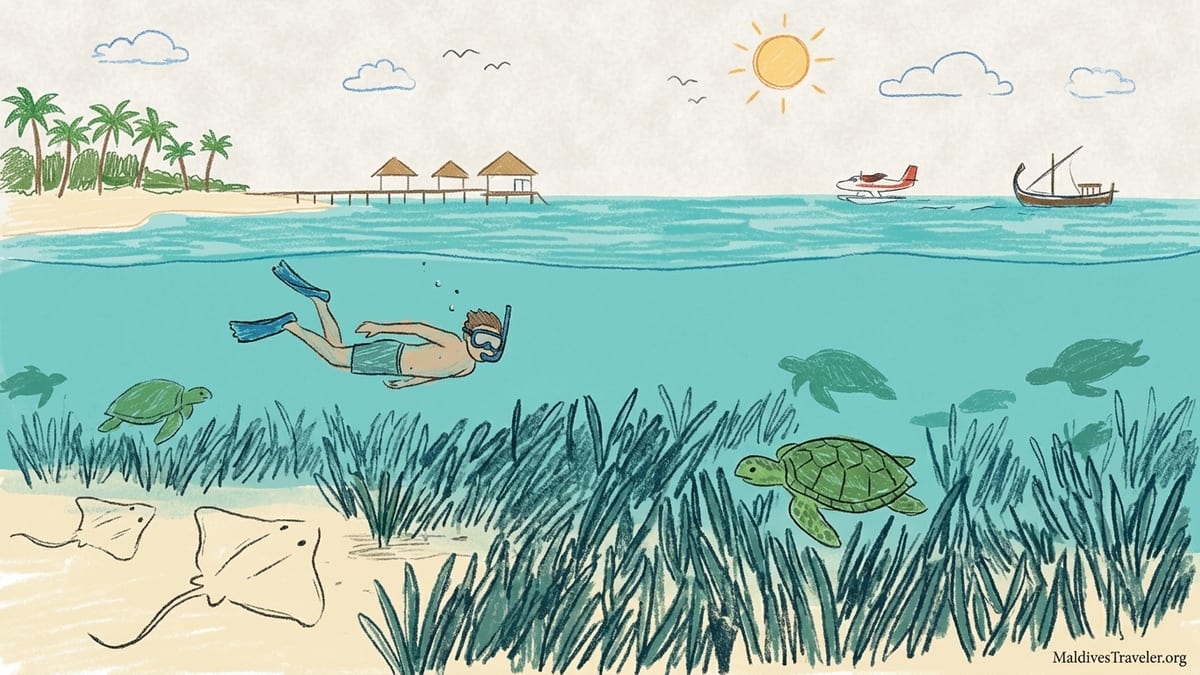
The first time I floated over Kuredu’s southern lagoon, it took just under five minutes for the first green turtle to rise out of the seagrass beneath me. By the time I swam back to shore, I had logged several encounters, a surprisingly long surface swim and a new respect for the scruffy underwater meadows that make this corner of Lhaviyani Atoll one of the Maldives’ most distinctive wildlife experiences.
Setting The Scene: Why Kuredu Is Known For Green Turtles
Kuredu Island sits on the eastern rim of Lhaviyani Atoll, about a 35 minute seaplane hop north of Malé. It is a relatively large resort island by Maldivian standards, with a three kilometre shoreline and a broad southern lagoon that looks, from the beach, like an easy paddle across a glassy turquoise swimming pool. That view hides what makes the place unusual: an expansive bed of seagrass that supports one of the most intensively documented green turtle populations in the country, monitored by the Olive Ridley Project from a marine biology centre based on the island.
Resort material and independent guides consistently point to a resident turtle population within the lagoon and on the house reef, with the resort itself promoting the fact that guests often meet turtles only a short distance offshore. Conservation reports and government assessments describe Kuredu’s seagrass as unusually extensive for the Maldives and highlight the high number of grazing green turtles that use the area. For travellers who care more about wildlife encounters than overwater villas, those dry descriptions translate into a realistic chance of sharing the lagoon with turtles on most calm days, provided you are willing to snorkel beyond the immediate shallows.
The atoll’s reputation is not just marketing language. Sea turtle identification projects run in Lhaviyani have logged well over a hundred individual green turtles around Kuredu alone, many photo identified on the lagoon side and along the northern house reef and nearby caves. Dive centres in the atoll refer to Kuredu as a green turtle hotspot, and experienced snorkelers familiar with multiple Maldivian resorts routinely single out the island’s seagrass meadows as one of the most reliable places to see the species without a boat trip.
This article focuses on what it is actually like to wade off the sand with mask and snorkel, where you have to swim to find the seagrass, how long the sightings take, and what happens when the lagoon feels strangely empty. Think of it as a field report rather than a brochure: times and distances are approximate, conditions change with tides and wind, and no wildlife encounter is guaranteed, but patterns emerge over several days in the water.
Entering The Lagoon: Where, How And First Impressions
The most convenient starting point for turtle-focused snorkelling on Kuredu is the broad main beach on the south side of the island. Imagine standing on the sand with the pool, reception area and southern jetty behind you. From here, the recommended entry is usually just to the left of the jetty when you face the ocean. The water in front is shallow for a long way, often knee to waist deep over pale sand with patchy seagrass before it deepens gradually towards the darker band that marks the main meadow.
On my first late-morning snorkel, the tide was midway and the lagoon calm, with a light onshore breeze. I waded out until the water reached my chest, put on fins and mask while still able to stand, and then kicked slowly along a line roughly parallel to the shore, angled slightly seaward. For the first 50 to 70 metres the bottom was mostly sand with scattered algae and isolated blades of grass, at a depth of 1 to 1.5 metres. Visibility hovered around 15 to 20 metres horizontally, with sunlight painting moving ripples on the seabed, enough to see detail on the bottom without feeling lost in open water.
Past that point, the colour of the lagoon began to shift from pale turquoise to a deeper green-blue. The depth increased to around 2 to 3 metres, and the seabed became visibly mottled with darker patches of seagrass. Small reef fish appeared, including juvenile parrotfish and groups of silvery fusiliers. Even before any turtles showed up, the lagoon felt alive and surprisingly textured, with changing sand ripples, stingray tracks and isolated coral blocks acting as quiet landmarks in an otherwise flat landscape.
This first leg from the beach to the edge of the main seagrass belt took about four to five minutes of slow, relaxed finning, covering an estimated 120 to 150 metres. Less experienced swimmers might take longer, especially if they pause frequently to adjust gear or settle nerves, but for anyone comfortable in the water it feels more like an easy warm-up than a demanding open-water crossing. Importantly, all of this swimming still happens inside the protected lagoon, with the reef crest and any strong outside current far away towards the horizon.
Into The Seagrass: Depth, Visibility And Why It Matters
The core of the experience begins when you reach the thicker seagrass meadows. Here the depth averages between 2.5 and 4 metres, enough that you cannot stand but shallow enough to see the bottom clearly when conditions are good. On clear mornings with light wind, visibility can reach 20 to 25 metres, though after strong wind or heavy rain it can drop, with suspended sand giving the water a milkier, green hue. Under the surface, the seagrass looks like a dense, ankle to knee high lawn, with individual blades swaying in the current and shoals of juvenile fish weaving in and out of the leaves.
It is tempting for first-time visitors to dismiss this as scruffy lagoon vegetation compared with postcard coral gardens. In reality, these meadows are the reason Kuredu has so many turtles. Green turtles shift to a vegetarian diet as they mature, and healthy seagrass beds become their principal feeding grounds. On Kuredu, government environmental assessments and conservation groups have repeatedly pointed out that the island’s wide, relatively undisturbed seagrass fields are unusual in the Maldives and directly responsible for the high turtle density recorded around the island.
From an ecological perspective, the seagrass beds also stabilize sediment, improve water quality and act as nurseries for a range of species. Juvenile parrotfish, surgeonfish and rabbitfish hide and graze in the blades before moving out to the reef. Stingrays comb through for buried prey, leaving circular depressions in the sand. The meadow also captures and stores carbon, adding to the case for leaving it intact. When resorts in the Maldives used to consider seagrass an eyesore and occasionally removed it to maintain bare-sand aesthetics, conservationists argued strongly for Kuredu’s approach of keeping it as a living habitat, not least because guests interested in turtles are increasingly aware of the link.
For snorkelers, there is a more immediate lesson. If you want regular turtle encounters on Kuredu without a boat, you have to be willing to leave the postcard shallows and swim over this greener, less glamorous zone. The payoff tends to come quickly on good days. During three morning snorkels in similar conditions, turtles appeared within three to seven minutes of entering the main seagrass area, often initially as dark silhouettes lying still on the bottom before resolving into the familiar oval shell and flipper outline.
Real Turtle Encounters: Numbers, Timings And Behaviour
On the best of my lagoon snorkels, I logged six individual green turtle encounters over about 45 minutes in the water. The first sighting came approximately eight minutes after I left the beach, once I had been over the denser seagrass for three or four minutes. The turtle was resting on the bottom at roughly three metres depth, facing slightly into the light current, with two remoras tucked under its plastron. I stayed at the surface, breathing calmly through the snorkel, and watched as it nipped methodically at the grass, pausing for several minutes before pushing off to ascend.
That first turtle set the tone. Over the rest of the swim, I saw two large adults actively grazing, one juvenile moving between patches of shorter grass, and two individuals gliding slowly just below the surface, presumably moving between feeding spots. At no point did I drop down to dive alongside them; instead, I maintained a respectful distance from the surface, generally three to five metres horizontally and looking slightly down and ahead so that the turtles remained within my peripheral vision rather than directly underneath.
Across multiple snorkels, the general pattern was similar. On an average day with calm water and reasonable visibility, two to four turtle encounters in a 30 to 45 minute lagoon snorkel felt normal, with the first sighting typically occurring within 5 to 15 minutes of leaving the beach. Some days were busier. One late afternoon, as sunlight slanted into the water and turned the grass almost bronze, I could see three turtles within the same broad field of view, two grazing and one rising to the surface. There is no formal guarantee of numbers, and all impressions are anecdotal, but when combined with long-running ID data, the impression that Kuredu’s lagoon supports a consistently high turtle presence feels well grounded.
Behaviourally, most turtles showed little interest in snorkelers who remained calm, horizontal and quiet at the surface. Individuals grazing on the bottom often continued feeding with occasional side glances upward, only moving away if someone tried to dive directly down or approached from in front of their head. Turtles cruising mid-water sometimes altered course slightly to maintain distance, especially from groups. None of the turtles I saw displayed rapid escape responses such as explosive kicks or sudden direction changes that would indicate acute disturbance, but several did veer away when snorkelers cut across their likely path to the surface.
Distance, Etiquette And Sharing The Lagoon With Others
Kuredu’s marine biologist and dive centre promote a turtle code of conduct that largely mirrors national guidance and conservation advice: do not touch, chase or feed turtles; keep a respectful distance; and never block their route to the surface. In practice, this translates into giving turtles at least two to three metres of space laterally, more if they are moving, and positioning yourself to the side rather than directly in front or directly above them. If a turtle chooses to swim closer of its own accord, you resist the urge to reach out and instead hold position, watching its route carefully until it has passed.
From the surface, breathing through a snorkel, maintaining that distance is easier than many people expect. The lagoon is wide, and the turtles compact but noticeable shapes on the bottom. On solo or small-group swims, it is simple to hang back, kick slowly to track a grazing turtle from several metres away, and then pause entirely while it rises for air. Where etiquette breaks down is usually in larger guided groups or when a particularly photogenic turtle surfaces close to several people at once, prompting underwater cameras and action cameras to surge forward.
On one guided outing with around ten participants, the group encountered a medium-sized turtle resting close to a sand patch at roughly three metres depth. Despite the guide’s briefing, four or five guests instinctively tried to dive down for close-up shots. The turtle responded by lifting off the bottom and moving away at a steady but noticeably faster pace, with flicks of its front flippers that looked sharper than the lazy strokes of undisturbed grazing. The guide intervened, signalling the group to stay at the surface and spread out. After a minute of patient floating, the turtle slowed again and resumed feeding further down the meadow, with the group observing from a healthier distance.
For snorkelers breathing at the surface, the key practical advice is to prioritise your own relaxed rhythm over any urge to keep up with faster swimmers. Concentrate on long, slow breaths and steady fin kicks, watch for signs of stress in turtles such as sudden course changes or repeated aborted attempts to surface, and be willing to abandon a particular animal if the situation feels crowded. Given the size of the seagrass area and the number of turtles known to use it, moving on often leads to a calmer encounter a few minutes later.
Currents, Safety And How Hard The Swim Really Feels
Despite being a lagoon, the water off Kuredu’s south side is not a static pond. Tidal movement can create a gentle but noticeable current running along the shore or diagonally across the seagrass meadow. On most of my snorkels, the current was light enough that I could comfortably swim against it at a slow pace, but on one day after several hours of wind the drift became strong enough that planning the direction of the swim mattered.
For safety and comfort, a common strategy is to begin your snorkel up-current from your intended finishing point. For example, if the current is running from east to west along the beach, you enter from the eastern section of the main beach, swim straight out to the seagrass, then let the current assist as you drift gently back towards the jetty area over the course of 30 to 40 minutes. This approach reduces effort, conserves air in your snorkel breathing and gives you more freedom to pause when turtles appear without worrying that you will have a hard slog back at the end.
In terms of distance, a typical turtle-focused loop from the beach, out to the main seagrass belt and back covers somewhere between 300 and 600 metres of swimming, depending on how much you meander and how long you spend tracking specific animals. Confident swimmers who are used to relaxed, continuous movement in open water will find this manageable, but those who only occasionally snorkel from the shore should be honest about their stamina. Lifejackets or snorkel vests provided by the resort can add a margin of safety, especially on the first day while you get used to the lagoon’s feel.
Conditions are not constant. Wind, tide and rain can all affect visibility and current strength. On windy afternoons, surface chop combined with a mild opposing current can make the return leg noticeably more tiring, even within the lagoon. During one such session, I cut the snorkel short after around 20 minutes and two turtle sightings, choosing to angle back towards shore rather than continue further out where the grass looked thicker but the swim home less certain. That decision did not feel dramatic, but it is precisely the kind of judgment call that keeps lagoon snorkelling relaxed rather than stressful.
When The Turtles Are Shy: A Low-Sighting Day
No matter how many resident turtles live around Kuredu, not every snorkel will deliver the encounters visitors imagine. One overcast morning, following a night of moderate wind and scattered showers, I entered the lagoon from the same point on the main beach and followed the now familiar route out over the seagrass. Visibility was clearly reduced, perhaps 8 to 10 metres at best, with fine sediment hanging in the water column and the sun a pale disc behind cloud.
For the first 20 minutes, the lagoon felt quiet. There were still fish in the grass, including goatfish, juvenile snappers and small groups of batfish, plus the occasional stingray flush from the sand, but no sign of turtles. I adjusted my path slightly, zigzagging across the meadow and pausing above promising looking clearings where grazed circles in the grass suggested recent feeding. Occasionally a darker patch on the bottom resolved into a coral rock rather than a resting shell. The lack of turtles did not make the snorkel boring, but it did recalibrate expectations after the previous day’s abundance.
Eventually, at around the 25 minute mark and close to the point where I had planned to turn back, a juvenile green turtle appeared out of the murk, already kicking upward for air. It surfaced 5 to 6 metres away, exhaled in a brief spray of bubbles, drew three quick breaths and then dropped back toward the bottom, where it landed in a patch of shorter grass. I watched from the surface for several minutes, but the reduced visibility meant that the animal faded in and out of view whenever it moved more than a few metres away.
On that snorkel, I logged only the single turtle encounter in roughly 35 minutes of swimming, despite covering a similar area to the previous, more productive days. Back on shore later, staff at the dive centre mentioned that windy nights and stirred-up sediment often make turtles harder to spot, and that on such days they may shift slightly to deeper or clearer sections of the lagoon or house reef. For travellers who only have a few days on the island, this kind of natural variability is important to keep in mind. Kuredu offers good odds, not guarantees, and building in several snorkelling windows across your stay significantly increases the chances of a memorable interaction.
Independent Snorkel Or Guided First Time, And Are Turtles Enough Reason To Choose Kuredu
After multiple days in the water, one practical question remains: should a confident beginner attempt the lagoon turtle snorkel independently on day one, or start with a guided session from the resort’s dive and snorkel centre? For guests who are strong swimmers, comfortable in deep water and experienced with basic snorkel gear, heading out from the beach alone or with a partner is realistic, as long as conditions look calm and you follow the resort’s safety guidelines. The route from the main beach to the seagrass is straightforward, the lagoon is sheltered compared with outer-reef sites, and staff are used to pointing guests towards the right area and advising on tides.
For true beginners, hesitant swimmers or anyone unfamiliar with reading currents, a guided first snorkel is a sensible investment. The resort’s marine biologist and snorkel guides run regular turtle-focused lagoon trips, usually timed for favourable light and tide. These outings include a briefing on turtle behaviour, distance rules and local conditions, as well as in-water supervision. On my guided session, having a local guide who knew exactly where the seagrass meadows were thickest dramatically cut the time to first sighting, and the presence of a surface float offered an extra sense of security for less confident members of the group.
As for whether turtles alone justify choosing Kuredu over other Maldivian islands, the answer depends on your priorities. If your main goal is frequent, unguided encounters with green turtles from the beach, without relying on boat trips, Kuredu’s combination of extensive seagrass, documented resident population and accessible lagoon makes a strong case. There are other Maldivian resorts with good turtle snorkelling, but relatively few combine such a broad, near-shore feeding ground with an on-island research presence that has catalogued individual animals for years.
However, islands are rarely about a single experience. The same lagoon also hosts rays and reef fish, and the house reef and nearby channels are known for sharks and larger pelagics, making Kuredu appealing to mixed groups where some members dive while others snorkel. The island’s size, range of accommodation and social energy will not suit travellers seeking minimalist, boutique quiet, but for many visitors the chance to swim repeatedly with wild turtles within a few fin kicks of the beach becomes a highlight that shapes how they remember the trip. If green turtles sit high on your wish list and you are happy to embrace the unglamorous beauty of seagrass meadows, Kuredu is one of the more convincing arguments in the Maldives.
FAQ
Q1. How far from the beach are the main turtle seagrass beds at Kuredu?
The denser seagrass meadows where turtles are most often seen usually begin roughly 120 to 200 metres from the southern main beach, in water around 2.5 to 4 metres deep, though exact distances vary with tide and your entry point.
Q2. How long does it typically take to see the first turtle when snorkelling the lagoon?
On calm, clear days many snorkelers report their first turtle within 5 to 15 minutes of leaving the beach, though on windier or murkier days it can take 25 minutes or more, or you may see none at all.
Q3. How many turtles can I realistically expect to see on one snorkel?
On average, two to four turtle encounters during a 30 to 45 minute lagoon snorkel seem common in good conditions, with occasional sessions delivering more and some producing only one or even no sightings.
Q4. What is a responsible distance to keep from turtles while snorkelling?
A practical guideline is to maintain at least two to three metres of space laterally from any turtle, remain at the surface rather than diving down above them, and avoid blocking their path to open water or the surface.
Q5. Do I need to dive down to enjoy the turtle encounters, or is surface snorkelling enough?
Surface snorkelling is sufficient for rewarding encounters. The lagoon is shallow enough that you can observe turtles clearly from above while breathing through your snorkel, without needing to free dive or approach closely.
Q6. Is the current in Kuredu’s lagoon strong enough to be dangerous for beginners?
Most days the lagoon current is gentle, but it can strengthen with wind and tide. Beginners should check with the dive or snorkel centre before entering, stay within sight of the beach and consider using a snorkel vest or jacket for added safety.
Q7. Are the seagrass beds a sign of an unhealthy lagoon?
No, in this context the seagrass meadows are a positive sign. They provide essential food for green turtles, shelter juvenile fish, stabilise the seabed and store carbon, so their presence is part of what makes Kuredu’s lagoon ecologically important.
Q8. What equipment should I bring or rent for a turtle-focused snorkel at Kuredu?
A well-fitted mask, snorkel and fins are essential, and many visitors also use a light rash vest or short wetsuit for sun and jellyfish protection. The resort can usually provide rental gear and buoyancy aids if you do not bring your own.
Q9. Can children or less confident swimmers safely join a lagoon turtle snorkel?
Yes, provided they are supervised, wear appropriate flotation and conditions are calm. For families and nervous swimmers, joining a guided lagoon snorkel with a local guide is often the safest and most reassuring introduction.
Q10. If I care mainly about turtles, should I still book guided boat trips or stay with the house lagoon?
If your priority is maximising turtle time, starting with several lagoon snorkels from the beach makes sense, then adding a guided boat trip if you want variety or different habitats. The lagoon often delivers frequent turtle encounters without leaving the island.