


The Southern Maldives feels like a different country from the polished postcard of the central atolls. Fewer people make it this far down the Indian Ocean chain, but those who do find raw reef walls, serious shark encounters, sleepy local islands and a slower, more grounded version of Maldivian life. If you are planning your first trip and wondering whether to go beyond the usual resort ring around Malé, this guide explains what “Southern Maldives” really means, how it differs from South Malé Atoll, and what to expect in Huvadhoo (Gaafu), Fuvahmulah, Addu and Laamu.
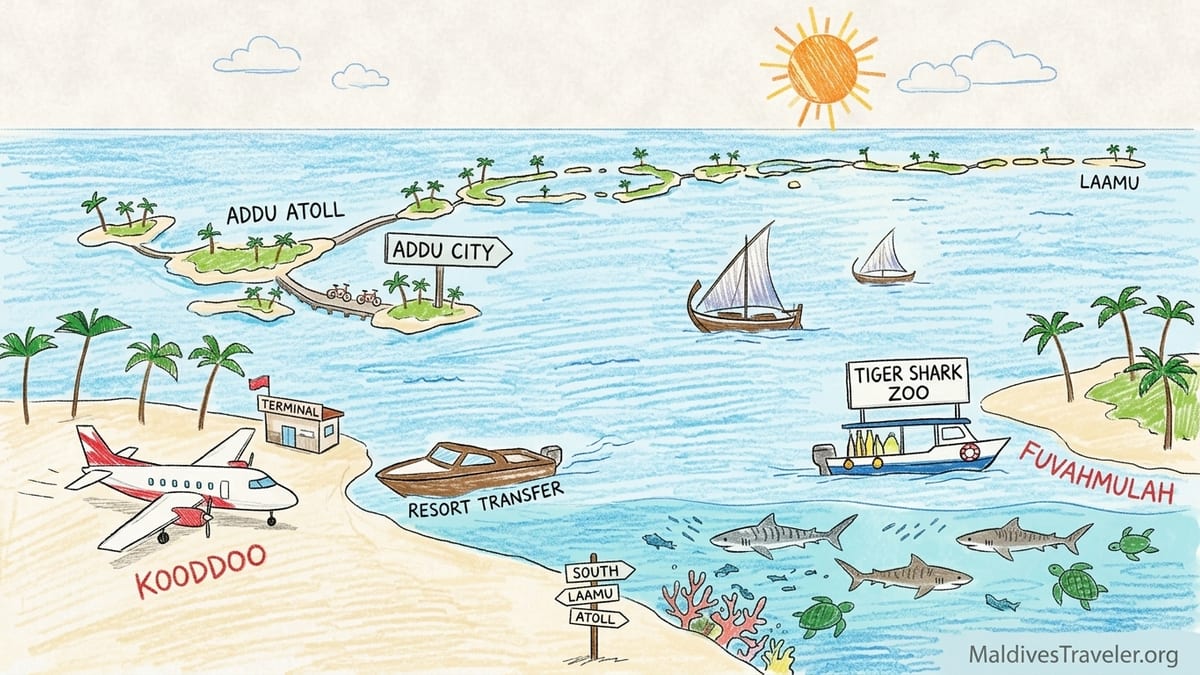
What Travelers Really Mean by the Southern Maldives
When travelers talk about the “Southern Maldives,” they are not referring to South Malé Atoll, which sits just below the capital and is one of the most developed parts of the country. Instead, the phrase usually describes the chain of atolls that begin several hundred kilometers south of Malé: Huvadhoo (often split into Gaafu Alifu and Gaafu Dhaalu), the single-island atoll of Fuvahmulah, Addu Atoll at the southern tip, and, as a northern extension, Laamu. These atolls sit well below the main tourist belt and feel noticeably more remote.
The confusion starts because South Malé Atoll is geographically “south” of Malé and packed with well-known resorts like Olhuveli and Cocoa Island. It is connected by quick speedboat transfers from Velana International Airport and has heavy seaplane traffic overhead. By contrast, the Southern Maldives in the travel sense almost always involves a domestic flight. You might fly from Malé to Kooddoo in Huvadhoo, to Fuvahmulah Island, to Gan in Addu City, or to Kadhdhoo in Laamu before any speedboat or car transfers.
On a map, a southern itinerary might link several of these regions by domestic hops. A typical example is a week at Mercure Maldives Kooddoo Resort in Gaafu Alifu, followed by three or four days diving with tiger sharks in Fuvahmulah, and then a couple of nights in Addu’s Equator Village near Gan. This style of trip feels more like traveling between mini-destinations than staying on a single resort island, and that is part of the appeal.
Another key distinction is density. Around Malé, every horizon seems to reveal another resort. In the far south, you can still sail between channels in Huvadhoo or along Addu’s outer reef without seeing a single other dive boat. For many divers and independent travelers, that emptier seascape is a major reason to look beyond the central atolls.
Key Regions: Huvadhoo, Fuvahmulah, Addu and Laamu
Huvadhoo, often referred to by its administrative names Gaafu Alifu and Gaafu Dhaalu, is one of the largest and least developed atolls in the country. It is served mainly by Kooddoo and Kaadedhdhoo domestic airports. Resorts like Mercure Maldives Kooddoo and Park Hyatt Maldives Hadahaa use these airports as gateways, with short speedboat rides to their private islands. Several local islands, such as Thinadhoo and Vilingili, host guesthouses that cater to divers and surfers looking for a quieter base than the big-name resorts.
Fuvahmulah is completely different. Instead of a ring-shaped atoll, it is a solitary island that rises steeply from deep ocean. There are no classic lagoon resorts here, just a low-key Maldivian town with guesthouses, dive centers and a small domestic airport. Visitors stay on land and boat out for day diving. Many come specifically for tiger shark encounters at sites often marketed as guaranteed, such as “Tiger Zoo,” run by operators like Pelagic Divers Fuvahmulah and Fuvahmulah Dive School, which focus on close but managed shark experiences.
Addu Atoll, also known as Seenu, is the country’s southernmost atoll and its second main urban center. Multiple inhabited islands are linked by a causeway, so you can drive or cycle between Hithadhoo, Maradhoo, Feydhoo and Gan. Gan International Airport connects Addu with Malé in about 90 minutes on domestic carriers, and in some seasons with international flights from Colombo. Private-island options include Canareef Resort Maldives and South Palm Resort Maldives, while Hithadhoo and Gan host small guesthouses for budget travelers and divers who want easy access to reefs and the British Loyalty shipwreck.
Laamu sits slightly closer to Malé but still feels like an outpost compared with the central atolls. Kadhdhoo Airport provides domestic access, and boats fan out from there to private-island resorts like Six Senses Laamu as well as to nearby local islands. Laamu has become known for consistent waves at surf breaks such as Ying Yang and for manta ray cleaning stations around the atoll channels, making it an appealing bridge between a classic resort experience and the wilder south.
Private-Island Resorts vs Local-Island Stays
The southern atolls offer a classic Maldivian choice between all-inclusive private-island resorts and more affordable stays on local islands. In Huvadhoo, the resort cluster includes Mercure Maldives Kooddoo Resort, located on the same island as the domestic airport, and Park Hyatt Maldives Hadahaa, which requires a speedboat transfer further into the atoll. Nightly rates can vary widely, from approximate low-season prices around the mid-hundreds of US dollars for an entry-level beach villa at Mercure, to significantly higher prices at luxury properties like Park Hyatt, depending on the season and promotions.
On local islands such as Thinadhoo in Gaafu Dhaalu or Fuvahmulah City itself, guesthouses typically start in a much lower bracket for basic double rooms, often including breakfast. These stays feel less polished than resort life but give you walkable access to local cafes, small supermarkets and everyday island rhythms. In Fuvahmulah, for instance, a diver might book a package that combines guesthouse accommodation, domestic flights and multiple dives per day with a specialist operator instead of paying resort rates for each component.
Addu offers an interesting middle ground. Canareef Resort Maldives and South Palm Resort function as classic private islands, but Addu City’s causeway-linked islands support a modest guesthouse scene where you can rent bicycles, explore WWII-era remains, and eat at simple local restaurants. Equator Village, converted from former Royal Air Force buildings near Gan Airport, combines resort-style facilities with easy access to local life, making it appealing to travelers who dislike feeling sealed off from the community.
In Laamu, Six Senses Laamu stands out as a high-end private island with a sustainable focus, reached by a domestic flight to Kadhdhoo followed by a short boat ride. It attracts a mix of honeymooners, surfers and divers. Around Kadhdhoo and nearby local islands, small guesthouses and surf camps cater to travelers who want access to the same waves and reefs at a lower price point, albeit without the spa, villa or butler trappings of the resort world.
Diving, Sharks, Mantas and Reefs in the Deep South
Diving is the main reason many first-time visitors choose the Southern Maldives over the more settled central atolls. Huvadhoo is known among liveaboards and experienced divers for its wide channels, drift dives and strong currents that attract grey reef sharks, silvertips and schooling barracuda. Resorts such as Park Hyatt Maldives Hadahaa and guesthouse-based operations on islands like Thinadhoo arrange daily boat dives into outer reef channels where encountering dozens of reef sharks on a single dive is not unusual during the right season.
Fuvahmulah has become one of the world’s headline destinations for tiger shark encounters. Unlike many Maldivian dive areas that focus on reefs and channels, much of Fuvahmulah diving takes place along sheer walls dropping from around 5 to 45 meters before plunging into blue water. Dive sites around the island attract large pelagic species, including resident tiger sharks that are often seen on every dedicated shark dive, alongside occasional hammerheads, thresher sharks and oceanic manta rays. Operators structure the day so that divers typically do one tiger shark dive and two reef or blue-water dives, with briefings that emphasize body positioning, eye contact and respect for shark behavior.
Addu Atoll offers a more traditional reef-diving profile but with some unique highlights. The British Loyalty shipwreck, a WWII-era tanker lying between roughly 16 and 33 meters, is one of the Maldives’ most accessible large wrecks. Outer reef sites host manta cleaning stations during certain seasons, and divers often combine a morning wreck dive with afternoon reef drifts to see turtles, eagle rays and schooling jacks. Because Addu sees fewer divers than popular central atolls like Ari, even well-known sites rarely feel crowded.
Laamu bridges these experiences with a mix of manta encounters, channels and outer reefs. Guests at Six Senses Laamu, for example, may have house-reef dives with turtles and reef sharks as well as boat trips to manta cleaning stations, while independent divers staying on nearby local islands head to many of the same sites with smaller, local outfits. Across all of the southern atolls, visibility and pelagic activity tend to peak from roughly December to April, though sharks and mantas can appear at any time of year and exact timing varies by micro-location and weather.
Getting There: Domestic Flights and Transfers
Reaching the Southern Maldives almost always involves at least one domestic flight after you land at Velana International Airport near Malé. Huvadhoo is served by Kooddoo Airport in Gaafu Alifu and Kaadedhdhoo in Gaafu Dhaalu. Many resort packages bundle the 60 to 90 minute domestic flights with speedboat transfers so you do not need to book separate tickets. For instance, a stay at Mercure Maldives Kooddoo might include a domestic flight segment from Malé directly onto the island’s airstrip, followed by a two-minute buggy ride to reception.
Fuvahmulah has its own small airport that handles direct domestic flights from Malé. Tiger shark dive packages often include return flights, airport pickup, accommodation and a set number of dives to simplify logistics. On arrival, guests usually transfer by van to their guesthouse within minutes. Because dive centers are clustered around the harbor, daily boat departures feel more like small expeditions than resort excursions.
Addu’s Gan International Airport is the main southern gateway, with daily domestic flights from Malé and occasional regional services from cities like Colombo depending on the season. From Gan, you can reach resorts like Canareef or South Palm by speedboat in roughly 10 to 30 minutes, or stay close to the airport at Equator Village. Local taxis and hired bicycles make it easy to move along the causeway that links Gan, Feydhoo, Maradhoo and Hithadhoo, so staying on a local island does not require relying on boats for every errand.
Laamu’s Kadhdhoo Airport sits closer to Malé than Huvadhoo or Addu but still requires a domestic hop. Most visitors arrive on a scheduled flight of under an hour, then transfer by speedboat to their resort or local-island guesthouse. Compared with the central atolls, domestic flights will add noticeable cost to your trip, especially for couples or families, so it is worth factoring those segments into your budget early and checking whether your chosen resort or dive center can bundle tickets at a slightly lower rate than booking independently.
Beaches, Everyday Life and How the South Feels Different
On the surface, a white-sand beach in Huvadhoo looks much like a white-sand beach in South Malé Atoll, but the rhythm of life around it is different. Private islands in the south tend to feel quieter and more self-contained than busy resorts closer to Malé. You might share the sunset bar at Park Hyatt Hadahaa or South Palm Resort with a few dozen guests instead of the hundreds seen at some mega-resorts in the central atolls. Night skies can feel darker and more star-filled because there is less light pollution from neighboring islands.
Local islands are where the difference becomes more obvious. Fuvahmulah has paved roads, small cafes, motorbikes and a lived-in atmosphere that is closer to a provincial town than an idyllic sandbar. Addu’s causeways allow you to cycle for kilometers past schools, mosques and harbors, stopping at open-air tea shops or small bakeries that serve short eats and sweet milk tea. Huvadhoo’s local islands are quieter, but even there the soundscape includes roosters, call to prayer and children playing football rather than only the soft background music of a resort pool.
Beaches on local islands often have designated bikini beaches where visitors can swim in regular swimwear while the rest of the shoreline follows local dress norms. Facilities can be basic: a handful of loungers, some natural shade and perhaps a small snack kiosk. By contrast, resort beaches come with full service, bars and watersports centers. In the south, though, both types of beaches are more likely to feel empty. Walk a few minutes beyond the main stretch on Fuvahmulah’s Thoondu pebble beach or along the outer shore of a Huvadhoo local island and you may find yourself alone with the surf.
For many first-time visitors, the trade-off is between the simplicity of a resort stay and the deeper sense of place offered by local islands. The Southern Maldives leans toward the latter. English is widely spoken in tourism settings, but you will hear more Dhivehi in the streets, and conversations with local dive guides or guesthouse owners often become part of the experience.
Planning Your First Southern Maldives Itinerary
Designing a first-time itinerary starts with deciding how many domestic flights you are comfortable with. An accessible option is to pick one core base in the south and stay there for a week. For example, you might fly to Gan, spend five nights at Canareef Resort or Equator Village to combine reef diving, the British Loyalty wreck and cycling along the causeway, then finish with two nights at a guesthouse in Hithadhoo for a more local feel. This keeps transfers simple while giving a taste of both resort and local life.
A more dive-focused trip might center on Huvadhoo or Fuvahmulah. In Huvadhoo, you could stay at a local island guesthouse that runs dedicated channel diving, aiming for two or three dives on outer reefs most days. In Fuvahmulah, a typical one-week shark package might include around 10 to 15 dives, mostly centered on tiger shark interactions plus some deeper blue-water or reef dives. Operators often recommend that divers have at least Advanced Open Water certification and be comfortable in currents before attempting some of the more demanding sites.
For travelers with more time and budget, a multi-stop route that stitches together Laamu, Huvadhoo, Fuvahmulah and Addu is possible using domestic carriers. You might surf and snorkel around Laamu for four nights, transfer south to Huvadhoo for channel diving, jump across to Fuvahmulah for tiger sharks, and end in Addu for wrecks and cycling. This starts to resemble a mini-expedition, with each atoll offering a distinct character. The key is to allow buffer days for weather-related delays and to book domestic segments early in peak season when flights can fill with resort guests.
Regardless of the route, it helps to plan around the broad dry season from about December to April if you prioritize visibility and calmer seas. Shoulder months can still offer excellent conditions, often with slightly lower prices, but monsoon transitions sometimes bring choppier crossings that may be uncomfortable if you are prone to seasickness. Because infrastructure in the south is lighter, a delayed flight or rough seas have more impact on daily plans than they would in the Malé region, so staying flexible is part of the experience.
FAQ
Q1. What exactly counts as the Southern Maldives for travelers?
The Southern Maldives usually refers to Huvadhoo (Gaafu Alifu and Gaafu Dhaalu), Fuvahmulah, Addu Atoll and often Laamu as a northern extension, rather than South Malé Atoll.
Q2. How is the Southern Maldives different from South Malé Atoll?
South Malé Atoll sits just below the capital and is packed with resorts reachable by speedboat, while the Southern Maldives involves remote atolls that require domestic flights and feel far less developed.
Q3. Is the Southern Maldives suitable for a first trip to the country?
Yes, if you are comfortable with longer transfers and want quieter islands, serious diving and more local culture. For quick, simple resort breaks, the central atolls are easier.
Q4. Do I need to be an experienced diver to visit places like Fuvahmulah and Huvadhoo?
For shark-heavy channel dives and Fuvahmulah’s tiger shark sites, Advanced Open Water certification and comfort in currents are strongly recommended, though some operators tailor gentler dives for less experienced guests.
Q5. Are there all-inclusive private-island resorts in the Southern Maldives?
Yes. Examples include Mercure Maldives Kooddoo and Park Hyatt Maldives Hadahaa in Huvadhoo, Six Senses Laamu in Laamu and Canareef Resort Maldives and South Palm Resort in Addu.
Q6. Can I stay on local islands instead of resorts in the south?
Yes. Islands such as Thinadhoo in Huvadhoo, Fuvahmulah City and Hithadhoo or Gan in Addu offer guesthouses that give access to diving and local life at lower prices than most resorts.
Q7. How many domestic flights should I plan for a first-time southern itinerary?
Most travelers take one domestic return flight from Malé to a single southern base. More ambitious trips that link Huvadhoo, Fuvahmulah and Addu may involve two or three internal segments.
Q8. When is the best time to visit the Southern Maldives for diving?
Conditions vary by atoll, but many divers target the December to April period for clearer water and calmer seas, while accepting that pelagic sightings remain possible year-round.
Q9. Is the Southern Maldives more expensive than the central atolls?
Domestic flights add cost, but guesthouses on local islands can be significantly cheaper than central-atoll resorts, so overall budgets vary depending on how much resort time you include.
Q10. What kind of traveler will enjoy the Southern Maldives most?
Curious divers, repeat Maldives visitors and anyone who values quieter islands, wildlife encounters and a more grounded sense of Maldivian daily life are likely to appreciate the south.