


Fuvahmulah has evolved into a specialist destination where most operators bundle hotels or guesthouses, domestic flights, Tiger Zoo dives and island logistics into a single package. For divers, that is good news: this remote southern atoll is complicated to reach independently, but today there are clear, bookable options from roughly 1,000 to over 2,000 dollars per person, depending on length of stay and inclusions. This guide compares real-world 2026 packages so you can choose the right combination of nights, dives, comfort level and budget for your own tiger shark adventure.
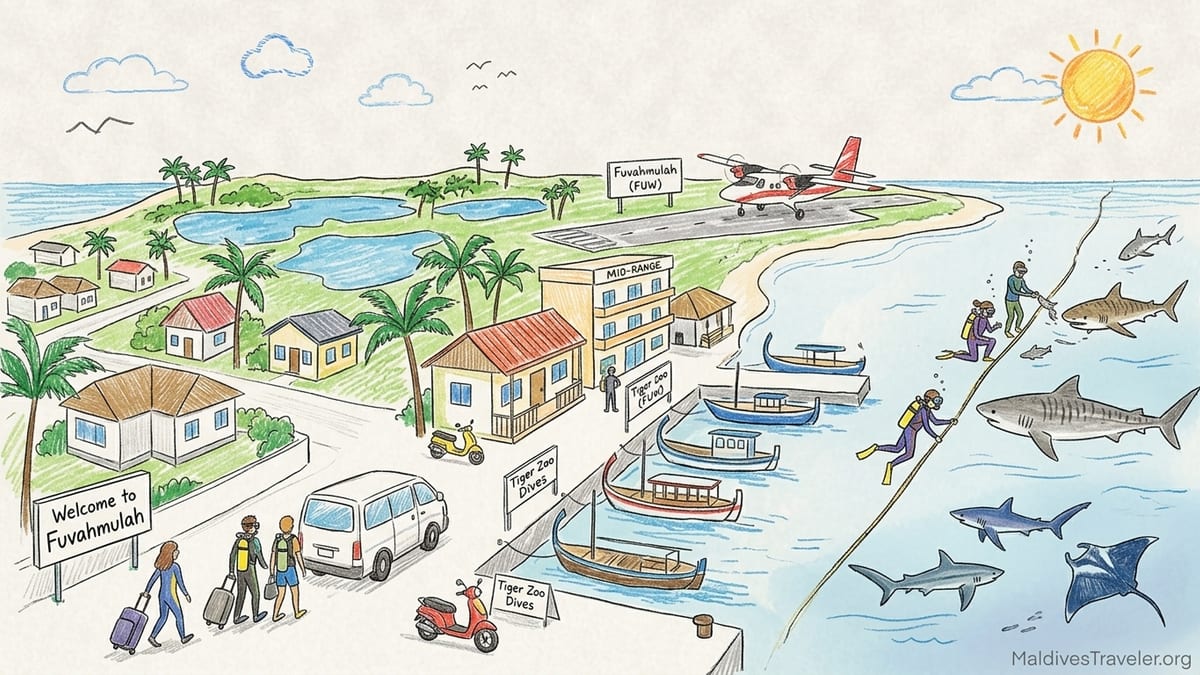
Why Fuvahmulah Packages Look Different From the Rest of the Maldives
Fuvahmulah sits far south of the central atolls and is reached almost exclusively by domestic flights from Malé. The island has its own airport and typically sees at least two flights per day from the capital, but schedules and luggage rules change more often than resort speedboat transfers. Because of this, most tiger shark operators now build domestic flight tickets directly into their dive packages, coordinating arrival and departure times for you and often blocking group seats in high season.
On the ground, there are no overwater villas or big-name resort chains. Instead, you find a growing mix of local guesthouses, small hotels and diver-oriented lodges clustered around the harbour and on quiet residential streets. Dive centres arrange airport pick-up, daily harbour transfers, scooter rental, and even restaurants for surface intervals. This is why packages in Fuvahmulah are usually all-encompassing: they move you seamlessly from international arrival in Malé to the Tiger Zoo and back again.
Prices in 2026 reflect this full-service approach. A compact 3-night / 5-dive package with domestic flights and guesthouse accommodation can start around 1,050 to 1,150 dollars per person, while 7-night programmes with 12 to 15 dives and Tiger Zoo visits on most days typically range between about 1,800 and 2,100 dollars, depending on meal plan, room type and equipment rental. Ten-night and longer trips, which add extra pelagic dives and rest days, push total costs even higher, but reduce the per-dive price and offer more flexibility for bad-weather days.
Another big difference from central-atoll holidays is the focus on one star attraction. While many Maldives islands sell “bit of everything” reef diving, Fuvahmulah is unapologetically about tiger sharks. Packages are structured to give you multiple visits to the Tiger Zoo, then fill remaining days with blue-water pelagic dives, reefs and thresher or oceanic manta encounters. The level of shark intensity you want over 3, 5, 7 or 10 nights should be a major factor in choosing your package.
3-Night Tiger Shark Samplers: Who They Suit and What You Get
Three-night stays are the shortest standard option offered by many dive centres, designed as “samplers” or add-ons to a broader Maldives itinerary. A common structure in 2026 is 3 nights of accommodation, 5 dives and return domestic flights bundled into one price. For instance, Fuvahmulah Central Dive Center lists a 3-night, 5-dive Rapid Package starting from just over 1,050 dollars per person including Malé–Fuvahmulah flights, local transfers and taxes, typically in a simple guesthouse room with breakfast.
In practice, such a package usually means arrival from Malé on day one, a check dive plus first Tiger Zoo session on day two, two more dives on day three, then a final morning dive or rest before flying out on day four depending on your flight time and no-fly limits. Most operators aim to include at least one or two Tiger Zoo dives in the 5-dive allocation, topping up with reef or blue-water pelagic dives. Equipment rental is often extra at roughly 25 to 35 dollars per full kit per diving day, so budget an additional 75 to 100 dollars if you are not bringing your own gear.
Meals on 3-night packages are often on a bed-and-breakfast basis, keeping sticker prices attractive. A compact guesthouse option like some Cozy Roots or Cozy Nest Fuvahmulah packages can start from about 1,100 dollars for 3 nights and 5 dives in double occupancy, with guests paying out of pocket for lunches and dinners at cafés around the harbour. Expect to spend roughly 15 to 30 dollars per person per day on meals, more if you prefer coffee shops and seafood grills over local hedhikaa snacks.
A 3-night programme works best if you are already in the Maldives, perhaps finishing a central atolls liveaboard, and want to “tag on” tiger sharks without blowing your budget or adding many extra days of annual leave. It is less ideal for once-in-a-lifetime visitors flying in from long-haul destinations, as weather disruptions or a single day of poor visibility can eat up a big share of your limited dive slate.
5-Night Tiger Focus: Balancing Cost, Time and Tiger Zoo Frequency
Five-night stays have become a sweet spot for divers who want several Tiger Zoo encounters without stepping up to the price of a full week. Tiger Shark Retreat and similar clubs advertise 5-day / 14-dive or 6-day / 17-dive programmes across a variety of lengths, but in practice a 5-night option frequently delivers around 9 to 12 dives, with three or four of those at the Tiger Zoo and the rest on walls, pinnacles and blue-water sites nearby.
Price-wise, many 5-night packages sit in the 1,400 to 1,700 dollar range per person in 2026 when domestic flights are included. That usually covers shared twin or double accommodation in a midrange guesthouse, daily breakfast and sometimes simple lunches on the boat, plus airport and harbour transfers. Dinners are typically independent. If you step up to a small hotel with larger rooms, such as AIG Grand or Ataraxis-style properties, you can expect 5-night tiger packages to creep closer to 1,800 dollars, especially in main season from December to April.
Inclusions around the Tiger Zoo vary by operator. Some centres promise daily tiger dives whenever conditions allow, letting you decide on the spot whether to dive the Zoo every morning or alternate with reef sites. Others cap Tiger Zoo visits at three or four during a 5-night stay to keep crowds down and maximise safety. It pays to read the fine print: if tiger sharks are your core goal, look for wording that mentions dedicated tiger shark dives rather than vaguely stating “pelagic encounters”.
For many divers, 5 nights offers a comfortable rhythm. You can arrive, shake off jet lag, enjoy three full diving days with multiple shark sessions, and still have time for a scooter ride across the island’s freshwater lakes or a beach sunset without feeling rushed. Your cost per dive drops compared with a 3-night sampler, but you still maintain enough flexibility to move on to another atoll or liveaboard afterward.
7-Night All‑In Packages: The Classic Fuvahmulah Week
Seven nights is the standard length of stay for dedicated tiger shark programmes in Fuvahmulah. Many operators structure their flagship offers around a 7-night, 15-dive template, which provides 5 full dive days and one or two lighter days for arrival and departure. For example, AIG Dive Club’s Tiger Realm Expedition pairs 7 nights at AIG Grand with 15 dives, of which 5 are dedicated tiger shark dives and 10 explore other sites, along with domestic flights, full-board meals and local transport, priced around 2,050 to 2,300 dollars per person depending on room occupancy.
Other 7-night options sit in a slightly lower band. Fuvahmulah Central Dive Center’s Exploring Package offers 7 nights and 15 dives from roughly 1,950 dollars including flights, guesthouse accommodation and breakfast, with lunches and dinners extra. DivePoint Maldives advertises a 7-night Fuvahmulah expedition with 5 dive days and 15 dives, domestic flights, breakfast and guesthouse stay from about 1,450 dollars during their 2026 summer promotion, though outside that limited window regular prices trend higher.
Beyond the headline rates, 7-night packages often include thoughtful extras that matter on a remote dive island. Common additions include tanks and weights, daily harbour transfers, reef-safe snacks and hot drinks between dives, and underwater photography of your Tiger Zoo encounters. Fees for BCD and regulator rental, however, are frequently left à la carte at around 5 to 10 dollars per item per dive or a flat 25 to 30 dollars per day. Over five dive days, renting a full kit can easily add 150 dollars or more to your bill, so consider bringing at least your own regulator and computer.
For most travellers coming from Europe, North America or East Asia, a 7-night programme is the best balance of cost, jet-lag recovery and shark time. The extra days provide a buffer if one morning is blown out by swell, or if you prefer to skip a session due to fatigue. They also give you scope to alternate intense Tiger Zoo mornings with quieter reef or thresher shark dives, which many divers find makes the overall experience richer and less overwhelming.
10-Night and Longer Stays: Value, Rest Days and Add‑On Adventures
Ten-night tiger shark packages remain a niche choice, but they are increasingly marketed to underwater photographers, technical divers and travellers combining Fuvahmulah with other southern atolls. Fuvahmulah Dive Maldives, for example, promotes a 10-night “Deep Fuvahmulah” package featuring up to 9 dive days with Tiger Zoo options on most days, round-trip Malé flights, transfers, accommodation and flexible meal plans, with lead-in prices around 2,590 dollars per person in 2026.
With this length of stay, the daily cost tends to flatten out. While your total bill may pass 2,600 or even 3,000 dollars once single supplements, full equipment rental and optional excursions are added, your per-dive cost often drops significantly because you might log 20 or more dives, including numerous tiger-focused sessions. Many 10-night programmes explicitly build in one or two rest days so you can explore the island’s lakes, cliffs and beaches or simply give your ears a break.
Longer stays also make it easier to add side trips without rushing. Some packages bundle a day trip to nearby Addu Atoll for wreck or manta dives, or offer custom extensions on liveaboards that visit Fuvahmulah as part of deep-south itineraries. If you are chasing a particular shot of tiger sharks in clear blue water, the extra days greatly increase your chances of encountering ideal conditions and smaller groups at the Zoo.
However, ten nights on a small island is not for everyone. There is only one main town, limited nightlife and modest dining variety compared with resort atolls. Before committing to a long package, consider your tolerance for repetition and your overall travel plan. Some divers prefer to spend 5 or 7 nights in Fuvahmulah and then shift to a more varied central atoll or liveaboard to round out their trip.
Guesthouse vs Hotel: Comfort, Meal Plans and Price Differences
One of the key choices in Fuvahmulah is whether to stay in a diver-focused guesthouse or a small hotel with more amenities. Guesthouses typically anchor the lower end of the price spectrum. A 7-night guesthouse package with 15 dives and domestic flights can run from about 1,800 to 2,000 dollars per person, often with breakfast only. Rooms are clean and air-conditioned but simple, with communal lounges and straightforward local breakfasts. This style suits budget-conscious travellers and those who plan to spend most of their time on the boat or exploring the island.
Hotels like AIG Grand, Ataraxis or newer boutique properties introduce more space, private balconies, larger beds and sometimes extras such as small spas or rooftop terraces. A comparable 7-night, 15-dive package in a hotel, especially on a half-board or full-board basis, can cost 200 to 400 dollars more than a guesthouse equivalent. In return, you gain quieter rooms, smoother in-house service and the convenience of on-site dining if you are tired after a three-dive day.
Meal plans significantly influence final cost. Full-board programmes, such as those used in some AIG or Raajje Roamers-style packages, bundle breakfast, lunch and dinner, which simplifies budgeting and appeals to travellers unused to local restaurants. On the other hand, many guesthouse-based packages stick to bed-and-breakfast or half-board, encouraging you to try cafés near the harbour or in the village, where meals may feel more authentic and slightly cheaper. Over a week, shifting from full-board to breakfast-only can mean a difference of 150 to 250 dollars, depending on your eating habits.
Single travellers should also pay attention to supplements. Fuvahmulah accommodation is primarily configured as twin or double rooms, and single supplements are often 50 to 60 dollars per night in guesthouses and higher in hotels. On a 7-night stay, that can add 350 to 500 dollars to your total, which might tip the scales toward choosing a modest guesthouse and spending the savings on extra tiger dives or quality rental gear.
What to Look For in a Diving Package: Dives, Tiger Zoo Days and Equipment
Regardless of length or comfort level, the fine print of your Fuvahmulah package matters. The headline number of nights tells only part of the story. Check how many actual diving days and total dives are included. A typical 7-night offer might provide 5 dive days and 15 dives, but some budget packages quietly cap you at 10 or 12 dives, which increases your effective price per dive. Also note whether arrival and departure days include diving or are treated as dry travel days.
The Tiger Zoo schedule is another critical factor. Some operators clearly state how many tiger-focused dives are guaranteed, such as 5 Tiger Zoo dives in a 15-dive programme, while others promise daily tiger dives whenever ocean conditions allow. If you are especially keen on sharks, lean toward packages that mention guaranteed or daily Tiger Zoo access. If you want a more varied itinerary with mantas and reef life, look for a ratio closer to one tiger dive for every two or three reef dives.
Equipment rental and included services can add up quickly. Tanks and weights are almost always included, but full kit hire rarely is. Many centres publish equipment prices in the order of 30 dollars per full set per dive day or 5 dollars per item per dive. Over the course of a 10- or 15-dive programme, that can easily exceed 150 dollars. Some late-booking promotions in 2026 have started to include free rental gear to attract travellers, but these offers are date-specific and should not be assumed.
Finally, look closely at domestic flight and transfer terms. Most packages cover return Malé–Fuvahmulah flights with at least 20 to 25 kilograms of checked luggage, which is valuable for divers hauling cameras and thick wetsuits. Double-check whether overweight baggage is included, and confirm the time buffer between your international and domestic flights. Malé’s compact airport makes tight connections feasible, but delays still happen, and many travellers prefer to overnight in the capital at the start or end of their trip as an extra safeguard.
Budgeting, Safety and When to Travel
On top of the package price, you should plan for additional expenses that are easy to overlook. Marine park or environmental fees, usually modest per day, may be added on-site rather than included. Nitrox, if available, often carries a surcharge, and optional extras such as private guiding, underwater photography sessions or special early-morning blue-water dives can be tempting add-ons at 60 to 100 dollars each. Gratuities for boat crew and guides are customary, so factor in a tip budget of perhaps 5 to 10 percent of your package cost if service has been good.
Safety considerations sit at the heart of Fuvahmulah’s operation standards. Tiger Zoo dives follow strict protocols, with divers positioned on a line, professional feeders managing fish scraps and shark behaviour closely monitored. When comparing operators, pay attention less to marketing language and more to indications of structured briefings, small group sizes and clear rules. Reputable centres also insist on recent dive experience, minimum certification levels and dive insurance for participation in tiger dives.
Seasonality influences visibility, currents and crowding. Peak tiger diving generally runs from roughly November to April, spanning the northeast monsoon, although tiger sightings are possible year-round. Some operators advertise discounted summer specials between July and September, such as Divepoint’s 2026 offer with 40 percent off diving and reduced guesthouse rates, which can bring a 7-night package under 1,500 dollars. In shoulder months, you might face more variable weather but fewer boats at the Zoo, which some divers consider a worthwhile trade-off.
International flight connections also shape your timing. Many long-haul routes into Malé land in the morning, allowing an afternoon domestic flight to Fuvahmulah. Others arrive late evening, necessitating a night in or near the capital. Because domestic schedules and fares can change, booking your international flights after confirming your preferred package and transfer window with the operator can prevent awkward gaps or rushed layovers.
The Takeaway
Choosing the right Fuvahmulah tiger shark package starts with deciding how many nights and dives match your goals and budget. Three-night samplers deliver a quick, high-impact tiger fix for travellers already in the Maldives, but leave little room for weather hiccups. Five-night stays add breathing space and more Tiger Zoo opportunities without fully committing to a week, while 7-night programmes remain the classic choice for dedicated shark enthusiasts flying in from afar.
Ten-night and longer itineraries suit photographers and repeat visitors who want a deep dive into Fuvahmulah’s pelagic life and island atmosphere, accepting a higher total price in exchange for more dives and rest days. Across all options, pay close attention to how many tiger dives are guaranteed, what meal plan and equipment rental policies apply, and whether domestic flights and transfers are neatly covered.
In 2026, realistic package prices run from roughly 1,000 dollars for shorter guesthouse-based stays with limited dives to over 2,000 dollars for week-long hotel packages including flights, full-board meals and 15 or more dives. With careful comparison of inclusions rather than headlines alone, you can secure a well-structured Tiger Zoo experience that feels smooth from arrival to departure and makes the most of this unique island’s world-famous shark encounters.
FAQ
Q1. How many dives should I plan for to make a Fuvahmulah trip worthwhile?
Most divers find that 10 to 15 dives, typically spread over 5 or 6 dive days, provide enough Tiger Zoo encounters plus a mix of reef and pelagic sites without feeling rushed or overwhelmed.
Q2. Are domestic flights between Malé and Fuvahmulah always included in packages?
In most cases yes, especially in 3-, 5- and 7-night packages, but you should always confirm that round-trip Malé–Fuvahmulah tickets and standard checked luggage are explicitly listed in your inclusions.
Q3. What is the difference between a guesthouse and a hotel package in Fuvahmulah?
Guesthouse packages are usually cheaper and simpler, with clean rooms and breakfast, while hotel packages cost more but add larger rooms, extra amenities and often half-board or full-board meals.
Q4. How often will I actually dive the Tiger Zoo during my stay?
On a 7-night, 15-dive package, many operators schedule 4 to 6 Tiger Zoo dives, with the rest on reefs and pelagic sites; some offer daily tiger dives if conditions allow, so check the stated policy.
Q5. Do I need my own equipment or can I rent everything on the island?
You can rent full scuba gear from most dive centres, but rentals are charged per dive or per day and can add 100 to 200 dollars over a week, so many divers bring at least personal items like regulators and computers.
Q6. How much should I budget on top of the package price?
Beyond the package, plan for equipment rental if needed, meals not covered by your plan, tips, optional extra dives, nitrox, and small local expenses, which together can add several hundred dollars over a week.
Q7. Is Fuvahmulah suitable for newly certified divers?
Conditions around Fuvahmulah can involve strong currents and deep sites, and Tiger Zoo protocols require good control, so most operators prefer divers with at least an advanced certification and recent logged dives.
Q8. When is the best time of year to book a Fuvahmulah tiger shark package?
Conditions are generally most reliable from about November to April, while July to September can offer attractive discounts and fewer boats but with a greater chance of variable weather.
Q9. Can non-divers or snorkelers join the trip and still enjoy Fuvahmulah?
Non-divers are welcome at most guesthouses and hotels, but Tiger Zoo encounters are scuba-only; non-divers can enjoy beaches, lakes, scooter rides and occasional snorkeling trips, though activities are more limited than on resort islands.
Q10. How far in advance should I book a tiger shark diving package for 2026?
For high season and popular 7-night programmes, booking 6 to 9 months ahead secures better flight timings and room choices, while last-minute deals are more common for shoulder or summer periods.