


The southern Maldives have become a bucket list destination for serious divers, drawn by fast channels, big pelagics and one of the world’s most reliable tiger shark encounters. Liveaboards are the only practical way to link Huvadhoo, Fuvahmulah and Addu in a single trip, and operators now offer a mix of focused 7-night Deep South safaris and longer Malé-to-Gan expeditions. This guide breaks down how the main routes work in practice, from domestic flights and number of dives to shark encounters, nitrox and which itinerary suits your experience level.
Understanding the Southern Maldives Deep South Circuit
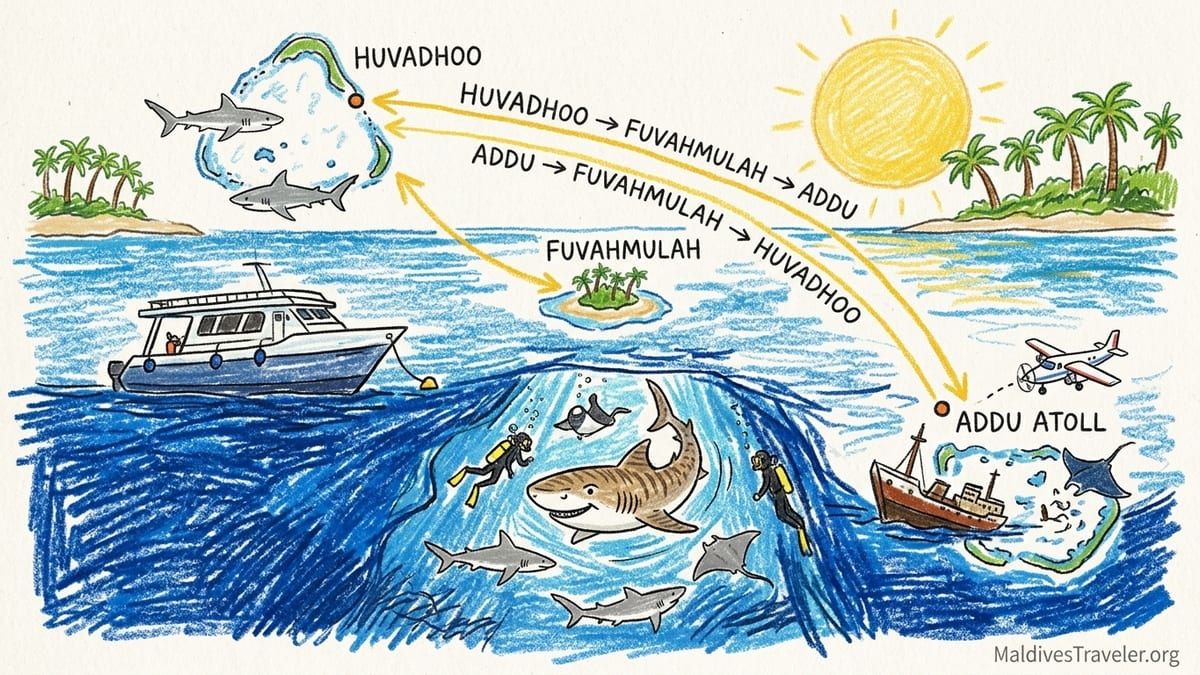
When liveaboard operators talk about “Deep South” in the Maldives, they usually mean a triangle of remote atolls at the far southern end of the archipelago: Huvadhoo (Gaafu Alif / Gaafu Dhaalu), the isolated island-atoll of Fuvahmulah, and Addu Atoll in the deep south. Many itineraries simply describe this as “Huvadhoo → Fuvahmulah → Addu” or the reverse. Boats position here seasonally between roughly January and April, when currents and visibility tend to be most reliable for shark-heavy channel diving and crossings.
Huvadhoo is one of the world’s largest atolls, riddled with passes that funnel oceanic water into its lagoon. This makes it a magnet for grey reef, silvertip and occasional hammerhead sharks on early morning channel dives. Fuvahmulah, sitting alone in the Equatorial Channel, is famed for near-guaranteed tiger shark encounters and frequent pelagics along its walls. Addu is the southernmost atoll and offers manta cleaning stations, the British Loyalty wreck and more relaxed reef and channel dives to decompress at the end of a big-animal week.
Almost all Deep South trips in this region are one-way. A classic 8-day / 7-night safari boards in Addu or Huvadhoo and disembarks at the opposite end, with a domestic flight required on either arrival or departure. Longer expeditions, typically 14 nights, start or finish in Malé and connect the Deep South with central atolls like Vaavu, Meemu and Ari, adding extra channels, thilas and manta stations en route. Current operators commonly advertise around 17 dives on a 7-night Deep South route and roughly 37 dives on a 14-night expedition, subject to weather and flight timings.
Huvadhoo → Fuvahmulah → Addu: The Signature Deep South Route
A typical southbound Deep South itinerary might start in Huvadhoo, work via Fuvahmulah and then finish in Addu. Blue Horizon’s long-running “Huvadhoo to Addu” route is a good example, structured around 7 nights on board and about 17 dives. Guests usually fly from Malé into Kooddoo in north Huvadhoo, join the liveaboard there, and then spend several days working south through the atoll’s channels before crossing to Fuvahmulah and on again to Addu.
In practice, the first three or four days are dominated by Huvadhoo’s channels. Sites such as Vilingili Kandu or Gemanafushi area passes are often dived at dawn or very early morning, dropping deep on the outer edge and hooking in on the lip of the channel to watch grey reef, silvertip and occasional oceanic blacktip sharks riding the current. Many boats describe this section as “advanced” because negative entries, strong current and 25 to 30 metre starting depths are commonplace. Divers spend afternoons on shallower reefs or inside the lagoon to keep within safe no-decompression limits across a multi-dive day.
Mid‑trip, the boat crosses the Equatorial Channel to Fuvahmulah. Operators that include Fuvahmulah almost always highlight at least one dedicated “tiger shark dive” here, run in cooperation with local guides who visit the same sector of reef daily. Tiger Zoo, or an equivalent domestic name, has become the star attraction, offering a high chance of multiple tigers circling at close range. Liveaboards typically manage this by joining a rotation system with land-based dive centres, and they sometimes limit guests to one tiger dive per day for safety and environmental reasons. Additional wall dives around Fuvahmulah frequently deliver thresher, oceanic manta, scalloped hammerhead or large schools of tuna, though these are always described as occasional sightings rather than guaranteed.
The final leg to Addu is generally more relaxed. Many itineraries build in a dive or two on the British Loyalty wreck, a deep Second World War tanker lying on her side around 30 metres, plus manta cleaning stations such as Maa Kandu or nearby outer-reef channels where eagle rays and grey reef sharks patrol. Because Addu sits slightly off the main tourist trail, sites are often uncrowded compared with popular reefs near Malé. Boats use these final days for shallower, wide-angle reef dives to ensure a generous 24‑hour no-fly interval before guests board their domestic flight back to Malé from Gan.
Addu → Fuvahmulah → Huvadhoo: Reverse Routes and Seasonal Positioning
Reverse itineraries, Addu → Fuvahmulah → Huvadhoo, follow the same triangle but in the opposite direction. Carpe Diem and similar operators promote one-way “Addu – Fuvahmulah – Huvadhu” routes between December and March, clustering tiger shark dives in the middle of the week and finishing with high-adrenaline channels in north and south Huvadhoo. For guests this can feel like a natural build-up: calmer coral gardens and mantas in Addu, then tigers and pelagics, then the most demanding channel dives at the end when everyone is tuned in to Maldivian currents.
On a reverse itinerary, logistics flip. You might fly from Malé to Gan at the start of the trip, join the boat there, then disembark in Huvadhoo and fly back from Kooddoo or Kaadedhdhoo. Operators often recommend guests add a buffer night in Malé or at an airport hotel at one end, especially in peak season when domestic schedules can change at short notice. Flight times between Malé and Gan are usually around 1 hour 35 minutes direct and sometimes longer with intermediate stops, while Malé to Kooddoo is around an hour on most schedules, so an extra night reduces stress and protects your diving in case of delays.
The diving rhythm also shifts on a northbound route. Some captains schedule the deepest, most challenging channels in south Huvadhoo earlier in the week while everyone is still fresh, then gradually soften the program with more lagoon and inner-reef dives in north Huvadhoo or Laamu as the boat repositions. While the number of dives remains broadly similar to a southbound itinerary, the sequence can change the feel of the trip. Many repeat visitors book the reverse route deliberately after having done the classic Huvadhoo-first version, simply to experience the same atolls in a different order and current direction.
Pricing for either direction is broadly comparable and usually higher than central atoll safaris. Recent examples on mid‑range boats show 7‑night Deep South trips priced in the region of 2,300 to 3,200 euros per person in a standard lower-deck twin, excluding domestic flights and extras such as nitrox, rental gear and service charges. Single travellers can sometimes find late‑season discounts, particularly in March, when liveaboards wrap up their southern season and reposition north.
Malé-to-Deep-South Expeditions: 14 Nights, 37 Dives and Extra Atolls
For divers who want the Deep South experience plus a taste of the central Maldives, longer Malé-to-Gan or Malé-to-Huvadhoo expeditions are increasingly popular. Boats such as Amba, Emperor class vessels and independent operators now schedule 12 to 14‑night repositioning trips that bridge Malé and the Deep South, usually once or twice each season. Blue Horizon’s 14‑night Deep South expedition, for instance, connects Malé with Addu via Vaavu, Meemu, Thaa, Laamu, Huvadhoo, Fuvahmulah and Addu, advertising around 37 dives if conditions cooperate.
The main practical difference between these 14‑night expeditions and a 7‑night Deep South loop is the sheer number of extra atolls. Rather than flying into the south, guests board in Malé and dive their way down over two weeks. Typical routes add famous channels in Vaavu, such as Miyaru Kandu and Alimatha area night dives with nurse sharks, plus Meemu and Thaa’s lesser-known passes before reaching Laamu and finally Huvadhoo. That means more variety: you might have reef manta cleaning stations one day, soft coral draped thilas the next, and then return to high-voltage channels once you reach Huvadhoo.
The diving schedule on a 14‑night expedition is intense but manageable. Operators often aim for two to three dives per day with occasional four‑dive days early in the trip, tapering back to protect rest before domestic flights or long-haul departures. Thirty‑plus dives afford more flexibility if weather disrupts a day or if currents are not favourable in a particular channel. Many guests treat these trips almost like a mini‑expedition: you might cross the Equator between Huvadhoo and Fuvahmulah, log tiger sharks mid‑trip, then finish with mantas and wrecks in Addu, all on a single itinerary.
Cost naturally scales up. Recent examples of 12 to 14‑night Deep South crossings show prices in the range of 3,500 to 4,500 euros per person in standard cabins, again excluding domestic flights and on‑board extras. However, when you divide by the number of dives and factor in that a 14‑night trip may deliver roughly 37 dives against around 17 on a week-long safari, the per‑dive cost is often comparable or even slightly lower. For experienced divers with sufficient time off, these long expeditions offer arguably the best value and variety in Maldivian liveaboard diving.
Flights, Logistics and When to Choose 7 Nights vs 14 Nights
Domestic positioning flights are an unavoidable part of Deep South liveaboards. For the 7‑night Huvadhoo ↔ Addu routes, you will almost always need one domestic leg to or from Malé at either the start or end of the trip. Common gateways include Kooddoo or Kaadedhdhoo in Huvadhoo and Gan in Addu. Flight durations from Malé are typically around 1 hour to Huvadhoo and 1 hour 35 minutes or more to Gan, with some flights stopping at intermediate atolls. Most liveaboard operators either arrange these flights for you or work through a partner travel agency, bundling the tickets into your invoice at published domestic fares.
Domestic tickets for these southern sectors have historically floated around a few hundred US dollars return per person, though prices fluctuate with fuel and season. Some premium liveaboards offer inclusive packages where domestic flights, nitrox and even rental gear are wrapped into a single headline price, while others list flights and surcharges separately. Before booking, ask your operator to confirm which airport you will use in Huvadhoo, whether the flight is direct, and how much checked baggage is included. Extra camera or dive gear can push you over standard allowances, and pre‑paying excess is usually cheaper than paying at the counter.
Choosing between a 7‑night dedicated Deep South trip and a 14‑night expedition comes down to time, budget and energy. If you are primarily interested in sharks, already comfortable in current, and can add a few days on either side for international connections, a focused 7‑night route that includes Huvadhoo, Fuvahmulah and Addu will deliver the highlights in one week. You will get around 17 dives, a couple of tiger shark dives, several deep channels and a glimpse of Addu’s mantas and wrecks. If you also want classic Maldivian reefs, manta cleaning stations and central atoll thilas, a 14‑night Malé-to-Deep-South crossing is more rounded, with about 37 dives and a broader mix of sites.
Another consideration is season. Many long Malé-to-south crossings occur at the very start or end of the Deep South season, as boats position in or out of the region. That can mean slightly cooler water and shifting plankton levels, which may move mantas or whale sharks around. Seven‑night Deep South loops, by contrast, are often scheduled at the heart of the season, targeting the strongest probability windows for tiger sharks and productive channel currents. When comparing brochures, look not just at duration but at specific departure dates and where the boat will be in the overall seasonal cycle.
Experience Level, Nitrox and Cabin Categories
Most Deep South liveaboards set a minimum certification level of Advanced Open Water or equivalent and around 30 logged dives for itineraries that include Huvadhoo and Fuvahmulah. Some operators are flexible if you can show recent experience in strong currents or have completed a drift or deep specialty course. A handful of boats explicitly describe their Deep South weeks as “experienced divers only” and may require guiding standards like SMB proficiency and comfort entering negative in current. If you are freshly certified or have limited drift experience, a central-atolls itinerary is usually recommended as a first Maldives trip before stepping up to the Deep South.
Nitrox is effectively standard on modern Deep South boats, either included in the trip price or charged as a flat weekly supplement. With repeated dives in the 25 to 30 metre range, nitrox offers significantly more no‑decompression time and a wider safety buffer over air, especially on multi‑day channel programs. Higher‑end boats often have membrane systems and can supply nitrox continuously, while more modest vessels may run partial‑pressure mixing with slightly more variable oxygen percentages. Before booking, ask whether nitrox is guaranteed for all dives and whether there are any planned air-only days, such as very deep wreck excursions.
Cabin categories mirror the broader Maldives liveaboard market. Older wooden boats such as Nautilus Two tend to offer large, traditionally styled cabins, mostly below deck, while newer steel-hulled yachts closer to 40 metres long may add upper-deck or suite options with bigger windows and private balconies. Price differences between a lower‑deck twin and an upper‑deck double on a 7‑night Deep South trip can be several hundred euros per person, rising further on 14‑night expeditions. Since most diving days start before dawn and include two or three dives, many divers prioritise stable sleeping conditions and hot showers over balcony space, but couples and non‑diving partners often appreciate the extra light and views.
Onboard amenities can make a difference on long expeditions. Look for boats with a separate dhoni for diving, as this keeps compressors and tanks off the main vessel, reducing noise and freeing deck space. Rinse tanks for cameras, shaded sundecks and indoor lounges become more important when you are at sea for 14 nights without touching land. Some operators add small touches such as free tea and coffee, post‑dive snacks and occasional barbecue nights on uninhabited sandbanks when schedules allow, though these are always weather‑dependent and never guaranteed.
Shark Encounters and What to Expect Underwater
The Deep South is marketed heavily around sharks, and for good reason, but expectations should still be realistic. Huvadhoo’s channels routinely deliver schooling grey reef sharks, with dozens or more individuals seen on a single dive when currents run well. Silvertips, dogtooth tuna, barracuda and the occasional scalloped hammerhead round out the cast. Many dive guides describe dawn and incoming‑tide dives as the most productive, when visibility can stretch to 30 metres and sharks hover in the blue. Outgoing tide dives may have reduced visibility but can attract different pelagic life hunting baitfish in the channels.
Fuvahmulah is where many guests hope for their lifetime shark photographs. Local operators popularised an organised tiger shark experience in which guides position guests in a controlled area on the reef and manage chum in the water column. The result is an exceptionally high chance of close tiger encounters, sometimes with several large individuals circling throughout the dive. Liveaboards that include this activity emphasise strict briefing procedures and clear protocols on body position, camera handling and maintaining eye contact from a kneeling or resting stance on the bottom. Outside the tiger dives, Fuvahmulah’s open‑ocean drop‑offs can produce threshers, oceanic mantas or schooling hammerheads, but these are naturally far less predictable.
Addu is more varied. Its channels can hold grey reef and eagle rays, while the British Loyalty wreck, sitting at around 30 metres, is often covered in schooling snapper and sweetlips. Manta cleaning stations in Addu may host resident populations that allow long, shallow encounters as the rays cruise over coral heads. Compared with Fuvahmulah’s intense pelagic drama, Addu feels gentler and more forgiving, which is part of why many itineraries end there. Divers can spend their last one or two dive days in the 10 to 18 metre range, off‑gassing gently while still logging charismatic megafauna.
All shark encounters are subject to conditions, and operators are increasingly careful to underline this in their materials. Strong currents, plankton blooms and swell can force last‑minute site changes. On a 7‑night itinerary with around 17 dives, that means every day counts, and a blow‑out day to weather can reduce your shark chances noticeably. On 14‑night expeditions, the greater number of dives and atolls visited dilutes the risk of a slow day or two. Either way, divers should arrive with flexible expectations and appreciate that even “guaranteed” tiger shark dives depend on safe visibility, current and vessel logistics.
The Takeaway
Deep South liveaboards in the Maldives deliver some of the most exciting shark diving in the Indian Ocean, but the details of your itinerary will shape the entire experience. A focused 8‑day / 7‑night Huvadhoo → Fuvahmulah → Addu or reverse route offers about 17 dives concentrated on big animals and channels, ideal for experienced divers with limited holiday time and a clear priority on sharks. Expect at least one or two tiger shark dives, multiple grey reef‑filled channels and a gentler finale among mantas and wrecks in Addu.
Fourteen‑night Malé-to-Deep-South expeditions broaden the canvas. With roughly 37 dives and several extra atolls such as Vaavu, Meemu, Thaa and Laamu in the mix, these crossings combine the headline Deep South highlights with central Maldives classics like manta cleaning stations and thilas. They demand more time and budget but often deliver better value per dive and greater resilience to weather or current disruptions.
Whichever route you choose, match the trip to your experience level, ask detailed questions about domestic flights, nitrox and cabin categories, and read recent trip reports to calibrate expectations about shark encounters. The Deep South rewards preparation: arrive current‑ready, camera batteries charged and open to whatever the Indian Ocean decides to deliver, and you will understand why so many divers now rank Huvadhoo, Fuvahmulah and Addu among the most memorable liveaboard routes on earth.
FAQ
Q1. Do I need to take a domestic flight for a Deep South liveaboard?
Yes. For 7‑night Huvadhoo ↔ Addu itineraries you will almost always take at least one domestic flight between Malé and either Gan in Addu or Kooddoo / Kaadedhdhoo in Huvadhoo. Fourteen‑night Malé-to-Deep-South crossings still often end with a domestic flight in one direction, depending on where the boat finishes.
Q2. How many dives will I typically do on a Deep South trip?
Most operators schedule around 17 dives on 8‑day / 7‑night Deep South routes and roughly 37 dives on 14‑night expeditions. Exact numbers vary with weather, domestic flight times and your final no‑fly window.
Q3. Is the tiger shark diving in Fuvahmulah really guaranteed?
No wild encounter can be guaranteed, but Fuvahmulah’s organised “tiger zoo” style dives offer some of the most reliable tiger shark sightings anywhere, thanks to daily visits and local guiding. Operators may cancel or modify dives if visibility, current or safety conditions are not suitable.
Q4. What certification level is recommended for Deep South liveaboards?
Advanced Open Water or equivalent with recent experience in currents and at least 30 to 50 logged dives is strongly recommended. Many dives involve negative entries, strong current and depths around 25 to 30 metres, especially in Huvadhoo’s channels.
Q5. Is nitrox essential for these itineraries?
Nitrox is not mandatory but is highly recommended because of repeated deep dives over several days. Most Deep South boats offer nitrox, either included or for a weekly fee, and many divers consider it a key safety and comfort feature on these routes.
Q6. How does a 7‑night Deep South trip compare with a central Maldives itinerary?
Seven‑night Deep South routes are more focused on sharks, fast channels and advanced conditions, with fewer coral gardens and resort-style reefs. Central atoll trips are generally easier, with more variety of shallow sites, manta cleaning stations and classic thilas, making them a better fit for less experienced or mixed‑ability groups.
Q7. When is the best time to dive the southern atolls?
Most operators schedule Deep South itineraries between roughly January and April, when prevailing currents and visibility tend to favour shark encounters in Huvadhoo and Fuvahmulah. Exact conditions vary year to year, so it is worth checking recent trip reports for your chosen month.
Q8. Are Deep South liveaboards more expensive than other routes?
Generally yes. Seven‑night Deep South trips are often priced higher than central-atoll safaris, and domestic flights add to the total cost. However, 14‑night crossings can offer a competitive per‑dive price because of the high number of dives included.
Q9. Can non‑divers or snorkellers enjoy a Deep South liveaboard?
These itineraries are designed primarily for experienced divers. While non‑divers can relax on board and occasionally snorkel on sheltered reefs, many signature dives take place in deep, current‑swept channels that are not suitable for snorkelling, so central atoll or resort-based trips are usually better for mixed groups.
Q10. How far in advance should I book a Deep South liveaboard?
Deep South seasons have limited departures and sell out quickly, especially for February and March dates on well-known boats. Booking 9 to 12 months ahead is common for prime cabins and dates, though last‑minute spaces sometimes appear closer to departure if boats adjust schedules or receive cancellations.