


If you have already decided that the Deep South of the Maldives is where you want to be, the real dilemma often becomes which southern destination to choose. Huvadhoo, Fuvahmulah and Addu all sit below the equator with richer local life, stronger currents and far fewer overwater villas than the classic postcard Maldives. Yet they deliver very different experiences: remote resort comfort and sharky channels in Huvadhoo, intensely focused big-shark encounters and local-island living in Fuvahmulah, and easy-going cycling, history and manta or wreck diving in Addu. This guide is written to help committed Deep South travelers make a clear decision between the three, or combine them intelligently in a single itinerary.
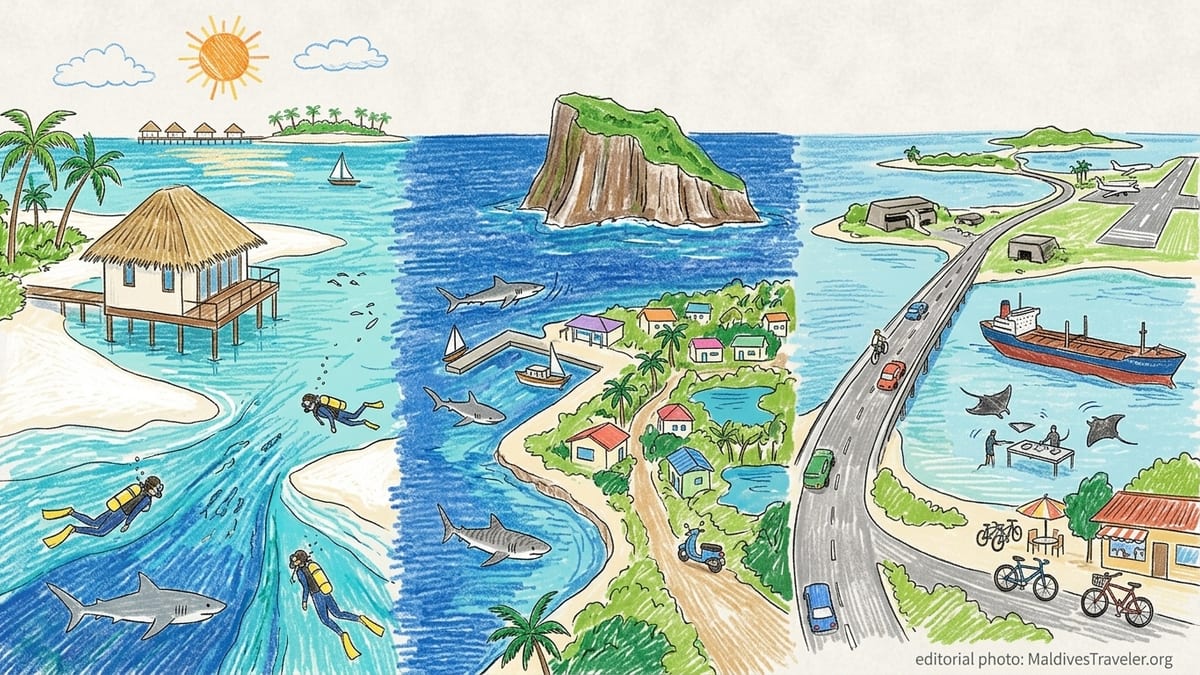
Deep South at a Glance: Three Very Different Experiences
All three destinations sit at the far southern end of the Maldives, reached by domestic flights rather than pricey seaplanes. From Malé, you typically fly around one hour to Gan for Addu, roughly the same to tiny Fuvahmulah’s airport, and a similar hop to one of Huvadhoo’s airstrips such as Kooddoo or Kaadedhdhoo followed by a speedboat to your resort or guesthouse. These flights usually cost significantly less than a seaplane transfer to a central atoll resort, which is one reason divers and long-stay travelers are gravitating south.
Huvadhoo (also written Huvadhu or Gaafu Alifu/Gaafu Dhaalu Atoll) is one of the largest and deepest atolls in the Maldives. It is known among experienced divers for powerful channel dives on its outer rim, where currents attract grey reef sharks, eagle rays and sometimes hammerheads along the famous One-and-a-Half Degree Channel. Many visitors experience Huvadhoo from dedicated dive resorts or liveaboards that work these channels intensively during the northeast monsoon.
Fuvahmulah, by contrast, is a single-island atoll rising steeply from the deep ocean with no enclosed lagoon. Its coastline drops quickly into blue water, which helps explain why it has become world renowned for close-range tiger shark encounters and other pelagic species. There are no standalone resort islands here. Travelers stay in local guesthouses and small boutique hotels, walk or scooter along leafy streets, and dive with local operators who may know individual sharks by sight.
Addu Atoll (also known as Seenu) is the Maldives’ southernmost atoll and home to Gan International Airport, once a British military base. The islands are linked by a 16‑kilometre causeway, making Addu one of the few parts of the country that you can explore by bicycle or car. Underwater, it offers year-round manta cleaning stations and accessible reef and wreck dives, including the famous British Loyalty oil tanker resting in the lagoon. On land you find real towns, remnants of World War II history and a more relaxed, easygoing local rhythm.
Huvadhoo: Remote Resort Luxury and Classic Channel Diving
Huvadhoo is the best choice if you want the deep south’s sharky reputation but prefer a self-contained resort environment with polished service. Well-known properties such as Park Hyatt Maldives Hadahaa, Mercure Maldives Kooddoo, Ayada Maldives and The Residence Maldives all sit in or around the atoll, each with in-house dive centers that run daily boats to nearby channels and pinnacles. Rooms are usually priced in line with other five-star and four-star Maldivian resorts, but domestic flights to Kooddoo or Kaadedhdhoo can sometimes be bundled into packages to reduce transfer pain.
Dive-wise, Huvadhoo is about variety and current-driven action. Outer reef channels like Nilandhoo Kandu and Vadinolhu Kandu are known among experienced divers for large schools of grey reef sharks, hunting trevally and passing eagle rays, particularly in the dry season. Liveaboard itineraries that include “Deep South” sections often spend several days here because conditions can be excellent when currents are favorable. Expect many dives in the 20 to 30 meter range, negative entries, reef hooks and blue water drifts, which makes the destination better suited to confident advanced divers.
On land, Huvadhoo is still very much about the resort bubble. Most resort islands offer clean, groomed beaches, lagoons for snorkelling and kayaks, small house reefs, spa menus and international buffets. You can often arrange a half‑day visit to a nearby local island to get a glimpse of everyday life, but compared with Fuvahmulah or Addu, your interaction with the local culture will be limited. This suits couples or honeymooners who want remote luxury and serious diving, but are not attached to independent wandering or café-hopping.
In terms of trip length, Huvadhoo rewards at least six to eight nights if you want to sample the key channels while still leaving non-diving time for beaches and spa days. Many dedicated divers tag a Huvadhoo week onto a week in a central atoll resort or spend ten nights on a liveaboard that runs a loop Huvadhoo–Fuvahmulah–Addu before flying home from Gan. If you are using resort points, as some travelers do at Park Hyatt, it can make sense to stay longer in Huvadhoo and let the loyalty scheme offset the higher food and drink costs.
Fuvahmulah: Local-Island Living and Intense Big-Shark Diving
Fuvahmulah is the clear choice for travelers whose priority is big-shark diving and who are comfortable basing themselves on a local island rather than a resort. The island’s steep walls and position in the open ocean have made it famous for tiger shark encounters at sites such as the harbor-side “Tiger Zoo,” where resident sharks are encountered at relatively shallow depths on almost every dive. Independent dive guides often describe Fuvahmulah as one of the most reliable tiger shark destinations in the world, with other highlights including threshers, oceanic manta rays and large schools of tuna and barracuda when conditions align.
Accommodation here is almost entirely in guesthouses and small boutique hotels such as Equator Retreat, Tiger Shark Residence, Fuvahmulah Central Hotel and several newer properties clustered near the island’s harbor and inland lakes. Nightly rates can be much lower than resort islands, particularly outside peak holiday weeks, which helps make up for the cost of multiple days of specialist diving. Many guesthouses offer packages bundling airport transfers, breakfast and two or three dives a day with local operators like Pelagic Divers, Fuvahmulah Central Dive Center or Shark Island Dive.
Life on Fuvahmulah feels more like staying in a small Maldivian town than a curated resort. You move around on foot, by bicycle or by renting a scooter for the day. Cafés and local restaurants cluster near the harbor and around residential streets, serving hedhikaa (short eats), fresh grilled fish and simple curries at prices far below resort menus. Between dives you can visit the freshwater lakes, stroll along the distinctive black pebble beach at Kalho Akiri Gando, or watch island life unfold from a harbor-side tea shop. Because this is a local island, alcohol is not served, and modest dress is expected away from designated bikini areas.
Fuvahmulah’s beaches are less textbook-turquoise than a resort lagoon, but they are dramatic in their own right. The fetch of the open Indian Ocean can mean stronger shore break and coarser sand or pebbles, which is beautiful for photography and beach walks but less ideal for small children. Non-divers can still enjoy the lakes, coastal viewpoints, scooter rides and whale- or dolphin-watching boat trips when available, but overall this is a diving-first destination. Most travelers planning three to four dives a day stay five to seven nights, allowing one or two rest days to explore the island.
Addu: Cycling, History, Mantas and Accessible Wreck Diving
Addu is the most balanced option for travelers who want serious diving but also value easy land exploration, a bit of history and the ability to get around under their own steam. Gan International Airport uses the former runway of RAF Gan, the British base that once anchored a secret Indian Ocean outpost. Today, parts of the base have been converted into Equator Village, a resort occupying former officers’ quarters, while other islands such as Hithadhoo and Feydhoo host guesthouses and small hotels along real streets rather than boardwalks.
One of Addu’s big draws is the 16‑kilometre Link Road causeway connecting several islands, which lets visitors cycle or drive through villages, coconut groves and seafronts. Bicycle rental is inexpensive and easy to arrange through guesthouses or resorts, and you can realistically spend an entire day pedalling between Gan, Feydhoo, Maradhoo and Hithadhoo, stopping for coffee, fresh juice or local snacks. This is one of the best places in the Maldives to see how people really live while still having good tourism infrastructure.
Underwater, Addu is known for two main experiences. The first is the British Loyalty wreck, an oil tanker scuttled by the British after the Second World War. It lies at dive depths in Addu’s sheltered lagoon and is accessible to experienced divers, offering a mix of structure, soft corals and schooling fish with generally manageable currents. The second is year‑round manta diving at cleaning stations such as Maa Kandu, where resident reef mantas are often seen on organized dive or snorkel excursions. Addu also has gentler reef sites like Turtle Point that suit less experienced divers or mixed-ability groups.
In terms of beaches, Addu does not compete with the private-resort sandbanks of central atolls, but there are local beaches, small artificial lagoons and some resort-managed stretches of sand suitable for swimming and sunset watching. Non-diving activities are more plentiful than on Huvadhoo or Fuvahmulah: cycling, visiting old British installations, walking through villages, kayaking in mangroves and birdwatching in wetlands all add variety. Most travelers allocate four to six nights here, sometimes bookending a longer deep south dive trip with a few easygoing days in Addu on either side of a liveaboard or Huvadhoo stay.
Transfers, Costs and Practicalities: Getting to the Deep South
All three destinations require at least one domestic flight from Malé, and that flight is the key logistical and budget consideration. Addu generally enjoys the most frequent and predictable services because Gan is a regional hub and some international charters occasionally operate direct flights there in peak season. Fuvahmulah and Huvadhoo airstrips see fewer flights per day, so arrival and departure times are more constrained, and you may have to adjust your Malé leg to line up with specific domestic schedules.
Prices shift year by year, but as a rough pattern domestic return flights to any of these southern airports often come in well below the cost of a return seaplane transfer to an outer-resort atoll in the central Maldives. On top of this, resort islands in Huvadhoo tend to package their speedboat transfers from the airport, while Fuvahmulah guesthouses either include airport pickups or charge modest fees. Addu’s advantage lies in its road network and causeway: once you land in Gan, many guesthouses or midrange hotels can be reached by car within minutes without needing a boat at all.
Day-to-day costs are where the three begin to diverge more clearly. Huvadhoo resorts are priced like other Maldivian upmarket properties: high nightly rates, plus additional costs for meals, dives and drinks. Fuvahmulah and Addu, as local-island destinations, generally have lower accommodation prices and very affordable local restaurants, but you will still pay specialist rates for technical or shark-focused dive operations. For example, a diver might book a week in a Fuvahmulah guesthouse with two tank dives per day and breakfast included for less than the room-only cost of a five-star resort in Huvadhoo, even before adding dives.
Seasonality also matters. Many liveaboards time their Deep South itineraries to coincide with optimal current and visibility patterns between roughly January and March, hopping between Addu, Fuvahmulah and Huvadhoo in a single cruise. Land-based travelers can visit year-round, but those most focused on sharks often target the same season to align with liveaboard schedules, while travelers primarily seeking a mix of mild reef dives and local culture in Addu might be more flexible, avoiding the wettest or windiest months.
Beaches, Culture and Non-Diving Days
If you are traveling with non-divers, or you simply do not want every day to revolve around tanks and currents, the character of each destination on the surface becomes critical. Huvadhoo resorts offer the most stereotypically Maldivian beaches: white sand, turquoise lagoons and overwater or beachfront villas. Non-divers can spend days snorkelling the house reef, using stand‑up paddleboards, joining dolphin cruises or simply rotating between pool, spa and sun lounger without needing to think about logistics.
Fuvahmulah, by comparison, offers rawer coastal beauty. Its shores are more exposed, with stretches of black pebble and coarse sand that feel wild rather than manicured. There are scenic viewpoints, surfable breaks in the right conditions and photogenic palm-fringed corners, but swimming can be rougher and there are fewer calm lagoon-style beaches for casual wading. Non-divers here tend to focus on island walks, scooter loops, birdwatching around the freshwater lakes and joining boat trips for dolphins or seasonal pelagics.
Addu sits between the two in terms of beach appeal but surpasses both for on-land variety. You can combine modest but pleasant local beaches with village strolls, café visits, explorations of old British bunkers and anti-aircraft emplacements, and long bicycle rides across the causeway. Local life is present everywhere: schoolchildren in uniforms, fishermen mending nets, and small shops selling spices and snacks. For many visitors, this mix of accessible culture and soft adventure makes Addu feel more rounded than the intense dive-first focus of Fuvahmulah.
Cultural etiquette matters in all three, especially off resort islands. On Fuvahmulah and in Addu’s inhabited areas, shoulders and knees should be covered away from designated bikini beaches, and alcohol is only available in specific resort zones or safari boats. In Huvadhoo resorts, the environment is more permissive, but a visit to a nearby village still requires modest dress. Learning a few Dhivehi greetings and taking an interest in local crafts or cuisine is widely appreciated and can lead to more meaningful interactions, particularly in Addu and Fuvahmulah where you share streets and cafés with residents.
How Many Nights Where: Sample Deep South Strategies
For a single-base trip, divers who want the easiest balance of diving and non-diving activities might choose five to seven nights in Addu. This gives time for several manta and wreck dives, a dedicated day for the British Loyalty, one or two full days of cycling and exploration along the Link Road, and at least one buffer day for weather or simple beach time. Families or mixed-ability groups often find Addu the least stressful choice because there is always something to do that does not involve currents or deep water.
For dedicated big-shark enthusiasts, five to seven nights in Fuvahmulah is usually the sweet spot. That allows for four to five full dive days with tiger shark dives and blue-water pelagic sites, plus at least one non-diving day to tour the island, visit the lakes and recover from repeated deep or current-heavy dives. It is technically possible to do a shorter three or four night stay, but given the effort of the domestic flight and the unpredictability of weather and visibility, a week increases your chances of experiencing the island at its best.
If your priority is resort comfort with strong chances of sharky channel dives, then six to nine nights in Huvadhoo works well, especially if you are splitting your time between a resort and a liveaboard or another atoll. Many travelers fly into Malé, connect straight to Kooddoo or Kaadedhdhoo, spend a week in a resort like Park Hyatt Hadahaa or Ayada, then either return to Malé or continue on to Gan for a few softer days in Addu. Combining Huvadhoo and Addu in a two‑week itinerary offers a good contrast between remote luxury and local life.
Those with two full weeks and a strong diving focus sometimes opt for a three-stop plan: four or five nights in Fuvahmulah, a week in Huvadhoo and three or four nights in Addu. Logistically this usually means flying Malé–Fuvahmulah–Huvadhoo–Gan–Malé or using a Deep South liveaboard to cover the long water legs, then spending extra days land-based at either end. While ambitious, it is one of the few ways to experience the full spectrum of the Deep South in a single trip, from tiger shark close-ups to channel drifts and historic wrecks.
The Takeaway
When you strip away marketing slogans, the choice between Huvadhoo, Fuvahmulah and Addu comes down to your appetite for adventure, your need for comfort and how much you care about life on land. Huvadhoo is ideal if you want the security and polish of a resort or liveaboard, combined with classic Maldivian channel diving and the feeling of being very far from anywhere else. It suits couples, honeymooners and experienced divers happy to let someone else handle all the logistics while they move between spa, villa and dive deck.
Fuvahmulah is the specialist’s choice. The island exists in most travelers’ imaginations as “tiger shark island,” and for good reason, but its appeal goes beyond adrenaline. Staying in small guesthouses, visiting lakes and black-stone beaches, and eating at local cafés can be deeply rewarding for open-minded travelers who value authenticity and are content with simple comforts. It is not the place for a first family beach holiday, but for serious divers and those curious about local Maldivian life, it is unforgettable.
Addu, finally, is the all-rounder. It may not have the absolute wildest channels or the biggest single attraction, but it offers a rare mix of cycling, everyday island life, historically significant sites and accessible diving with mantas, turtles and a substantial wreck. If you only pick one southern destination and you are traveling with companions whose enthusiasm for strong currents varies, Addu is often the safest and most satisfying choice. For many, the perfect Deep South trip is not “Huvadhoo versus Fuvahmulah versus Addu,” but rather “which one to start with this year, knowing you will probably come back for the others.”
FAQ
Q1. Which southern Maldives destination is best for first-time visitors to the Deep South?
Addu is usually the most forgiving introduction. It offers good diving, easy transfers to Gan, cycling on the causeway and plenty of non-diving activities, so it suits mixed groups and those unsure how much intense shark diving they really want.
Q2. Is Fuvahmulah suitable for non-divers or families with children?
Fuvahmulah is primarily a diving destination focused on tiger sharks and other pelagics. Non-divers can enjoy lakes, coastal walks and scooter rides, but beaches are more exposed and there are fewer structured activities for children compared with Addu or resort islands.
Q3. How difficult are the dives in Huvadhoo compared with the other two?
Many Huvadhoo dives are channel drifts with strong currents and negative entries, similar in difficulty to the more advanced sites in Fuvahmulah and slightly more demanding than typical Addu reef dives. Confident advanced divers with experience in currents will get the most out of Huvadhoo.
Q4. Can I visit more than one of these destinations in a single trip?
Yes, but it requires planning around domestic flight schedules or joining a Deep South liveaboard. A common combination is Fuvahmulah plus Addu, or Huvadhoo plus Addu, with a week in each or a shorter add‑on of three to four nights in Addu at the end.
Q5. Are there alcohol restrictions in Huvadhoo, Fuvahmulah and Addu?
On local islands like Fuvahmulah and Addu’s inhabited areas, alcohol is not served, following Maldivian law. Alcohol is available on resort islands in Huvadhoo and at certain resort-style properties in Addu, as well as on liveaboards operating in the Deep South.
Q6. When is the best time of year to dive the southern Maldives?
Land-based diving is possible year-round, but many divers target roughly January to March for Deep South trips, when conditions and currents often line up for strong shark and pelagic encounters, and when many liveaboards run special southbound itineraries.
Q7. How do costs compare between a Huvadhoo resort and a Fuvahmulah guesthouse trip?
Huvadhoo resorts typically have higher nightly rates and additional costs for meals and dives, similar to other five-star Maldivian properties. Fuvahmulah guesthouses are significantly cheaper per night, and package deals that include diving can offer strong value, though specialist shark diving still commands premium prices.
Q8. Is Addu good for learning to dive or for less experienced divers?
Addu can be a good option for newer divers because it offers sheltered reef sites and manageable currents alongside more advanced dives like the British Loyalty wreck. Many local dive centers are used to teaching or guiding mixed-ability groups.
Q9. Will I miss the classic “overwater villa” Maldives experience in these destinations?
Overwater villas exist at some Huvadhoo resorts but are rare in Fuvahmulah and Addu, which are more about local life and diving. If that visual is important to you, consider starting or ending your trip with a few nights at a central atoll resort that specializes in that style of accommodation.
Q10. How many nights should I plan for a Deep South trip if I want a mix of diving and relaxation?
For a balanced itinerary, plan at least 10 to 12 nights. For example, spend five to seven nights in a dive-focused base such as Fuvahmulah or Huvadhoo, then add three to five nights in Addu to cycle, explore and decompress before flying home.