


The southern Maldives feel a world away from busy North Malé Atoll, but reaching Kooddoo, Kaadedhdhoo, Fuvahmulah and Gan is surprisingly straightforward once you understand how domestic flights and onward speedboats fit together. This guide walks through real-world routings, baggage rules and timing tips so you can plan Huvadhoo and Addu trips with confidence, whether you are heading to a far-flung resort or a dedicated dive island.
Understanding the Southern Maldives Airport Gateway Chain
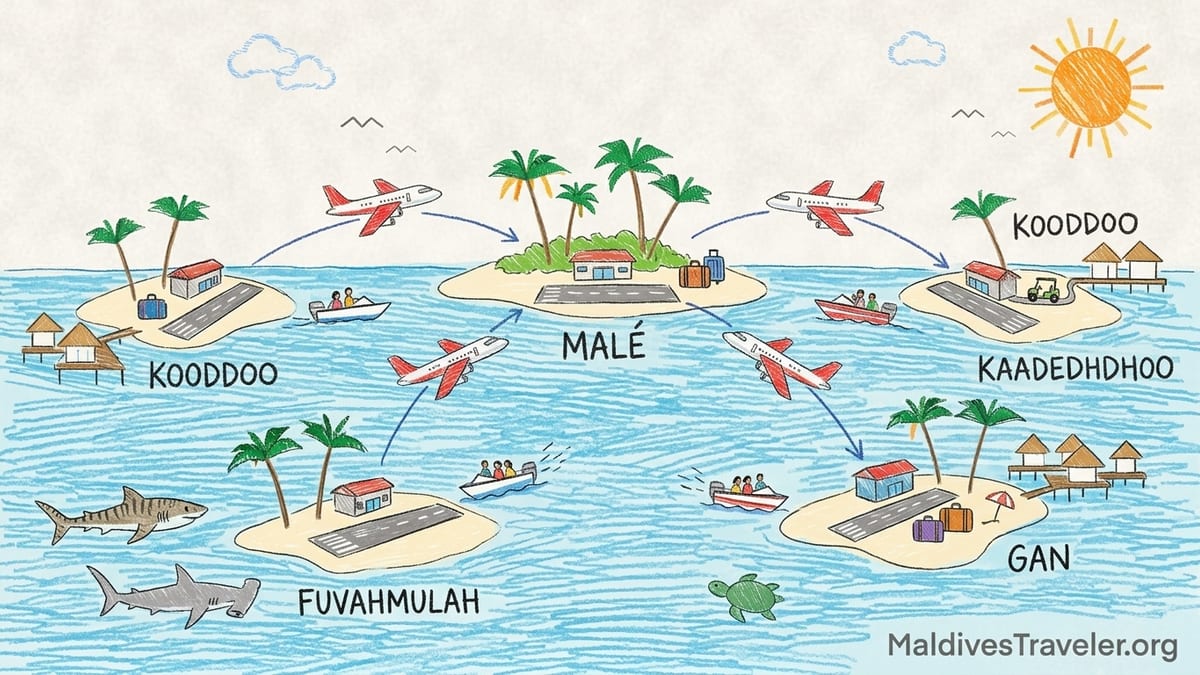
The southern half of the Maldives is anchored by four key domestic gateways: Kooddoo and Kaadedhdhoo for the twin Huvadhoo atolls, Fuvahmulah for its single-island atoll and shark-diving scene, and Gan at the southern end of the archipelago in Addu Atoll. All four are linked to Malé’s Velana International Airport by Maldivian, the national airline, using turboprop aircraft that shuttle locals, resort staff and visitors throughout the day. For most travellers, every southern itinerary starts and ends in Malé, with at least one domestic hop in each direction.
On a typical trip, a guest landing from an overnight flight into Malé in the morning will clear immigration in the international terminal, walk a few minutes to the neighbouring domestic terminal and check in for a Maldivian service to their chosen southern airport. From there, resort staff or dive operators take over, transferring guests by speedboat or occasionally by resort car if the hotel sits on the same island as the runway, as is the case at Mercure Maldives Kooddoo. This three-stage chain of international flight, domestic hop and local transfer is the backbone of travel to the deep south.
Although Malé acts as the hub, Maldivian also operates south-to-south links that connect Gan with Kooddoo and Kaadedhdhoo without a change in Malé. These are especially useful for travellers combining Huvadhoo with Addu on a single trip, for example spending a week diving in Gaafu Dhaalu then continuing to a resort in Addu Atoll without backtracking all the way to the capital. However, frequencies are limited, and schedules can shift with seasonal demand, so it remains important to check current timetables before locking in a multi-atoll route.
Because southern atolls are more remote, they are less crowded and often have healthier reefs and bigger pelagic life, but the trade-off is that you must plan around operating days and timings of domestic flights. Understanding the routes, baggage rules and typical connection windows will help avoid long waits in Malé or missed last boats to your resort.
Malé to Kooddoo and Kaadedhdhoo for Huvadhoo Atoll
Huvadhoo is split for administrative purposes into Gaafu Alifu and Gaafu Dhaalu atolls, and these are served by two different domestic airports. Kooddoo, in Gaafu Alifu, is the gateway for northern Huvadhoo resorts such as The Residence Maldives at Falhumaafushi and The Residence Maldives at Dhigurah, which both use the Kooddoo runway followed by a short speedboat ride. Kaadedhdhoo, in Gaafu Dhaalu, serves southern Huvadhoo properties including resorts such as Amari Havodda and a roster of dive liveaboards that turn around in this area.
From Malé, Maldivian typically schedules multiple daily flights to Kooddoo and Kaadedhdhoo, often with intermediate stops at other domestic airports. A real-world example is an afternoon Malé to Kooddoo service that also calls at Kadhdhoo in Laamu Atoll on some days, with total airborne time of around 1 hour 15 minutes. Travellers heading to Kaadedhdhoo can expect similar timings. Fares vary with season and booking channel, but package guests generally see the domestic leg bundled into an overall transfer fee quoted in US dollars by their resort or tour operator.
On arrival at Kooddoo or Kaadedhdhoo, resort teams usually meet guests right outside the tiny terminal building. A stay at The Residence Maldives, for instance, involves a staff escort from Kooddoo arrivals to a dedicated jetty where a resort speedboat completes the journey in about 7 minutes. Reaching Amari Havodda from Kaadedhdhoo might involve a 10 to 35 minute boat ride depending on sea conditions. These hops are not public services; they are virtually always arranged and charged by your resort or liveaboard company, so it is rarely practical to “build your own” transfer.
One special case in Huvadhoo is Mercure Maldives Kooddoo Resort, which shares the same island as the airport. Guests walk from the plane to the small terminal, meet the resort representative and then transfer by buggy or on foot to their villa with no speedboat or seaplane needed. For visitors anxious about seasickness or prone to worrying about missing the last boat, a runway-side resort like this can dramatically simplify logistics while still giving access to the remote south.
Malé to Fuvahmulah: Shark Diving Logistics and Timing
Fuvahmulah is unique among Maldivian atolls: a single, inhabited island ringed by deep ocean walls that attract resident tiger sharks and seasonal hammerheads. There are no big international-brand resorts here; instead, travellers stay in guesthouses and dive lodges that package together accommodation, dives and domestic flights. The island’s domestic airport sits just inland, with frequent Maldivian services connecting to Malé and occasional links onward to Gan.
Typical dive packages from operators such as Extreme Dive Fuvahmulah quote return Malé to Fuvahmulah flights as part of an all-in price and indicate approximate baggage allowances. Current information from these operators and Maldivian’s own policies suggests that domestic tickets often include around 20 kilograms of checked baggage and 5 kilograms of cabin baggage as standard, with many dive-focused packages negotiated to allow about 25 kilograms checked for guests carrying dive gear. Exact allowances can differ by fare type and contract, so travellers planning to bring heavy camera housings or twin sets should confirm weight limits in writing before departure.
Connection timing is a frequent concern for Fuvahmulah-bound divers. International flights from Europe or Asia may land in Malé late morning, with domestic departures to Fuvahmulah scheduled around midday and late afternoon. The airport layout makes this manageable: after clearing immigration and customs, it is a short indoor and outdoor walk to the domestic terminal, and check-in for local flights can often be completed up to 45 to 60 minutes before departure. Dive lodges commonly book the first workable connection and monitor for schedule changes, advising guests to avoid tight turnarounds of less than two hours between scheduled international arrival and domestic departure.
Because Fuvahmulah diving is demanding and highly weather dependent, many operators recommend arriving the day before your first planned shark dive. One practical pattern is to land in Malé in the morning, fly to Fuvahmulah that afternoon, settle into your guesthouse and start diving the following day. On the way home, lodges usually book a morning or early afternoon domestic leg back to Malé that connects safely with evening long-haul flights, factoring in at least two to three hours in case of minor weather delays.
Malé to Gan for Addu Atoll and South-to-South Connections
Gan International Airport sits at the southern tip of the Maldives and serves Addu Atoll, a horseshoe-shaped chain of islands linked by causeways. Gan handles a mix of domestic and limited international flights, but for most travellers the route remains Malé to Gan on Maldivian, followed by an onward transfer to a resort or local guesthouse. Resorts such as those on Gan and neighbouring islands in Addu typically use a combination of vehicle transfers along causeways and short speedboat hops to get guests from the runway to their rooms.
Flying from Malé to Gan takes just over an hour in most cases, sometimes with a stop in Fuvahmulah. Schedules can include morning and evening legs depending on season and demand. For example, it is common to see an early-evening departure from Malé that allows same-day connection from inbound flights arriving in the afternoon from the Gulf hubs. Resorts in Addu Atoll bundle the Malé to Gan flight and onward ground or boat transfer into a single per-person charge, usually quoted along with the room rate at the time of booking.
Gan also anchors Maldivian’s south-to-south domestic network. Current route maps and flight data show non-stop Maldivian services linking Gan to Kooddoo and Kaadedhdhoo, along with other mid-chain airports such as Kadhdhoo. This opens up itineraries that combine, for instance, a week at a Huvadhoo resort reached via Malé and Kooddoo followed by a domestic hop from Kooddoo down to Gan and several nights in Addu. In practice, these connecting flights do not operate every day of the week, and timings may not always align neatly with resort check-in and check-out times, so travellers need to build in at least a partial buffer day if they want to make full use of south-to-south links.
Addu’s geography means that some accommodations are reached entirely by road rather than speedboat. Guests staying on Gan itself or linked islands might transfer by resort van in under 20 minutes from the terminal. Visitors heading to more remote outer-reef properties in Addu, or to liveaboards turning around in the lagoon, may instead have a 10 to 30 minute speedboat crossing after a brief car ride. As in Huvadhoo, these legs are usually arranged and controlled by the property or boat operator rather than sold as stand-alone public services.
Baggage Rules, Extra Dive Gear and Practical Weight Management
Maldivian’s published baggage policy for domestic routes typically grants economy-class passengers around 20 kilograms of free checked baggage plus 5 kilograms of cabin baggage as a baseline, with higher allowances on some fare types and charter arrangements. Dive-oriented packages to destinations such as Fuvahmulah and Huvadhoo often negotiate a slightly higher checked baggage allowance, commonly around 25 kilograms, specifically to accommodate dive equipment. Travel organisers and dive centres highlight this in their pre-trip information sheets, though they also warn that overweight charges can apply if travellers exceed the combined allowance.
Divers planning to bring full sets of gear, multiple wetsuits and camera housings should think of Maldivian’s allowance as similar to a medium international economy ticket rather than an unlimited gear hauler. In practice, a typical diver might pack a 23 kilogram checked bag and a 7 kilogram carry-on, keeping regulators, computers and camera bodies in the cabin bag to protect against knocks. Heavier items such as fins and BCDs go into the checked bag, with any overflow managed by sharing weight across a buddy pair or by renting bulkier items like tanks and weights locally.
Overweight baggage charges on Maldivian evolve with time, but they are generally calculated per kilogram over the free allowance and collected at check-in. As examples from recent traveller reports, being five to eight kilograms over on a domestic sector can add a noticeable extra cost to a return trip, but not usually enough to justify leaving essential items at home. Divers who know they will run heavy on camera equipment sometimes pre-arrange an additional baggage allowance through their resort or dive operator, which can work out cheaper and smoother than paying ad hoc at the airport.
One practical tip is to separate what you truly need for the first few days from backup items. If your international airline offers a higher allowance than Maldivian, you may arrive comfortably underweight on the long-haul but over the limit for the domestic hop. Packing a small, compressible duffel that can be partially offloaded and stored in Malé by an agent or tour operator is one way to avoid surcharges while still travelling with everything you need for an extended stay in the Maldives.
Timing Domestic Flights After International Arrivals
Clear, realistic timing is crucial when planning domestic departures after long-haul arrivals into Malé. The airport is compact, but queues can develop at immigration and baggage claim during busy bank-flight periods when multiple widebodies land within a short window. As a rule of thumb, travellers should allow at least 90 minutes from scheduled international landing to the check-in deadline for a domestic Maldivian flight, and two hours is more comfortable, especially for families or those carrying significant hand luggage.
For example, if you land from Doha at 08:50 and Maldivian lists a Kooddoo departure at 10:30, you technically have enough time, but this leaves little margin for delays. Many resorts prefer to book guests on the next available flight around midday, giving a buffer for late arrivals and baggage delays. Experienced Maldives-focused travel agents routinely build in two to three hours between flights, especially for itineraries involving onward speedboats that only operate in daylight or that need to connect with other guests coming in on different services.
Getting from the international terminal to the domestic terminal is straightforward. After customs, resort staff with name boards often meet guests, collect checked baggage trolleys and escort them on the short walk to the domestic side. Independent travellers simply follow signage to the domestic departures area, which is in the same overall airport complex. Check-in for domestic flights usually closes around 45 minutes before departure, and security screening is similar to that for a short regional flight elsewhere in Asia.
One subtle but important consideration is the schedule of your resort or dive base’s last boat of the day. For many southern properties, speedboats run only in daylight hours and are timed to meet specific flights. If a weather delay or late incoming long-haul causes you to miss the last workable domestic leg, you may need to overnight in Malé or at an airport hotel. Planning a conservative connection on arrival and avoiding unnecessary same-day backtracking between atolls greatly reduces the chance of an unplanned night in the capital.
Resort-Arranged Transfers, Speedboats and Real-World Pricing
Across the Maldives, and particularly in the south where islands are far apart, resorts tightly control transfers. In almost all cases you cannot simply buy a Maldivian ticket and then shop around the pier for a cheaper boat. Instead, your chosen resort or liveaboard bundles the domestic flight and speedboat or car transfer into a compulsory package, quoted in US dollars per person and added to your room bill. This structure ensures that the right boat meets the right flight and that guests are not stranded on an uninhabited island with no public transport.
Real-world examples help illustrate what this looks like for a traveller. A resort in Gaafu Alifu Atoll might quote around 350 to 450 US dollars per adult for a return Malé to Kooddoo domestic flight plus speedboat transfer, with discounted rates for children and infants. A Huvadhoo liveaboard embarking from near Kaadedhdhoo may charge a similar figure that covers the domestic leg and a short tender ride to the vessel. In Fuvahmulah, guesthouses and dive centres frequently wrap transfers into full-board diving packages; a week-long tiger shark package might include domestic flights, dives, accommodation and meals in a single price around which operators then build seasonal promotions.
Speedboat pricing in the southern atolls can climb rapidly for private charters because of the long distances and fuel costs involved. Recent quotes from Maldives-based agents show inter-island private speedboat transfers across atoll channels costing several hundred US dollars one way, even for relatively short journeys. Shared resort boats are generally more affordable on a per-person basis, but they run on fixed schedules that align with specific flights. This is another reason why asking a resort to coordinate your domestic flights is usually more cost-effective than trying to tailor timings yourself.
For budget-conscious travellers staying on local islands in the south, public ferries and government-run high-speed services operate on some routes, but coverage is patchier than in central atolls and schedules can change. Most visitors headed to southern resorts or specialised dive destinations opt to pay resort transfer rates in exchange for predictability, shorter travel times and direct pier-to-pier connections.
Combining Southern Atolls: Do You Need to Backtrack to Malé?
With Kooddoo, Kaadedhdhoo, Fuvahmulah and Gan all served by Maldivian, a natural question is whether you can hop between them without returning to Malé. Maldivian’s own route maps and published schedules confirm that south-to-south links such as Gan to Kooddoo and Gan to Kaadedhdhoo exist, alongside flights connecting Gan, Fuvahmulah and mid-chain airports. On paper this makes it possible to design an itinerary that starts in Huvadhoo, continues to Fuvahmulah and ends in Addu, or vice versa, with only domestic hops in between.
In practice, combining several southern atolls on a single trip remains logistically more complicated than a simple “one resort, one atoll” holiday. South-to-south flights may run only a few times per week and often at times optimised for local demand rather than tourism. Some routes operate seasonally or with last-minute time changes. Travellers trying to link, for example, a Kooddoo-based resort directly to Fuvahmulah might find that the most reliable option is still to fly Kooddoo to Malé and Malé to Fuvahmulah on the same or following day, accepting an extra transit through the hub.
Resorts themselves can also be a limiting factor. Many properties are set up to handle guest flows exclusively from and back to Malé. Their internal systems and contracted seats on Maldivian assume Malé as the origin and destination, and they may not be prepared to coordinate or guarantee onward legs to another southern airport. If you want to combine, for example, a week at a Gaafu Dhaalu resort with a few days of diving in Fuvahmulah, you may need to take responsibility for the intermediate segment yourself and ensure all parties understand your arrival and departure times.
A realistic multi-atoll plan might therefore look like this: international arrival into Malé, domestic flight to Kooddoo and speedboat to your Gaafu Alifu resort; after several days, domestic flight from Kooddoo back to Malé with an overnight near the airport; then a morning flight from Malé to Fuvahmulah for a dive package; finally, a domestic hop from Fuvahmulah to Gan and a stay in Addu before flying back from Gan to Malé to meet your homebound flight. This kind of routing makes good use of Maldivian’s south-to-south services where they exist, but still uses Malé as a safety net between key segments.
The Takeaway
Travel in the southern Maldives revolves around four airports: Kooddoo and Kaadedhdhoo for Huvadhoo, Fuvahmulah for its famous shark diving and Gan for Addu Atoll. All are connected to Malé by Maldivian flights, and onward resort transfers are almost always arranged directly by properties or dive operators using a mix of speedboats and, in Addu’s case, causeway-linked road vehicles. Understanding this structure, along with realistic baggage allowances and connection times, turns what can look like a complex web of transfers into a predictable, bookable sequence of steps.
For most visitors, the simplest approach is still to choose one southern base and let the resort or dive centre arrange everything from Malé onward. Those with more time and an appetite for logistics can use Maldivian’s south-to-south routes to link Huvadhoo, Fuvahmulah and Addu in a single trip, ideally with buffer nights in Malé between key segments and a clear grasp of baggage rules. With a bit of planning, the reward is access to some of the Maldives’ quietest lagoons, healthiest reefs and most dramatic big-animal encounters, far from the speedboat-crowded waters of the central atolls.
FAQ
Q1. How much checked baggage is usually allowed on Maldivian domestic flights?
Most standard economy domestic tickets include around 20 kilograms of checked baggage plus 5 kilograms of cabin baggage, though some dive packages negotiate up to about 25 kilograms checked for guests carrying dive gear. Always confirm the exact allowance on your booking before travel.
Q2. Can divers bring heavy camera equipment and still stay within the allowance?
Yes, but planning is essential. Many divers travel with one checked bag around 23 kilograms and a 7 kilogram carry-on holding fragile cameras and regulators. If you expect to exceed your allowance, ask your resort or dive operator in advance about pre-purchasing extra baggage, which can be cheaper than paying overweight fees at the airport.
Q3. How long should I allow between my international flight arrival and a domestic connection?
A safe guideline is to leave at least 90 minutes and ideally two hours between your scheduled landing in Malé and the domestic flight check-in deadline. This allows for immigration, baggage claim, the short walk to the domestic terminal and security, plus a buffer for minor delays.
Q4. Do I need to book Maldivian domestic flights myself or will my resort handle it?
In most cases, southern resorts, liveaboards and dive lodges book domestic flights on your behalf and invoice you as part of a transfer package. You usually just provide your international flight details and let them coordinate seats and timings that align with their speedboats or vehicle transfers.
Q5. Are there direct flights between Gan and the Huvadhoo airports?
Yes, Maldivian’s current domestic network includes non-stop services between Gan and both Kooddoo and Kaadedhdhoo on selected days. Frequencies and times vary with season, so it is important to check up-to-date schedules when planning a multi-atoll itinerary.
Q6. Can I travel directly between Huvadhoo and Fuvahmulah without going back to Malé?
Depending on the season and timetable, some south-to-south routings are possible, often involving a connection through Gan or another domestic airport. However, flights may not operate daily, and schedules are subject to change, so many travellers still find it more reliable to connect via Malé for this combination.
Q7. How are transfers handled on arrival at Kooddoo or Kaadedhdhoo?
Resort or liveaboard staff meet passengers outside the small terminal buildings, assist with luggage and escort them to a waiting speedboat. For example, guests heading to The Residence Maldives typically ride a seven-minute resort speedboat from Kooddoo, while those bound for other Huvadhoo properties may have a 10 to 35 minute crossing.
Q8. Do any southern resorts avoid speedboat transfers entirely?
Yes. Mercure Maldives Kooddoo is built on the same island as Kooddoo Airport, so guests transfer from plane to resort by buggy or on foot rather than by boat. Some accommodations in Addu Atoll also rely mainly on road transfers over causeways from Gan, with no significant boat leg.
Q9. How expensive are private speedboat transfers in the southern atolls?
Private speedboats that cross atoll channels or cover long distances can cost several hundred US dollars one way, sometimes more, depending on distance, fuel prices and waiting time. Shared resort boats tied to specific flights are usually more economical on a per-person basis and are the norm for most guests.
Q10. Is it realistic to visit Huvadhoo, Fuvahmulah and Addu in one trip?
It is possible but requires careful planning, flexible dates and a willingness to build in buffer nights in Malé or at airport hotels. Using Maldivian’s south-to-south routes where available, you can combine a resort stay in Huvadhoo, shark diving in Fuvahmulah and a quieter finale in Addu, but you should expect extra domestic legs and higher transfer costs compared with a single-atoll holiday.