


The southern Maldives feel like a different country from the famous resort ring around Malé. Fewer boats, fewer overwater villas, more wild reef and lived-in islands. For travelers willing to fly beyond the usual atolls, Huvadhoo, Fuvahmulah, Addu and Laamu offer very different takes on the “Maldives dream” – from tiger shark encounters and cycling past British-era ruins to polished private-island luxury. This guide compares the strengths of each destination so you can match the right atoll to your style, budget and appetite for adventure.
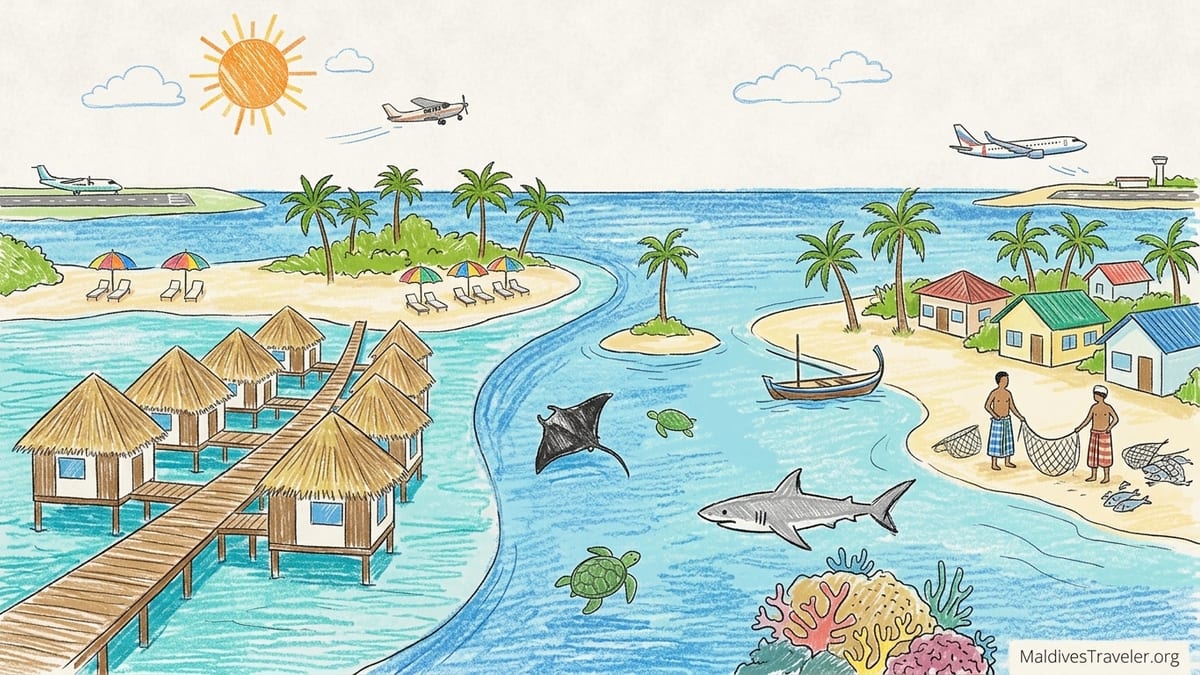
How the Southern Maldives Differ from the Classic Resort Atolls
Most first-time visitors stay near Malé in atolls such as Kaafu or Ari, where transfers are quick and resort choice is huge. The southern atolls sit several hundred kilometers further down the archipelago, closer to the equator. That extra distance means domestic flights or long liveaboard cruises, but it also means quieter lagoons, healthier reefs in many spots and a more everyday Maldivian feel once you step onto local islands. You are less likely to see a line of resorts on the horizon and more likely to share a beach with fishermen mending nets at sunset.
Flight patterns shape how your trip works in practice. From Malé, most travelers connect on 60 to 90 minute domestic flights to Kooddoo or Kaadedhdhoo for Huvadhoo, Fuvahmulah Airport for Fuvahmulah, Gan International Airport for Addu and Kadhdhoo or if you are staying at Six Senses Laamu, the resort’s preferred domestic hub for Laamu. Transfer schedules can limit same-day connections, so itineraries that look simple on a map may require an overnight in Malé or trimming dive days. That is why many serious divers commit their entire week to a single southern atoll rather than trying to hop between two.
Prices also shift as you head south. You still find ultra-luxury resorts such as Park Hyatt Maldives Hadahaa in Huvadhoo or Six Senses Laamu in Laamu, but you also see a growing network of guesthouses and small hotels on inhabited islands. On Fuvahmulah, for example, divers stay in simple but comfortable places like Hikers Villa or AIG Grand The Sundowner, then walk or drive a few minutes to the harbor for daily shark dives. Room rates at these properties can be closer to the price of a mid-range city hotel than a private-island villa, which makes the deep south one of the more affordable ways to experience Maldivian reefs.
Choosing between Huvadhoo, Fuvahmulah, Addu and Laamu is less about ranking attractions and more about matching priorities. Do you want total seclusion with a refined spa and quiet sandbank picnics, or are you happy to trade polished design for the ability to cycle between villages or step off a harbor wall onto a dive boat filled with local guides? The sections below break down what each atoll does best and who it suits, with concrete examples of how a week’s holiday actually feels on the ground.
Huvadhoo: Remote Luxury and Wild Reefs
Huvadhoo, sometimes written Huvadhu or Huvadhoo, is one of the largest and most sparsely populated atolls in the Maldives. Its remoteness is part of the appeal. Luxury resorts here, such as Park Hyatt Maldives Hadahaa in North Huvadhoo, build their identity around a sense of being far from everything. Park Hyatt’s island is ringed by a near-360 degree house reef, so you can wade in from the beach or steps of an overwater villa and be above living coral within a few fin kicks, without needing to board a boat every time you want to snorkel.
This atoll is ideal for resort travelers who want comfort first but still care about healthy marine life. A typical day at a property like Park Hyatt might start with breakfast under palm trees, a guided house-reef snorkel looking for turtles and reef sharks, then a late-morning spa treatment. In the afternoon, the resort can arrange a speedboat trip to an uninhabited sandbank, where staff set up a simple picnic and sunshades while you swim over bommies that see only a handful of visitors each week. Independent reports and resort materials highlight how operators here emphasize environmental design and relatively low villa counts, which helps the reef recover between visits.
Diving in Huvadhoo tends to focus on channels where fast-moving currents bring in sharks and schooling fish. Many liveaboard routes spend several days here because of the consistent sightings of grey reef sharks and other pelagic species. If you are a serious diver traveling with a non-diving partner, Huvadhoo can be a good compromise. You get advanced dives in the passes while your partner enjoys the spa, yoga platforms and lagoon snorkeling. Non-divers still have things to do, from cooking classes that introduce Maldivian flavors to local-island visits where you see how fishermen and families live away from the resort bubble.
Huvadhoo is less suitable if you want strong Maldivian community immersion every day. While resorts sometimes organize excursions to inhabited islands, you sleep and eat in a private resort environment with curated experiences. Couples who picture quiet evenings in an overwater bar, honeymoon-style seclusion and high-quality wine lists tend to be happiest here. Budget-conscious backpackers may find it harder to stay long unless they focus on the growing but still limited guesthouse scene on islands like Hoandedhdhoo, which is trying to develop local tourism with small properties and guided reef trips.
Fuvahmulah: Tiger Sharks and Local-Island Life
Fuvahmulah is unlike any other place in the Maldives. Geographically it is a single large island in the open ocean, not a ring-shaped atoll, and its position along deep oceanic currents attracts an extraordinary amount of pelagic life. Dive operators describe it as one of the world’s most reliable spots for encountering tiger sharks, with year-round sightings at specific shark-feeding sites just offshore. Local and independent guides consistently refer to it as the tiger shark capital of the Maldives, and dive centers build entire weekly packages around those encounters.
Travelers usually stay in small hotels or guesthouses rather than resorts. Options range from budget-friendly guesthouses near the island’s white-pebble beach to mid-range hotels like AIG Grand The Sundowner, which has a rooftop infinity pool for sunset views, and specialist dive lodges such as Sharks Lounge or The Shark Residence that package accommodation with daily dives. A typical diver’s day starts with coffee at the guesthouse, a short pickup to the harbor, three dives focusing on tiger sharks, deep plateaus and reef walls, and a late lunch back onshore. Evening life is low-key: chatting with dive guides on the terrace, walking to a café for hedhikaa (Maldivian short eats) and turning in early for the next morning’s briefing.
This is not an island designed first for non-divers. The main draw is the underwater life, particularly the close encounters with large sharks that take place in relatively shallow water under strict safety procedures. Environmental reviews of shark-diving practice here note the importance of briefings about behavior, body positioning and boat traffic. That makes Fuvahmulah a superb choice for confident, experienced divers and underwater photographers who are happy for most of the trip to revolve around diving. Couples where only one partner dives intensively sometimes split days so the non-diver uses bicycles to explore the island’s lakes, farmland and beaches, or books day trips with local guides, but it is hard to justify the extra domestic flights unless shark diving is a shared priority.
On the other hand, Fuvahmulah offers some of the richest Maldivian community experiences in the deep south. You are staying on a local island, not a private resort, so you see schoolchildren walking home, fishermen selling their catch and families gathering in small parks by the waterfront. Dress codes follow Maldivian norms, particularly in village areas, and alcohol is not served in town, which surprises some visitors used to resort culture. For travelers who want to understand how modern Maldives functions beyond tourist marketing and who do not mind basic but clean rooms instead of villas, Fuvahmulah can feel more like cultural immersion than vacation.
Addu: History, Cycling and Accessible Wrecks
Addu, also known as Seenu Atoll, is the southernmost atoll of the Maldives and one of the easiest in the deep south for non-divers to enjoy. Several of its islands are linked by a causeway road built during the British military era, creating a rare opportunity in the country: you can rent a bicycle or scooter and simply ride from village to village. The Addu Link Road connects islands like Gan, Feydhoo, Maradhoo and Hithadhoo, passing mosques, waterfront café strips and stretches of mangrove.
Gan itself has a layered history. During the Second World War and the early Cold War, it hosted a British naval and air base known as RAF Gan. Remains of oil tanks, old barracks buildings and the former airfield, now used as Gan International Airport, still sit on the island. Curious travelers can join informal tours with local guides who explain how the foreign base influenced local politics and economy, and how its closure in the 1970s changed daily life. Even if you are not a history buff, cycling past these relics then stopping for sweet black tea in a harbor café gives your Maldivian trip a narrative that goes beyond beaches.
Underwater, Addu is famous for two things: manta rays and the wreck of the British Loyalty, a World War Two-era tanker scuttled in the lagoon. The wreck lies at a depth that is accessible to recreational divers and has become an artificial reef, though it still reportedly leaks small amounts of oil. There are also cleaning stations where reef mantas gather, so operators can often offer relatively relaxed manta dives or snorkels when conditions align. Because the atoll is lagoon-protected, some dive sites here have gentler currents than the open-ocean channels of Huvadhoo or the shark plateaus of Fuvahmulah, making Addu a good choice for intermediate divers and confident snorkelers.
Addu suits mixed groups: serious divers get their wrecks and mantas, while non-divers enjoy cycling, island-hopping by road, and watching everyday Maldivian life unfold in Addu City’s neighborhoods. Accommodation ranges from modest guesthouses to small hotels on Gan that occupy repurposed military buildings or new beachfront structures. Prices generally run lower than high-end resort atolls, though you will not find the same level of overwater luxury. For many repeat visitors, that tradeoff feels worthwhile in exchange for the sense of being in a functioning island city rather than a curated resort bubble.
Laamu: Boutique Resort Life, Surf and Rich Reefs
Laamu Atoll offers something different again. Unlike Huvadhoo, which has several resorts, Laamu currently has a single flagship luxury property, Six Senses Laamu, known for its emphasis on sustainability and marine research. It runs its own domestic flight and speedboat transfers, meeting guests in Malé and escorting them to a lounge before the onward journey. Once at the resort, you find the classic Maldivian overwater-villa look combined with barefoot luxury details like sandy paths, open-air bathrooms and bicycles parked outside each villa for guests to move around the island.
The resort’s location gives it access to both calm lagoon reefs and exposed outer-reef surf breaks. One of the Indian Ocean’s better-known right-hand waves in this region, often referred to simply as Yin Yang, breaks on Laamu’s outer reef and is reachable by boat from Six Senses. Independent surf reports and guest reviews describe it as suitable for intermediates and up in solid swells, while inside sections and smaller days can be manageable for learners with an instructor. The resort also operates a small surf shack that offers lessons, board hire and boat trips, so it is entirely possible to learn to surf in the morning and then snorkel a coral bommie in the afternoon without leaving the property.
Divers and snorkelers benefit from Laamu’s combination of inner-lagoon patch reefs and drop-offs on the outside of the atoll. Conservation reports and visitor accounts point to healthy seagrass meadows that attract turtles, plus a network of dive sites where you may see reef sharks, schooling fish and macro life. Six Senses has partnered in the past with organizations focused on mantas, sea turtles and marine conservation, turning the resort into a base for citizen science-style guest programs such as turtle ID or reef monitoring. For families and couples who want a polished resort holiday but still care about choosing a property with a visible environmental and community program, Laamu is an appealing balance.
Laamu can also work for non-divers who do not surf. The resort leans into wellness, with yoga pavilions, a spa that incorporates local ingredients and a range of dining options from beachfront barbecues to tree-top restaurants. At the same time, the atoll has small guesthouses on inhabited islands such as Gan and Maamendhoo that host visiting surfers on stricter budgets, often arranging boat trips to the same breaks used by resort guests. If your priority is a single high-quality resort experience with a mix of reef life and wave-riding, Laamu is one of the most complete packages in the southern Maldives.
Choosing the Right Atoll for Your Travel Style
When deciding between Huvadhoo, Fuvahmulah, Addu and Laamu, start with who is traveling and what they enjoy on a typical day. For couples seeking seclusion, good food and pampering with the option of snorkeling and perhaps a few dives, Huvadhoo and Laamu stand out. A honeymoon at Park Hyatt Maldives Hadahaa or Six Senses Laamu usually revolves around private dinners, villa pools and spa rituals, with reef activities as highlights rather than the sole focus. Staff handle every transfer and tour, and you could easily spend a week without setting foot on a town street if you did not want to.
Serious divers who prioritize big animals and advanced sites are more likely to choose Fuvahmulah or a liveaboard itinerary that includes Huvadhoo and sometimes Addu. A dedicated week at a Fuvahmulah guesthouse such as Sharks Lounge or Tigershark Residence allows you to log multiple tiger shark dives and deeper pelagic drifts with specialized guides. You sacrifice resort-level amenities, but your budget buys far more time underwater. If you want variety rather than repetition of one signature species, a liveaboard that spends several days in Huvadhoo’s channels and at least a day or two in Addu for the British Loyalty wreck can deliver that mix, though these trips require comfort with currents.
For visitors who care more about Maldivian community life than polished resort product, Addu and Fuvahmulah are the best fits. In Addu, you can stay in a simple hotel on Gan, rent a bicycle and spend the day riding along the causeway, stopping in village cafés and exploring local markets. In Fuvahmulah, you walk from your guesthouse to a family-run restaurant where the owner might recommend the day’s fish curry or invite you to try homemade short eats. Dress codes, prayer times and social norms shape your day more directly here than they do in a resort, but many travelers find that rewarding rather than restrictive.
Non-divers who still want the southern Maldives should think carefully about their threshold for remoteness and simplicity. A non-diving partner of a dedicated shark diver might enjoy Fuvahmulah for a few days if they are satisfied with cycling, beach strolls and reading by the guesthouse, but those who expect spa menus and multiple restaurant choices might feel stranded. For them, Huvadhoo or Laamu make more sense. Likewise, parents traveling with younger children tend to gravitate toward Laamu’s structured kids’ activities, shallow lagoon and surf lessons, or to a resort in Huvadhoo with family-friendly villas, instead of Fuvahmulah’s more intense dive-focused scene.
The Takeaway
The southern Maldives are not a single destination but a set of distinct travel worlds stitched together by domestic flights and liveaboard routes. Huvadhoo offers remote, high-comfort resort stays with excellent reefs, ideal for couples and mixed groups where not everyone dives. Fuvahmulah is the domain of shark devotees and travelers who prefer local-island authenticity over polished design, accepting that almost everything on the itinerary will revolve around diving. Addu blends accessible diving with a unique cycling and history circuit, making it a favorite for adventurous non-divers who still want plenty to see between snorkel sessions.
Laamu, anchored by Six Senses Laamu, delivers a boutique resort experience where you can surf reef breaks in the morning, join a marine-biology talk in the afternoon and eat dinner barefoot under the stars. It suits travelers who want comfort, sustainability credentials and a mix of activities more than raw cultural immersion. By understanding these differences and being honest about your priorities, you can choose a southern atoll that feels not just beautiful but aligned with how you actually like to travel.
For many visitors, the deepest reward of heading this far south is the feeling of space. Boat traffic thins, horizons widen and the ocean’s wildlife often feels closer and less disturbed. Whether you are floating above a Huvadhoo channel, watching mantas glide past a cleaning station in Addu, gliding down the face of a Laamu wave or holding position on a Fuvahmulah reef ledge as a tiger shark materializes from the blue, the southern atolls offer moments that can redefine what you think a Maldivian holiday can be.
FAQ
Q1. Which southern Maldivian atoll is best for non-divers?
Addu and Laamu are generally the most rewarding for non-divers. Addu offers cycling, local cafés and Second World War history, while Laamu’s flagship resort focuses on wellness, snorkeling, light adventure and laid-back beach time.
Q2. Is Fuvahmulah suitable for first-time divers?
Fuvahmulah is better suited to confident, certified divers due to its deep sites, large sharks and sometimes strong currents. Beginners usually have a safer, more enjoyable introduction to diving in calmer resort atolls or in protected parts of Huvadhoo or Addu before tackling Fuvahmulah.
Q3. How many days should I spend in Huvadhoo?
A week is a good minimum for Huvadhoo if you are flying from Malé, as it allows time to settle into the resort, schedule two or three dive days, and still enjoy sandbank picnics, spa treatments and local-island visits without rushing.
Q4. Can I combine Fuvahmulah with another southern atoll on one trip?
It is possible but often logistically awkward. Because Fuvahmulah is a standalone island with its own domestic airport, you usually need to route back through Malé to reach other atolls, which can cost a day of travel that might otherwise be spent diving.
Q5. Where is the best place in the south for manta rays?
Addu and Laamu tend to offer the most reliable manta encounters in the south, with cleaning stations and seasonal aggregations, while mantas are more of an occasional bonus in Huvadhoo and Fuvahmulah.
Q6. Are there true luxury resorts in the southern Maldives?
Yes. Park Hyatt Maldives Hadahaa in Huvadhoo and Six Senses Laamu in Laamu are both high-end properties with private villas, full-service spas, curated dining and strong reputations among international luxury travelers.
Q7. Which atoll offers the most Maldivian community interaction?
Fuvahmulah and Addu provide the most day-to-day interaction with local life because you stay on inhabited islands. You can eat in local cafés, visit markets and see how Maldivians live beyond resort environments.
Q8. Is Laamu a good choice for learning to surf?
Yes, Laamu is well suited to learners and improvers. Six Senses Laamu operates a surf shack with instructors who run beach lessons followed by sessions on gentler reef sections when conditions are suitable.
Q9. Do I need a liveaboard to enjoy the southern Maldives?
No. You can base yourself in a resort or guesthouse in each atoll and still access excellent diving and snorkeling. Liveaboards are useful if you want to sample multiple atolls on one trip or focus heavily on advanced channel dives.
Q10. Which atoll should couples choose for a once-in-a-lifetime romantic trip?
For a classic romantic escape with strong service and privacy, Huvadhoo and Laamu stand out, especially at Park Hyatt Maldives Hadahaa or Six Senses Laamu, where villas, dining and spa experiences are tailored to couples.