


The far south of the Maldives feels like a different country from the resort-dense central atolls. Here, vast blue channels, quiet local islands and a handful of polished resorts sit just above the equator, promising fewer crowds and wilder seas. The challenge is not whether to go, but where to base yourself: a private island in Huvadhoo, a shark-diving guesthouse in Fuvahmulah, a road-linked local island in Addu, or a design-forward resort in Laamu. Each choice shapes everything from your transfer bill to how many restaurants you can walk to at night. This guide compares the main southern options and helps you decide which kind of stay fits the trip you actually want.
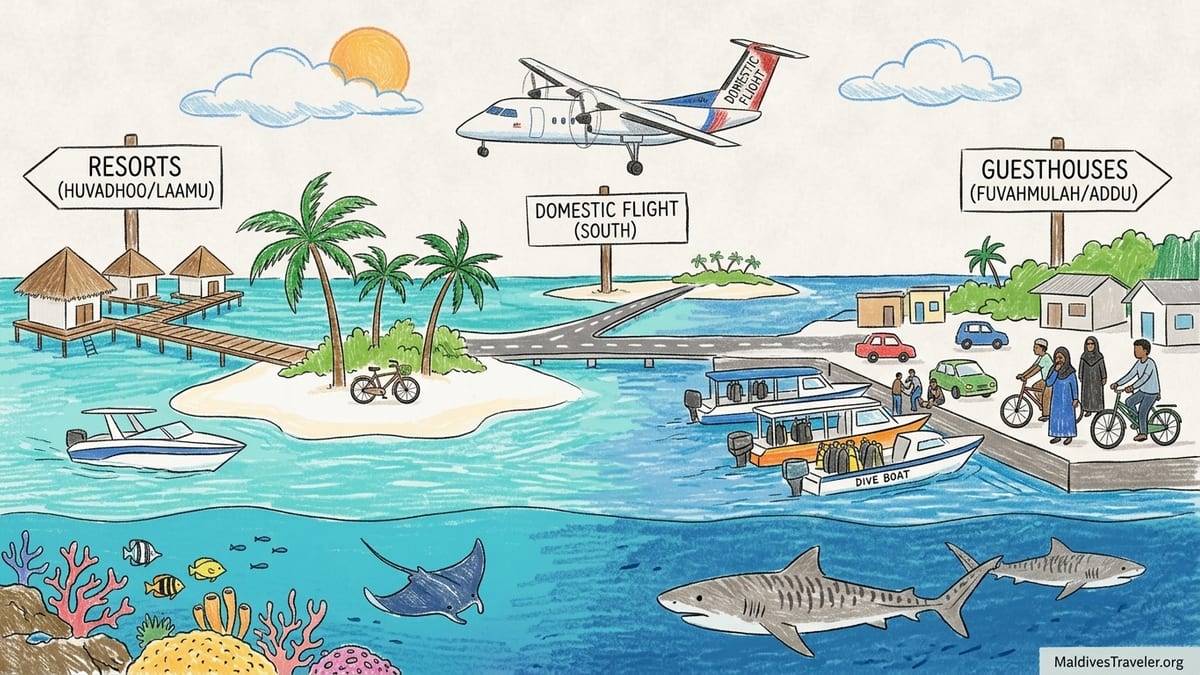
Understanding the Southern Atolls and Domestic Flights
The southern Maldives sit hundreds of kilometres below Malé, so almost every stay here begins with a domestic flight. From Malé’s main international airport, travellers typically connect on Maldivian or Manta Air services to small airports such as Kooddoo or Kaadedhdhoo in Huvadhoo, Fuvahmulah Airport in Gnaviyani, Gan International Airport in Addu, or Kadhdhoo in Laamu. From these airstrips, resorts add a speedboat hop, while guesthouses on inhabited islands are usually a short car or taxi ride away. Travel times from Malé to the southern airports often run 60 to 90 minutes in the air, compared with 20 to 35 minutes for central atolls.
Domestic flights are one of the biggest hidden costs of going south. Return fares for foreigners are commonly quoted in the region of a few hundred US dollars per person when bundled into resort or dive packages, and surcharges for luggage and dive gear can add to that. Resorts such as Six Senses Laamu and many Huvadhoo properties typically insist that guests book the domestic sector through them so they can manage connections, which is convenient but locks you into their negotiated rates. Dive guesthouses in Fuvahmulah and Addu often include domestic flights inside week-long dive-and-stay packages, which can soften the blow if you are primarily visiting for underwater time rather than lounging.
When you factor in these transfers, the cheapest room rate rarely tells the full story. A couple booking a seven-night stay at a Huvadhoo resort might find that domestic flights and resort speedboat transfers add the equivalent of several extra nights to the bill. By contrast, Addu’s Gan airport sometimes has occasional direct international services from nearby countries, which means some travellers can fly in without backtracking to Malé at all. Laamu and Huvadhoo are the most dependent on domestic-flight plus speedboat combinations, Fuvahmulah is flight only, and Addu offers the most flexible routings thanks to its role as the country’s southern transport hub.
Because connections balloon total travel time, southern atolls suit trips of at least five to seven nights. On very short stays, the hours and cost invested in reaching these atolls can feel disproportionate compared with a quick transfer to a central-atoll resort. If you are determined to see the south on a shorter holiday, consider pairing a central-atoll resort with a separate, longer future trip focused entirely on one southern atoll.
Huvadhoo: Private-Island Resorts and Blue-Channel Isolation
Huvadhoo Atoll, sometimes split into Gaafu Alifu and Gaafu Dhaalu, is one of the largest natural atolls in the world. It is also one of the quietest tourist regions in the Maldives, with a string of private-island resorts scattered across a huge lagoon. Properties like Mercure Maldives Kooddoo Resort, Ayada Maldives and Pullman Maldives Maamutaa sit on their own islands, reached by a domestic flight to Kooddoo or Kaadedhdhoo followed by a short private boat transfer. For travellers, that means classic Maldives visuals: an overwater villa above impossibly blue water, no local village in sight, and near-total separation from the outside world.
In Huvadhoo, isolation is the selling point. Once you arrive, the resort becomes your entire universe. House reefs are usually within easy swimming distance, and many islands have drop-offs just a few fin kicks from the beach, so you can snorkel with reef fish, turtles and occasional reef sharks before breakfast. Dive boats fan out to nearby channels for drift dives and pelagic encounters, with some Huvadhoo sites known among experienced divers for strong currents and the chance to see grey reef sharks and schooling barracuda. Because there are no neighbouring restaurant strips or local cafes, almost all dining happens in resort venues, from buffet main restaurants to speciality outlets and bars.
That isolation has cost implications. Food and drink prices on Huvadhoo resorts sit firmly in international luxury territory, and there is nowhere to wander out for a cheap curry. This is where all-inclusive or full-board plans become more than an indulgence. Many guests find that once they add two or three restaurant meals and a few cocktails per day, an all-inclusive package works out comparable in total cost while removing the shock of a long bill at checkout. At Pullman Maldives Maamutaa, for example, the fully inclusive concept typically covers three meals, drinks and many non-motorised activities, which suits travellers who prefer to forget about per-item pricing once they arrive.
For some, the drawback of Huvadhoo is that the experience can feel socially and culturally sealed off. You will meet Maldivians working in the resort, but you will not be walking through local streets, visiting independent dive shops or buying short eats from neighbourhood teashops. If your dream trip is pure blue water, curated menus and a sense of being marooned on a luxury island far from anywhere, a Huvadhoo resort is close to ideal. If you want to experience local life or keep costs contained, another southern atoll may fit better.
Fuvahmulah: Shark-Dive Guesthouses in a One-Island Atoll
Fuvahmulah is one of the most unusual places in the Maldives. It is a single, large island that forms its own atoll, sitting alone in the open ocean. There are no resort islands here, only a growing cluster of dive-focused guesthouses and small hotels strung along the main streets and coastal lanes. Travellers fly in on a domestic hop from Malé to Fuvahmulah Airport, where dive centres and guesthouses such as Fuvahmulah Dive, Pelagic Divers Fuvahmulah and The Shark Residence typically meet guests at arrivals and transfer them by car to town. Many dive operators offer packages that bundle accommodation, breakfast, daily tiger shark dives and domestic flights, which simplifies planning for visitors who are here for one thing: pelagic encounters.
Underwater, Fuvahmulah has become famous for its resident tiger sharks and seasonal appearances of thresher sharks, oceanic manta rays and large schools of pelagic fish. Access is via speedboats that leave from small harbours on the island each morning rather than from private jetties. Surface conditions can be rough compared with protected resort lagoons, and dives are typically for experienced divers comfortable with deep water and blue-water descents. A sample price list from dive operators shows individual shark dives commonly priced in the low hundreds of dollars, with discounts for multi-dive packages, and many guests plan their entire stay around three-dive days, followed by evenings reviewing footage in their guesthouse lounge.
On land, Fuvahmulah looks and feels different from the postcard image of the Maldives. Instead of a tiny sandbar with one restaurant, you find an inhabited island with mosques, schools, corner shops and a modest but growing cafe scene. Guesthouses range from simple, clean rooms with breakfast included to boutique-style properties with small pools and leafy gardens. Public beaches exist, but bikini beaches are limited to designated stretches, so sunbathing in swimwear is less casual than on a resort island. Alcohol is not served in local establishments, in line with Maldivian law, so evenings tend to revolve around coffee, juices and early nights ahead of dawn dives rather than bar hopping.
Fuvahmulah is not ideal if you envision a classic honeymoon with overwater villas and all-day lounging in a calm lagoon. It is, however, one of the best choices in the country for divers who prioritise big animal encounters over resort trimmings and who do not mind trading infinity pools for simple rooms, hearty Maldivian meals and dive trucks rumbling past in the morning. If one partner is a non-diver, think carefully: surface swimming beaches are less of a focus here, and days are structured around the dive schedule, so some couples prefer to combine Fuvahmulah with a resort stay elsewhere.
Addu Atoll: Resort Island Privacy or Local-Island Road Trips
Addu Atoll, also known as Seenu or Addu City, is the southernmost atoll in the Maldives and feels more like a low-key tropical town than a string of isolated islets. Several of its main islands, including Gan, Feydhoo, Maradhoo and Hithadhoo, are linked by the 16 kilometre Link Road causeway, creating a rare thing in the Maldives: a place where you can rent a bicycle or scooter and travel for kilometres without stepping on a boat. Gan International Airport sits at one end of this chain, providing domestic flights from Malé and occasional direct flights from nearby countries, which makes Addu one of the easiest southern atolls to reach in terms of logistics.
For accommodation, Addu offers two distinct experiences. On one hand you have resort-style stays such as Canareef Resort Maldives and South Palm Resort Maldives, both located on private islands reached by speedboat from Gan. These properties work like classic Maldivian resorts: once you check in, you are largely confined to the island, with your own beach, pool, restaurants and dive centre. Canareef, for instance, stretches along a long slim island with villas facing a lagoon on one side and more exposed ocean on the other, and offers bicycle hire, spa treatments and organised excursions. South Palm Resort sits on another island with a similar all-in-one concept and optional all-inclusive meal and drink plans.
On the other hand, Addu’s linked local islands are now dotted with guesthouses, boutique hotels and homestay-style options. In Hithadhoo, Maradhoo, Feydhoo and Gan you can stay in a guesthouse that looks outward to the community rather than inward to a resort. Options range from modest family-run houses with a handful of rooms to smarter boutique properties with modern decor and direct beach access. At night you can walk to small restaurants serving Maldivian curries and grilled fish, stop at cafes for coffee and snacks, and join locals strolling or fishing along the waterfront. Because the islands are connected by road, divers and snorkellers can base themselves in one guesthouse but join trips departing from different harbours along the causeway, expanding the choice of sites and operators.
The trade-off between resort and local-island stays in Addu comes down to how much independence and cultural contact you want. At a resort like Canareef or South Palm, alcohol is available, bikini beaches are unrestricted and everything from airport transfers to dive bookings is handled inside the resort. Prices reflect that, with nightly rates and dine-in costs generally higher than on the inhabited islands. On Hithadhoo or Feydhoo, room rates are usually lower, meals at local cafes cost a fraction of resort restaurant dishes, but alcohol is not served and swimwear rules apply on local beaches except on designated bikini stretches. For some travellers the ability to rent a bicycle, ride across causeways, visit Addu Nature Park wetlands and stop at different cafes feels richer than staying confined to a single resort island.
Addu’s diving is an extra point in its favour. The atoll has a mix of channels, outer reef walls and sheltered inner reefs, plus the wreck of the British Loyalty, a World War II-era tanker resting on its side and popular with wreck divers. Many local dive centres run from the inhabited islands, while resorts operate in-house dive shops. For keen divers on a budget, basing on a local island guesthouse and joining day boats can provide access to similar sites for less than resort-based dive prices, at the cost of swapping resort conveniences for a more DIY, road-linked daily routine.
Laamu: Design-Forward Luxury and Soft-Adventure Access
Laamu Atoll has one of the most recognisable luxury resorts in the southern Maldives: Six Senses Laamu. Reached via domestic flight from Malé to Kadhdhoo followed by a resort speedboat, it occupies its own island surrounded by a broad lagoon, with a mix of overwater and beach villas that have become a staple of glossy travel features. For visitors, Laamu offers a polished version of the southern experience: excellent house-reef snorkelling, sophisticated but relaxed dining, and a strong focus on sustainability and wellness, all wrapped in a barefoot-luxury aesthetic.
Staying here is decidedly high-end, but the resort attempts to justify rates with thoughtful touches. Villas are spaced for privacy, many overwater units have direct ladder access to the sea, and house-reef snorkelling is close enough that confident swimmers can explore coral heads and reef life without joining a boat trip. The resort’s surf breaks and dive sites are reached by small boats, and there is a strong emphasis on marine biology, with on-site staff often leading guided snorkels and talks. For couples who want southern isolation without sacrificing restaurant variety, Six Senses Laamu’s several dining venues, from barefoot-chic overwater bars to fine-dining spaces, make it easier to stay a week without feeling repetitive.
Transfer-wise, Laamu is more straightforward than Huvadhoo because there is essentially one main resort handling most tourist arrivals. The resort coordinates domestic flight times and adjusts speedboat transfers around delayed services where possible. Costs are still significant: return domestic flights and boat transfers for two can add the equivalent of several nights in a mid-range guesthouse elsewhere in the country. However, because everything runs through a single resort, the experience from Malé arrivals hall to villa deck is usually seamless, which is a key reason Laamu appeals to honeymooners and time-poor professionals willing to pay for convenience.
Unlike Addu or Fuvahmulah, there is limited scope here for combining resort life with local-island exploration unless you are prepared to arrange separate day trips or an additional guesthouse stay in another atoll. Most guests commit to the resort bubble for the duration of their trip, accepting that their Maldivian experience will be curated and comfortable rather than embedded in local daily life. For travellers who want to end a longer, more adventurous journey with a few days of high-comfort seclusion before flying home, Laamu works as a strong southern finale.
How Much Isolation Do You Really Want?
Across Huvadhoo, Fuvahmulah, Addu and Laamu, the crucial decision is not just which island, but how isolated you want your base to be. On a Huvadhoo private island or at Six Senses Laamu, the resort is the only world you will inhabit: you will eat in on-site restaurants, drink at on-site bars, snorkel and dive with in-house guides, and see the same faces over breakfast and sunset drinks each day. For many travellers, especially honeymooners and those seeking deep rest, that is exactly the point. The predictability, convenience and absence of external decisions make it easy to relax.
On local islands like Fuvahmulah or the linked islands of Addu, isolation is replaced by immersion. You trade swim-up bars for corner shops, buffets for noodle cafes, and curated entertainment for the rhythms of local life. Days involve walking or cycling along real streets, thinking about dress codes when you leave the guesthouse, and choosing where to eat each night rather than scanning a resort activities board. This can be rewarding for travellers who value authenticity, conversation and spontaneity over design and service theatrics. It can also feel confronting if you arrive expecting a private-island fantasy and discover a working town instead.
Some travellers respond by splitting their time. One common pattern is to spend four or five nights in a Fuvahmulah dive guesthouse doing shark dives, then fly back via Malé and connect onward to a Huvadhoo or Laamu resort for three or four nights of pure relaxation. Others pair a few nights at a local guesthouse in Addu, exploring by bicycle and sampling small cafes, with a stay at a nearby resort such as Canareef or South Palm for a taste of classic Maldives luxury. The key is to accept that moving between atolls takes time and money; shifting within the same atoll, such as from an Addu guesthouse to an Addu resort, usually makes more logistical sense than trying to hop between multiple southern atolls within a single short trip.
Think about practical personality traits too. If you or your travel partner tend to get restless staying in one place, a road-linked island in Addu or a larger inhabited island like Fuvahmulah may soothe that urge with small daily adventures, even if the accommodation itself is simpler. If decision fatigue hits easily, an all-inclusive resort package in Huvadhoo or Laamu removes hundreds of micro-choices about where to eat, what to pay and how to get around. Neither style is inherently better; they simply suit different temperaments and stages of life.
Costs, Meal Plans and House Reefs: Comparing Value
When you compare southern options side by side, it helps to separate four cost categories: transfers, room rates, meals and activities. Transfers are highest where domestic flights and private speedboats are bundled by resorts. A seven-night all-inclusive stay at a Huvadhoo resort might come with return domestic flights, speedboat transfers and full-board dining included in a package price that looks steep but predictable. In contrast, a Fuvahmulah guesthouse may quote a modest nightly rate, but you still need to add domestic flights, shark-dive packages and meals at local cafes, which can bring the total closer to a mid-range resort than the room rate suggests.
House reefs and included activities can tilt the value equation. A resort with a superb, easily swimmable house reef can save you from booking multiple paid boat excursions, especially if snorkelling is your main priority. In the south, many private islands in Huvadhoo and Laamu have strong house reefs, while Addu’s resort islands and some local beaches have decent but more variable snorkelling. Fuvahmulah is different: the most famous marine life is off the reef edge in deep water, reached by boat, so you cannot rely on casual house-reef snorkels to see the headline animals. Divers there should factor in two or three boat dives a day when calculating trip budgets.
Meal plans are where resort versus local-island stays diverge most clearly. On inhabited islands like Fuvahmulah and Addu’s causeway-linked towns, you can eat inexpensively in local cafes and restaurants, sharing plates of rice, curry and fresh fish for a small fraction of resort restaurant prices. Many guesthouses include breakfast and sometimes simple dinners, leaving lunches open to explore town. On private-island resorts, choice is richer but almost always pricier, which is why half-board and all-inclusive plans are popular. If you like multi-course dinners and cocktails, an all-inclusive plan in Huvadhoo or Laamu can end up cheaper overall than paying as you go, but travellers who eat lightly and skip alcohol may prefer bed-and-breakfast or half-board to avoid paying for inclusions they will not use.
Finally, consider the value of time. If you are flying a long distance to reach the Maldives, every half-day spent in transit within the country is time you are not on the beach or underwater. For travellers on ten-day trips, it may be worth paying more for a seamless resort package that handles all domestic flights and transfers, leaving you free to stretch out on a sun lounger within a few hours of landing in Malé. On longer trips, you can be more flexible, building in stopovers on local islands and accepting an extra domestic hop or two in exchange for a wider range of experiences.
The Takeaway
Choosing where to stay in the southern Maldives is really a choice about how you want to feel day to day. Huvadhoo’s private-island resorts and Laamu’s design-forward luxury deliver the classic, high-comfort Maldivian fantasy, amplified by the sense of being far from the busy central atolls. Fuvahmulah offers one of the most intense dive experiences in the country, trading resort polish for big-animal drama and the texture of daily life on a working island. Addu, with its causeway-linked towns and mix of resorts and guesthouses, sits in the middle: more independent than a resort, more practical than a one-island atoll, and rich in small discoveries for travellers who enjoy exploring under their own steam.
Before you book, write down what matters most: shark dives, seclusion, restaurant choice, cultural immersion, low daily costs, or minimal transit. Then match those priorities to each southern option. If you crave isolation, a Huvadhoo or Laamu resort belongs at the top of the list. If you are an experienced diver chasing tiger sharks, Fuvahmulah is the obvious target. If you want a southern base where you can cycle between islands, chat with cafe owners and still duck into a resort for a day trip or final-night splurge, Addu’s linked islands are your friend. There is no single best place to stay in the southern Maldives, only the one that best reflects how you want your days and nights to unfold once you finally step off that domestic flight and smell the salt in the air.
FAQ
Q1. Is the southern Maldives worth the extra domestic flight compared with closer atolls?
The southern atolls suit travellers with at least a week to spare who value quieter resorts, adventurous diving and a sense of remoteness. If you only have three or four nights, the time and money spent on domestic flights can feel disproportionate, and a closer central-atoll resort may offer more beach time per day.
Q2. Which southern atoll is best for experienced divers?
Fuvahmulah is the top choice for experienced divers focused on big pelagic species such as tiger sharks and threshers. Huvadhoo and Addu also offer excellent channel and wreck diving, but Fuvahmulah’s deep blue-water sites and shark encounters make it a specialist destination where diving, rather than resort facilities, is the main reason to visit.
Q3. Can I drink alcohol on local islands like Fuvahmulah or Addu City?
Alcohol is not served in local cafes, restaurants or guesthouses on inhabited islands, in line with Maldivian law. If access to bars and alcoholic drinks is important, you will need to stay on a licensed resort island such as those in Huvadhoo, Laamu or the resort islands within Addu Atoll, or plan occasional resort day trips where available.
Q4. How do transfer costs compare between Huvadhoo, Fuvahmulah, Addu and Laamu?
All four regions require at least one domestic flight from Malé, which is a significant cost per person. Huvadhoo and Laamu usually add private resort speedboats on top of the flight, while Fuvahmulah and Addu’s local-island guesthouses normally use short road transfers from their airports. Some dive and resort packages bundle flights and transfers into a single rate, which can simplify budgeting.
Q5. Are southern Maldives resorts suitable for families with children?
Many southern resorts, such as larger properties in Huvadhoo and Laamu, welcome families and offer kids’ clubs, shallow lagoon areas and family villas. However, long transfers and higher costs can be tiring with younger children, and strong currents at some southern dive sites mean that advanced diving is generally for adults and older teenagers with experience.
Q6. What is the main difference between staying in a Huvadhoo resort and an Addu guesthouse?
A Huvadhoo resort stay is typically fully self-contained, with private beaches, multiple restaurants, alcohol service and house-reef access, but no independent shops or local streets. An Addu guesthouse places you in a lived-in community linked by roads, with local cafes, smaller beaches and more day-to-day independence, but no resort-style bars or all-inclusive buffets.
Q7. Do I need to be an advanced diver to enjoy Fuvahmulah?
Most of Fuvahmulah’s famous dives are suited to experienced divers comfortable with deep water, blue-water descents and variable surface conditions. Some operators offer introductory dives and training, but the destination is generally recommended for certified divers with a solid number of logged dives rather than complete beginners seeking calm, shallow reef dives.
Q8. Is it realistic to combine more than one southern atoll in a single trip?
Combining multiple southern atolls is possible but adds extra flights and transfers. It tends to work best on longer trips of ten nights or more, for example pairing a Fuvahmulah shark-diving stay with a Laamu or Huvadhoo resort. For shorter holidays, most travellers find it more relaxing and cost effective to choose one southern atoll and explore it in depth.
Q9. How do dress codes differ between resort islands and local islands?
On resort islands, swimwear is acceptable on beaches and by pools, and dress codes are usually relaxed, with smart-casual attire requested in some restaurants. On local islands such as Fuvahmulah or Addu’s inhabited islands, visitors are expected to dress modestly away from designated bikini beaches, covering shoulders and knees when walking through town or visiting cafes.
Q10. When is the best time of year to visit the southern Maldives?
Weather and sea conditions vary throughout the year, but many travellers aim for the drier months when seas are calmer and visibility is often good. Specific diving highlights, such as certain shark or manta seasons, can shift by atoll, so it is wise to check current advice from resorts or dive centres when planning dates rather than relying solely on general Maldives seasonality.