


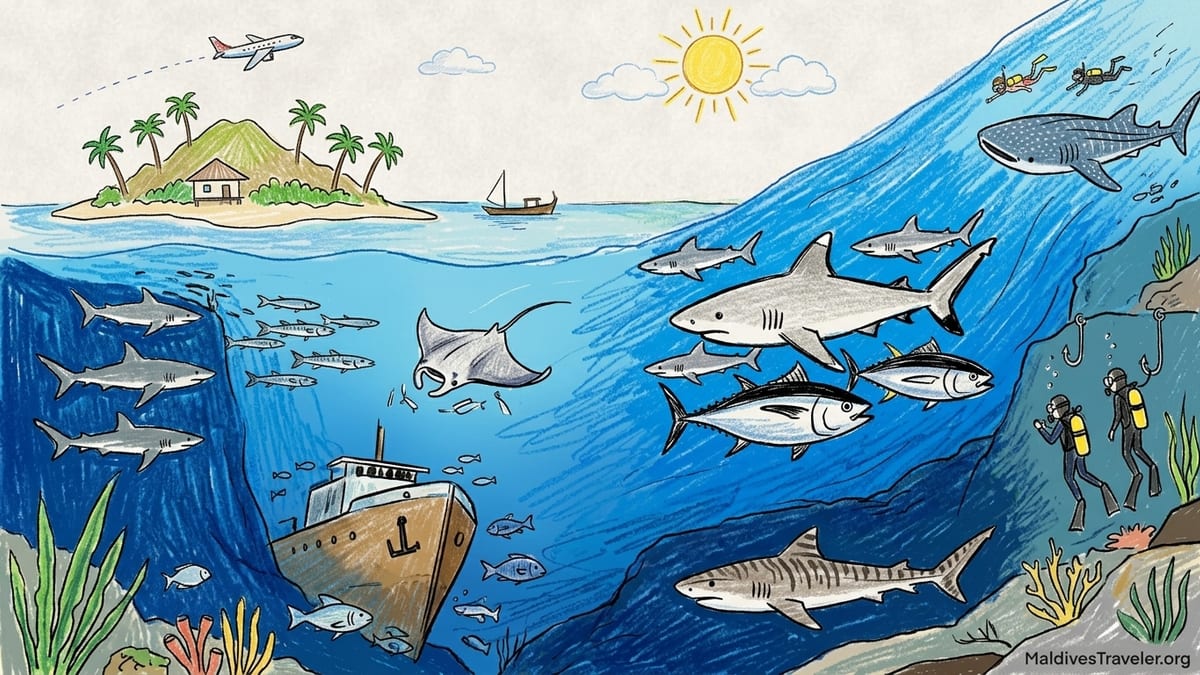
The far south of the Maldives has quietly become one of the most exciting big-animal dive destinations on the planet. South of the busy central atolls, Fuvahmulah, Huvadhoo and Addu offer sharply different underwater experiences, often on a single deep-south liveaboard route that links all three. From tiger sharks and blue-water pelagics to manta cleaning stations and historic wrecks, this is where Maldives diving feels wild, seasonal and still a little exploratory.
Why the Deep South Is Different
Most first-time visitors know the Maldives for calm lagoon dives, easy pinnacles and the occasional manta or whale shark. The southern atolls are another story. Here, the geography opens directly to the Indian Ocean, currents are stronger and the marine life shifts toward schooling sharks, pelagics and dramatic topography. Deep-south trips also tend to be quieter, with fewer boats and a more expedition-like feel, especially between January and April when many liveaboards relocate south for shark season.
Commercially, operators package the region as a single "Deep South" product, but in practice you get three distinct zones. Fuvahmulah is the headline for tiger sharks and other ocean wanderers, Huvadhoo (also written Huvadhu or Gaafu) is all about channel dives and reef sharks, while Addu at the southern tip combines manta cleaning stations, the British Loyalty wreck and varied reef diving. Most week-long routes from brands such as Emperor, Master Liveaboards or Carpe Fleet include at least parts of all three, often starting in Addu and ending around Huvadhoo or vice versa.
For divers comparing itineraries, this matters. A seven-night Deep South cruise with two days in Fuvahmulah will feel very different from a southern itinerary that skips Fuvahmulah and spends most of the week on Huvadhoo channels and Addu reefs. Understanding what each area is known for helps you decide whether to commit to a liveaboard, build a land-based stay, or combine both to maximise specific encounters.
Practicalities also differ. The deep south requires domestic flights from Malé to Gan, Fuvahmulah or one of Huvadhoo’s airstrips, plus occasional overnight stays at either end of a cruise. That adds cost but also means you spend your week far from the crowds that concentrate around North and South Malé and Ari Atolls.
Fuvahmulah: Tiger Sharks and True Blue-Water Diving
Fuvahmulah is unique in the Maldives. It is a single island rising from deep water rather than a classic ring-shaped atoll, which means there is no protective lagoon. The reefs drop quickly into blue water, and that geography attracts a lineup of pelagic species. The island has built its reputation on reliably encountering tiger sharks, but divers also report thresher sharks, oceanic manta rays, mola mola in cooler months and seasonal schooling hammerheads on deeper blue-water drifts.
The best-known experience is the dedicated tiger shark dive, run by a handful of local centres based in simple guesthouses along Fuvahmulah’s shore. A typical day might include a morning briefing, a short ride on a local-style dhoni to a fixed site where tiger sharks regularly patrol, and a controlled dive along a shallow ledge while guides manage positioning. On busy days when a liveaboard arrives, there may be 15 to 20 divers in the water, but several operators now stagger entries or limit group size to keep the experience manageable.
Beyond tiger shark encounters, Fuvahmulah’s appeal for experienced divers is its feeling of raw blue-water diving. A second or third dive of the day may be a drift along steep walls with the reef on one side and nothing but deep blue on the other. This is where threshers, silky sharks, large tuna and schooling barracuda often appear just outside recreational depths. Divers with solid buoyancy and comfort in mid-water will appreciate the freedom to watch the blue, stay streamlined and react calmly when a shark appears from below or behind.
Fuvahmulah suits advanced, current-ready visitors. Many operations set a minimum of Advanced Open Water with 30 to 50 logged dives, and they will often check your skills on an easier reef before taking you to the main shark sites. Nitrox is common and strongly recommended, both for added safety and longer bottom times, but you can still dive air if you are conservative with depth and no-decompression limits. Underwater photographers should expect fast-paced action and often limited time with the sharks, favouring wide-angle setups, fisheye lenses and strobes tuned for close-focus big-animal work rather than static reef scenes.
Huvadhoo: Channels, Reef Sharks and Whale Shark Chances
Huvadhoo Atoll, officially split into Gaafu Alifu and Gaafu Dhaalu, is one of the largest and deepest lagoon systems in the Maldives. It is ringed by dozens of channels that funnel oceanic water into and out of the atoll. These passes, known locally as kandus, are the stage for Huvadhoo’s signature dives. When the current runs into the atoll, divers hook into the channel edges, hover at around 20 to 30 metres and watch walls of grey reef, blacktip and whitetip sharks holding position in the current with barracuda, jacks and eagle rays riding the flow behind them.
Named sites such as Vilingili Kandu on the eastern rim are often highlighted on deep-south itineraries for their shark numbers. On a good day, groups report 20 or more grey reef sharks patrolling a single ledge, with schooling snapper and fusilier clouds framing the scene. During the northeast monsoon months, roughly January to April, visibility can be excellent and surface conditions calmer, making this the preferred season for liveaboards to base around Huvadhoo.
Whale sharks are an added wild card. Unlike South Ari, where operators often focus on snorkelling with shallow-feeding juveniles close to the reef, Huvadhoo’s whale shark sightings tend to be more opportunistic and spread around the southern and western outer reefs. Some liveaboards report several encounters in a week, usually late-afternoon snorkels or shallow dives when a shark is spotted cruising near the surface. Other weeks pass with none, so it is better to treat whale sharks as a welcome bonus rather than a guarantee.
Huvadhoo’s diving varies from easy inner-reef sites to serious high-current channels. Many operators require at least 30 dives on your log and comfort with negative entries, rapid descents and deploying an SMB in blue water. A typical day on a Huvadhoo-focused liveaboard might start with a predawn or early-morning channel dive while the current is strongest, followed by a more relaxed inner-reef drift in the late morning and a third dive on a thila or coral-covered slope in the afternoon. This rhythm works well for experienced divers who want big animals and dynamic conditions without every dive feeling like a workout.
Addu: Mantas, Wrecks and Gentle Reefs
Addu, also known as Seenu Atoll, is the southernmost atoll in the Maldives and has its own distinct atmosphere. The lagoon is partially enclosed and ringed by long islands that were once part of a British naval and air base. Underwater, that history and geography translate to a mix of sheltered reefs, channels with manageable current, manta cleaning stations and one of the country’s most iconic wrecks, the British Loyalty.
The British Loyalty is a World War II-era oil tanker scuttled in Addu’s lagoon in the mid-1940s. Today it sits mostly intact in recreational depths, with the deck around 16 to 18 metres and the seabed near 30 metres. The wreck is encrusted with hard and soft corals and attracts schooling fish, turtles and the occasional passing shark. Penetration is limited and usually reserved for experienced wreck divers with proper training, but even a simple swim along the hull and around the superstructure is highly photogenic and accessible to divers with a few dozen logged dives.
Manta rays are the other major draw. Several cleaning stations around Addu’s outer reefs host resident manta populations, with peak sightings often reported between late December and April when plankton concentrations are higher on the atoll’s western side. Divers usually position themselves on sandy patches down-current of coral bommies where cleaner wrasses attend mantas in slow, repeated loops. On a good day, you might spend an entire 60-minute dive with multiple mantas circling within camera range, offering very different behaviour and angles than the more transient feeding frenzies seen in central atolls.
Beyond mantas and the wreck, Addu offers relaxed drift dives along healthy hard-coral slopes, overhangs with soft corals and reef life similar to central Maldives, but with far fewer boats. Many visitors base themselves at one of the resorts on Gan or neighbouring islands and dive with on-site centres that run regular trips to manta points and the wreck. For newer divers, Addu can be an ideal introduction to the deep south, with calmer conditions and easier navigation than Huvadhoo’s hardest channels or Fuvahmulah’s blue-water pelagics.
Experience Levels, Currents and Safety Considerations
The deep south is not exclusively for experts, but it does reward divers who are honest about their experience and fitness. Fuvahmulah’s main shark sites, many Huvadhoo channels and some of Addu’s more exposed outer reefs can feature strong currents, downcurrents and blue-water ascents. Operators compensate with careful briefing, guide ratios and surface support, but you will get more from the trip if you arrive practiced in a few specific skills.
Currents are the defining factor. In Huvadhoo, for instance, an incoming current at a channel like Vilingili Kandu can mean a fast negative entry, immediate descent to 20 metres and then a quick swim to the channel edge before you clip in with a reef hook. On an outgoing current, the same site becomes a more gentle drift inside the atoll with fewer sharks but easier conditions. In Fuvahmulah, some dives involve hovering in mid-water along a reef wall with the bottom dropping beyond safe limits, so your depth awareness and buoyancy control matter more than on a shallow coral garden.
As a rule of thumb, divers planning a deep-south trip should have an Advanced Open Water or equivalent, at least 40 to 50 logged dives and recent experience in currents. Nitrox certification is very helpful, as many of the best shark action happens between 20 and 30 metres where extended no-decompression time adds both safety margin and more time on the hook. Operators commonly refuse particularly challenging sites to those who cannot demonstrate good trim, controlled descents and ascents, or basic SMB deployment.
Safety infrastructure is improving but still relatively sparse compared to heavily trafficked regions. Liveaboards carry emergency oxygen and coordinate with regional hyperbaric chambers, but evacuation from the far south still involves domestic flights or long boat journeys. For that reason, conservative profiles, computer use, adequate surface intervals and diving insurance that clearly covers remote liveaboard itineraries are strongly recommended.
Liveaboard vs Land-Based: How to Structure Your Trip
Most divers experience the southern Maldives on a liveaboard, for a simple reason: distance. The stretch between Addu and northern Huvadhoo spans hundreds of kilometres with few tourist islands in between. A typical eight to ten-night deep-south route will start in Gan in Addu, spend a couple of days on Addu reefs and the British Loyalty, then cruise north to Fuvahmulah for tiger sharks and pelagics before continuing into southern and northern Huvadhoo to work through a cluster of signature channels.
On these itineraries, boats typically offer three dives a day plus occasional night dives, full-board accommodation and domestic flights packaged into the price. As of late 2025, deep-south liveaboards often price from the lower to mid four figures per person for a week, depending on season and cabin type, with additional costs for nitrox, rental gear and crew tips. Guests wake up each morning at a new kandu or reef, brief on the main deck then transfer to a separate dive dhoni that handles gear and entries.
Land-based diving is growing, especially in Fuvahmulah and Addu. In Fuvahmulah, small guesthouse-and-dive packages appeal to travellers who want several consecutive days focused on tiger sharks rather than a single day as part of a cruise. These often bundle airport transfers, half-board accommodation and two or three dives a day, and they can be cost-effective for groups. In Addu, resort-based divers enjoy easier logistics, with daily two- or three-dive boats visiting mantas and the wreck and plenty of non-diving activities on off-gas days.
For some, the ideal compromise is a liveaboard for Huvadhoo channels, bookended by short land stays. A diver might fly into Gan two days early to settle in and dive Addu’s mantas, join a one-week liveaboard north through Fuvahmulah and Huvadhoo, then stay an extra night near the disembarkation point to buffer domestic and international flights. This approach reduces stress around connections, allows a rest day before flying after multiple deep dives, and gives more flexibility to repeat favourite sites.
Underwater Photography: Choosing the Right Atoll
Each of the three southern areas offers different strengths for underwater photographers, and that can be the deciding factor when comparing routes. Fuvahmulah is about big animals in often-variable visibility. Photographers typically favour full-frame or APS-C bodies with fisheye or ultra-wide zoom lenses, dual strobes, and compact rigs that are easy to manoeuvre in current. Expect fleeting encounters, backlit subjects and blue backgrounds. Having your settings dialled in before you descend makes the difference between a single keeper frame and a missed opportunity when a tiger or thresher glides past.
Huvadhoo’s channels are ideal for wide-angle scenics featuring multiple sharks, reef structure and schooling fish. Visibility is often good during the main season, but currents can be strong, so bulky rigs and dangling accessories are a liability. Many photographers pre-set mid-range apertures and slightly higher ISOs to balance ambient blue water with strobe-lit foregrounds, then park themselves on the hook and let the subjects come to them. On calmer inner-reef dives, there are macro subjects, though most visitors come for sharks rather than critter-hunting.
Addu, by contrast, lends itself to slower, more deliberate shooting. Manta cleaning stations give repeated passes at predictable distances and angles, and the British Loyalty wreck provides a wealth of fixed compositions, from coral-encrusted railings to schooling snapper silhouetted against hatches and masts. Photographers can comfortably alternate between wide-angle wreck and manta work and closer-focus reef scenes, making Addu attractive for those who want variety without relentless current.
If you are planning a single trip with photography as a priority, a deep-south liveaboard that includes all three regions offers the broadest portfolio in one itinerary. Serious shooters may still choose to add extra nights in Fuvahmulah or Addu for more time on specific subjects. Renting or bringing a laptop for daily backups, carrying spare O-rings and ports and confirming that your boat or guesthouse offers secure camera rinse tanks and charging stations are practical considerations that will improve your overall experience.
The Takeaway
Diving the southern Maldives is less about ticking a generic "Maldives" box and more about choosing the right combination of Fuvahmulah, Huvadhoo and Addu for your interests and experience. Fuvahmulah excels for tiger sharks, threshers and blue-water pelagics, but expects advanced conditions and focused operations. Huvadhoo delivers some of the country’s most exciting channel dives, with walls of reef sharks and real but unpredictable chances of whale sharks. Addu balances the equation with manta cleaning stations, the historic British Loyalty wreck and gentler reefs that remain engaging for both new and seasoned divers.
Current deep-south liveaboard itineraries connect these three areas precisely because they complement one another so well. Together, they cover almost the full spectrum of Indian Ocean diving in a compact region: big sharks, mantas, wrecks, reefs and characterful local islands. If you arrive prepared for currents, choose reputable operators and budget a little extra time for domestic flights and surface intervals, the deep south can deliver a Maldives experience that feels both more remote and more rewarding than the classic central routes.
FAQ
Q1. Do I need to be an expert diver to visit the deep south Maldives?
While you do not need to be an expert, the region suits confident divers with an Advanced certification or equivalent and at least 40 to 50 logged dives, including some in current. Less experienced divers can still enjoy Addu’s sheltered reefs and mantas, but Fuvahmulah and the strongest Huvadhoo channels are best left until you are fully comfortable in moving water.
Q2. When is the best time of year to dive Fuvahmulah, Huvadhoo and Addu?
Most liveaboards schedule deep-south itineraries between roughly January and April, when seas are calmer and visibility is often better in the south. Tiger sharks are present at Fuvahmulah year-round, but many operators favour late-wet or early-dry seasons for more stable sea conditions. Mantas in Addu and shark-rich channels in Huvadhoo are also reliable across much of this period, with some variation from year to year.
Q3. Are tiger shark dives in Fuvahmulah safe?
Tiger shark dives in Fuvahmulah are highly managed, with briefings, experienced guides and clear positioning rules, but they still involve close encounters with large predators in open water. Operators typically limit the group size, maintain strict protocols and assess diver experience before allowing participation. As with any big-animal dive, following instructions, maintaining situational awareness and staying within your comfort zone are key to keeping risk low.
Q4. Can I see whale sharks in the deep south, or is South Ari better?
You can encounter whale sharks in Huvadhoo and occasionally around other southern atolls, often during snorkel or shallow dive encounters along outer reefs. However, sightings are less predictable than in South Ari, which is famous for its more regular whale shark activity. If your main goal is guaranteed whale shark encounters, South Ari remains the safer bet, while the deep south offers whale sharks as a possible bonus on a broader shark-focused trip.
Q5. Should I choose a liveaboard or a resort for deep-south diving?
If you want to experience all three areas in one trip, a liveaboard is usually the most efficient choice, allowing you to move from Addu to Fuvahmulah and Huvadhoo without backtracking. If you prefer a slower pace or want to focus on just one highlight, land-based stays make sense: a guesthouse in Fuvahmulah for several days of tiger shark diving, or a resort in Addu for mantas, the wreck and relaxed reefs.
Q6. What kind of dive gear is best for these itineraries?
A standard warm-water setup with a 3 mm wetsuit, open-heel fins, and a reliable BCD and regulator is sufficient for most divers. Adding a reef hook, spool and SMB is essential for channel and blue-water dives, and many divers appreciate a compact dive computer with clear displays for managing depth and no-decompression limits. Underwater photographers should focus on streamlined rigs that minimise drag and snag points in current.
Q7. Are there non-diving activities in Fuvahmulah, Huvadhoo and Addu?
Addu offers the most non-diving options, including cycling around causeway-linked islands, visiting World War II-era sites and enjoying local cafes. Fuvahmulah has scenic coastal walks, freshwater lakes and quiet village streets but limited formal tourism infrastructure. Huvadhoo is more spread out, and on liveaboards most non-diving time is spent relaxing on deck, snorkelling or taking occasional shore excursions to local islands.
Q8. How do domestic flights work for deep-south itineraries?
Most trips involve flying from Malé to Gan, Fuvahmulah or one of Huvadhoo’s domestic airports on local carriers, with flight times usually under 90 minutes. Liveaboard and guesthouse operators often arrange these flights as part of a package, and it is wise to plan at least one buffer night in Malé or at the start or end point to allow for weather or schedule changes, as well as safe no-fly intervals after diving.
Q9. Is nitrox necessary for diving in the southern Maldives?
Nitrox is not strictly necessary, but it is strongly recommended, especially for repeated dives in the 20 to 30 metre range where much of the shark action happens. Using nitrox with appropriate depth limits can extend your bottom time and add an extra safety margin on multi-day, multi-dive itineraries. Many boats and dive centres offer nitrox as a paid upgrade, and some include it in the overall package.
Q10. How far in advance should I book a deep-south liveaboard?
Deep-south itineraries are more limited in number than central routes and often cluster in a few peak months, so cabins can sell out many months, sometimes a year, in advance. Booking early gives you a better choice of dates, boats and cabin types, and also allows more time to arrange domestic flights, insurance and any extra land-based stays you want to add before or after the cruise.