


For travelers already committed to spending at the five-star level in the Maldives, the real question is not whether to splurge, but where that money will deliver the biggest upgrade in experience. Nowhere is this calculation sharper than in the deep south, where ultra-remote atolls such as Huvadhoo and Laamu promise wilder reefs, quieter islands and more space per guest than the busy central atolls near Malé. The trade-off is longer, pricier transfers and a feeling of being very far from everywhere. This guide looks closely at headline properties including Raffles Maldives Meradhoo, Park Hyatt Maldives Hadahaa and Six Senses Laamu to help you decide whether that added remoteness is truly worth it for you.
Why the Southern Atolls Feel Different
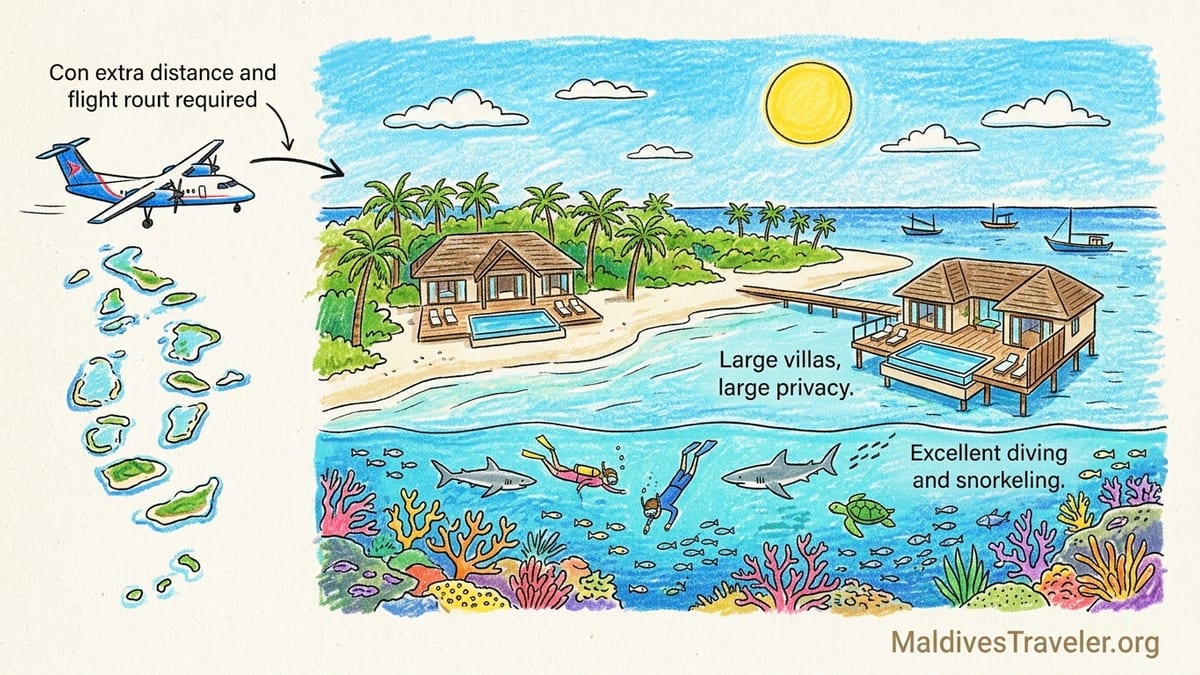
The Maldives stretches across 26 atolls, but most visitors never look beyond the central Kaafu atoll around Malé and its near neighbors. By contrast, Huvadhoo and Laamu sit far south, involving at least one domestic flight on top of your international arrival. That extra distance has a practical upside: fewer resorts, fewer day boats and a far smaller resident population. A speedboat ride around Gaafu Alifu or Laamu still feels like an expedition, not a shuttle loop between packed islands.
Environmentally, the southern atolls are often cited by marine biologists and experienced divers as among the healthiest parts of the country, with reefs that have bounced back faster from past bleaching events. In practice, that can mean snorkelling over coral gardens that still show pockets of color and structure, rather than the flatter, more algae-dominated reefs some guests now encounter closer to Malé. For travelers targeting house-reef snorkelling and serious diving as a central reason to visit, this is where the south begins to justify its premium.
Culturally, you are also further away from the tourism machine. Staff teams at Raffles Maldives Meradhoo, Park Hyatt Maldives Hadahaa and Six Senses Laamu are still highly polished, but the rhythm of the surrounding islands remains more traditional. You are likely to see more local fishing boats than transfer speedboats on the horizon, and night skies tend to be darker, with less light pollution bleeding across from neighboring resorts.
All of this comes with a cost in time and money. Transfers to the southern atolls typically involve a 60 to 90 minute domestic flight from Malé, plus a speedboat hop. While resorts bundle these into packages, it is not uncommon for a couple to spend well over 1,000 US dollars on transfers alone. For some guests that money would be better spent upgrading to a bigger villa or a higher meal plan in a closer atoll. For others, the isolation is precisely the point of traveling this far.
Getting There: Transfer Time, Cost and Comfort
Transfer logistics are where the gap between remote southern resorts and those near Malé is most obvious. A five-star property in North Malé such as Baros or a luxury brand on a private island close to the airport often requires only a 15 to 30 minute speedboat ride. Many of these speedboat transfers cost from roughly 150 to 300 US dollars per adult for a round trip, and departures can be relatively flexible, including after dark, which helps if your international flight lands late in the evening.
By contrast, Park Hyatt Maldives Hadahaa in Huvadhoo typically arranges a domestic flight of around 60 to 105 minutes, depending on routing, to Kooddoo airport, followed by a 30 minute speedboat ride to the resort. Raffles Maldives Meradhoo, located even deeper in the far south, quotes about 55 minutes on a domestic flight plus a 15 minute speedboat, or approximately a 90 minute seaplane when available, with shared round-trip transfers for two adults easily exceeding 1,000 US dollars and seaplane options sometimes priced above that per person. Six Senses Laamu uses a similar model, with a domestic hop and short speedboat, framed as part of the experience with an airport lounge and on-the-ground handling from the resort’s team.
Beyond cost and duration, travelers should factor in operating hours. Seaplanes and some domestic services run only during daylight, so an arrival in Malé after mid-afternoon can mean an overnight near the airport and a fresh transfer the next morning. That is rarely required for speedboat-only resorts closer to Malé, where transfers operate well into the evening. If you have just four or five nights in the Maldives, losing an extra half-day at each end to transfers can feel disproportionate, no matter how beautiful the destination.
On the positive side, resort-managed domestic transfers are generally seamless once you land. At Raffles or Six Senses Laamu you are usually met at the international arrivals hall, escorted to a lounge, and then shepherded onto the domestic flight and speedboat without needing to handle bags or tickets yourself. Some travelers even count the low-flight views over the southern atolls as a highlight of the trip. If your Maldives dream includes that sensation of flying over strings of empty islands and reefs, the southern transfer route can feel like part of the luxury rather than a hurdle.
Villa Size, Layout and Private Pool Experience
One of the main reasons high-spend travelers consider the remote southern resorts is the expectation of larger, more private villas. At Park Hyatt Maldives Hadahaa, for example, beach pool villas are listed around 300 square meters including outdoor space, with a generous deck, private plunge pool and shaded areas framed by dense vegetation. The three-bedroom Kiaali Residence, positioned at the edge of the house reef, pushes the footprint far higher and is aimed squarely at families or small groups for whom space matters as much as location.
Raffles Maldives Meradhoo is similarly generous, with beachfront pool villas that feel more like private homes, often exceeding 200 square meters. The design here leans into residential comfort, with separate living and sleeping areas, high ceilings, large bathrooms and wide decks spilling out onto the sand. Overwater villas at Raffles are deliberately spaced apart so that you are unlikely to see neighbors on their decks from your own, which adds to the sense of a private retreat. The private pools are large enough for proper floating and short laps, not merely a plunge or Instagram backdrop.
Six Senses Laamu’s villa design is more rustic-luxury, with a “castaway but polished” aesthetic. Beach villas and overwater villas typically combine around 100 square meters of interior space with expansive outdoor decks, some with upper-level dining platforms and netted hammocks above the lagoon. Private pools are not universal across all categories, but the pool villas offer a particularly strong sense of seclusion due to clever use of screening, vegetation and angled positioning. Guests there often describe a feeling of owning their own beach or slice of lagoon, especially in the larger family configurations.
When you compare these villas against many five-star properties closer to Malé, you often find that entry-level categories near the airport can be significantly smaller, sometimes under 100 square meters counting both indoor and outdoor space. Some near-Malé brands make up for this with slick interior design and modern amenities, but if raw square footage, outdoor living and a sizeable private pool are top priorities, the remote southern properties usually offer stronger value for the nightly rate, especially outside the absolute peak season around late December and early January.
Privacy, Seclusion and the Feel of the Island
Privacy is not only a function of villa size. It is also about how many neighbors you have and how the resort’s public spaces are laid out. In Huvadhoo and Laamu, resorts such as Park Hyatt and Raffles are among just a handful in their atolls, which makes the broader seascape feel lonelier in the best possible way. Stand on your deck at night and you are likely to see darkness punctuated by a few fishing dhonis, rather than the glow of multiple resorts scattered across the horizon.
On the island itself, Park Hyatt Hadahaa is known for its dense natural vegetation, with villas tucked back behind a ring of trees and shrubs that act as natural privacy screens. You may glimpse other guests as you cycle along the main sandy paths, but you rarely see them from your deck. Raffles splits its experience between an island and an overwater area, with water villas separated by substantial gaps and angled away from direct sight lines. Many guests note that they can spend an entire day on their deck or pool without seeing another person, particularly in the overwater section.
Six Senses Laamu, though larger and more developed as a resort, still retains an intentionally low-rise, natural look. Villas are spaced to create pockets of intimacy along the shore and over the lagoon, and the absence of high structures or harsh lighting preserves a sense of quiet. The central arrival and dining areas can feel lively at peak times, but once you cycle back to your villa the mood shifts to one of seclusion. For honeymooners or privacy-focused couples, that contrast between sociable hubs and hidden retreats can be especially appealing.
Compared with luxury resorts close to Malé, the difference is not that those islands lack privacy, but that there are more boats, more day-trippers and more resort lights within visible range. High-end properties such as the Ritz-Carlton or Patina in the Fari Islands, for example, deliver polished villa privacy and strong butler service, yet guests may still see seaplanes passing regularly overhead or neighboring islands clearly in view. Travelers who equate luxury with a sense of being almost alone on the ocean tend to find that feeling more easily satisfied in the deep south.
Reef & Diving: Are the Southern Waters Really Better?
The southern atolls have acquired a reputation among divers and snorkellers as some of the best remaining reef environments in the Maldives. Park Hyatt Hadahaa is often singled out for its 360-degree house reef encircling the island, reachable within a short swim from the beach. Guests commonly report seeing reef sharks, turtles and dense fish life directly off the sand, which is not a guarantee in many more developed central atolls. For certified divers, Huvadhoo offers channels with strong currents that attract pelagic species, appealing to those comfortable with drift dives.
Raffles Maldives Meradhoo benefits from its position in one of the world’s largest natural atolls, with access to outer reefs and channels that remain relatively lightly dived. The resort operates its own dive center, which can arrange private trips to quieter sites, something that is harder to achieve in crowded atolls where multiple resorts share the same reefs. While no resort can promise specific sightings, guests here have a solid chance of encounters with reef sharks and occasional rays even on more relaxed recreational dives.
Six Senses Laamu is known not only for its house reef but also for nearby surf breaks and manta ray cleaning stations in the surrounding atoll. The resort works closely on marine conservation projects, which adds a layer of engagement for travelers who care about reef health. Snorkelling excursions often yield turtle and shark sightings in relatively shallow water, and visibility is frequently excellent outside of seasonal plankton blooms. This combination of healthy house reef access and high-quality off-island excursions is one of the resort’s strongest selling points.
Closer to Malé, there are still excellent reefs and famous dive spots, but the density of resorts and boat traffic is much higher. That can mean sharing dive sites with multiple groups and, over time, more pressure on the coral. If your idea of value is measured in memorable underwater encounters rather than room hardware or proximity to the airport, paying for remoteness in Huvadhoo or Laamu often feels like money well spent. The caveat is that conditions are always seasonal and weather-dependent, so expectations should be set around “improved odds” rather than guaranteed superiority.
Dining, Spa and Butler Service at the Top Southern Resorts
At this price point, travelers rightly expect dining that justifies the journey. Park Hyatt Hadahaa focuses on quality over sheer quantity of venues, with its main restaurant, specialty outlets and private dining options leaning into fresh seafood, Maldivian flavors and international classics. Menus are typically concise but well-executed, and guests who stay a week often rotate between a la carte dinners and themed nights. The resort’s bar and beachfront dining areas are intimate rather than showy, matching the island’s quieter mood.
Raffles Maldives Meradhoo positions itself a notch higher on formality and service. Its overwater restaurant and beachside venues emphasize fine dining techniques, with multicourse tasting menus available and more elaborate presentation. For many guests, breakfast is a highlight, with made-to-order hot dishes and extensive cold options served with genuinely attentive table service. In-villa dining is treated as seriously as the restaurants, with staff able to stage private dinners on the deck or beach for special occasions.
Six Senses Laamu differentiates itself with a strong sustainability and wellness thread running through its food and spa programs. Dining highlights often include treetop restaurants, organic garden produce, innovative vegetarian and seafood dishes and a popular ice cream and chocolate studio that becomes a ritual stop for many guests. The spa is a central feature, offering a broad menu of massages, holistic therapies and visiting practitioners. Guests regularly comment that spa treatments at Six Senses feel more like a destination experience than a bolt-on amenity.
Butler service in the southern resorts is generally strong and highly personal. Raffles, in particular, is known for “legendary butler service” across all villas, with staff handling unpacking, activity planning and small surprises such as bubble baths or sunset snacks. Six Senses assigns guest experience managers who act as informal butlers, coordinating everything from snorkel trips to pillow choices, while Park Hyatt’s hosts tend to be slightly more discreet but equally capable of quietly arranging logistics in the background. Compared to some near-Malé resorts where staff can feel stretched due to higher guest counts and quick guest turnover, the southern properties benefit from lower density and longer average stays, which often translates into more consistent, individualized attention.
How Do They Compare to Five-Star Resorts Near Malé?
To understand whether the southern splurge is worth it, it helps to compare against a hypothetical near-Malé option. Imagine a five-star resort in North Malé that offers a 20 minute speedboat transfer, polished modern villas of around 80 to 120 square meters, multiple restaurants, a spa and a lagoon suited more to swimming and watersports than house-reef snorkelling. Your transfer might cost around 200 to 300 US dollars per adult and you could be in your villa within an hour of clearing immigration. For a five to six night trip, that efficiency translates into almost a full extra day of usable time compared with flying south.
Now consider a stay at Park Hyatt Hadahaa or Six Senses Laamu, where a couple might pay upwards of 1,000 US dollars for shared domestic transfers and add roughly three to four hours of additional travel in each direction. That premium could also pay for an upgrade from a base villa to a larger pool villa at a closer resort, or push you into a higher meal plan that reduces incidental spending. For travelers whose priority is ease, flexibility with arrival times and a strong all-round resort product, a high-end property near Malé remains the more rational choice.
Where the calculus shifts is when privacy, reef quality and a feeling of remoteness are central to your Maldives dream. A week at Raffles Meradhoo or Park Hyatt Hadahaa almost guarantees a quieter island, a larger villa footprint and easier access to healthy reefs than many near-Malé counterparts. Guests who work demanding jobs and value the psychological distance from the rest of the world often describe the southern atolls as uniquely restorative. The lack of visible neighboring islands, the darker night skies and the relative absence of boat traffic contribute to a sense of being truly away.
Another point of comparison is crowding at shared spaces. High-profile near-Malé resorts with multiple restaurants and beach clubs can feel busier at breakfast buffets, main pools or sunset bars, even when villa privacy is excellent. In the southern atolls, guest numbers are usually lower and turnover is slower, so the resort rarely feels crowded. If you want to walk around the island and encounter only a handful of fellow guests, or snorkel a section of house reef without other groups nearby, that is often more achievable at Raffles, Park Hyatt or Six Senses Laamu than at an equally luxurious property within easy reach of Malé.
The Takeaway
For travelers already budgeting at the five-star level, the question is less “Can I afford the Maldives?” and more “Where will my money make the biggest difference?” Paying extra to reach Huvadhoo or Laamu almost always buys more space, more quiet and better access to healthy reefs. Resorts such as Raffles Maldives Meradhoo, Park Hyatt Maldives Hadahaa and Six Senses Laamu are designed around that sense of isolation, from villa layouts that maximize privacy to activity programs that lean heavily into snorkelling, diving and slow, nature-focused days.
However, the southern leap is not automatically the right move. Short stays of four or five nights, families with young children who may struggle with longer transfers, and travelers who prioritize variety of dining, shopping or nightlife may be better served by an excellent resort closer to Malé. The savings on transfers can meaningfully upgrade your room category or meal plan in a central atoll, and the convenience of speedboat access is hard to beat if your international flights are not perfectly aligned with domestic schedules.
If your ideal Maldives experience revolves around long, quiet days in a large villa with a private pool, frequent snorkel sessions on a house reef and a sense of being far from everyone except your partner or family, then the extra cost and time to reach Huvadhoo or Laamu is usually worth it. In that scenario, the remoteness is not a surcharge on your trip; it is the core feature you are paying for. If, on the other hand, you see the Maldives as just one more stop on a longer itinerary and value convenience over solitude, a five-star resort closer to Malé will likely deliver everything you need at a lower overall cost.
The practical way to decide is to run the numbers on transfers and ask yourself what that money could buy if spent differently. If the trade-off is a slightly smaller villa and a busier lagoon but an easier journey and more flexible schedules, you may find that a central-atoll resort is the more sensible option. If the trade-off is between that and waking up in a villa where the nearest lights are fishing boats and the soundtrack is waves on the outer reef, the southern atolls will look very tempting indeed.
FAQ
Q1. Are Huvadhoo and Laamu really worth the longer transfer compared with resorts near Malé?
The southern atolls are worth it if you value privacy, larger villas and stronger reef experiences above convenience. If you have at least seven nights and care deeply about snorkelling or diving, many guests find Huvadhoo and Laamu deliver a more memorable stay than equally expensive resorts closer to Malé. For shorter trips or travelers focused on spa, dining variety and easy access, a near-Malé five-star often makes more sense.
Q2. How much more do transfers to Raffles Meradhoo, Park Hyatt Hadahaa or Six Senses Laamu typically cost?
Exact prices vary by season and offers, but it is common for a couple to spend more than 1,000 US dollars on shared domestic flight and speedboat transfers to the southern atolls, and sometimes significantly more when seaplane options are involved. By comparison, a speedboat transfer to a luxury resort near Malé might run around 150 to 300 US dollars per adult round trip, leaving a meaningful budget difference you could put toward a higher room category or meal plan.
Q3. How do villa sizes in Huvadhoo and Laamu compare with five-star resorts closer to Malé?
Southern luxury resorts often provide noticeably larger villas. Beach and pool villas at Park Hyatt Hadahaa and Raffles Meradhoo, for example, can exceed 200 to 300 square meters including outdoor areas, with generous decks and sizable private pools. Many five-star resorts near Malé offer excellent design but smaller footprints in their entry categories, sometimes under 100 square meters. If expansive indoor-outdoor living space is a key priority, the southern properties tend to offer better value for the nightly rate.
Q4. Is the snorkelling and diving really better in the southern Maldives?
There is no universal rule, but the southern atolls generally have healthier and less pressured reefs than the most developed central areas. Resorts like Park Hyatt Hadahaa and Six Senses Laamu are known for strong house reefs and access to high-quality dive sites with good chances of seeing reef sharks, turtles and rays. Conditions remain weather-dependent, so nothing is guaranteed, but if underwater experiences are your main reason for visiting, the odds of standout snorkelling and diving are often higher in Huvadhoo and Laamu.
Q5. How does the level of privacy compare between southern resorts and near-Malé properties?
Privacy is typically stronger in the southern resorts because of lower overall guest density, more space per villa and fewer neighboring islands. At Raffles Meradhoo and Park Hyatt Hadahaa, villas are screened by natural vegetation or spaced widely over the water, so it is quite possible to spend long stretches without seeing other guests. Near-Malé resorts can offer excellent villa privacy too, but there is usually more visible boat traffic, more seaplanes and more resort lights in the distance, which slightly erodes the feeling of isolation.
Q6. What about dining and spa quality in Huvadhoo and Laamu versus near Malé?
At the high end, dining and spa quality in the southern atolls is fully competitive with central atoll resorts, just with fewer venues. Park Hyatt Hadahaa and Raffles Meradhoo emphasize refined, often intimate restaurants and strong in-villa dining, while Six Senses Laamu stands out for creative, wellness-oriented cuisine and an extensive spa program. Near-Malé resorts may offer more restaurant choices and easier access to external experiences, but most guests at the southern properties find the food and spa standards match or exceed their expectations for this price level.
Q7. Will I lose a full day of my holiday just getting to a southern atoll resort?
You should expect to invest several extra hours each way when traveling to Huvadhoo or Laamu compared with a speedboat-only resort near Malé. That said, if your flights align with domestic schedules, you can usually reach your resort on the same day you land, albeit later in the afternoon. For trips of seven nights or more, most guests feel the additional travel time is justified. For stays of four or five nights, the proportion of your holiday spent in transit becomes harder to ignore.
Q8. Are southern atoll resorts suitable for families with children?
Yes, but with caveats. Six Senses Laamu, in particular, is popular with families thanks to its kids’ programs, spacious villas and relaxed vibe. Park Hyatt Hadahaa and Raffles Meradhoo can also work well for older children who enjoy snorkelling and nature. The main consideration is the longer transfer; some parents find the domestic flights and speedboats tiring for younger kids. If you are traveling with toddlers or babies, a five-star resort within a short speedboat ride of Malé may be more comfortable.
Q9. When does it make more sense to choose a luxury resort closer to Malé instead?
Choosing a near-Malé resort makes sense if your stay is short, your international flights arrive late, or you prioritize ease of access above all else. It also suits travelers who want a more social atmosphere, a greater variety of dining and nightlife, or who plan to combine the Maldives with several other stops in the region. In these cases, the money you save on transfers to the south can meaningfully enhance your room type or dining package at a central-atoll property.
Q10. Overall, who is the ideal guest for Raffles Meradhoo, Park Hyatt Hadahaa or Six Senses Laamu?
The ideal guest is a repeat Maldives traveler or first-time visitor with a clear focus on seclusion, reef quality and space. These resorts particularly suit honeymooners who want a strong sense of privacy, couples or solo travelers who prioritize snorkelling and diving over nightlife, and families with older children who appreciate nature and do not mind longer transfers. If you view the journey south as part of the adventure rather than an inconvenience, the experience at these properties can feel uniquely rewarding.