


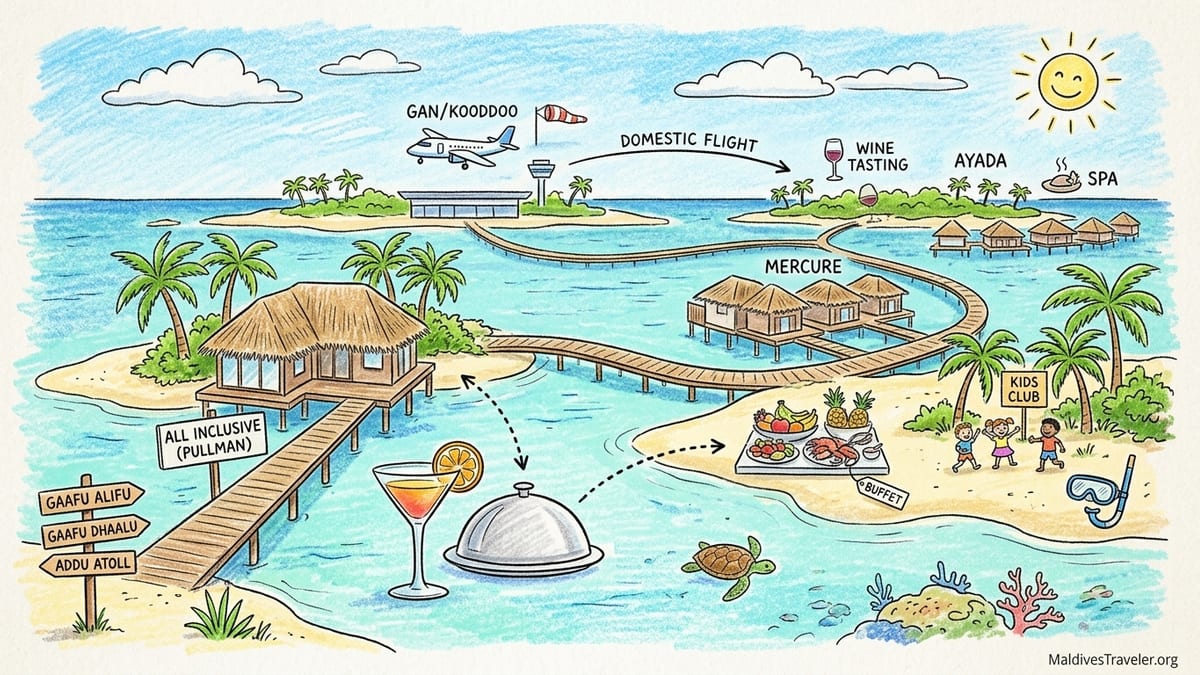
The southern atolls of the Maldives feel like a world apart: fewer islands, longer domestic flights, almost no independent restaurants and a stronger sense of remoteness than the busier North and Central atolls. That isolation is exactly why the meal plan you choose can make or break your budget. In places like Gaafu Alifu, Gaafu Dhaalu and Addu, all-inclusive packages at resorts such as Pullman Maldives Maamutaa, Mercure Maldives Kooddoo, Ayada Maldives and Canareef Resort are not just a convenience; they can be a strategic financial decision.
Why Southern Maldives All-Inclusive Works Differently
In the northern atolls, many resorts sit a short speedboat ride from Malé and a handful even have nearby local islands where you can grab a simple curry for 10 to 15 US dollars. In the deep south, that option effectively disappears. Resorts in Gaafu Alifu, Gaafu Dhaalu and Addu are each on their own island with no outside restaurants within walking or swimming distance, so every coffee, snack or cocktail comes from your resort. Over a seven-night stay, that difference can add up to hundreds of dollars.
On a typical southern resort, a main-course lunch dish often starts around 25 to 30 US dollars before tax and service. A soft drink is usually 6 to 8 dollars and a beer or glass of house wine runs 10 to 14 dollars. For a couple taking one lunch, two cocktails each and a shared dessert, it is easy to hit 120 dollars per day just on items that half-board would not cover. Once you factor in the domestic flight cost and the psychological burden of signing every slip, a well-designed all-inclusive package can feel like a relief as much as a perk.
This is why the southern Maldives features prominently in 2026 all-inclusive searches. When travelers plug dates such as February or March 2026 into major booking engines and filter for all-inclusive in the south, four names repeatedly surface at the top: Pullman Maldives Maamutaa, Mercure Maldives Kooddoo, Ayada Maldives and Canareef Resort. These properties have leaned into robust inclusions, sometimes bundling domestic flights and excursions that would be substantial extras elsewhere.
Another factor is weather and logistics. Domestic flights to hubs like Kooddoo and Gan can face delays due to storms, and transfers are tightly tied to airline schedules. When you know that your food, drinks and at least some activities are already included, an unexpected extra night because of a delayed flight hurts less. In the southern atolls, all-inclusive is as much about predictability as it is about indulgence.
Pullman Maldives Maamutaa: High-End, High-Inclusion All-Inclusive
Pullman Maldives Maamutaa, in Gaafu Alifu Atoll, markets itself as a five-star all-inclusive resort rather than a resort that happens to offer an all-inclusive add-on. Its 2025–2026 all-inclusive factsheet highlights a generous list of inclusions, including a large choice of beverages, multiple dining venues and credits for both spa and excursions. For guests arriving from Malé, Pullman is accessed via a domestic flight to Kooddoo followed by a short speedboat ride, with some all-inclusive offers bundling the domestic transfer cost into the package price.
Unlike simpler plans that confine guests to one buffet restaurant, Pullman’s all-inclusive allows dining across several outlets, including an overwater cafe and bar that serves specialty coffee, smoothies and cocktails, and evening venues for tapas and sunset drinks. One of the resort’s selling points is its “wine wall,” where selected house wines are available within the package, a rarity in the Maldives where even a modest bottle can easily exceed 75 dollars at dinner. For wine-drinking couples who might otherwise share a bottle every second night, this alone can offset a significant portion of the all-inclusive supplement.
Pullman’s package goes beyond food and beverage. Recent factsheets show a one-time excursion credit per person and a spa credit per villa per stay, which many guests use for a 60-minute treatment early in the trip. While you still pay for diving itself, the resort runs a PADI dive center, and certified divers can use their excursion credits for activities such as dolphin cruises or snorkeling safaris. In practice, a couple staying seven nights might find that their inclusive activities cover one or two outings they would have booked anyway.
Families in particular tend to extract strong value here. Pullman’s family beach pool villas with separate kids’ rooms, bunk beds and private pools are designed so that parents are not limited to a single bedroom. The daily replenished minibar, which is included in many all-inclusive offers, is significant. Soft drinks, juices and snacks that would otherwise cost 6 to 12 dollars each become a non-issue for parents with thirsty teenagers raiding the fridge after snorkeling or the kids’ club.
Mercure Maldives Kooddoo: Accessible, Mid-Range All-Inclusive
Mercure Maldives Kooddoo, also in the Gaafu Alifu region, shares Kooddoo Island with the domestic airport that links the atoll to Malé. This location slightly shortens transfer times compared with more remote resorts and has helped Mercure position itself as a relatively affordable all-inclusive option in the south. Package brochures for 2025–2026 list all-inclusive as the default plan on many contracted rates, especially in markets like Europe and Southeast Asia.
Mercure’s all-inclusive offer typically covers buffet-style breakfast, lunch and dinner in the main restaurant, selected a la carte options in specialty venues and a range of alcoholic and non-alcoholic beverages by the glass. The spirits list is more modest than at ultra-luxury properties but still includes common international brands of gin, rum and whisky, along with house cocktails, wine and beer. For many couples who drink a few cocktails at the pool, a glass of wine with dinner and perhaps an aperitif at sunset, this mid-range selection hits the sweet spot between value and choice.
One standout aspect of Mercure’s positioning is value for domestic transfers in package pricing. Several regional tour operators advertise five-day all-inclusive stays including return domestic flights between Malé and Kooddoo. When you compare this with booking a half-board stay and paying the domestic flight separately, the difference can narrow quickly. If domestic flights for two adults cost roughly 600 to 800 dollars combined, an all-inclusive package that absorbs most of that cost may work out similar in total, even if the nightly rate appears higher.
Mercure’s approach suits travelers who want a classic Maldivian experience without the price tag of high-end brands. Snorkeling and non-motorized watersports such as kayaks or stand-up paddleboards are generally included, while motorized activities and diving are extra. If you are particularly focused on house-reef snorkeling at the doorstep and a solid, uncomplicated food-and-drink package, Mercure is often one of the first southern properties travel agents mention to price-conscious couples.
Ayada Maldives: Layered All-Inclusive for Food Lovers
Ayada Maldives in Gaafu Dhaalu Atoll is frequently described as a food-forward resort, which is reflected in its nuanced meal-plan structure. Guests choose between half-board, full-board and multiple tiers of all-inclusive such as Crystal and Diamond plans. These packages differ in the number of restaurants included, the level of beverage choice and added benefits like spa treatments or signature experiences. Recent marketing materials and travel agency contracts through 2026 continue to show Ayada as a flexible option where food and drink can be tailored closely to guest preferences.
On half-board, guests typically receive breakfast and dinner in the main restaurant, with a set number of dinners at specialty outlets during a week-long stay. Drinks, aside from basic items like still water, are extra. For travelers who drink little or no alcohol and who are comfortable paying out of pocket for a light lunch at the pool bar, half-board can keep costs manageable while still allowing some variety. Reports from 2026 honeymoon planning forums show that couples often compare a half-board stay in a garden or beach villa with an all-inclusive stay in a higher category such as a sunset lagoon pool villa, sometimes finding the price gap narrower than expected once transfers and taxes are included.
The higher-tier all-inclusive plans at Ayada, particularly Diamond, cater to guests who value a more premium beverage list and spa access. Diamond-type packages have included a daily or per-stay spa treatment credit, access to a wide selection of cocktails and international wines, and perks like sunset cheese-and-wine tastings on the overwater Ile de Joie venue. For a pair of wine enthusiasts who might otherwise purchase a bottle at 100 dollars or more several times during their stay, the economics of upgrading to the top-tier all-inclusive can quickly make sense.
Ayada’s location on a larger island, with long beaches and a strong house reef, appeals to guests who like to explore as much as they lounge. Non-motorized watersports and some group activities are usually included, but diving and premium excursions cost extra regardless of plan. The real decision at Ayada comes down to how much you will use the beverage inclusions and spa benefits. A couple that prioritizes wellness treatments, sunset tastings and a wide wine selection will see value in Diamond. Guests who are moderate drinkers and plan to spend more time snorkeling than in the bar may find a mid-tier all-inclusive or even half-board a better fit.
Canareef Resort Maldives: Space and Simplicity in Addu Atoll
Canareef Resort, set along one of the longest resort shorelines in the country in Addu Atoll, takes a different approach from the Gaafu properties. The resort offers half-board, full-board and all-inclusive plans, often with aggressive pricing aimed at both international guests and Maldivian residents or expatriates. A recent local-resident offer for travel into early 2026 listed nightly per-person rates such as roughly 200 US dollars for half-board and 320 dollars for all-inclusive in a double room, giving a realistic feel for the price ladder.
All-inclusive at Canareef typically covers three buffet meals in the main restaurant and a selected list of alcoholic and non-alcoholic beverages. Room service and minibar items usually remain chargeable, as do specialty a la carte dishes at bars. Transfers to Canareef require a domestic flight from Malé to Gan and then a short speedboat ride, and resort documents emphasize that transfers must be arranged through the hotel to match domestic schedules. Transfer costs are not always bundled into the base all-inclusive rate, so it is crucial to confirm whether your package includes the domestic flights or if they will be added separately.
Canareef’s strengths are space and a relaxed, unpretentious atmosphere. Villas line both the sunrise and sunset sides of the island, and inclusions such as free use of bicycles, gym access, kids’ club and a dedicated pool at the main bar create a holiday village feel. For families, the ability to cycle together along the island, drop children at the club and know that buffet meals are covered ahead of time can outweigh the fact that premium spirits may be limited compared with Pullman or Ayada.
Where Canareef’s all-inclusive sometimes struggles is for guests who expect extensive fine dining or top-shelf labels. However, the resort’s comparatively lower nightly rates mean that budget-sensitive travelers often find that even with paying separately for a few cocktails or special experiences, a half-board or full-board stay here costs significantly less than an all-inclusive stay at more upscale southern properties. The key is to look at your own drinking and activity habits rather than defaulting to all-inclusive just because you are in Addu Atoll.
Premium All-Inclusive vs Half-Board and Full-Board: How the Math Works
Across the southern Maldives, the real comparison is rarely “all-inclusive versus nothing.” It is usually premium all-inclusive versus half-board or full-board. Half-board includes breakfast and dinner, leaving lunch and all drinks to be paid as you go. Full-board adds lunch but still excludes most drinks. Premium all-inclusive sits at the top, bundling three meals, a broad drink selection and, sometimes, activities or domestic transfers into a single nightly rate.
Consider a seven-night stay in early 2026 at a mid-to-upscale southern resort where a typical half-board rate for a beach villa might run 900 to 1,000 US dollars per night for two before taxes, and upgrading to premium all-inclusive adds 250 to 350 dollars per night. On paper that increase looks large. But if each person consumes one light lunch at 30 dollars, two to three drinks at 12 to 15 dollars each, one coffee and a dessert, that can reach 110 to 150 dollars per person daily, or 220 to 300 dollars per couple. Add a bottle of wine for 100 dollars every other night and you are quickly matching or exceeding the all-inclusive premium.
For light drinkers, the picture changes. A couple that rarely drinks alcohol, eats a substantial breakfast, often skips lunch and is happy to pay for a few mocktails or coffees can see significant savings with half-board. At Ayada, for instance, numerous travelers in 2026 discussions compare half-board and all-inclusive pricing and find that the differential can reach four figures over a week. In these cases, the freedom to dine in specialty restaurants using a fixed number of included dinners, then pay a la carte for modest extras, often provides both variety and cost control.
Full-board occupies a middle ground but is less common as a top choice among repeat Maldives travelers unless it is heavily discounted. It appeals to families with children who need three meals a day and where drinks beyond juice or soft drinks are minimal. However, full-board without a beverage package can leave adults with large bar bills at the end of the stay. Many guests either opt for half-board plus a drinks package, where available, or jump directly to all-inclusive to remove that uncertainty.
The most common mistake is focusing only on the headline nightly rate and not calculating realistic on-island spending. Before committing, sketch your usual pattern on a typical holiday: how many drinks, how many snacks, how often you order dessert or a second glass of wine, how many excursions you genuinely do. Then compare the total estimated cost on half-board or full-board to the all-inclusive supplement for your exact dates, remembering to include taxes and service charges, which can add more than 20 percent to every bill.
Excursions, Diving and Kids’ Inclusions: What Really Adds Value
In the southern atolls, excursions and diving are central to the experience, and the way these are priced within or outside packages makes a substantial difference. None of the main southern resorts offer truly unlimited free diving on all-inclusive plans, but some include credits or discounted rates that soften the cost. Pullman Maldives Maamutaa, for example, provides a one-time excursion credit per person, which guests can apply to a dolphin cruise or snorkeling trip, and a spa credit per villa. These are not huge sums in isolation but can equate to a complimentary shared outing or treatment for a couple.
Ayada’s higher-tier all-inclusive options weave in more experiential elements, such as sunset tastings, spa access and expanded minibar inclusions. These perks tend to appeal to couples and honeymooners who will actually attend the events and book spa time. If you skip those inclusions, you are effectively paying for benefits you do not use. Mercure’s package focuses more on making everyday activities like house-reef snorkeling, kayaks and some non-motorized sports feel effortless, while keeping big-ticket items like motorized watersports, private excursions and PADI courses on a pay-per-use basis.
Families should look closely at kids’ clubs, child dining policies and age-based discounts. Pullman and Canareef both emphasize children’s facilities, including kids’ clubs with daily programming and family-friendly pools. Offers often let younger children stay and eat free or at heavily reduced rates when sharing with parents, which shifts the value calculation in favor of all-inclusive if you have two or more children who will be eating full meals and ordering drinks at the bar or cafe. In contrast, a couple traveling alone may find that high child-discount structures have been baked into pricing they do not personally benefit from.
Diving deserves particular attention in the south, where channels in Gaafu and Addu are famous for sharks and strong currents. None of the major resorts make dives free on all-inclusive, but some run loyalty discounts for repeat divers, multi-dive packages or occasional promotions. As of 2026, diving insurance is typically an additional cost, and certification courses always sit outside all-inclusive. If your primary reason to visit the south is a full week of diving two or three times a day, you should budget separately for that and treat the meal plan decision as a separate question.
The Takeaway
For the southern Maldives, the question is rarely “Is all-inclusive good or bad?” but “At this specific resort, for my specific habits, does this particular all-inclusive package make sense?” Pullman Maldives Maamutaa delivers a premium, almost cruise-like all-inclusive where food, drinks, spa credits and activities are woven together, ideal for guests who fully lean into the resort and enjoy frequent drinks and experiences. Mercure Maldives Kooddoo offers a more accessible version where core food and drink needs are met comfortably without ultra-luxury frills.
Ayada Maldives shines when you value culinary variety and are willing to think more carefully about which tier of inclusions aligns with your lifestyle. Its half-board, full-board and layered all-inclusive options provide room to calibrate. Canareef, meanwhile, trades on space, relaxed charm and sharp pricing, where half-board or simple all-inclusive can make the Maldives feasible for travelers who might otherwise feel priced out of the south.
In remote atolls where you cannot simply walk off the island for a cheap dinner, all-inclusive can be a powerful tool for cost certainty. But it is not automatically the smartest choice. Before you book, plug realistic daily spending into a spreadsheet or even a notepad and compare the total stay cost under each plan, including transfers. Then choose the resort and package where you feel free to order what you want without constantly glancing at prices, while still staying within your comfort zone.
FAQ
Q1. Is all-inclusive always better value than half-board in the southern Maldives?
All-inclusive is not automatically better value. It makes most sense if you drink alcohol regularly, plan to eat three full meals a day and enjoy ordering coffees, juices and snacks without thinking about price. Light drinkers who often skip lunch may find half-board or full-board cheaper, even once they add a few a la carte items.
Q2. Which southern Maldives resort has the most generous all-inclusive package right now?
Among the southern properties commonly appearing in 2026 searches, Pullman Maldives Maamutaa stands out for generous beverage choices, multiple dining venues and added credits for spa and excursions. However, whether it is “best” for you depends on how much you will actually use those inclusions compared with more modest packages at Mercure, Ayada or Canareef.
Q3. Do any southern Maldives all-inclusive plans include domestic flights from Malé?
Some packages, particularly at Pullman Maldives Maamutaa and Mercure Maldives Kooddoo, are sold through tour operators with domestic flights bundled into the total price. Others quote room and board separately from transfers. Always check your confirmation carefully to see if the domestic flight between Malé and the resort’s atoll is included or listed as an extra line item.
Q4. How much should I budget for drinks if I choose half-board instead of all-inclusive?
As a rough guide, at southern resorts a soft drink can cost around 6 to 8 US dollars and alcoholic drinks often 10 to 15 dollars. A couple who each have two cocktails, one coffee and share a bottle of wine every other night might easily spend 150 to 200 dollars per day on drinks alone, plus any lunches or snacks. If your expected spend is far lower than that, half-board may still win.
Q5. Are children well catered for on all-inclusive plans in the southern atolls?
Yes, especially at family-focused resorts like Pullman Maldives Maamutaa and Canareef. These properties usually offer kids’ clubs, children’s menus, family pools and reduced or complimentary meal plans for younger children sharing a room with parents. Always check age limits, as some discounts apply only up to a specific age such as 11 or 12 years old.
Q6. Does all-inclusive cover diving in the southern Maldives?
No, diving is almost always charged separately, even on premium all-inclusive plans. Some resorts provide small credits, discounted dive packages or occasional free trial dives in shallow water, but full dive courses and boat dives are additional costs. Factor this into your budget if channel diving in Gaafu or Addu is a key part of your trip.
Q7. Is Ayada Maldives worth the extra cost for its higher-tier all-inclusive plans?
Ayada’s higher-tier plans make sense for guests who value premium beverages, regular spa treatments and curated experiences such as sunset tastings. If you mostly drink soft drinks and house wine and do not plan to visit the spa often, a lower-tier all-inclusive or half-board plus a la carte extras may deliver better value for the same stay dates.
Q8. How do transfer logistics affect the choice between all-inclusive and half-board?
In the southern atolls, domestic flights and speedboats are mandatory and there are no outside restaurants nearby. This means that once you arrive, your resort controls all food and beverage options. Knowing that meals and drinks are prepaid through all-inclusive can ease stress, particularly if weather delays extend your stay unexpectedly and you end up spending more time on the island than planned.
Q9. Can I mix meal plans during my stay, such as starting on half-board and upgrading later?
Some resorts allow upgrades on arrival or partway through a stay, but policies vary widely and upgrades may be priced higher than if you had booked all-inclusive from the start. If you are unsure, ask your agent or the resort for written confirmation of upgrade options and costs before traveling, then decide based on how your first day or two on the island feels.
Q10. What is the simplest way to decide between all-inclusive and half-board for the southern Maldives?
Write down a realistic day on holiday for you: how many drinks, how many meals, whether you like desserts, coffees and snacks, and how often you book excursions. Put approximate prices next to each item using the resort’s sample menus if available. Then compare that daily total plus a buffer against the all-inclusive supplement for your actual travel dates. Choose the option that gives you financial peace of mind while still fitting your typical habits.