


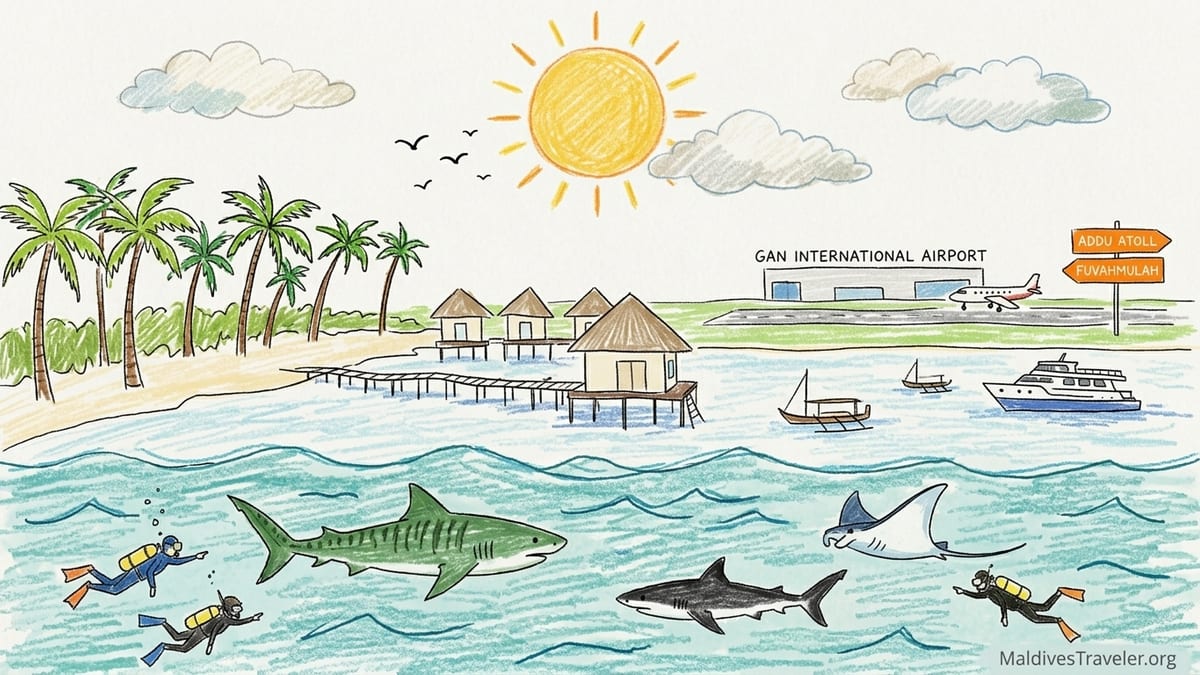
The southern Maldives, anchored by Gan in Addu Atoll and the shark mecca of Fuvahmulah, has a very different rhythm to the busy central atolls around Malé. The monsoons arrive slightly differently, the weather feels more equatorial, and the diving calendar is driven by powerful channels and blue-water pelagic life. If you time your visit well, you can combine long sunny days with tiger shark or manta encounters and still find resort deals that would be unthinkable over Christmas in the central Maldives.
Understanding Southern Maldives Seasons from Gan
Gan, in Addu Atoll at the far south of the country, sits almost on the Equator. That position smooths out some of the stark seasonal contrasts you see further north, but it does not eliminate the monsoon pattern. Gan has a tropical rainforest climate with significant rain all year, yet wind direction, sea state and visibility still shift with the monsoons. Climatically, you will notice fewer prolonged dry spells than in North Malé, but also fewer days of relentless rough weather.
The Maldives experiences two main monsoon regimes. The northeast monsoon, locally called Iruvai, typically dominates from roughly December through March, with its dry core between January and March. The southwest monsoon, Hulhangu, broadly runs April to November, with the wettest and windiest stretch usually from May into October. Transition months around April and November can be highly changeable but often deliver some of the best diving, especially in the south where currents and big animals respond quickly to shifting winds and plankton.
For visitors using Gan International Airport as a gateway, this means that “high season” weather advice you read for Malé can be misleading. A week that looks statistically wet in central atolls can be perfectly workable in Addu, with passing squalls rather than all-day rain. Conversely, a blue-sky forecast for Malé in late April might coincide with choppier crossings on a liveaboard pushing down to Fuvahmulah. When planning, it is better to think in terms of likely wind, sea conditions and visibility rather than assuming that one set of Malé averages applies everywhere.
Practically, this translates into different decisions. A honeymoon couple booking a resort such as Canareef or Equator Village in Addu might happily choose late April for softer prices and accept the possibility of a few showers. A group of experienced divers planning an expedition week of channel dives and pelagic encounters around Fuvahmulah and Huvadhoo may instead target February or early March, when the northeast monsoon is mature, seas are more settled in the deep south, and visibility is often better in the channels.
Beach Weather by Season in the Southern Atolls
From a beach perspective, the driest and sunniest period in the deep south tends to run from about January through March. Days at this time are typically hot, humid and bright, with scattered clouds and brief showers rather than prolonged rain. On Gan’s lagoon islands, that means long stretches of usable sunshine for the pool or sandbank picnics and enough breeze from the northeast trade winds to keep evenings comfortable. Sea conditions around the atoll rim are usually moderate, so resort speedboats to nearby islands rarely cancel outright.
April is a transition month. You can still experience full weeks of sunshine, but humidity climbs and thunderstorms become more frequent, especially in the afternoon. If you spend a week in Addu then, you might enjoy five days of classic blue-sky mornings, with two days where lunch is indoors during a heavy downpour. The upside is that the sea surface remains warm and inviting, and the light winds can make lagoon water feel like glass, ideal for stand-up paddleboarding and beginner snorkeling right off the beach.
From May to October, southern atolls move deeper into the southwest monsoon. Expect more frequent showers, cloudier skies and stronger winds, particularly during bursts of unsettled weather. In practice, this may mean two or three wet days in a ten-day stay, plus several days with mixed conditions where mornings are sunny and passing squalls arrive in the afternoon. On exposed ocean sides of Addu, surf can build enough to close certain sea-based activities temporarily, although protected lagoons usually remain swimmable. Temperatures remain warm, and many guests still spend most days outdoors.
November and early December are another transition period, often underrated for beach holidays. Rains generally begin to ease, and wind directions become more variable before the northeast pattern reestablishes. On an island like Gan, this can deliver mirror-calm mornings and pastel sunsets with fewer crowds than January or February. If your priority is relaxation and you are willing to tolerate the possibility of a few unsettled days, late November into the first half of December can be an attractive compromise between price and beach-friendly weather.
Monsoons, Currents and Diving Conditions
For divers, the monsoon calendar matters as much for currents and visibility as it does for rain. Across the Maldives, the northeast monsoon usually brings clearer water on the eastern sides of atolls and excellent visibility in many channels. In southern atolls including Addu and Fuvahmulah, December to April is therefore the classic window for photogenic blue water, especially on morning dives when sun angles are high and currents can be more predictable. Liveaboard operators that schedule deep-south itineraries often cluster their departures between January and March to make use of these stable conditions.
During the southwest monsoon, from roughly May to November, currents tend to favour inflows and plankton-rich water on the western sides of atolls. In the far south this can mean slightly reduced visibility on certain sites but also higher productivity in the food chain, which benefits filter feeders and pelagic predators. Divers might notice that walls which were a vivid blue in February take on more of a teal or green tint in July, with baitfish schools thicker around the reef. While photographers chasing wide-angle reef scenes often favour the dry season, macro specialists and those hunting for dramatic big-fish action can find the “green season” rewarding.
It is also worth noting that southern atolls are more exposed to open ocean than many central atolls. Fuvahmulah, for example, is a single-island atoll rising sharply out of deep water, and its dive sites are heavily current-influenced. Seasonal differences in swell and wind direction there are more pronounced than in sheltered lagoons around Malé. A February trip might feature manageable surface chop and clean descents along reef walls, while an August visit could involve bouncy zodiac rides and stronger surge on shallow safety stops. For safety and comfort, most local operators recommend that new divers aim for the December to April window when booking their first serious deep-south expedition.
Gan and Addu Atoll provide a gentler introduction. The atoll’s sheltered interior lagoon offers a range of leeward sites that can be dived year-round, even when outer reefs are wind-exposed. Many visiting divers split their time between easy wrecks like the British Loyalty in Addu’s calm lagoon and more advanced channel or ocean-side dives when weather allows. This flexibility means that an intermediate diver on a February holiday can enjoy several days of moderate-current shark dives, then switch to relaxed coral gardens if a passing front briefly roughens the sea.
Pelagic Wildlife: Sharks, Mantas and Seasonal Highlights
The southern Maldives are regarded as one of the best places in the Indian Ocean for reliable big-animal encounters. Fuvahmulah has gained global attention as a hotspot for tiger sharks, threshers, oceanic manta rays and other pelagic species. Many of these visits are not strictly seasonal in the simple sense of “present” or “absent,” but their predictability and the safety margins for divers do fluctuate with the monsoons. Operators on Fuvahmulah often point to January through March as the most consistent period for daily tiger shark dives, when seas are calmer and currents more manageable for repeat visits to offshore cleaning areas.
Oceanic mantas and other ocean wanderers around Fuvahmulah show more nuanced seasonality. Local guides report that late April and May, when the monsoon begins to shift, can produce spectacular encounters as plankton levels rise and currents change direction. A diver who spends five days around Fuvahmulah in early May, for example, might combine daily tiger shark briefings with two or three dives focused on deeper blue-water cleaning stations where oceanic mantas circle up from the depths. As conditions grow windier into June and July, trips may still run, but operators may cancel specific ocean-side dives on rough days.
In Addu Atoll, pelagic life is tied more to channels and outer-reef cleaning stations. Grey reef sharks, dogtooth tuna and eagle rays can be seen year-round, but numbers and behaviour change with current strength and visibility. From roughly January to April, divers often enjoy clear-water channel dives where twenty or more grey reef sharks patrol downcurrent of a corner, visible from a comfortable distance. During the southwest monsoon, increased nutrient levels can bring in more schooling fish and hunting action, but visibility often shortens, so animals may appear suddenly out of the haze.
Other pelagic highlights include seasonal whale sightings in the deep south channel between Laamu and Huvadhoo, which some liveaboard operators try to time for March and early April when seas are calm enough to transit the open ocean. While encounters with species such as blue whales or sperm whales are never guaranteed, the combination of seasonal plankton patterns and navigable sea states makes late northeast monsoon an attractive window for exploratory pelagic trips. For guests prioritising these once-in-a-lifetime encounters, choosing a specialist liveaboard itinerary during that short season is often more important than picking a specific resort.
Resort and Liveaboard Prices Through the Year
Pricing in the Maldives is strongly seasonal, and the southern atolls are no exception, even though they sit off the main Malé tourist circuit. Peak international demand runs from around late December through March, driven by European winter sunseekers and festive holidays. During this period, southern resorts with good air links to Gan can command rates similar to comparable properties in central atolls. A four-star resort in or near Addu might price a standard villa at roughly 600 to 900 US dollars per night for two including breakfast in February, with all-inclusive packages costing more, while liveaboards that venture to the deep south often charge a premium over their central atoll itineraries because of fuel and distance.
Shoulder seasons offer meaningful savings. In April and again from late October into early December, nightly resort rates in the south often soften. Guests might find mid-range beachfront rooms in Addu closer to the 350 to 550 US dollar range at this time, especially outside major holidays. Liveaboard operators sometimes discount late-season or transition-month departures, particularly if they combine southern and central atolls rather than running a full deep-south expedition. For flexible travellers who can tolerate some weather variation, these shoulder windows can deliver strong value without sacrificing too much in terms of conditions.
Low season, typically May to early October, brings the largest potential discounts. Across the country, aggregated booking portals often show average resort prices falling well below the dry-season peaks, and this trend generally extends to the deep south. It is not unusual to see promotional offers where local-guesthouses or simpler resort rooms in or near Addu drop into the 150 to 250 US dollar per night range for two, especially when bundled with domestic flights from Malé. Ultra-luxury properties, if they have a presence in the south, may still charge well above 1000 US dollars per night but often include extras such as complimentary domestic transfers or spa credits to stimulate demand.
There are a few caveats. The most specialised deep-south dive operators, particularly those focusing on Fuvahmulah tiger shark trips or limited-season pelagic expeditions, may not discount heavily even in wetter months because their products are niche and capacity is limited. On popular February and March dates, for example, a week-long advanced diver package including accommodation, multiple tiger shark dives and boat transfers can easily cost several thousand US dollars per person. Booking many months in advance is advisable if you want specific weeks around prime diving windows and are targeting smaller, high-demand operations.
Planning Your Trip by Traveler Type
Different visitors will read the same seasonality very differently. For a classic honeymoon or anniversary trip where beach time, calm lagoons and polished resort service are the priorities, January through early April remains the safest bet for the southern Maldives. A couple flying into Gan might spend ten nights in Addu at a resort with a house reef, accepting higher nightly rates in exchange for the highest probability of sun, manageable winds and clear snorkelling visibility. They might then add a two- or three-night side trip to Fuvahmulah for a shark-focused excursion if both partners are certified divers and comfortable with the advanced nature of those dives.
For serious divers, especially those chasing pelagic checklists, the calculus is more complex. Many experienced guests deliberately choose late February or early March for a two-week combination of Addu, Fuvahmulah and possibly a liveaboard transit through Huvadhoo, because this period aligns stable northeast monsoon currents with peak deep-south itineraries. Others target late April or May for a slightly wilder, more unpredictable mix of conditions, aware that some dives may be lost to weather yet hopeful for rarer encounters with oceanic mantas or other open-ocean sharks that respond to changing plankton and current patterns.
Budget-conscious travellers might lean into the shoulder seasons. A small group of friends, for instance, could plan a ten-night trip in late November, splitting time between an affordable guesthouse in Addu and a mid-range resort offering occasional upgrades and promotions. They would likely encounter a mix of sunny and unsettled days, but could stretch their budget significantly compared with a February visit, while still enjoying warm water, fewer crowds on dive boats and a good shot at decent visibility on key sites.
Families need to balance school holidays, child-friendly activities and weather risk. Easter often falls during the tail end of the northeast monsoon or into the transition, which can work well for southern atolls. Daytime downpours are possible but usually short-lived, and lagoon water remains warm for younger swimmers. Over the long northern summer school break, from June to August, storms and wind are more likely, but many families still travel successfully at this time, focusing on larger resorts with sheltered kids’ pools, indoor play areas and flexible cancellation or rescheduling policies in case a tropical disturbance disrupts flights.
The Takeaway
Timing a trip to the southern Maldives is less about finding a single perfect month and more about aligning your priorities with the monsoon-driven rhythm of Gan, Addu and Fuvahmulah. The northeast monsoon, broadly from December to March, offers the steadiest sun, calmer seas and the clearest water for classic reef diving and advanced pelagic encounters. Shoulder months such as April and November trade some stability for better prices and the possibility of dramatic wildlife interactions around seasonal current shifts. The southwest monsoon from May to October brings more wind and showers, but also energises the marine food web.
If your dream is waking to flat turquoise water and walking straight off your villa deck into clear snorkel conditions, target January to March around Gan and Addu, and budget for peak-season pricing. If you are an experienced diver chasing tiger sharks at Fuvahmulah or exploratory pelagic itineraries through the deep south, consider late February to early April and work closely with reputable operators who understand local currents and safety protocols. Travellers who value value above perfection can use late November or April to capture meaningful discounts with only modest weather compromises.
Whatever month you choose, planning with the southern atolls specifically in mind, rather than relying on general Malé statistics, will pay off. Consider domestic flight timings to Gan, factor in a buffer day if you are connecting to a southern liveaboard, and be realistic about your comfort level with currents and rough seas. Done right, a well-timed visit to the southern Maldives delivers not only the postcard sandbanks and blue lagoons that made the country famous, but also some of the most exciting big-animal diving in the Indian Ocean.
FAQ
Q1. When is the overall best time to visit the southern Maldives for first-timers?
For most first-time visitors, January to March is the most balanced window, combining generally sunnier weather, calmer seas, good visibility and straightforward logistics via Gan.
Q2. Is the weather around Gan really different from Malé?
Yes, Gan is closer to the Equator and has a more consistently wet, tropical climate, so it tends to have fewer long dry spells but also fewer prolonged periods of rough weather than the northern atolls.
Q3. Which months are best for tiger shark diving at Fuvahmulah?
Local operators usually recommend January through March for the most reliable conditions and frequent tiger shark encounters, with additional opportunities in the April transition if seas remain manageable.
Q4. Can I still enjoy a beach holiday in the southern Maldives during the southwest monsoon?
Yes, from May to October you can still have plenty of sunshine, but you should expect more showers, occasionally stronger winds and the possibility that some ocean-side activities are limited on rough days.
Q5. When are resort prices generally lowest in the southern atolls?
Prices are typically lowest from May to early October, with notable value also in late November and early December, outside major holiday periods and school vacations.
Q6. Are the southern atolls suitable for beginner divers?
Addu Atoll is suitable for beginners because of its sheltered lagoon and easier sites, but places like Fuvahmulah are best reserved for experienced divers comfortable with currents and blue-water entries.
Q7. How far in advance should I book if I want to visit in February or March?
For peak months like February and March, it is wise to book flights, resorts and especially specialised dive packages at least six to nine months in advance to secure preferred dates.
Q8. Will rain ruin my trip if I travel in April or November?
Not usually. In these transition months, rain tends to come in short, intense showers rather than all day, so you may lose a few hours here and there but still enjoy many usable beach and dive days.
Q9. Is it worth combining Addu and Fuvahmulah on one trip?
Yes, many divers combine Addu for wrecks and more relaxed reef diving with a shorter, more intense stay on Fuvahmulah focused on tiger shark and pelagic encounters, when time and budget allow.
Q10. What is the water temperature in the southern Maldives through the year?
Water temperatures are generally warm year-round, often around the upper 70s to low 80s Fahrenheit, with only a small drop during the windiest part of the southwest monsoon.