


“No News, No Shoes” sounds like marketing until you are standing on Kunfunadhoo Island’s sand path, clutching your city shoes in one hand while a barefoot butler gently insists you will not need them again. My stay at Soneva Fushi in Baa Atoll’s UNESCO Biosphere Reserve was less about overwater Instagram moments and more about navigating a huge jungle island by bicycle, dealing with very real mosquitoes, puzzling over four‑figure restaurant bills and discovering whether this famously eco‑luxury resort actually delivers a better holiday for the price it commands. This is what the experience was like in practice, from villa and reef to kids’ club, astronomy and the awkward sides of ultra‑luxury that the brochures never mention.
Getting There and First Impressions of a True Jungle Island
My Soneva Fushi experience started at Malé’s Velana International Airport, where a Soneva representative met me airside and walked me to the resort’s lounge for the seaplane transfer. The resort now operates its own branded seaplane on certain rotations between Malé and Baa Atoll, with the chartered private plane priced at around 9,500 US dollars net each way for exclusive use, a figure that reflects both the distance and the ultra‑luxury positioning. For regular shared transfers, the resort prices return seaplane seats per person and folds them into packages or quotes; on my stay this added a substantial amount on top of the room rate and is worth factoring into any budget from the outset.
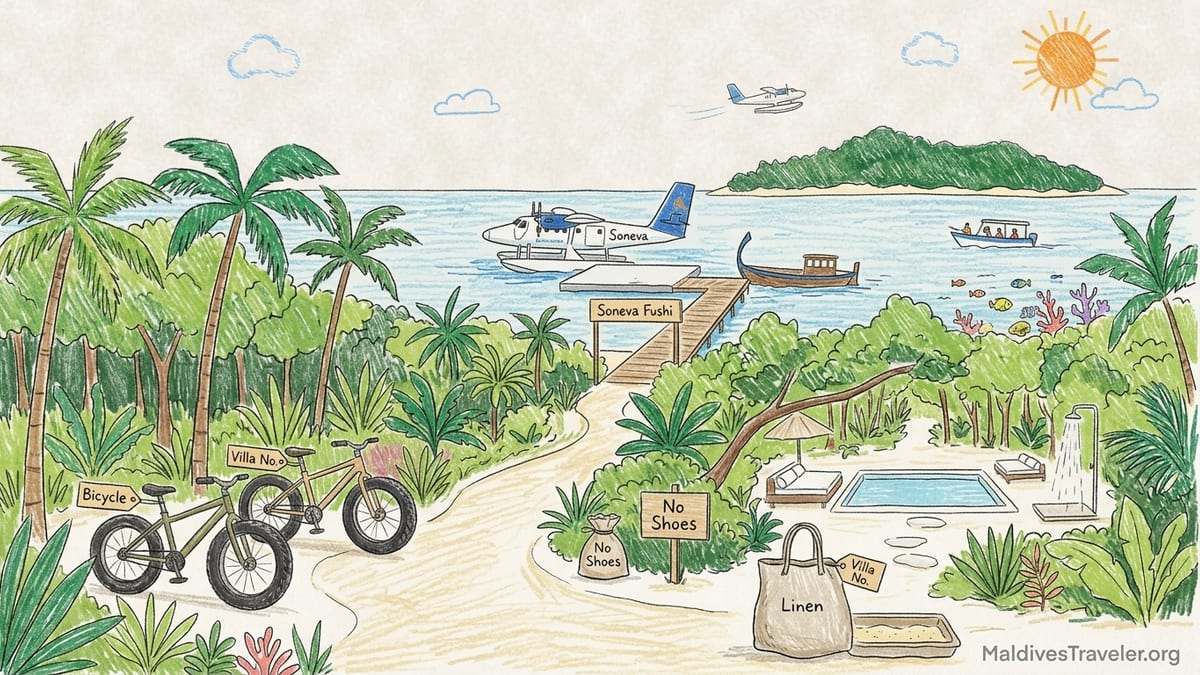
The flight itself took about 35 minutes over the atolls, landing directly at Soneva Fushi’s own platform. From there, a dhoni boat covered the last couple of minutes to the jetty. The heat and humidity were immediate, but so was the sense of arriving at a real, forested island rather than a sandbank with a ring of villas. Kunfunadhoo is one of the largest resort islands in the Maldives, with dense interior jungle and long sandy perimeters. That scale is central to the Soneva Fushi experience and shapes almost every practical aspect of a stay, from how you move around to how private your villa feels.
At the jetty, I was introduced to my Barefoot Guardian, Soneva’s term for the personal butler assigned to each villa. Before I could instinctively reach for my phone, my shoes went into a small linen bag marked with my villa number. The “No News, No Shoes” policy is enforced with a light touch but real consistency: paths are sand, restaurants have wooden or sand floors, and staff remain barefoot too. I did not see anyone scrolling news in public spaces; the idea is to lean into detachment, though in‑villa Wi‑Fi is fast and available if you really need to log in.
The first buggy ride along the main sand avenue made two things clear. First, Soneva Fushi feels almost like a Maldivian version of a tropical national park, with thick canopy on both sides, birds overhead and the sea occluded by vegetation for long stretches. Second, distances here are not theoretical. From the jetty to my villa on the sunrise side took several minutes by buggy, and I was already trying to work out how it would feel by bicycle in the afternoon heat.
The Villa: 1 Bedroom Crusoe with Pool and What It Actually Includes
I stayed in a 1 Bedroom Crusoe with Pool on the sunrise side, one of Soneva Fushi’s entry‑category beach villas. Recent rate checks for shoulder season show these starting at roughly 2,500 to 3,500 US dollars per night plus taxes and service for two adults, typically including daily breakfast and, on certain offers, extras such as shared seaplane transfer credit or resort experiences. My booking included breakfast and a mix of half‑board credit that could be used at selected restaurants, though it did not cover premium alcoholic drinks or signature experiences.
The villa itself felt more like a small house than a room. A high wooden gate opened onto a sandy courtyard with the private pool, daybeds and an outdoor shower. Inside, the ground floor held an airy living area, a semi‑open bathroom with a sunken bath and outdoor shower, and a walk‑in wardrobe. Stairs led to an upper deck with a shaded seating area that looked into the jungle canopy rather than out to sea. From the bedroom, a short sand path under low branches led directly to the beach and lagoon.
The design is consciously rustic: whitewashed walls, exposed timber, sand on the floor in some areas and hand‑carved signs. Finishes are high quality but deliberately uneven; there are no glossy marble slabs here. The trade‑off is that air‑conditioning is limited to enclosed spaces, and the semi‑open bathroom means you are sharing the space with geckos and the occasional harmless insect. I enjoyed hearing the ocean muffled through the greenery at night, but travelers who like hermetically sealed, clinically finished suites may find the Crusoe category too bohemian for the price.
From a practical standpoint, inclusions were generous but not limitless. The minibar had soft drinks and bottled water replenished without charge, but wine and spirits were at prices that would not feel out of place in a top London hotel bar. The room included bicycles for each adult, a beach bag, reef‑safe sunscreen and flip‑flop‑style sandals should you decide barefoot life is not for you. Laundry was charged per item, and turndown service arrived each early evening with mosquito coils and natural repellent spray, a hint of the island realities that come with a jungle setting.
Island Layout, Bicycles, Buggies and the Reality of a Jungle Resort
Before arriving, I imagined gentle cycles along the beach at sunset. In reality, the main way to get around Soneva Fushi is via sand tracks running through dense foliage, and that is both magical and occasionally inconvenient. Each guest is given a personal bicycle, adjusted and labeled by the Barefoot Guardian; the bikes are sturdy with fat tires, chosen for deep sand rather than speed. On my second afternoon, it took about ten minutes to ride from my villa to the main hub area that houses breakfast, several restaurants and the chocolate and ice‑cream rooms, and I arrived damp with sweat in the midday sun.
At night, the same ride felt much more atmospheric. The island keeps lighting low to protect turtles and reduce light pollution, so the path is illuminated just enough to see where you are going. One evening after dinner, I cycled back alone with only a torch and the crunch of sand under the tires for company. For some guests, that sense of isolation and immersion in nature is the point. For others, particularly families with younger children or travelers with mobility issues, it can feel like an obstacle. In practice, many repeat guests rely heavily on the complimentary buggy service, ordering pick‑ups by WhatsApp through their Barefoot Guardian.
I tried to stick mostly to the bicycle to see how functional the island felt under my own steam. Over four days, I used a buggy only twice: once during a heavy rain shower and once when running late for an experience on the opposite side of the island. Each time the buggy arrived within about ten minutes, but that wait time can feel longer if you are watching the clock for an observatory slot or dinner reservation. The roads themselves are not manicured boulevards. They are bumpy in places, with exposed roots and occasional puddles after rain. A few times I had to slow to a walking pace in deeper sand.
This is where Soneva Fushi’s jungle character becomes polarizing. If you dream of stepping out of your villa onto a perfectly raked beach path that leads fifty meters to a restaurant, you may be frustrated. If you enjoy the feeling of being in a tropical forest, knowing that you are actually still on a luxury resort island, the daily rides become part of the charm. Personally, I found it atmospheric in the morning and evening but slightly tiring under the midday sun. I would think carefully about this if traveling with older relatives or if you anticipate frequent trips back and forth for napping children.
Beach Quality, Reef and the “No News, No Shoes” Life in the Water
A key question for any Maldives resort is whether the beach outside your villa is genuinely usable. On the sunrise side where my Crusoe villa sat, the beach was wide, soft and largely free of coral rubble, with a gentle gradient into the lagoon. There was some natural erosion at certain points along the shore, but my stretch felt swimmable at all tides during my stay. The water was the classic Maldivian turquoise with decent visibility, and I often saw small reef fish from the edge of the shore.
For serious snorkeling, the house reef off the main island is the main attraction. Soneva Fushi’s location in the Baa Atoll UNESCO Biosphere Reserve gives it access to healthy coral patches and marine life, although like almost everywhere in the Maldives, bleaching events have taken a toll. I joined a guided snorkeling trip that set out from the dive center by boat to reach a section of outer reef. Visibility was good, with table corals in shades of muted brown and pale lilac, and plenty of parrotfish, surgeonfish and the occasional reef shark gliding in the distance. Turtles are a realistic sighting here, and we encountered two hawksbills feeding on the reef slope.
What the resort does not have in front of every villa is a dramatic drop‑off reef right off the beach. From my Crusoe villa, I could comfortably swim out and see coral bommies with fish life, but for the best reef structure I still preferred going out by boat or walking down toward the designated snorkeling entry points. The trade‑off is that the lagoon stayed calm and accessible for casual dips and children’s play. For families, the combination of a swimmable lagoon and organized snorkeling safaris works well. Hardcore snorkelers or divers, however, might find more dramatic house reefs at smaller, steeper islands in other atolls.
In day‑to‑day life, the “No News, No Shoes” philosophy extended naturally to the beach. There are no loud music speakers or intrusive announcements; staff speak softly, and guests mostly move barefoot from villa to shore. I left my bicycle leaning under the trees and cut straight across warm sand to the water numerous times a day. Being barefoot constantly does change how you experience the island, shifting the focus from polished finishes to simple sensations like hot sand at noon or cool, damp sand after rain. Whether that feels restorative or inconvenient depends on how attached you are to conventional resort luxury markers.
Breakfast, Restaurants, Reservations and the Awkward Side of Pricing
Breakfast at Soneva Fushi is served at the main dining area near the arrival jetty and was one of the strongest parts of my stay. The spread included multiple juice and smoothie stations, fresh tropical fruit, charcuterie, cheeses, an entire bakery section with still‑warm pastries, and made‑to‑order egg and dosa counters. There were also healthier options like chia puddings, house‑made granola and dairy‑free milks. For a resort at this level, the breadth and quality felt appropriate, and the atmosphere was relaxed enough to arrive in a swimsuit and cover‑up straight from a beach walk.
Where the experience becomes more complicated is with lunch and dinner. Soneva Fushi has an impressive number of dining venues, from the main buffet and live‑cooking restaurant to specialty outlets in the treetops and seafood‑focused spots on the shore. During my visit, I ate at three: the main all‑day restaurant, an Asian‑inspired restaurant set slightly above ground among the trees and an overwater, fine‑dining experience with a set menu. Food quality was generally excellent, with a strong emphasis on organic ingredients and a thoughtful vegetarian offering.
The awkward part is the bill. Even by high‑end Maldives standards, Soneva Fushi’s restaurant pricing commands a significant premium. A simple lunch of two dishes and a soft drink could easily approach 80 to 100 US dollars per person before tax and service. At dinner, a shared appetizer, two mains and a dessert, plus a modest bottle of wine, pushed the total into the several hundreds. Tasting menus at the top venues land significantly higher. The resort frequently runs offers that include half‑board or resort credit, which helps, but guests arriving on a bed‑and‑breakfast package can experience sticker shock if they have not fully budgeted for dining.
Reservations were also more essential than I had anticipated. In low and shoulder season, it is generally possible to secure a table at one of the main venues on the day, but if you want specific experiences like the overwater restaurant or chef’s table dinners, booking early through your Barefoot Guardian is important. I appreciated that my Guardian proactively messaged me each morning with a suggested dining plan and alternatives, though at times the back‑and‑forth about restaurant times and menu formats made the holiday feel more scheduled than spontaneous.
Service, the Barefoot Guardian and How Much Programming Helps or Hurts
Soneva’s service model revolves around the Barefoot Guardian, who acts as butler, concierge and fixer. From the first WhatsApp introduction at the seaplane lounge, my Guardian handled restaurant bookings, snorkel trips, spa appointments and even minor villa quirks such as adjusting the bicycles and replacing a flickering outdoor light. Response times were impressively fast: messages sent from my villa typically received replies within a few minutes, and my Guardian greeted me in person at almost every meal during the first two days to ensure things were going smoothly.
This high‑touch service can be a double‑edged sword. On one hand, it streamlines the complexity of a resort with multiple restaurants, experiences and transfer options. On the other, it can create a subtle pressure to fill the day with activities. Soneva Fushi’s weekly programme is thick with options: sunrise yoga, glass studio workshops, sustainability tours at the Eco Centro, astronomy sessions at the observatory, movie nights at the outdoor cinema, sunset dolphin cruises and more. In theory, you could go from one curated moment to the next from dawn to midnight.
I consciously chose only a handful: a guided house‑reef snorkel, an observatory session, one spa treatment and a glassblowing demonstration. Even with that relatively light schedule, I found myself checking the clock more than I would normally like on a beach holiday. The resort is very good at creating a sense that there is always something special you could be doing, and that can detract from the quieter pleasures of simply sitting on your deck and listening to the waves. After the second day, I told my Guardian I wanted one completely unscheduled day with no check‑ins, and to the team’s credit, they respected that completely.
Overall, service quality felt warm, intuitive and human rather than rigidly polished. Staff addressed me by name, remembered my coffee order at breakfast and noticed when I shifted from cycling to buggies in the heat, quietly offering more frequent buggy assistance without making an issue of it. There were minor imperfections: a delayed buggy here, a missing pool towel there, and confusion over one restaurant reservation time, but nothing that significantly undercut the stay. Whether it feels worth the premium depends largely on how much you value that near‑constant, personalized support compared with a more anonymous, self‑service style of luxury.
Astronomy, Glass Studio and Whether the Experiences Justify the Hype
Of the many activities on offer, I chose two that felt core to Soneva Fushi’s identity: the observatory and the Glass Studio. The observatory sits slightly set back from the main area, with a retractable roof and a powerful telescope that can be booked for small‑group or private sessions. My evening slot lasted about 45 minutes, led by an in‑house astronomer who guided us through visible planets and prominent constellations. Without heavy light pollution, the sky above Baa Atoll is ink‑black and crowded with stars, and the ability to see the bands of Jupiter or the craters of the moon in detail felt quietly extraordinary. This was one of the few scheduled experiences that genuinely deepened my connection to the place rather than just filling time.
The Glass Studio was a different kind of highlight. Built as a sustainability project to recycle glass waste from Soneva’s resorts and others in the Maldives, it doubles as an art space where guests can watch or join glassblowing sessions. I opted for a short workshop and worked with an artist to create a small glass bowl. It was hot, noisy and entirely unglamorous in the best possible way. Instead of another polished cocktail class, I left with a deeper appreciation for the amount of energy and skill that goes into reshaping what would otherwise be waste. Finished pieces are later delivered to the villa once cooled.
Both experiences came at an extra cost, which, while not insignificant, felt more justified than some of the more conventional add‑ons like sunset cruises or private sandbank dinners. They tapped into Soneva’s stated priorities of education, conservation and creativity, and they are difficult to replicate at many other resorts. If you are looking for value in the programming, I would prioritize these over more generic activities that you can find elsewhere in the Maldives or at luxury resorts globally.
Did the island’s extensive programming overall improve the holiday? For me, selectively, yes. Left unchecked, the constant menu of “rare experiences” could easily turn a supposedly slow, barefoot escape into a packed itinerary that resembles a luxury summer camp. Used intentionally, two or three carefully chosen experiences added texture to days that were otherwise framed by swimming, reading and long, barefoot dinners.
Kids, The Den and How Family‑Friendly the Resort Really Is
Although I traveled without children, I spent time exploring The Den, Soneva Fushi’s vast kids’ club, and spoke with several parents during my stay. The Den covers more than 1,300 square meters and feels like its own mini village, with pools, a pirate ship, music and dress‑up corners, a small cinema space and art rooms. Supervised daily programming is included in the stay for children aged roughly four to seventeen, ranging from treasure hunts and nature walks to cooking classes and creative workshops. For families, this transforms the dynamic of the holiday, providing children with a structured place to burn energy while parents enjoy spa time or uninterrupted meals.
Parents I spoke to were effusive about the staff at The Den, describing them as attentive, patient and genuinely engaged. One family with two children under ten told me their kids were “dragging us out of breakfast” to get back to the club in time for a pirate‑themed morning. Another mentioned that their Barefoot Guardian helped coordinate Den drop‑offs with snorkel excursions, so that the children were blissfully occupied while the adults did a longer reef trip the kids might have found tiring. The fact that the kids’ club sits under the canopy, integrated into the jungle rather than walled off from it, reinforces the sense that children are experiencing the island environment rather than an air‑conditioned playroom transplanted from a city mall.
Family villas and residences also add practical value. While I stayed in a one‑bedroom Crusoe, I toured a Soneva Fushi Family Villa Suite with Pool, which adds a children’s room off the main bedroom and more indoor space. Rates for these larger villas increase steeply, but for multi‑generation groups or families used to renting houses, they make sense. Importantly, many of these villas have enclosed or partially enclosed pools, which helps parents feel more relaxed about safety.
The trade‑off for families lies, again, in the island’s scale and rusticity. Getting small children to and from The Den in the heat can be a sweaty exercise unless you rely heavily on buggies, and parents of very young toddlers may find the sand paths and open staircases in some villas more stressful than relaxing. However, compared with smaller, manicured islands that offer a kids’ corner rather than a genuine facility, Soneva Fushi stands out as a place where children are not only tolerated but actively considered in the resort’s design and programming.
Mosquitoes, Privacy and the Less‑Instagrammable Realities
No honest review of Soneva Fushi can ignore mosquitoes. A large, green island in a tropical climate inevitably attracts them, and despite the resort’s fumigation and preventive measures, they are part of life here. In my villa, mosquito coils burned discreetly each evening and housekeeping set up a bed net without being asked. Even so, I collected a handful of bites over the first two nights, mostly on ankles and wrists when I forgot to reapply repellent before sitting on the deck at dusk. Guests who are particularly prone to bites should bring strong, comfortable repellent and expect to use it daily, especially at sunrise and sunset and during dinners held close to the vegetation.
Privacy is more nuanced. From inside my Crusoe villa’s courtyard, I could not see another guest, and the jungle barrier between villas is substantial. On the beach itself, however, paths emerge at semi‑regular intervals, and occasional walkers and cyclists passed by the front of the villa through the trees. I never felt overlooked inappropriately, but those expecting complete visual isolation on the sand may be surprised. Overwater villas, by contrast, offer a more immediate sense of horizon and distance from foot traffic but at the cost of that thick jungle envelope.
There are other, smaller frictions. Sand gets everywhere, including in drawers and on bedside tables, no matter how often housekeeping sweeps. The rustic finishes that feel charming on day one can appear slightly worn by day four if you are used to sharp luxury branding. Lighting inside the villas is warm and slightly dim in the evenings, which is atmospheric but not ideal if you are trying to work or read detailed print. Air‑conditioning struggles a bit in the hottest hours of the afternoon, particularly in high‑ceilinged living rooms, making shady outdoor spaces or the pool more appealing than indoor lounging.
None of these issues are deal‑breakers in themselves, but together they underline that Soneva Fushi is not a sterile bubble of luxury separated from its environment. You feel the island, in both positive and challenging ways. Whether that is what you want for a trip at this price point is a question worth sitting with before you book.
The Takeaway
So, does Soneva Fushi justify its premium, and for whom? For travelers who value a manicured resort aesthetic, short walking distances, highly polished interiors and predictable, hotel‑style service, the answer is probably no. There are other Maldivian properties where you can step from your room to an overwater deck in seconds, dine at fewer but equally competent restaurants and pay less for the same basic combination of sun, sand and clear water.
Where Soneva Fushi earns its reputation is in the way it leans fully into the idea of a lived‑in, barefoot island home layered with intelligence and intent. The jungle heavy layout, the serious investment in kids’ facilities, the presence of an observatory and Glass Studio, the commitment to glass recycling and broader sustainability projects, and the interpersonal warmth of the Barefoot Guardian model combine into a stay that feels more like inhabiting a tiny, eco‑focused community than spending a week in a luxury hotel. When it works, it is quietly magical: cycling through dimly lit forest to an astronomy session, watching your child sprint toward The Den, taking a late‑night swim in a pool lit only by candles.
In my view, Soneva Fushi is truly worth the premium for three types of guests. First, families who will fully use The Den, the large villas and the gentle lagoon, and who value experiences over shiny surfaces. Second, repeat Maldives visitors who have already stayed at smaller, manicured islands and now want something that feels more expansive and rooted in conservation, even if that comes with mosquitoes and long bicycle rides. Third, travelers who care deeply about sustainability and are excited by the idea of funding a resort that invests visibly in waste reduction, reef projects and educational programming, rather than simply consuming a generic luxury package.
For honeymooners who mainly want still‑water selfies and easy access to a reef, or for travelers who want to spend as little mental energy as possible on logistics, there are better value choices. Soneva Fushi does not try to be effortless. Instead, it asks you to participate in the island: to cycle, to notice, to decide when to say yes and when to say no to its abundant programming. If that sort of engaged, barefoot luxury appeals to you and the rates fit within your budget, Soneva Fushi can be an exceptional choice. If not, the very qualities that its fans cherish might leave you wondering why your jungle villa costs quite so much.
FAQ
Q1. How do you get to Soneva Fushi from Malé, and how long does it take?
The resort is reached by seaplane from Malé’s Velana International Airport, with a flight time of around 30 to 40 minutes followed by a short boat ride from the landing platform to the jetty.
Q2. Which villa category is best for a first stay at Soneva Fushi?
For most couples, a 1 Bedroom Crusoe with Pool or Soneva Fushi Villa Suite with Pool offers a good balance of space, privacy and direct beach access without stepping into the very high pricing of the multi‑bedroom residences.
Q3. Are meals included, and how expensive is dining at the resort?
Most rates include breakfast, and some promotions add half‑board or resort credit, but lunch and dinner are generally extra and can be expensive, with even simple meals reaching city fine‑dining levels once tax and service are added.
Q4. Is Soneva Fushi suitable for families with young children?
Yes, particularly for children aged four and above who can join The Den’s supervised activities. Families with toddlers will still enjoy the lagoon and villas but may find the sand paths and distances more challenging.
Q5. How strong is the snorkeling and diving at Soneva Fushi?
The resort has access to healthy sections of reef within the Baa Atoll UNESCO Biosphere Reserve, best reached by boat trips or guided snorkeling, while the lagoon in front of many villas is ideal for casual swimming and beginner snorkeling.
Q6. Do you really have to go barefoot all the time?
The “No News, No Shoes” policy encourages guests to be barefoot, and most paths and restaurants are designed for it, but the resort provides simple sandals and you are free to wear them if you prefer.
Q7. How bad are the mosquitoes on the island?
There are mosquitoes due to the jungle environment, especially at dawn and dusk, but the resort mitigates them with fumigation, coils and nets; using repellent daily is still advisable if you are prone to bites.
Q8. Is it easy to get around if you do not like cycling?
Every guest receives a bicycle, but a complimentary buggy service is available via your Barefoot Guardian; you may wait several minutes for pick‑ups, so it is convenient but not instant door‑to‑door transport.
Q9. What makes Soneva Fushi different from other luxury resorts in the Maldives?
Its large, jungle‑covered island, serious focus on sustainability, extensive kids’ facilities, observatory, Glass Studio and highly personalized Barefoot Guardian service create a more immersive, village‑like feel than many manicured, compact islands.
Q10. Who is Soneva Fushi really worth the premium for?
It best suits families who will fully use The Den, repeat Maldives visitors seeking a more nature‑intense experience, and travelers who value sustainability projects and distinctive programming over glossy, conventional luxury.