


Baa Atoll in the Maldives is both a UNESCO Biosphere Reserve and one of the densest clusters of luxury resorts in the country. For travelers, that creates a pleasant problem: with so many legendary names crammed into one lagoon, how do you actually choose where to stay? This guide compares the headline resorts of Baa Atoll by what truly separates them in day to day experience and overall trip cost, not just by star ratings or brand prestige.
Why Baa Atoll Is Different From The Rest Of The Maldives
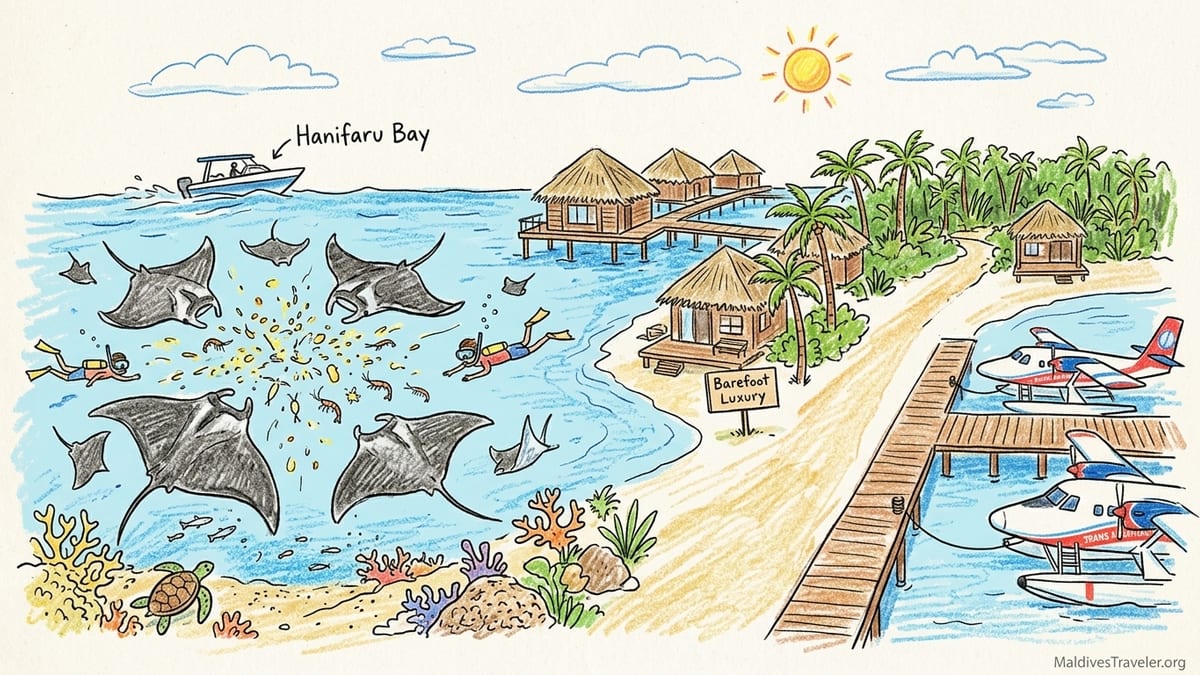
Baa Atoll sits northwest of Malé and is protected as a UNESCO Biosphere Reserve. The atoll is famous for Hanifaru Bay, where seasonal plankton blooms attract huge gatherings of manta rays between roughly June and November. That single natural spectacle has pulled in many of the Maldives’ most recognisable resort brands, from Soneva and Four Seasons to Anantara and Dusit.
Compared with resort chains in other atolls, Baa’s properties often lean into the marine environment. Four Seasons Landaa Giraavaru, for example, runs a major marine discovery and research program on site, while Anantara Kihavah markets its proximity to Hanifaru Bay along with a strong house reef that you can access directly from shore. Several resorts here partner with marine biologists for guided snorkelling, turtle identification projects, and coral planting experiences that go beyond simple boat trips.
For guests, this concentration of high end resorts means two things. First, you are unlikely to end up somewhere genuinely poor. Second, the differences that matter are more subtle. Island size, villa count, reef quality, transfer costs, meal plans, and children’s policies have a bigger impact than whether one resort markets itself as five star and another as ultra luxury.
Before you fixate on a big name, it helps to be clear about what you want: easy access to mantas, a walkable reef, a small adults oriented island, or an active all inclusive. The sections below compare Soneva Fushi, Four Seasons Landaa Giraavaru, Anantara Kihavah, Milaidhoo, Vakkaru, Amilla, Finolhu, Dusit Thani, Royal Island and NH Collection Reethi within those real world decision categories.
Getting There, Transfers And How They Change The Real Price
Every Baa Atoll trip starts with a domestic transfer from Malé. Most of the resorts covered here use seaplanes that land directly at the resort’s jetty, usually operated by Trans Maldivian Airways. Typical flying time from Malé to Baa is about 30 to 40 minutes, which is short by Maldivian standards but still adds a half day of travel on arrival and departure once check in and waiting time are included.
Seaplane pricing is one of the biggest invisible costs. In 2026, Soneva Fushi’s official rate for its seaplane transfer is listed at around 1,300 US dollars per adult round trip and 650 dollars per child, for a flight of about 30 minutes each way from Malé. That means a family of four can easily spend more than 3,900 dollars just reaching the island and back, before any villa or food costs. Four Seasons Landaa Giraavaru and Anantara Kihavah publish broadly similar premium seaplane pricing brackets, often in the high hundreds of dollars per person round trip, reflecting their position at the top of the market.
Resorts such as Finolhu, Vakkaru, Amilla, Dusit Thani and Milaidhoo usually sit in the mid to upper range of seaplane costs, sometimes bundled into packages offered by tour operators or loyalty programs. Some properties, including Finolhu, can also arrange domestic flights via Baa’s Dharavandhoo airport plus speedboat when late arrivals miss the seaplane window, which adds reliability but also another layer of logistics and potential waiting time. More value oriented options like Royal Island and NH Collection Reethi sometimes offer lower transfer pricing or include promotions with partial credits, but you should always verify current figures at booking stage because they change frequently with fuel and operator costs.
When comparing resorts, it is crucial to add transfers into your total budget rather than treating them as a side note. A couple booking a five night stay at a strong mid tier resort such as Vakkaru or Amilla might find that the room rate difference compared with Anantara Kihavah narrows once you add 1,500 to 2,000 dollars worth of seaplane tickets for two people. Equally, points redemptions at boutique properties like Milaidhoo can become dramatically better value if seaplane transfers are included or discounted, as they have been in some recent loyalty offers.
Best Resorts Near Hanifaru Bay And For Manta Encounters
If seeing manta rays in Hanifaru Bay is the main reason you are choosing Baa Atoll, then distance to the bay and how efficiently a resort organises excursions should drive your decision. Several of the big names on this list market themselves heavily around manta season, but there are differences in how often they run trips and how long you spend on the boat rather than in the water.
Four Seasons Landaa Giraavaru has one of the highest manta profiles. It runs a well known Marine Discovery Centre with research programs focused on manta rays and whale sharks, and guests can join guided trips that combine education on board with time in the water at Hanifaru Bay when conditions are right. Transfers from Landaa’s jetty to the bay are relatively short boat rides by local standards. This mix of convenience and scientific context makes Landaa particularly appealing for wildlife focused travelers who want more than a simple snorkel outing.
Dusit Thani Maldives and Amilla Maldives are also well placed for Hanifaru excursions and both promote manta focused experiences during the June to November season. Dusit’s location on Mudhdhoo Island inside the biosphere reserve allows it to market itself as a base for snorkeling with mantas and whale sharks, while Amilla’s dive center offers regular Hanifaru trips that can be booked through its guest app alongside other activities. In practice, travel times from any of these resorts to the bay are usually kept to manageable lengths, but being closer can mean more flexible departure times to catch the right currents.
Anantara Kihavah and Finolhu, though somewhat further from the core of Hanifaru, still operate seasonal trips into the bay and combine them with strong house reef or sandbank experiences. For guests, the key question is how many manta focused outings you realistically plan to do. If it is just one headline snorkel, being ten or fifteen minutes further by speedboat probably matters less than the resort’s overall atmosphere and reef. If you want multiple tries to maximise your chances in a short stay, properties with more frequent or flexible Hanifaru schedules such as Landaa or Dusit become more compelling.
Best House Reefs And Lagoon Atmosphere
In Baa Atoll, the headline difference in snorkelling experience is less about the atoll itself and more about how each resort’s island sits on its reef. Some islands have a drop off only a few fin kicks from the beach, while others sit in open lagoons that require boat trips for serious snorkelling. For many guests, having a house reef that you can access independently each day is more valuable than any single excursion.
Anantara Kihavah is widely regarded as one of Baa’s strongest house reefs. The island is ringed by a rich drop off that can be reached from both beach and overwater villas. Guests frequently report seeing turtles, reef sharks and dense fish life within a short swim of their room, and the resort connects this everyday reef access with its SEA underwater restaurant and coral aged wine cellar, which sit several metres below the surface beside the reef. For travellers who want to snorkel daily without arranging boats, Kihavah offers one of the most complete reef experiences at the higher end of the price spectrum.
Milaidhoo, a small boutique island with around 50 villas, also offers strong house reef access with easy entry points from its curved beaches. Because the island is compact and villa numbers are low, reef spots feel uncrowded and you can often swim above coral gardens in relative solitude, especially early in the morning. This suits couples and honeymooners who prioritise intimacy and long, unstructured snorkels over a broad menu of organised activities.
Vakkaru and Dusit Thani both combine pleasant lagoons with accessible reef edges, offering a balance between safe swimming areas for families and more interesting drop offs for confident snorkelers. Amilla and Soneva Fushi, by contrast, sit on larger natural islands where the reef is a little further from certain villa zones. They compensate with variety: different sides of the island give different experiences, from shallow seagrass meadows visited by turtles to deeper channels patrolled by rays and sharks. Finolhu’s setting is about vistas and sandbanks as much as reef depth, making it more attractive to guests who prioritise beaches, bars and social life over intensive snorkel sessions.
Ultra Luxury Versus Barefoot Luxury: Atmosphere And Villa Count
Baa Atoll’s resorts all describe themselves in glowing terms, but there is a clearer split between formal ultra luxury and relaxed barefoot luxury than marketing suggests. Ultra luxury here tends to mean more structured service, grand villas, and a polished aesthetic, while barefoot luxury means sand paths, intentionally rustic design, and a stronger emphasis on nature over gloss.
Soneva Fushi and Four Seasons Landaa Giraavaru represent the two poles of that spectrum. Soneva Fushi is built on one of the atoll’s larger natural islands with lush vegetation and long sandy paths. Its trademark “No News, No Shoes” philosophy literally invites guests to store their shoes on arrival and walk barefoot everywhere, including the restaurants. Villas are large, often multi bedroom, and intentionally quirky, with wooden walkways, open air bathrooms, and hidden nooks. The island’s size and layout create a sense of wildness that feels very different from the precise landscaping of many newer properties.
Four Seasons Landaa Giraavaru, with just over 100 beach and overwater villas, leans more towards classic ultra luxury. Pathways are manicured, architectural lines are clean, and service flows through the familiar Four Seasons structure of concierges, butlers and specialists. The resort’s marine research programme and ayurvedic spa add depth, yet the overall feeling is of a sophisticated, international resort rather than an off grid hideaway. Guests who enjoy structured activities, fine dining with dress codes, and predictable brand standards often gravitate here.
Anantara Kihavah straddles the line. With around 80 pool villas, it feels more intimate than Landaa but more formal than Soneva. Every villa category includes a private pool, removing the sense that you have to pay for an upgrade to enjoy basic comfort. Design is contemporary with Maldivian touches, and the underwater restaurant plus rooftop observatory create a sense of destination without tipping into spectacle. By comparison, Milaidhoo delivers barefoot luxury on a boutique scale with only about 50 villas, emphasising personalised service and simplicity rather than architectural drama.
Amilla and Vakkaru sit in the middle of the market in terms of atmosphere. Both offer polished villas and strong food programs but keep the island vibe relaxed. Amilla’s island is fairly large, with a collection of residences and overwater villas spread out enough that you can always find quiet corners despite a moderate villa count. Vakkaru’s pathways thread through mature coconut groves, giving it a classic Maldivian feel that appeals to both couples and families without the performative rusticity of some eco focused brands.
Best Resorts For Families, Couples, And All Inclusive Stays
Different islands in Baa Atoll lean naturally toward either family travel or couples, depending on kids’ facilities, villa layouts and entertainment. Several also offer all inclusive or dine around plans that make overall costs more predictable, which can be helpful for families and groups.
Amilla, Finolhu, Vakkaru and Dusit Thani are particularly strong for families. Amilla positions itself as a “home from home” with spacious villas and residences, plus a dedicated kids club and flexible meal timings. Its meal plan documents highlight dine around options that allow families to eat in multiple restaurants on half board or full board, important when you want variety without uncontrolled à la carte bills. Finolhu adds a beach club atmosphere, frequent live music and playful design, making it suitable for multigenerational groups who want daytime kids’ activities and more social evenings.
Vakkaru offers family friendly beach pool villas with separate sleeping areas for children, as well as a kids club and a good spread of casual and upscale dining around its lagoon. Dusit Thani, drawing on its Thai hospitality background, combines shady gardens, a strong kids’ club and an all inclusive option that can bundle most food and drinks into one rate. For parents, that removes a major layer of anxiety around menus and extras, especially when teenagers are involved.
Couples and honeymooners often gravitate to smaller islands such as Milaidhoo and to the quieter zones of Anantara Kihavah and Soneva Fushi. Milaidhoo’s low villa count, focus on Maldivian inspired design, and lack of loud nightlife create an atmosphere where evenings are about long dinners and stargazing rather than DJ sets. Anantara Kihavah’s overwater villas, underwater restaurant and observatory bar make it one of the most romantic options in the Maldives for those who can afford its high overall cost once transfers and dining are added.
Royal Island and NH Collection Reethi appeal to travellers who prioritise value and predictability. Both typically offer full board and all inclusive packages at significantly lower nightly rates than the ultra luxury set, with simpler villas and more traditional buffet based dining. These islands suit guests who want the Baa Atoll setting, house reef access and boat excursions, but who are willing to trade brand prestige and cutting edge design for a more contained budget.
Food, Dining Concepts And Meal Plans
In a remote atoll where nearly everything must be flown or shipped in, food quickly becomes one of the biggest line items on your bill. Understanding how each resort structures its dining and meal plans helps avoid cost surprises once you arrive.
Soneva Fushi and Four Seasons Landaa Giraavaru both present food as a core part of the experience, with multiple signature restaurants, tasting menus and extensive wine cellars. Soneva runs frequent themed dinners, a “no menu” restaurant concept where chefs improvise based on your preferences, and generous complimentary elements such as chocolate and ice cream rooms that are open at set hours. Landaa’s restaurants emphasise fine dining and wellness, with an ayurvedic menu alongside Italian and Asian options. Neither resort is inexpensive to dine at, but both deliver breadth and quality that many guests consider part of the reason to choose them.
Anantara Kihavah’s SEA underwater restaurant is one of the most distinctive dining venues in Baa Atoll. The restaurant sits below the surface, surrounded by reef life, and serves set multi course menus paired with wines from a cellar of several hundred labels. Independent reports in 2026 suggest that a dinner for two at SEA usually starts in the high hundreds of dollars before drinks, and that the restaurant is not fully covered by standard half board or full board plans. On the surface, Kihavah offers a range of other restaurants including grills and an all day dining venue, so guests can mix statement meals with more modest evenings.
Amilla and Vakkaru place particular emphasis on flexible dine around meal plans. Amilla’s own dining information notes that half board and full board guests can often choose from multiple restaurants instead of being restricted to a single buffet, and that villa dining is available around the clock but not always included in meal plans. Vakkaru similarly promotes a mix of beachside casual outlets and more formal options, with many packages including credits that can be used across venues. This model tends to work well for travellers who want choice without committing to fully premium priced dining every night.
Finolhu, Dusit Thani, Royal Island and NH Collection Reethi typically offer the most straightforward all inclusive experiences among this group. Finolhu combines buffet meals with à la carte options and a lively bar scene, while Dusit Thani layers Thai influenced cuisine onto the standard Maldivian resort template. Royal Island and NH Collection Reethi keep things simpler and more traditional, often with one main buffet and a small number of alternative venues. For budget control, all inclusive at these properties can bring a five or six night stay within reach of travellers who might otherwise be priced out of the Baa Atoll marquee names.
Sandbanks, Beaches And Island Character
Not all Baa Atoll beaches feel the same. Island size, orientation to prevailing winds, and how much natural vegetation has been preserved all change the experience once you step off your deck. For some travellers, the star of the show is not the villa itself, but the stretch of sand it overlooks.
Soneva Fushi’s advantage is its large, heavily vegetated island. Long sandy paths cut through jungle to reach quiet beaches where you may not see another guest for some time. Many villas have wide private frontages, and the feeling is often of staying in a luxury beach house in the tropics rather than on a compact man made island. This suits travellers who like to cycle, explore and change their walking route each day, rather than circling a tiny island in ten minutes.
Finolhu is arguably Baa’s headline sandbank property. The resort stretches along a thin island arc flanked by a sweeping sand spit, with a more than kilometre long sandbank that leads past its laid back Crab Shack restaurant back to the main island. Editorial coverage has highlighted how this long, pale sandbank feels almost like a separate destination, ideal for daytime walks, drone style photography and sunset picnics. The flip side is that the island can feel more exposed to wind and waves in certain seasons compared with more compact, sheltered islands.
Anantara Kihavah and Vakkaru deliver classic, photogenic Maldivian beaches with broad curves of white sand and turquoise shallows, while Milaidhoo’s tiny footprint creates a sense that every beach is steps from a villa. Amilla mixes long straight beaches with pockets of overwater villas and jungle paths. Dusit Thani and Royal Island have pleasant but more conventional beaches, which are often more than adequate for swimming and lounging but do not have the dramatic sandbank formations of Finolhu or the wild jungle feel of Soneva.
If wide beaches and sandbanks are critical to your enjoyment, it can be worth looking closely at satellite images before booking. Some small, heavily overwater focused resorts in the Maldives struggle with erosion or narrow beaches at high tide. In Baa Atoll, the resorts highlighted here generally maintain attractive shorelines, but Finolhu’s sandbank and Soneva’s long natural coastlines stand out for guests who want to walk for more than a few minutes without looping back on themselves.
Best Value Within Baa Atoll Once Everything Is Counted
Value in Baa Atoll is not simply about finding the cheapest sticker price. Transfers, food, and extras can shift the total by thousands of dollars. The question is which resorts deliver the strongest mix of reef, service, dining and atmosphere for what you actually spend.
At the very top of the market, Soneva Fushi, Four Seasons Landaa Giraavaru and Anantara Kihavah command high nightly rates and high transfer costs, but offer distinct personalities. Soneva is the choice if you want a large, barefoot focused island where luxury is expressed in space, privacy and sustainability touches rather than marble. Landaa suits travellers who want structured luxury with deep marine programming, while Kihavah is ideal if a great house reef plus statement dining such as the SEA underwater restaurant are non negotiable. For guests comfortable with five figure trip budgets, the question is less about saving money and more about picking the ecosystem that matches their style.
In the mid to upper tier, Vakkaru, Amilla, Milaidhoo, Finolhu and Dusit Thani often represent better value relative to the ultra luxury group once transfers and food are included. A five night stay at one of these properties, booked on a well constructed half board or all inclusive plan, can sometimes come in several thousand dollars lower than a similar stay at Kihavah or Landaa while still delivering a strong reef, good food and comfortable villas. Among these, Milaidhoo stands out for couples who value intimacy, while Vakkaru balances couples and families and Amilla caters especially well to larger groups and families.
For price sensitive travellers who still want the UNESCO Biosphere setting, Royal Island and NH Collection Reethi can bring Baa Atoll within reach. Their villas are simpler and service less elaborate, but standard all inclusive packages can significantly reduce uncertainty around total cost. They are also more likely to be offered in mainstream package deals from European and Asian tour operators, which may include charter flights and transfers in a single price.
When assessing value, it helps to sketch a real world budget. For a couple from North America staying six nights in early shoulder season, a mid tier Baa resort on half board with seaplane transfers might realistically come to a low to mid five figure sum including flights, while an ultra luxury choice on mainly à la carte dining could push higher. If that extra outlay secures everyday snorkelling on a world class house reef, or a once in a lifetime underwater dinner, it may be worth it. If your priorities are more about swimming pools, decent food and a beautiful beach, the middle of the market often looks increasingly compelling as prices rise at the top end.
The Takeaway
Choosing a resort in Baa Atoll is less about finding a single “best” island and more about matching the resort’s character to the trip you have in mind. Soneva Fushi is the choice for travellers who want a big, deeply natural island and are happy to lean into its “No News, No Shoes” philosophy. Four Seasons Landaa Giraavaru speaks to those who enjoy polished ultra luxury with serious marine research on site. Anantara Kihavah combines one of the strongest house reefs in Baa Atoll with underwater dining and a complete set of pool villas, making it compelling for snorkel obsessed couples and honeymooners.
In the next tier, Milaidhoo excels for privacy and boutique barefoot romance, Vakkaru for a balanced mix of reef, food and family facilities, Amilla for generous villas and flexible dining, Finolhu for sandbank drama and a beach club mood, and Dusit Thani for a blend of Thai hospitality, Hanifaru access and realistic all inclusive options. Royal Island and NH Collection Reethi provide simpler but more affordable gateways into the UNESCO Biosphere Reserve, particularly for guests booking packages or strict all inclusive stays.
Whichever resort you shortlist, add seaplane transfers and meal plans to your spreadsheet from the start. A property that appears cheaper on nightly room rate alone may level out once you cost in transfers, à la carte dining and extras such as underwater dinners or private sandbank picnics. The result may be that a mid priced resort with good half board, a solid house reef and manageable transfer costs becomes your personal “best resort in Baa Atoll,” even if it lacks the flashiest name.
FAQ
Q1. When is the best time to visit Baa Atoll for manta rays at Hanifaru Bay?
The main manta season around Hanifaru Bay usually runs from about June to November, when plankton blooms draw large numbers of manta rays into the bay, with activity often peaking around late July to early October. Exact sightings depend on weather and currents, so even in season it is wise to allow at least two or three possible excursion days in your stay rather than counting on a single outing.
Q2. How long is the seaplane transfer from Malé to Baa Atoll resorts?
Most seaplane flights from Malé to Baa Atoll resorts take around 30 to 40 minutes in the air, though you should allow extra time for check in and potential waiting at the seaplane terminal. Because seaplanes only operate in daylight, guests arriving after mid afternoon are sometimes routed via a domestic flight to Dharavandhoo airport plus speedboat, or asked to overnight in Malé and fly the next morning.
Q3. Are overwater villas or beach villas better in Baa Atoll?
Overwater villas give direct lagoon access and iconic views, but beach villas offer more privacy, easier shade, and simpler access for families with children. In Baa Atoll, guests focused on snorkelling sometimes prefer beach villas close to entry points on strong house reefs such as at Anantara Kihavah or Milaidhoo, while honeymooners prioritising views and sunrise or sunset decks often choose overwater villas at resorts like Landaa Giraavaru or Vakkaru.
Q4. Which Baa Atoll resorts are best for families?
Amilla, Vakkaru, Finolhu and Dusit Thani stand out for families, thanks to good kids’ clubs, family friendly beach pool villas and flexible dining. Royal Island and NH Collection Reethi also welcome families and tend to offer simpler all inclusive plans that make budgeting easier, though their facilities and villa styles are less elaborate than at the higher priced resorts.
Q5. Which Baa Atoll resorts are best for couples and honeymoons?
Milaidhoo and Anantara Kihavah are particularly popular with couples who want intimacy and strong snorkelling. Milaidhoo’s small villa count and quiet evenings suit honeymooners seeking privacy, while Kihavah’s combination of a strong house reef, underwater restaurant and pool villas makes it one of the most romantic options in the atoll for those comfortable with higher overall costs.
Q6. How expensive is food at Baa Atoll resorts?
Food at Baa Atoll resorts is generally expensive compared with mainland restaurants, because almost all ingredients are imported and there is no competition nearby. High end properties such as Soneva Fushi, Four Seasons Landaa Giraavaru and Anantara Kihavah often charge premium prices for à la carte dinners and signature venues, while mid tier resorts and those with all inclusive plans, such as Vakkaru, Amilla, Finolhu and Dusit Thani, can offer better predictability through buffets, dine around options and set menus.
Q7. Do I need an all inclusive plan or is half board enough?
For many guests in Baa Atoll, half board, which covers breakfast and dinner, strikes a good balance, especially if you tend to skip lunch or eat lightly at midday. All inclusive makes more sense for travellers who plan to drink regularly, have children who snack frequently, or want to avoid thinking about menu prices at all. In higher end resorts with many premium exclusions, it is important to check what exactly is covered before paying extra for an all inclusive label.
Q8. How important is a house reef compared with day trips?
A strong house reef lets you snorkel freely every day without booking a boat, which many travellers find more valuable over a week than a single spectacular excursion. In Baa Atoll, guests who value daily snorkelling often choose resorts such as Anantara Kihavah, Milaidhoo, Vakkaru or Dusit Thani, while those who are content with gentle lagoon swims and an occasional guided trip may place more weight on villa design, food or kids’ facilities.
Q9. Are seaplane transfers safe and comfortable?
Seaplanes in the Maldives are operated under civil aviation regulations and have become a routine part of resort access. The cabins are small and somewhat noisy, and luggage limits are strict, but flights are short and views over the atolls can be spectacular. Travellers prone to motion sickness may wish to sit toward the front near the wings and avoid heavy meals immediately before flying.
Q10. How far in advance should I book a Baa Atoll resort?
For peak manta season, school holidays and major festive periods around Christmas and New Year, it is sensible to book at least six to nine months in advance, especially for smaller resorts like Milaidhoo or for specific villa types such as premium sunset overwater villas. Outside those windows, four to six months is often enough to secure good availability, though last minute deals can appear at more mainstream resorts and value oriented properties like Royal Island or NH Collection Reethi.