


Baa Atoll is one of the Maldives’ most desirable regions, home to Hanifaru Bay’s manta gatherings and a dense cluster of luxury resorts and local-island guesthouses. Yet reaching it is not as simple as walking out of Malé airport and jumping on the prettiest plane. Your transfer choice will depend heavily on what time your international flight lands, how much luggage you carry, your budget and whether you are staying on a private resort island or on Dharavandhoo itself. This guide focuses only on logistics so you can make clear, cost aware decisions before you book a hotel.
Understanding Baa Atoll’s Gateways: Seaplane vs Dharavandhoo
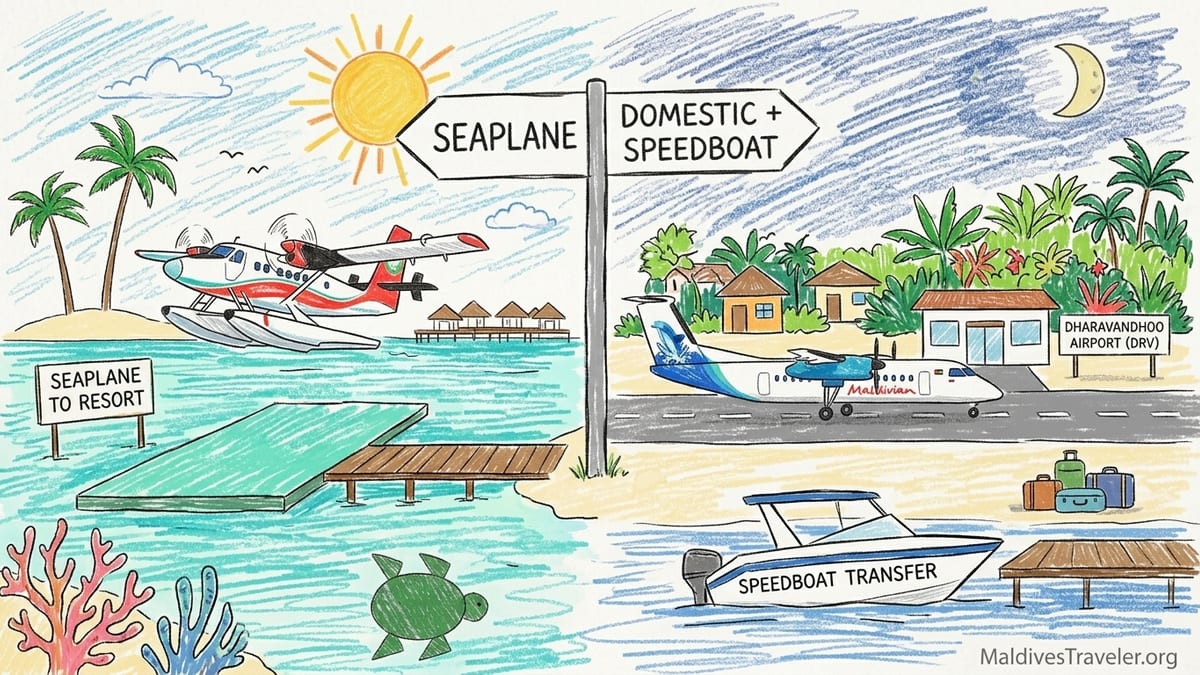
Almost every international traveler to Baa Atoll starts at Velana International Airport in Malé. From there you either fly by seaplane directly to your resort’s island platform, or you take a domestic flight to Dharavandhoo Airport followed by a shorter speedboat ride. Dharavandhoo is widely described as the key domestic gateway to Baa, and it sits close to Hanifaru Bay and several resort islands. Visit Maldives and recent destination guides note that Baa is the country’s only UNESCO Biosphere Reserve, which helps explain why this relatively small atoll has both frequent domestic flights and a high density of resorts.
On the seaplane side, most Baa Atoll resorts are served by shared seaplane transfers that operate from the dedicated seaplane terminal at Velana. Milaidhoo, Amilla and several other high end properties quote a seaplane journey of about 35 minutes from Malé to the resort. These flights feel like a scenic, once in a lifetime experience, but they come with important constraints: daylight only operations, strict luggage rules and higher prices than domestic flights.
Dharavandhoo Airport, by contrast, functions like a regular domestic airport within the Maldives network. Maldivian, the national carrier, currently operates multiple daily flights from Velana to Dharavandhoo, with a published flight time of about 20 minutes and roughly 40 to 50 flights per month on the route. That translates to several departures most days, usually spread from early morning into the evening. From Dharavandhoo, resort speedboats fan out across Baa Atoll, typically taking between 10 and 45 minutes depending on distance, while guesthouses on the island itself are just a few minutes’ walk from the small terminal.
For travelers, the key takeaway is that both routes are well established. The decision is less about which sounds more glamorous and more about matching schedules, budgets and baggage needs to your actual international arrival and departure times.
Daylight-Only Seaplanes and What Your Arrival Time Really Means
Seaplanes in the Maldives do not operate at night because they land on open water without runway lighting. In practice, that means seaplane operators only schedule flights during daylight hours, roughly between about 6:00 and 17:00, with many resorts advising cut off times around mid afternoon. Some transfer guides for 2026 describe a practical seaplane window of approximately 6:00 to 15:30 for international arrivals, so that luggage can be collected, guests can be escorted to the seaplane terminal and flights can safely reach the resort before sunset.
Resorts in Baa Atoll apply this in concrete ways. Milaidhoo’s transfer information notes that guests arriving in Malé after about 15:30 are routed via a domestic flight to Dharavandhoo plus a 15 minute speedboat ride instead of seaplane. Amilla Maldives advises that guests landing at Velana after about 15:00 are generally booked on a 20 minute domestic flight to Dharavandhoo followed by a 10 minute boat transfer. These resort supplied thresholds are more useful than any theoretical schedule because the resort actually books the transfer on your behalf.
To understand how this affects you, work backwards from your international arrival time. For example, if your long haul flight lands at 08:30, you will usually clear immigration and collect bags by around 09:30, leaving plenty of time to catch a seaplane. If you land at 14:15 on a busy day, you might not reach the seaplane terminal in time for the last practical departures, so the resort may either insist on a domestic flight via Dharavandhoo or require an overnight in Malé. If you arrive after 17:00, seaplane is essentially off the table for that day and domestic or an overnight are your primary options.
When comparing resorts, do not simply note that one offers a “35 minute seaplane” and another requires a “20 minute domestic flight plus 30 minute speedboat.” For late day arrivals, the second option may actually get you on the island the same evening, while the seaplane only property might involve an unplanned night at an airport hotel and a lost vacation day.
Domestic Flights to Dharavandhoo: Schedules, Waiting and Speeds
Dharavandhoo is one of the busiest domestic airports in the Maldives outside Malé. Aviation summaries show around 46 monthly flights between Malé and Dharavandhoo, operated mainly by Maldivian using turboprop aircraft such as the Dash 8. That averages out to more than one flight per day in each direction, though the exact schedule varies with season and day of the week. Manta Air previously operated the route but recent traveler reports indicate it has focused more on seaplanes, leaving Maldivian as the primary domestic carrier for Dharavandhoo.
For travelers, this means you are usually not choosing an exact departure time when you book your resort. Instead, you send your international flight details and the resort coordinates with the airline to allocate you on the closest feasible domestic flight. Actual departure times can move by an hour or more as schedules change, and neither the airline nor the resort will usually confirm specific times far in advance. The benefit is that domestic flights operate into the evening, so guests on late international arrivals, even after sunset, can often still reach Baa Atoll the same night.
The flight itself is short, typically 20 to 25 minutes from Malé to Dharavandhoo. Once you land, most Baa resorts that use this route arrange a speedboat to meet the flight. For Amilla, this is about 10 minutes by boat, for Milaidhoo around 15 minutes, and for more distant islands such as Vakkaru or Royal Island the ride can stretch toward 30 to 45 minutes. Because these onward boats are coordinated to connecting flights, you rarely wait long on the Dharavandhoo side.
The trade off comes in Malé. Unlike seaplane passengers who are usually escorted fairly quickly to the seaplane terminal, domestic-flight guests may wait several hours in or near the main terminal for their assigned departure. During busy periods, resorts arrange access to shared lounges where you can rest, shower and snack. If you land in Malé early in the morning, that waiting period might feel minor. If you land at noon and do not depart until late afternoon, however, the total door to door journey can be as long as or longer than a seaplane ride with an overnight in Malé.
Baggage, Cost and the Hidden Price of Transfers
Transfer logistics are intimately tied to baggage and cost. Seaplane operators in the Maldives generally allow around 20 kilograms of checked luggage plus about 5 kilograms of hand luggage per person, with overweight charges levied per extra kilogram. Some resorts or tour operators pre purchase extra allowance in packages, but you should assume that large camera cases, dive bags or checked sports equipment may incur additional charges or, in rare cases, need to follow on a later plane if the seaplane is weight restricted.
Domestic flights to Dharavandhoo are usually aligned with standard airline baggage policies, often around 20 to 25 kilograms of checked luggage, plus hand luggage. Overweight fees are still possible, but the perception from many travelers is that domestic routes feel slightly more forgiving for heavy suitcases than the tightly weight balanced seaplanes. Speedboats have generous space for bags, though crew can still limit items for safety in rough seas.
On price, up to date transfer cost comparisons for 2026 show a clear pattern. Shared seaplane transfers to Baa Atoll luxury resorts often fall in the range of about 600 to 800 US dollars per adult for a round trip, and at some ultra luxury properties can climb higher. One Maldives transfer specialist lists example prices where a resort like Four Seasons Landaa Giraavaru in Baa charges within that range for a 35 minute seaplane return transfer. By contrast, travel planners focused on Baa Atoll list domestic flight plus speedboat return transfers in the approximate band of 250 to 450 US dollars per adult, depending on the resort’s negotiated rates and the length of the boat ride.
This has a major impact on the real cost of your stay. Travelers scanning hotel booking sites often compare room rates without noticing that one property includes a mandatory 700 to 900 US dollar per person seaplane transfer, while another charges around 300 US dollars per person for domestic and speedboat. For a couple, that difference can easily exceed 800 to 1,000 US dollars for the trip. For a family of four, transfer costs can approach or exceed 2,000 US dollars. The only way to compare resorts fairly is to add the quoted round trip transfer cost to your accommodation and meal budget before deciding which island is “cheaper.”
Waiting in Malé: Lounges, Kids and Weather Delays
Whether you take a seaplane or a domestic flight to Dharavandhoo, almost every visitor will spend at least some time waiting at or around Malé’s Velana airport. For seaplanes, the resort or seaplane operator’s staff usually meet you just outside customs, take charge of your checked bags and escort you to a dedicated seaplane terminal by shuttle. Many Baa Atoll resorts, including Milaidhoo and Amilla, use private or shared lounges here, where guests find soft seating, light refreshments, restrooms and sometimes showers. Families often appreciate that these lounges offer air conditioning and relative calm after a long overnight flight.
For domestic flights, waiting tends to happen in or adjacent to the main domestic terminal. Some resorts work with contract lounges, while others simply advise guests to wait in the public seating area until check in opens. If you arrive much earlier than your scheduled domestic departure, you might have several hours of downtime. Travelers can use this window to buy a local SIM card, withdraw local currency if needed or simply rest. With young children, the key is to be prepared: bring snacks, entertainment and a change of clothes in your hand luggage, and avoid scheduling tight onward connections until you know your actual domestic departure time.
Weather is a variable in both transfer types. Seaplanes can be delayed or temporarily grounded during heavy rain, low visibility or strong winds, especially in the wet season from roughly May to October. When this happens, operators hold flights at the seaplane terminal or delay departures from resorts. Domestic flights, operating on paved runways with navigation aids, are more resilient to poor weather, though strong storms can still disrupt schedules. Speedboats from Dharavandhoo to outer islands may also run slower or more cautiously in rough seas, lengthening the journey and sometimes causing guests to arrive later than planned.
The best planning approach is to accept that transfer times within the Maldives are approximate. Build in patience and buffers, especially on your departure day when a delayed seaplane or rough sea crossing could risk a missed international flight. Most resorts recommend leaving your island at least 4 to 5 hours before an international departure, sometimes more if the transfer involves a domestic flight plus boat and the flight schedule is not tightly synchronized with your outbound flight time.
Resort Examples: How Transfer Arrangements Differ
Baa Atoll is small enough that many islands are a short flight from Malé, but transfer arrangements vary substantially by resort positioning, price point and target market. Understanding a few concrete examples helps illustrate why you need to check each resort’s specific policy rather than assuming all Baa transfers are the same.
Milaidhoo is a boutique luxury island often reached by a 35 minute seaplane journey. Its official guidance states that guests landing in Malé after about 15:30 will be routed via a domestic flight to Dharavandhoo and then a 15 minute speedboat ride. This means Milaidhoo effectively operates a hybrid approach: seaplane for guests landing in the morning and early afternoon, domestic and speedboat for those arriving late in the day.
Amilla Maldives, another high end resort in Baa, also offers a 35 minute seaplane from Malé but clarifies that arrivals after about 15:00 are usually transferred by a 20 minute domestic flight to Dharavandhoo followed by a 10 minute speedboat. Guests who strongly prefer seaplanes and arrive late may therefore need to accept an overnight stay near the airport or accept the domestic alternative. Meanwhile, mid market resorts and those oriented toward families sometimes use domestic flight and speedboat as their default, reserving seaplane only for guests who explicitly request and pay for the premium.
Other islands in the atoll, such as Royal Island or Vakkaru, emphasize seaplane transfers in their marketing but will still arrange domestic alternatives in periods of limited daylight, poor weather or aircraft maintenance. Transfer duration then becomes a sum of each leg: for example, 20 to 25 minutes domestic to Dharavandhoo, plus 30 to 40 minutes by speedboat, plus ground handling time on each end. When combined with varying costs, the difference between resorts that are nominally in the same atoll can be significant.
These variations underline why travelers should request up to date written confirmation of transfer type, duration, operating hours and approximate cost from each resort before finalizing a booking. Small print in rate sheets can change from year to year, and while general patterns hold, individual exceptions matter when you have a tight schedule, young children or a firm budget.
Staying on Dharavandhoo Itself: Simpler Logistics for Independent Travelers
Dharavandhoo is not just a transit hub for resort guests. It is also a lived in local island with a growing cluster of guesthouses and dive operators, especially popular with independent travelers who want to access Hanifaru Bay without luxury resort prices. Local information from late 2024 and 2025 mentions around a dozen guesthouses on the island and several dive centers running daily trips in season to the manta aggregation sites.
For travelers staying on Dharavandhoo itself, the transfer equation simplifies dramatically. Instead of adding a seaplane leg or a secondary speedboat, you simply fly to Dharavandhoo and walk or take a short vehicle transfer to your guesthouse. Once you clear the tiny terminal, staff from your chosen property often meet you at the exit and help with bags. Travel times from the airport to most guesthouses are measured in minutes, not tens of minutes.
The cost profile also shifts. You pay only for the domestic flights between Malé and Dharavandhoo, with no extra private resort boat or seaplane mark up. Some guesthouses offer package deals that bundle return domestic flights and airport pickup with accommodation and manta excursions, giving a clear upfront price for budget planning. While you lose the convenience of direct seaplane access and private island amenities, you gain flexibility and lower overall transfer costs, which can be particularly attractive for long stays or solo travelers.
Travelers choosing this option should still factor in Malé waiting time and domestic schedule variability, but they avoid the extra complexity of aligning both a domestic flight and a resort boat schedule. For those comfortable with a bit of DIY planning, Dharavandhoo as a base can be one of the most efficient ways to experience Baa Atoll’s marine life.
Key Scenarios: How to Choose for Your Specific Trip
It helps to look at typical travel scenarios and how seaplane versus Dharavandhoo domestic routes play out in real life. Consider first an early morning Malé arrival, with an international flight touching down around 07:30. After clearing formalities by roughly 08:30, you have excellent chances of catching a mid morning seaplane to most Baa Atoll resorts. In this case, choosing a seaplane focused property like Milaidhoo or a seaplane transfer option to Amilla makes sense, as you are likely to be on the island around late morning with minimal waiting. You can factor in higher seaplane cost against the added value of maximizing your first day in paradise.
Now picture an afternoon arrival, say landing at 13:00. After immigration and baggage claim, you might be ready for onward travel around 14:00 to 14:30. You are now uncomfortably close to the practical seaplane cut off. Some operators do manage mid to late afternoon departures, but resorts may not guarantee them, especially in shoulder seasons or if your international flight is delayed. In this scenario, a resort that routinely uses Dharavandhoo domestic flights, or that explicitly offers domestic plus speedboat as a backup, becomes more attractive. You may spend extra time waiting in Malé, but you have a better chance of reaching your resort the same day compared with a property that only accepts seaplane arrivals earlier in the afternoon.
For arrivals after the seaplane cut off, such as landing at 18:00 or later, your realistic options narrow to either an overnight near Malé or a domestic flight and speedboat if your resort and the airline have late departures. Some domestic schedules include evening flights to Dharavandhoo, which can allow same night arrivals at nearby resorts, but this is not guaranteed for every date. Families or risk averse travelers might wisely choose a Malé airport hotel for the first night, then fly on fresh the next morning. If you are determined to avoid an overnight, prioritize resorts that clearly advertise domestic access and ask them in advance how late they can realistically move guests on your specific arrival date.
For a family with children and lots of luggage, comfort and baggage policies become central. Seaplanes are exciting for kids but involve narrow cabins, potentially high cabin temperatures during boarding and strict weight checks. Domestic flights offer conventional overhead bins, more familiar seating and sometimes slightly higher or more flexible luggage allowances. If your family travels with multiple suitcases, strollers and water sports gear, the domestic plus speedboat route to a Baa resort may reduce stress, even if it adds some transfer time. You should also factor the cost difference: a family of four can easily save several hundred to more than a thousand dollars by choosing a resort whose default transfer is domestic and speedboat rather than seaplane.
Finally, for the local island guesthouse traveler heading specifically to Dharavandhoo, the logic is the most straightforward. You select a domestic flight time that fits your international arrival as closely as possible, accept some waiting at Velana and enjoy the simplicity of walking from Dharavandhoo’s terminal to your accommodation. Seaplanes rarely serve Dharavandhoo directly in a way that is useful for guesthouse visitors, and private seaplane charters are prohibitively expensive for most travelers. In this case, domestic flights are not just a budget choice but the only practical and sensible option.
The Takeaway
Baa Atoll is close enough to Malé that reaching it is never especially long in flying time, but the details of how you get from runway to overwater villa or guesthouse porch matter more than most first time visitors expect. Seaplane transfers deliver dramatic views and a fast, direct hop to many luxury resorts, but they are bounded by daylight, strict baggage rules and higher prices. Domestic flights to Dharavandhoo, followed by relatively short speedboat rides, extend operating hours into the evening and usually cost less, at the expense of more time spent waiting around airports.
The most important lesson when planning a Baa Atoll trip is to build your transfer strategy around your actual international arrival and departure times, not just your instinctive preference for a certain aircraft type. If you land in Malé early and are comfortable paying for the experience, a seaplane can be a highlight. If you arrive mid or late afternoon, prefer more forgiving luggage policies or travel as a cost conscious family, a resort that leans on Dharavandhoo domestic flights may ultimately be both smoother and better value.
Above all, treat transfer costs as part of the true price of any Baa Atoll stay. Ask each resort or guesthouse for current round trip transfer prices, operating windows and backup plans, then add those numbers into your budget before comparing room rates. With that homework done, you can pick the island, transfer type and timing that fit your reality rather than relying on glossy photos of seaplanes alone.
FAQ
Q1. How long does it take to reach Baa Atoll from Malé?
The flying time is short: about 35 minutes by seaplane or around 20 to 25 minutes on a domestic flight to Dharavandhoo, plus 10 to 45 minutes by speedboat if you are continuing to a resort island. The overall door to door journey, including waiting in Malé and transfers on each end, usually ranges from 2 to 5 hours.
Q2. Are seaplanes to Baa Atoll available at night?
No. Seaplanes in the Maldives operate only in daylight because they land on the ocean without runway lights. In practice this means roughly early morning to mid or late afternoon. Guests arriving in Malé in the evening must either take a domestic flight and speedboat if available or spend the night near the airport.
Q3. Which is cheaper, seaplane or domestic flight plus speedboat?
Shared seaplane transfers to Baa Atoll luxury resorts often cost in the range of several hundred US dollars per person for a round trip, while domestic flight plus speedboat packages are typically noticeably lower. Exact figures depend on the resort’s contract with operators, but for most travelers domestic plus speedboat is the more economical option, especially for families.
Q4. How many flights per day go from Malé to Dharavandhoo?
Schedules change seasonally, but current route summaries show around 40 to 50 flights per month between Malé and Dharavandhoo, averaging several departures most days. Maldivian is the main carrier. Your resort or guesthouse will usually book you on the departure that best fits your international flight times.
Q5. What are the baggage limits for seaplane transfers?
Seaplane transfers in the Maldives typically allow around 20 kilograms of checked luggage plus about 5 kilograms of hand luggage per person. Overweight items are charged per kilogram and in some cases may be sent on a later flight if the seaplane is near its weight limit. Always check your resort’s latest policy before packing.
Q6. Is the domestic route via Dharavandhoo better for families with children?
Many families do find the domestic plus speedboat route more comfortable. Aircraft cabins are more familiar, there is usually slightly more tolerance for luggage, and boats from Dharavandhoo to nearby resorts are relatively short. However, young children often enjoy the novelty of seaplanes, so the best choice depends on your kids’ temperament, your arrival time and your budget.
Q7. Do I need to book my seaplane or domestic transfer myself?
In almost all cases, no. Resorts and many guesthouses arrange transfers on your behalf once you send your international flight details. They have direct agreements with seaplane and domestic operators, and the cost is added to your room bill. Independent travelers staying on Dharavandhoo can sometimes book domestic tickets directly, but coordinating through accommodation remains common.
Q8. What happens if bad weather delays my seaplane or boat?
Seaplanes and speedboats may be delayed during heavy rain, strong winds or poor visibility. If this occurs on arrival, you may spend extra time in a lounge or waiting at the terminal until conditions improve. On departure, resorts adjust your transfer time to preserve as much safety margin as possible before your international flight. It is wise to allow several hours of buffer when scheduling your departure day.
Q9. Can I stay overnight in Malé if my flight arrives too late?
Yes. Many travelers whose flights land after the seaplane window choose to spend the night at an airport hotel or on a nearby local island, then continue to Baa Atoll the next morning. This can be less stressful than trying to catch a last minute domestic flight and boat late in the evening, particularly for families or travelers with long haul jet lag.
Q10. Is staying on Dharavandhoo cheaper than a Baa Atoll resort once transfers are included?
Often it is. Guests staying on Dharavandhoo usually pay only for domestic flights between Malé and Dharavandhoo and a short local transfer, while resort guests add a private speedboat or seaplane cost on top of accommodation and meals. For budget conscious travelers or longer stays, this difference can be substantial and is worth comparing alongside room prices and the type of experience you want.