


Planning a family trip to the Maldives often starts with dreamy photos of overwater villas and manta rays gliding through electric-blue water. The reality, especially in Baa Atoll with younger children in tow, is more complicated. The rewards are enormous, but so are the logistics. After a recent family stay in Baa Atoll, this is what was genuinely harder than expected, what turned out to be surprisingly easy, and how I would plan differently next time.
Reaching Baa Atoll With Children Is Not “Just One More Flight”
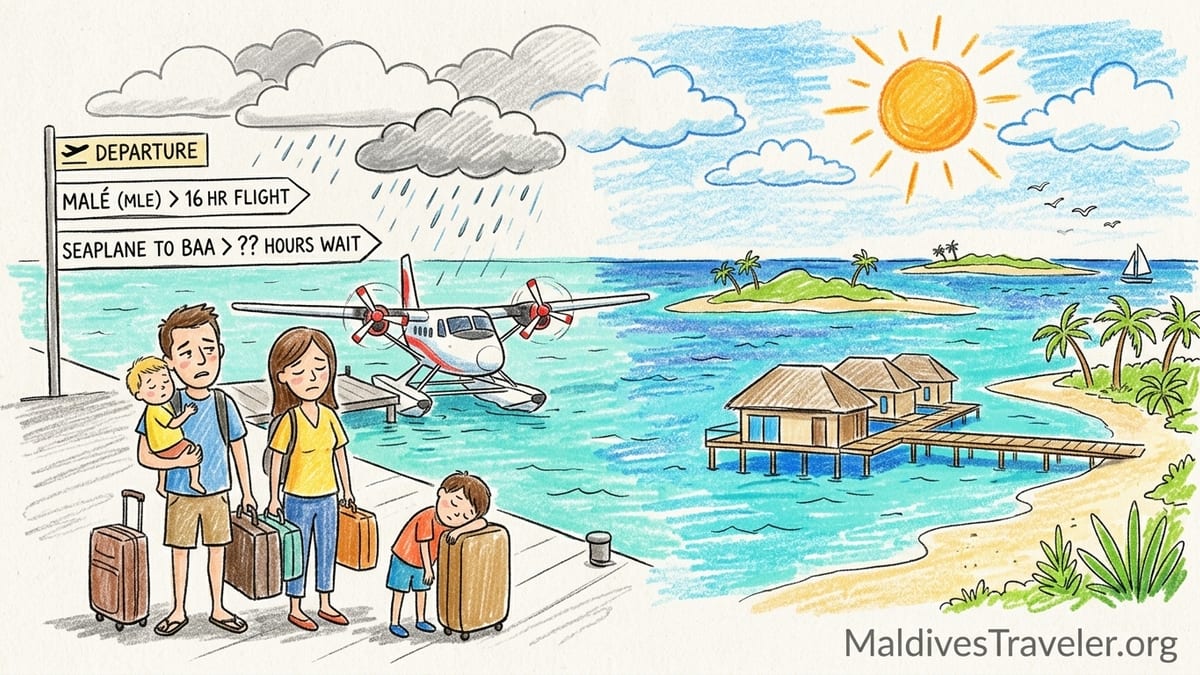
From North America or Europe, getting to Baa Atoll with kids is an endurance event, not a simple hop. Most families connect through hubs such as Doha, Dubai, Istanbul or Singapore, then fly into Velana International Airport in Malé. That long-haul segment alone can run 14 to 16 hours from U.S. gateways like New York or Los Angeles, often overnight. The problem is what happens after you land in Malé with children who have been awake for most of that time.
Many Baa Atoll resorts are reached by seaplane from Malé. The actual flight time is not bad, usually around 30 to 45 minutes over spectacular atolls and lagoons. The difficult part for families is the unpredictability around it. Seaplanes only fly during daylight, are scheduled around arriving international flights and weather, and can be delayed or batched to consolidate passengers. That can mean two or three hours sitting in a lounge with children who just want a bed and a swim. When one of our flights was pushed back by an hour due to a passing storm front, our youngest fell asleep face-down on a beanbag chair in the seaplane terminal.
Even when you take a domestic flight plus speedboat instead of a seaplane, you are still layering one more check-in, another security line, and another wait onto an already long journey. For families arriving from Europe on morning flights, it is common to reach the final resort only mid to late afternoon. From the west coast of the United States, it can mean leaving on a Friday evening and not seeing your villa until Sunday lunchtime. Parents who picture “land, transfer, nap” often underestimate how drawn-out those last steps feel.
The most useful strategy I saw other families use was to book an overnight in Hulhumalé or Malé on the way in, especially when landing in the evening. A simple airport hotel with a pool, a pizza, and 12 hours of real sleep before the seaplane transfer made their children look like completely different people the next morning, compared with the pale, overstimulated kids collapsing in the lounge after 24 hours in transit.
Seaplane Logistics, Luggage Rules and Waiting With Tired Kids
The romance of the Maldives seaplane is real. Boarding barefoot from a wooden dock and watching tiny islands drift past is magical, especially for children. The parts that rarely make it onto Instagram are the early wake-ups, strict luggage rules and slightly chaotic boarding process that come with it.
Most seaplane operators that serve Baa Atoll, such as Trans Maldivian Airways and Manta Air, work with a standard baggage allowance around 20 kilograms of checked luggage plus 5 kilograms of hand baggage per paying passenger, with a small extra fee per additional kilogram. That matters for families because modern long-haul tickets on major airlines often include 23 to 30 kilograms of checked baggage per person. It is entirely possible to land within your airline allowance and still be technically overweight for the onward seaplane. I watched one family in front of us quietly moving sunscreen, diapers and swim vests from one suitcase to another on the floor of the check-in area, trying to shuffle weight so they would only pay for one overweight bag instead of three.
On the people side, children under two are usually counted as infants on laps and do not receive their own luggage allowance, even though babies often come with the bulkiest gear. Some families handled this by bringing compact travel strollers that fold into the overhead bin of their long-haul flight, then gate-checking them or sending them in the hold for the seaplane. Others rented baby cots, high chairs and even bottle warmers from the resort to reduce what they had to carry. What surprised me was how much emotional energy it took on that final leg just to keep track of small items like tablets and soft toys in an environment with limited space and lots of noise.
The waiting itself is the other underestimated stress point. Seaplane lounges in Malé are generally comfortable, sometimes with small play corners, snacks and drinks. But you are still asking jet-lagged children to sit in artificial light for one or two more hours while you keep one eye on the departure screens and another on a toddler circling a tray of fruit juice. Flights are sometimes rescheduled at the last minute based on weather over the atolls or operational considerations. I spoke with one couple from London whose afternoon seaplane to Baa was moved to the early evening because of heat and visibility issues at the island’s small floating platform. Their four-year-old fell asleep hard in the lounge and had to be carried on and off the aircraft, turning what could have been a magical first flight over the islands into a bleary, tearful blur.
Heat, Sun, Sunscreen and the Reality of Tropical Afternoons
Almost every image of Baa Atoll shows open skies, blindingly white sand and turquoise water. What you do not feel in those photos is the combination of heat and humidity that hits a child who has come straight from a northern winter. The Maldives sits close to the equator and experiences a warm tropical climate year-round, with daytime temperatures frequently in the high twenties to low thirties Celsius. In practice that means that walking 500 meters under the midday sun with a preschooler and a beach bag can feel like a small expedition.
Families often underestimate the constant battle with sunscreen. Many resorts in Baa Atoll now actively encourage or even require reef-safe sunscreen and rash guards to protect the coral environment. That is good news for the reef but adds another layer of complexity for parents. We found that applying a thick layer of mineral sunscreen to two sandy, half-dressed children three or four times a day was more exhausting than almost anything else on the trip. In the end, the best combination was long-sleeve UV swim shirts and surf leggings for the kids, with sunscreen focused on hands, feet, faces and necks. Another family from Germany we met in the kids’ pool swore by packing one bottle of familiar sunscreen from home for the first couple of days, then buying additional stock on the island despite the higher price just to save luggage weight.
The heat also changes the rhythm of family days in Baa Atoll. Even during the drier months from roughly December to April, short bursts of heavy rain can roll through, but the default afternoon is still hot and bright. What this meant in real life was that our youngest simply refused to walk on the sand barefoot around lunchtime. From about 11:30 to 3:30, most families naturally migrated to shaded kids’ clubs, indoor game rooms, naptime in the villa or quiet swims in shaded pools. If you arrive expecting to spend full days on the beach, it can be a shock to discover that the most comfortable outdoor hours for children are usually early morning and late afternoon, with a long indoor or shaded break in between.
Hydration became another constant focus. With the combination of heat, seawater and activity, our children drank far more water and juice than at home. Many Baa Atoll resorts now include reusable water bottles or have refill stations to reduce plastic waste. I would still travel with one bottle per child and a clear rule that we filled them every time we passed the bar or main restaurant. Looking around, it was easy to spot the families who were on top of this and those who were not. Sunburn and mild heat exhaustion remain some of the most common medical complaints for visitors, and they are both far easier to prevent than to resolve when you are isolated on a small island.
Overwater Villas, Deck Safety and Deep Water Around Your Door
For many parents, the dream shot from a Maldives holiday is their child jumping off the private deck of an overwater villa into a clear lagoon. Baa Atoll has some of the most picturesque stilted villas in the country. What is less obvious from the brochures is how those structures feel with curious toddlers or non-swimming children. The ladders usually descend directly into water that can be significantly deeper than a typical hotel pool, and currents around the stilt legs can be surprisingly strong.
On arrival, the first thing we did in our overwater villa was evaluate every exit to the deck. The railings were solid, but the gate latch was within reach of a determined three-year-old on tiptoes. The drop to the water on the outer side of the deck was several meters. While the lagoon in front of the villa looked calm, staff reminded us that tides and currents change quickly around the atoll channels, and that even competent adult swimmers needed fins on windy days. Our children had to wear life vests every time they stepped onto the deck, even just to sit with us and watch fish after dinner. It was manageable, but it required constant vigilance that felt more like being on a houseboat than in a typical beach hotel room.
We also discovered that many resorts in Baa Atoll set minimum age guidelines for overwater villas, typically around 6 to 8 years, and sometimes require parents of younger children to sign an additional waiver. During our stay, one family who had booked an overwater villa with a four-year-old decided to switch to a beach villa after two nights simply because they felt they could not relax. They described lying awake listening for small footsteps while jet lag had their son popping up at odd hours. The resort helped them move and the mood of their holiday changed within 24 hours. Their child could finally play in the sand in front of the villa while the adults sat on the terrace, rather than being constantly shepherded away from an open drop to deep water.
If your heart is set on an overwater villa experience in Baa Atoll with young children, one sensible compromise is to book only a couple of nights at the end of the trip, once everyone has adjusted to the time zone and the resort layout, and to choose designs with enclosed decks or higher railings. It is also worth asking specific questions in advance about deck gates, rail heights and whether safety locks can be added. The glossy brochure image is real, but so is the responsibility, and it is easier to enjoy the view when you are confident your child cannot open the door unaided.
Excursions, Minimum Ages and Snorkeling With Kids Who Are Not Strong Swimmers
Baa Atoll is famous for its marine life, especially around the UNESCO-listed biosphere reserve and sites like Hanifaru Bay, where manta rays gather seasonally. Families often arrive with big expectations about snorkeling and wildlife encounters. The part many do not realize until they are on the island is that almost every excursion has a minimum age and a minimum level of swimming ability, and these are enforced for safety and insurance reasons rather than flexibility.
When we checked in, the activities team handed us a sheet listing excursions and age limits. Dolphin cruises on large boats welcomed all ages, but guided snorkeling trips to outer reefs required children to be at least 6 or 8, depending on the particular reef and sea conditions. Trips into more open water channels or to manta aggregation sites had even stricter rules. One American couple we met had flown to Baa Atoll largely for the chance to take their manta-loving seven-year-old into Hanifaru Bay. In the end, sea conditions during their stay meant that only strong adult swimmers were allowed into the water with guides, while younger guests watched from the boat. Their daughter still saw mantas from above the surface, but it was very different from what they had pictured from travel articles.
The underlying challenge is that many snorkeling sites in Baa Atoll involve deep water, channels with current or drop-offs from the house reef into the blue. Even where life jackets are provided, guides need to be sure that participants can follow directions and manage basic movements like clearing a mask or holding onto a surface line without panicking. Our older child, who swims comfortably in a pool but had limited experience with fins, needed two short practice sessions in the shallow lagoon before she felt confident enough to venture to the outer reef. The resort’s house reef, reachable from the beach, became more important than we expected because it allowed daily, low-pressure snorkels without boarding a boat or committing to an organized excursion.
If your children are younger or not yet strong swimmers, the most satisfying water experiences in Baa Atoll may be closer to shore than you expect: feeding reef fish from a pier, floating over a shallow patch reef at waist depth, or exploring seagrass beds where turtles sometimes graze. Several parents we spoke to had arrived with ambitious plans for multiple boat trips and discovered that their kids were happiest simply drifting with a mask in the shallows in front of the villa or the main beach, returning to the pool or kids’ club once they were tired.
Medical Access, Minor Emergencies and Rainy-Day Realities on a Small Island
One of the less glamorous but important questions parents should ask about any remote destination is: what happens if someone gets sick or injured. Baa Atoll is no exception. The good news is that the Maldives has a network of healthcare facilities, including Baa Atoll Hospital on the island of Eydhafushi and several health centers across the atoll. Many established resorts also maintain small on-island clinics staffed by a nurse or doctor for basic issues such as fevers, ear infections, minor cuts or dehydration. The trade-off is that anything serious will still require a boat or seaplane evacuation to a larger facility, often in Malé, and that can be delayed by poor weather or nightfall.
During our stay, we witnessed several very typical family incidents. One child developed a painful ear after days in the pool and sea water. The island clinic checked for infection, provided ear drops, and advised an activity break for 24 hours. Another guest slipped on a wet wooden walkway after an afternoon rain shower and cut his chin badly enough to need stitches. Resort staff cleaned the wound, then arranged a speedboat to a nearby medical center on an inhabited island. The entire process took several hours and wrote off a day of his family’s vacation. None of these situations were dramatic, but they were a clear reminder that even small mishaps take longer to resolve when your nearest road is a boardwalk and your ambulance is a boat.
Then there is the question of weather. Baa Atoll, like the rest of the Maldives, experiences a distinct wet season roughly from mid May to November associated with the southwest monsoon, and a drier season from about December to April. Even in the dry months, short tropical showers can appear almost any week. For families, the real test is not a 20-minute downpour but the two or three consecutive days when wind and cloud dominate and boat excursions are cancelled. During one low-pressure system that moved through while we were in Baa, visibility dropped, wind made the sea choppy and rain came and went in long sheets. On those days the island shrank.
On the first rainy morning, the kids’ club filled up quickly with craft activities, movies and indoor games. By the second afternoon, parents were pacing the covered walkways pushing strollers, stopping at the small library for yet another picture book. Children splashed in the rain in warm pools until thunder rolled in and lifeguards cleared everyone out. Screens came out more than most of us liked to admit. The experience was a reminder to pack not just swimsuits and flip-flops but also a mental rainy-day kit: compact board games, card decks, stickers and books that can handle humid air, downloaded movies on a tablet, and the patience to turn a small villa into a temporary playroom.
What Turned Out Much Easier Than Expected
For all of these frictions, several aspects of being in Baa Atoll with children were far easier than I had imagined from home. The first was the sheer absence of traffic and urban noise. Once you are on the island, there are no cars, crossings, or busy roads. Children roam mainly on sand paths and boardwalks. The biggest hazards are tripping on a tree root or slipping on a wet pier, not speeding scooters or intersections. For city-based families, watching a six-year-old wander barefoot from villa to beach without crossing a single street feels almost revolutionary.
The second unexpected ease was how compact everything was. Most Baa Atoll resort islands are small enough that you can walk from one end to the other in 10 to 20 minutes, and many also provide bicycles with child seats or small buggies. Compared with sprawling mainland resorts where getting from your room to breakfast involves elevators and long corridors, the Maldives rhythm is refreshingly simple. Our typical morning went like this: wake up, slide open the villa door, let the children dig in the sand while we ordered coffee, walk three minutes to breakfast, then amble to the pool or lagoon. Shoes were optional; traffic noises were replaced by waves and the rustle of palm fronds.
Mealtimes were easier too. On a dedicated resort island, every restaurant is, by definition, on site. Once you have navigated the initial jet-lagged dinner, there is no hunting for child-friendly options in a new city or negotiating taxis with car seats. Many Baa Atoll properties offer half-board or full-board meal plans, and a good portion now include separate children’s menus, early seating times and simple dishes that can be customized. We watched staff cheerfully bring plain grilled fish instead of spicy curry for a cautious eater, and a chef who offered to blend fruit into smoothies for a toddler who had gone off solid food for a day in the heat. Parents were able to eat proper meals without constantly scanning a busy street outside a restaurant door.
Kids’ clubs were another pleasant surprise. While offerings vary by island, the general trend in Baa Atoll is toward structured, creative programs rather than a single room with a television. Activities ranged from Maldivian craft sessions and marine biology talks to guided sandcastle competitions and short, supervised snorkels in shallow water. Where age-appropriate, many clubs allowed children to be signed in for a couple of hours while parents took a longer swim, visited the spa or simply read a book in the shade. For families who are used to city breaks where every outing involves planning and supervision from dawn to dusk, this felt almost luxurious.
Finally, the environment itself helps children settle. The sea is warm enough year-round that even cautious kids can spend long periods in the water without shivering, and the transition from villa to beach often takes less than a minute. That frequency and ease of water access meant that we did not need to plan “big swim sessions.” Instead, the day filled with many small dips: a pre-breakfast paddle, a quick snorkel before lunch, a sunset splash in the shallows. This rhythm made jet lag more manageable than expected. When a child was wide awake at 5 a.m., the solution was as simple as stepping out into the dawn light and letting them play quietly on the sand while the sun rose over the lagoon.
My Honest Age Sweet Spot, Villa Choice and What I Would Pay Extra For Next Time
After juggling seaplanes, sunscreen battles, rainy afternoons and midnight deck checks, one question I kept coming back to was: at what age does a trip to Baa Atoll with children really start to feel like a holiday rather than an expedition. Having now experienced it with younger kids and having watched families with babies and teenagers around us, I would personally say that the sweet spot begins around age 6.
At six or seven, most children have enough stamina to handle the travel day with some strategic sleep, can participate in basic snorkeling with a life vest in calm conditions, and are allowed into more kids’ club activities and gentle excursions. They are usually old enough to remember the experience for years, but still young enough to delight in simple pleasures like chasing crabs at the shoreline or spotting reef fish in ankle-deep water. Older children and teenagers clearly gained even more from the trip, especially on the marine side, but the jump from toddler to early school age seemed to be the point at which parental shoulders visibly dropped.
On the perennial question of beach villa versus overwater villa, my own view shifted significantly after staying in both with kids. If I were returning to Baa Atoll with any child under 8, I would choose a beach villa as the primary base every time. Having sand and shallow water directly in front of the room meant our children could play semi-independently while we sat on the terrace, and we could step inside for snacks, naps or bathroom breaks within seconds. I would consider booking one or two nights in an overwater villa at the end of the stay as a special treat, but not as the main accommodation.
As for what I would pay extra for next time, the answer has less to do with room category and more to do with logistics and support. I would gladly spend more on three things. First, a flight schedule that allows an overnight stop on the way in, reducing the chance that we arrive in Malé at dusk exhausted and have to scramble for a last seaplane. Second, a resort in Baa Atoll that offers strong on-site medical support, clearly communicated safety protocols and flexible, well-run kids’ clubs, even if the nightly rate is slightly higher. Third, direct access to a healthy, shallow house reef from the main beach, so that our family’s most meaningful snorkeling can happen at our own pace without needing to book daily boat trips. Those elements may not feature prominently in glossy brochures, but after a real family stay, they are the details that most clearly separate a beautiful holiday from a genuinely restful one.
The Takeaway
A family trip to Baa Atoll in the Maldives is neither a simple beach break nor an unattainable fantasy. It is a real-world experience made of airport naps, sandy sunscreen bottles, rain-spattered boardwalks and, in between, some of the most extraordinary seascapes your children are likely ever to see. The hardest parts are almost all logistical: the long string of flights and transfers, the baggage rules, the fine print on age limits, the awareness that medical care is a boat ride away and that the ocean at your doorstep is both beautiful and powerful.
The easiest parts, once you are there, are almost everything else. Life shrinks to a small, walkable island. Meals are close, predictable and flexible. Kids’ clubs soak up restless energy. The warm ocean invites constant, low-pressure play and discovery. If you choose your timing, accommodation type and support systems with clear eyes, Baa Atoll can be an unforgettable introduction to the Indian Ocean for your children rather than an exercise in parental endurance.
For families weighing whether this is the right trip for right now, the honest answer is that Baa Atoll rewards patience and preparation. If your children are still very small and the idea of managing multiple flights, strict luggage allowances and constant overwater vigilance leaves you tense, there is no harm in waiting a few years. The manta rays, coral reefs and slow sandy paths will still be there when your kids are ready to remember them.
FAQ
Q1. How long does it really take to reach Baa Atoll from the United States with kids?
From major U.S. cities you are usually looking at one long-haul flight of 14 to 16 hours to a hub such as Doha or Dubai, a shorter connecting flight of 4 to 5 hours into Malé, then a 30 to 45 minute seaplane or domestic flight plus speedboat to Baa Atoll. With layovers and waiting time, the total door to door journey often runs between 24 and 36 hours.
Q2. Are seaplanes safe and suitable for young children?
Seaplanes in the Maldives are widely used and follow standard aviation safety rules, and resort staff handle them as routine transfers. The main challenges for young children are the noise, the heat and the tight seating, not safety itself. Most families report that children find the flight exciting, but it helps to bring small ear protection and to keep expectations realistic about delays and waiting.
Q3. Will we have problems with luggage weight on the seaplane?
You might, especially if you pack to the maximum allowance on your international tickets. Seaplane operators typically include around 20 kilograms of checked luggage and 5 kilograms of hand baggage per paying passenger, which can be less than long-haul airline limits. Overweight bags are usually accepted up to a point but charged per kilogram. Planning shared family suitcases, renting bulky baby items on the island and packing lighter can reduce stress and extra costs.
Q4. Is the sun in Baa Atoll really that strong for children?
Yes. The Maldives sits close to the equator and receives intense sun year-round, so unprotected skin can burn in well under an hour. Combined with high humidity and reflection from white sand and water, this can be tough on children’s skin and energy levels. Long-sleeve UV swimwear, broad-brimmed hats, reef-safe sunscreen and regular shade breaks are more or less essential for a comfortable family trip.
Q5. Are overwater villas recommended with toddlers or non-swimming kids?
Most parents who have tried both usually prefer beach villas with younger children. Overwater villas in Baa Atoll sit above deep water and feature open decks or ladders directly into the sea, which require constant supervision. Many resorts set minimum ages for overwater bookings or ask parents of small children to sign a safety waiver. Beach villas allow easier, more relaxed play in shallow sand and water directly outside the room.
Q6. Can young children join snorkeling and manta ray excursions in Baa Atoll?
It depends on the child and the conditions. Boat-based snorkeling trips and visits to sites like Hanifaru Bay usually have minimum age requirements and expect guests to be comfortable in deep water with a life vest and fins. Calm, shallow snorkeling is often possible directly from the resort beach or house reef with parental supervision, which tends to work better for younger or less confident swimmers.
Q7. What kind of medical care is available if a child gets sick?
Many Baa Atoll resorts have a small clinic or on-call medical professional who can treat common issues such as fevers, minor injuries, dehydration or ear infections. For more serious problems, staff arrange transfer to a larger facility such as Baa Atoll Hospital or a hospital in Malé by speedboat or seaplane, depending on location and weather. Travel insurance that covers medical evacuation is strongly recommended for families.
Q8. What happens if it rains for several days in a row?
Short tropical showers are common in Baa Atoll at any time of year, and longer rainy spells are more frequent between about May and November. When heavy rain and wind set in, boat excursions may be cancelled and families spend more time in kids’ clubs, indoor play areas, villas and covered common spaces. Packing compact games, books and downloaded movies, and choosing a resort with strong indoor children’s facilities, can make these stretches much more bearable.
Q9. Is food on Baa Atoll islands suitable for picky eaters and young kids?
In most established Baa Atoll resorts, yes. Buffets and à la carte menus usually include simple options such as pasta, grilled chicken or fish, and fresh fruit alongside Maldivian and international dishes. Many properties offer children’s menus, are willing to adjust spice levels and can cater to common allergies with advance notice. Because every restaurant is on site, you do not need to travel off the island in search of child-friendly meals.
Q10. What is the best age to take children to Baa Atoll for the first time?
Any age can work with enough preparation, but many parents find that trips become significantly easier and more rewarding once children are around six or seven. At that age, kids usually cope better with long flights and time changes, can join more activities and excursions, and are old enough to remember snorkeling, dolphins and island life. Younger children can still enjoy Baa Atoll, but the experience may feel more demanding for parents.