


From the moment I descended the spiral staircase into SEA, the underwater restaurant at Anantara Kihavah in Baa Atoll, it was clear this was meant to be the resort’s showpiece experience. Glass walls curve around a compact dining room set six metres below the lagoon, reef fish flicker past like thrown confetti and the staff speak about vintages with the reverence usually reserved for temples. Yet in a destination where private dives, manta safaris and sandbank dinners all compete for high-end budgets, the real question is simple: was dining beneath the reef worth the money, or is SEA more spectacle than substance?
Why I Chose SEA, And How I Booked It
I visited SEA in early 2026 during a five-night stay at Anantara Kihavah, on the western side of Baa Atoll inside the UNESCO Biosphere Reserve. I was travelling as a couple, both experienced snorkellers and divers who had already earmarked funds for a manta excursion and a half-day private boat charter. That made SEA a deliberate trade-off against other big-ticket activities rather than an automatic splurge bundled into a honeymoon package.
Current resort information lists SEA as part of the overwater SEA.FIRE.SPICE.SKY complex, with the restaurant and its wine cellar sitting roughly six metres below the house reef. Official materials and partner fact sheets confirm breakfast by request from 8:30 am to 10:30 am, lunch between 12:00 pm and 2:00 pm and dinner in the evening, with dinner promoted as an adults-only experience except on specific family nights such as Mondays and Thursdays. Before committing, I checked these details again with the resort concierge on arrival, who confirmed that the schedule and adults-only policy were still as advertised, with rare exceptions for private buyouts or festive-period adjustments.
Because the dining room is small, with a single row of tables facing the panoramic glass, SEA books out quickly. I reserved lunch and later added dinner, both made eight weeks ahead through a travel adviser working with the resort. Closer to arrival, I tried to shift lunch to a different day and was offered only waitlist status, which the staff said was typical for high season. If SEA is a must-do, treat it like a key part of your itinerary and request your preferred service time at the moment you confirm accommodation, rather than waiting until check-in.
The Setting: Six Metres Under The House Reef
Reaching SEA involves a short buggy ride along the jetty to the complex and then a discreet entrance that feels almost like a yacht club. Inside, a compact lounge area leads to a spiral staircase wrapped around a glass column. With every step down, daylight thins and the water outside deepens from pale turquoise to a saturated cobalt, until you step into the dining room and realize the lagoon has become your wallpaper.
The room itself is intimate rather than cavernous, housing a single row of tables aligned along the glass on both sides, plus a handful of seats closer to the central aisle. There are no bad views, but there is a hierarchy. The two-person tables pressed right against the longest curve of glass feel closest to the reef slope, with fish often passing at eye level. I requested a window table when booking and the team honored that note, placing us at one of these prime positions for both services. The furnishings are contemporary but not fussy: pale wood, neutral upholstery and soft lighting that never throws reflections onto the glass, which is essential for visibility once the sun begins to drop.
Unlike some underwater venues attached to sandy lagoons, SEA benefits from being perched on Anantara Kihavah’s house reef, part of Baa Atoll’s wider coral system. The resort is not shy in its marketing claims, describing SEA as the Maldives’ first underwater wine cellar and highlighting marine encounters with reef sharks, turtles and dense schools of fish. In practice, the view delivers a genuine sense of immersion, with the reef slope visible on one side and the blue water column on the other. You are not staring at an artificial aquarium, but at the resort’s real reef traffic passing the windows on their own schedule.
Lunch At SEA: Menu, Prices And Marine Life
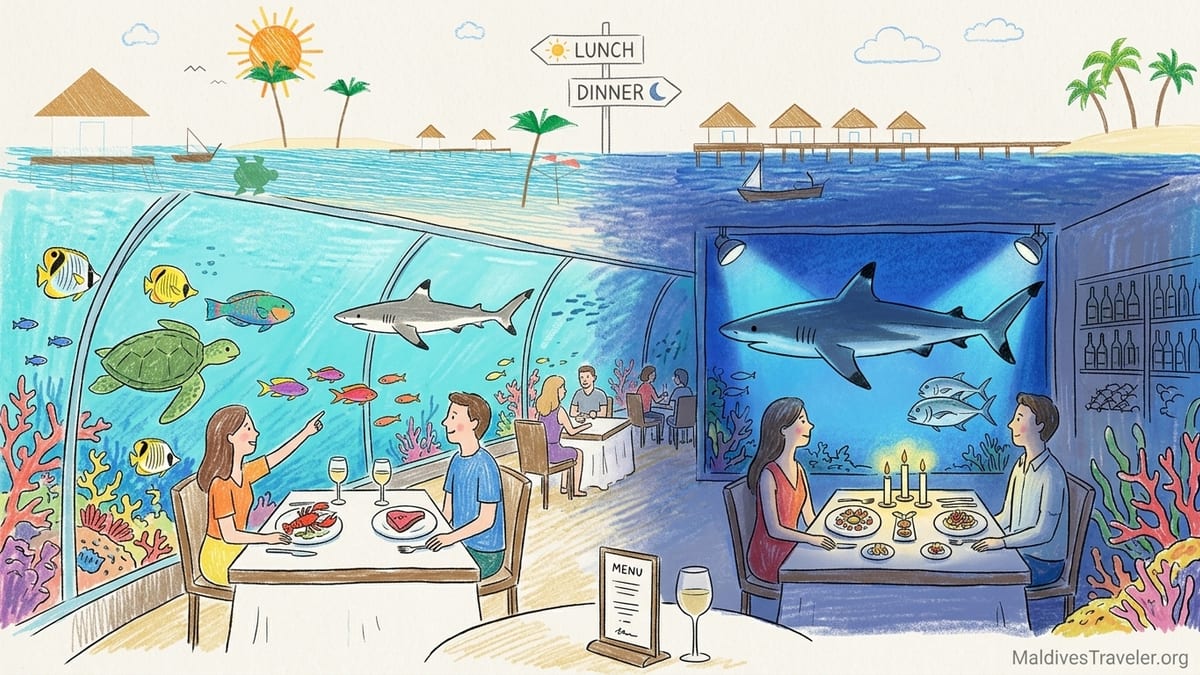
For my first visit I chose lunch, which multiple staff members endorsed as the best time for visibility. In March, when sun is high and afternoon showers sporadic, the midday light was strong enough to illuminate the reef without creating harsh glare. As we sat, staff drew our attention to a cleaning station just off the glass, where parrotfish and smaller reef species hovered, and to the open water side where jacks and the occasional reef shark patrolled.
The menu at lunch is structured around a degustation format with several choices in each course rather than unlimited à la carte dining. In 2026, the standard four-course lunch menu was priced around 250 to 300 US dollars per person before tax and service, with optional wine pairings raising the total significantly. The kitchen positions SEA as a fine-dining caviar-led restaurant and the opening course reflected that: a delicate pairing of farmed sturgeon caviar with a warm potato espuma and a briny, almost buttery brioche. Subsequent courses offered a choice between line-caught Maldivian fish, a lobster preparation and a single meat option. I opted for a seared yellowfin tuna with citrus segments and a fennel salad followed by a butter-poached lobster tail over barley risotto.
Portions were thoughtfully sized for the climate: enough to feel indulgent without leaving us overfull, which would have dulled the experience. The sommelier, clearly proud of SEA’s much-publicized wine cellar and its international awards, proposed a by-the-glass pairing rather than a formal tasting flight, which kept the lunch bill from spiralling into four figures. With mineral-forward white Burgundy and a later glass of dry German Riesling, our two-person lunch including water and coffee came to just over 800 US dollars after taxes and service. For many travelers that is a serious fraction of a Maldives day’s budget and turning down extras such as premium champagne or rare vintages helps keep it from rising further.
In terms of marine life, lunch justified its reputation. During our ninety-minute seating we saw at least three blacktip reef sharks cruise slowly past the windows, several larger jackfish and a constant turnover of butterflyfish, surgeonfish and brightly colored anthias swarming over the coral heads. A single hawksbill turtle glided through halfway through the main course, grazing on the reef for several minutes in full view of half the restaurant. Visibility that day was at least ten to fifteen metres, with water clarity affected only briefly by a passing rain cloud. Even when we focused on the plates in front of us, the gentle motion of fish in our peripheral vision kept reminding us of where we were.
Dinner At SEA: Atmosphere, Adults-Only Rules And Visibility
For comparison, I returned three nights later for dinner, booking the restaurant’s seven-course signature tasting menu. The evening setting is more obviously romantic: candles on the tables, slightly dimmer interior light and attention drawn to the illuminated reef outside. According to the resort’s current guidelines, dinner at SEA is reserved for guests aged 12 and above, effectively adults-only, except for designated family nights on certain days of the week. During my visit those exceptions fell on Monday and Thursday. I booked a Saturday evening to experience the adults-only atmosphere and, indeed, every table around us was occupied by couples or small groups of adults.
The tasting menu price at dinner was notably higher than lunch. In 2026, the starting point hovered in the low to mid 400 US dollar range per person before drinks, tax and service, with optional caviar upgrades and wine pairings easily adding several hundred dollars more. The menu skewed more indulgent, including a dedicated caviar course, a rich foie gras dish, a refined Maldivian reef fish preparation and a slow-cooked Wagyu beef course. Desserts leaned toward restrained portions of chocolate and tropical fruit rather than towering constructions, perhaps wisely given the heat.
Service at dinner felt more theatrical, with formal dish presentations and frequent references to the provenance of ingredients and the cellar’s history. Our sommelier was keen to emphasize that SEA’s wine list has been recognized repeatedly by specialist bodies and offered to show us the adjacent cellar space after dessert. For wine-focused travelers, that pedigree is a genuine selling point and the list did include a depth of older vintages and classic regions that you will not find at most Maldivian resort restaurants.
Visibility outside the glass, however, was inevitably different from lunch. Floodlights installed around the structure attract plankton and small fish, which in turn draw in predators. During our dinner we saw a higher number of hunting jackfish and at least two reef sharks pass closer to the windows than at lunchtime. The trade-off was that the broader reef structure faded into darkness and anything more than a few metres from the glass disappeared into black. The atmosphere was moody and dramatic rather than panoramic. If your main priority is seeing the coral and a full cross-section of marine life, lunch delivers more; if you are drawn to the idea of nocturnal predators circling an underwater dining room, dinner has its own intensity.
Dress Code, Seating Experience And Practical Details
SEA presents itself as fine dining, but the dress code reflects the realities of a barefoot resort. For both lunch and dinner, the guidance shared at check-in was “elegant resort wear,” which translated in practice to linen trousers or tailored shorts and a shirt for men, and light dresses or coordinated separates for women. Closed shoes were not required. Many guests, myself included, arrived in flat sandals and slipped them off once seated. I did not see anyone turned away for attire, but guests who arrived in beachwear or wet clothing would likely have felt out of place.
Inside the restaurant, all seating is at standard-height tables with cushioned chairs. There are no bar stools or awkward perches, which matters over the course of a two to three-hour meal. Tables are spaced closely enough that you can sense the presence of other diners, but not so close that private conversations feel exposed. Sound design is subtle; most of what you hear is low conversation, the occasional soft chime from the kitchen and, at lunch, a faint background soundtrack that never competes with the visual show outside.
Booking expectations are important to set. Based on my experience and conversations with staff, lunch and dinner at SEA often fill weeks in advance during popular travel months and during school holidays. Breakfast, available on request, tends to see lighter demand and can sometimes be arranged a few days ahead, but that flexibility should not be assumed. Guests on half-board or full-board meal plans should also know that SEA typically is not fully covered by dining credits. In my case, a half-board package that included daily breakfast and dinner at other outlets did not apply any credit toward SEA, so every dirham spent there was in addition to the room and board rate.
The restaurant is comfortably air-conditioned. After coming in from Baa Atoll’s humidity, you do feel a distinct temperature drop, so a light shawl or linen layer is welcome, particularly for slender guests who chill easily. The descent and ascent involve a staircase rather than an elevator, which may be a consideration for those with limited mobility; staff are attentive but the structure itself has physical constraints that cannot be ignored.
Food Versus Setting: Would The Menu Stand Alone?
Assessing whether SEA is “worth it” requires separating the quality of the cooking from the value added by the underwater setting. Judged purely as cuisine, both my lunch and dinner would hold their own against high-end resort restaurants in other parts of the world. Sauces were precise, seafood properly handled and plating refined without pointless flourishes. The caviar courses in particular felt like the work of a kitchen comfortable with its chosen niche, highlighting texture and temperature as much as salt and richness.
At the same time, the price point is undeniably elevated by the location. If you transposed the exact same menu to a chic rooftop in Dubai or a city-center hotel in London, charging 250 to 450 US dollars per person before drinks would be challenging without multiple Michelin stars to back it up. Much of what you are paying for at SEA is access: to the house reef from a dry vantage point, to one of the region’s more serious wine cellars and to the bragging rights of having eaten in an underwater dining room in the Maldives.
I found that the first thirty minutes at both lunch and dinner were dominated by the novelty of the setting. We, like most guests, took photographs, whispered every time a shark passed and interrupted the sommelier’s explanations to point out a turtle. After that, attention shifted more naturally toward the plates and conversation, and SEA began to feel less like a spectacle and more like a very good restaurant with an exceptional view. Interestingly, by the dessert course the underwater setting had receded just enough that we stopped watching the glass continuously, checking it instead in quiet moments while sipping coffee.
Would I seek out the same menu without the underwater element if prices were identical? Probably not. For me, the justification came from the combined package: fine dining plus reef theatre through the window and access to a world-class wine list that I would be unlikely to explore in many other places. The food alone was not revolutionary enough to merit the tariff in a vacuum, but in its exact location, it felt proportionate to the overall experience.
Lunch Or Dinner: Which Service Is Better Value?
Having tried both lunch and dinner within the same week, I would recommend most travelers prioritize lunch unless there is a compelling reason to dine at night. The midday light in Baa Atoll filtered through crystal-clear water revealed far more of the reef structure, coral colors and background fish life than the spotlit nocturnal scene at dinner. For first-timers or for those who may only dine at SEA once, the ability to see the environment in full daylight makes the underwater concept much more tangible.
From a financial perspective, lunch is typically the more accessible entry point. With menu pricing landed in the mid 200s to low 300s in US dollars per person before drinks, it still sits firmly in special occasion territory but undercuts the starting price of the more extensive dinner tasting menu. For guests already investing heavily in seaplane transfers, villa rates and other activities, that difference can represent the cost of an additional guided house-reef snorkel or a shared sunset cruise elsewhere in Baa Atoll.
Where dinner pulls ahead is in ambience. The adults-only policy creates a quieter, more intimate environment and the artificial lighting does draw predatory fish in fascinating ways, especially when they streak in from the darkness to snap at schooling baitfish near the glass. If your idea of underwater drama is all about sharks coming close and you value hushed conversation over mid-day brightness, then paying the premium for dinner can make sense. Couples celebrating honeymoons, proposals or milestone anniversaries might find dinner’s atmosphere more aligned with their expectations.
For travelers who are primarily motivated by photography, lunch offers sharper, more vibrant images with color-accurate fish and coral. Dinner shots rely on the restaurant’s lighting and tend to capture silhouettes and reflections rather than gradient blues. After reviewing my own photos, almost all of the keepers came from lunch, while dinner memories are more experiential than visual.
SEA Versus Other Baa Atoll Experiences: Where To Spend Your Budget
Every traveler to the Maldives faces trade-offs. In Baa Atoll a comparable spend to a SEA dinner for two could fund, for example, a private two-tank scuba dive to sites outside the house reef, a manta ray excursion to Hanifaru Bay in season, or a customized half-day private boat trip with snorkelling and sandbank stop. These alternatives give you direct contact with the biosphere reserve’s marine life, sometimes on a grander scale than anything visible from the restaurant windows.
Comparing my SEA visits with a manta-focused trip earlier in the week made those trade-offs concrete. On a clear day at Hanifaru Bay we watched more than twenty mantas barrel-rolling just below the surface during peak feeding, at a cost comparable to a single degustation dinner for one at SEA. The intimacy of SEA’s glass-walled room felt entirely different, but the raw volume of animals was higher and the emotional impact arguably stronger during the snorkelling excursion.
That said, not all guests dive or feel comfortable in open water. For non-swimmers, older travelers or those visiting outside peak manta season, SEA can serve as a controlled, comfortable way to experience Baa Atoll’s reef life without the physical demands of long fin kicks or dealing with currents. It is also fully weatherproof. On days when wind and rain make boat outings less appealing, SEA remains unaffected and can salvage a special-occasion evening that might otherwise be spent indoors.
In practical terms, I would position SEA as one pillar of a broader Baa Atoll itinerary rather than its only centerpiece. If your budget allows for one major splurge beyond accommodation, I would still lean toward an in-water experience such as a privately guided house reef dive, a manta safari in season or a bespoke boat charter, especially if you are already comfortably familiar with fine dining. If there is room for two indulgences, pairing SEA lunch with a day on the water strikes a satisfying balance between spectacle and immersion.
The Takeaway
SEA underwater restaurant at Anantara Kihavah delivers precisely what it promises: a high-end meal served inside a transparent capsule on the resort’s house reef, framed by sharks, turtles and shoals of tropical fish. It is not subtle in its luxury, with prices that tilt firmly toward the aspirational end of even Maldivian resort dining, and much of its value proposition rests on the uniqueness of the setting and the strength of its wine program rather than boundary-pushing cuisine alone.
From my firsthand experience, lunch provided the best overall balance of visibility, marine variety and cost, while dinner excelled in intimacy and a certain nocturnal drama at a steeper premium. The food was consistently polished and well executed, with stand-out caviar and seafood courses, but it was the turtle gliding past the window during lunch and the sudden flash of a shark at dinner that lodged most firmly in memory days later.
Asked whether I would spend the money again, my answer would be qualified. I would happily return for lunch on a future visit to Baa Atoll, particularly with first-time Maldives travelers in tow, as a way to introduce them to the reef environment without masks or fins. If my budget forced a choice between SEA dinner and a private diving or snorkelling excursion, however, I would choose the water every time. For me, the Maldives is ultimately about being in the ocean rather than next to it, no matter how thick the glass.
SEA is worth doing once if your finances allow and if you approach it with clear expectations: you are paying a premium for a front-row seat on Baa Atoll’s underwater world, accompanied by skillful cooking and serious wines. If that combination resonates more than another hour in a wetsuit or on a boat, then descending those last few steps into the blue will feel like money very well spent.
FAQ
Q1. How far in advance should I book SEA underwater restaurant at Anantara Kihavah?
In peak and shoulder seasons it is prudent to request your preferred date and service time at the moment you confirm your villa booking, ideally six to eight weeks ahead. Same-week availability does occur, especially for breakfast or shoulder dates, but lunch and dinner often sell out well before arrival for popular months and festive periods.
Q2. What are the current opening times and meal periods at SEA?
At the time of my visit, SEA offered breakfast on request from around 8:30 am to 10:30 am, a regular lunch service from roughly noon to 2:00 pm and dinner in the evening, typically starting around 7:00 pm. Because resort schedules can change with seasons and special events, guests should reconfirm exact seating times with the hotel just before travel.
Q3. Is dinner at SEA really adults-only?
Current resort policy positions dinner at SEA as an adults-focused experience, with a minimum age requirement and only specific evenings, such as designated family nights, allowing younger guests. During my Saturday dinner seating, all diners were adults and the atmosphere was quiet and refined, which matched the restaurant’s fine-dining positioning.
Q4. How much does a meal at SEA cost, and what is included?
In early 2026, a four-course lunch tasting menu started in the region of 250 to 300 US dollars per person before drinks, tax and service, while the extended dinner tasting menu began in the low to mid 400s. These prices generally cover the food only. Wine pairings, premium caviar upgrades and rare bottles from the underwater wine cellar add substantially to the final bill.
Q5. Is there a dress code for SEA, and do I need shoes?
The restaurant describes its dress code as elegant resort wear. In practice that means smart casual clothing such as linen trousers, tailored shorts, shirts, dresses or coordinated separates. Guests are not required to wear closed shoes and many arrive in sandals or barefoot, although beachwear and wet swimwear would feel out of place in the fine-dining environment.
Q6. Which marine animals are you most likely to see during a meal?
From the dining room I personally saw blacktip reef sharks, a hawksbill turtle, several species of reef fish including parrotfish, butterflyfish and surgeonfish, and larger jackfish. Sightings vary with time of day and conditions, but the restaurant’s position on the house reef makes encounters with reef sharks and dense schools of smaller fish relatively common.
Q7. Is lunch or dinner better for underwater visibility?
Lunch typically offers clearer, wider views of the reef, coral structures and background fish life thanks to strong natural daylight. Dinner relies on artificial lights that create a dramatic, spotlighted effect and often bring predatory fish closer to the glass, but the broader reef fades into darkness, so you lose some of the panoramic feel.
Q8. How long does the novelty of dining underwater really last?
In my experience, the first thirty minutes are dominated by the novelty of the surroundings as guests take photos and react to every passing fish. After that, focus gradually shifts to the food and conversation, with the windows becoming an ever-present backdrop rather than the sole attraction. The sense of wonder does not disappear, but it settles into the rhythm of a long, relaxed meal.
Q9. Does SEA accept credits from half-board or full-board meal plans?
During my stay, half-board dining benefits at Anantara Kihavah did not apply to SEA, which was charged fully as an extra. Some packages may occasionally include a specific SEA lunch or offer set inclusions, but in general guests should budget for SEA separately and not assume that standard meal plans will offset its cost.
Q10. If I can afford only one big splurge, should I choose SEA or a diving or snorkelling excursion?
If you are comfortable in the water and visiting Baa Atoll during a good marine season, a private diving or snorkelling trip, such as a manta excursion to Hanifaru Bay, usually delivers a more immersive connection with the environment for a similar or slightly lower cost than a full dinner at SEA. If you do not swim, prefer controlled surroundings or value wine and fine dining as much as wildlife, SEA becomes a more compelling choice. Ideally, a balanced itinerary would include both an in-water experience and one visit to SEA.