


From the air, Dharavandhoo looks like many other Maldivian islands: a neat oval of palms set in pale turquoise, a reef tracing the shoreline like a ring. It is only when the plane banks for landing that you notice how unusual it is. The airstrip almost fills one side of the island, ending just a few coconut trees away from village streets and small guesthouses. I spent several days based here, using Dharavandhoo both as a springboard to explore Baa Atoll and as a place to slow down and live, briefly, on a Maldivian local island. This is what it was really like.
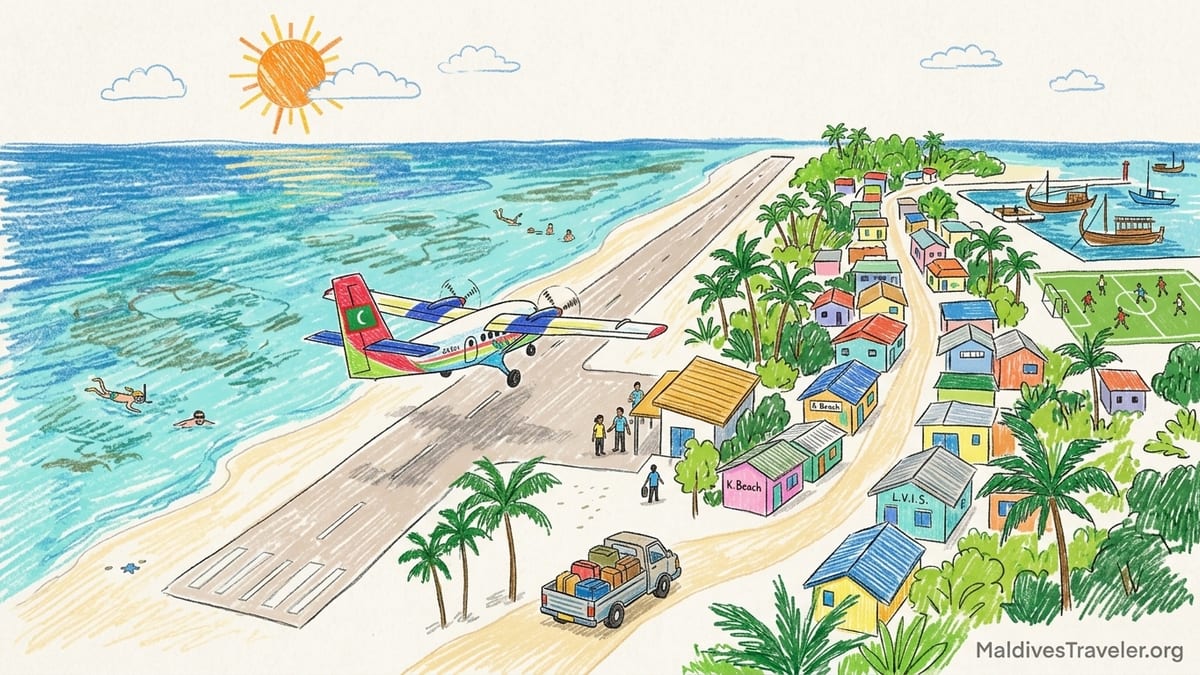
Arriving On An Island With Its Own Runway
My journey to Dharavandhoo started at Velana International Airport in Malé, the standard gateway to the Maldives. Instead of walking towards seaplanes or speedboat jetties, I checked in for the short domestic hop to Dharavandhoo Airport, the small regional hub that serves Baa Atoll. Flights on local carriers usually take around 35 to 40 minutes and run several times a day in high season, shared by resort staff, local residents and independent travelers heading to guesthouses. Landing is more dramatic than the timetable suggests. The aircraft seems to skim the reef before the wheels touch down on a strip that appears to run almost the length of the island.
From the terminal, Dharavandhoo’s scale becomes clear. The airport building is compact, with a handful of check-in desks and a simple arrivals hall. There is no long transfer or speedboat ride. Guesthouse staff wait just outside the door, and my bags were loaded into a small pickup for the two-minute drive through sandy streets to my accommodation. You could just as easily walk. Most guesthouses sit within 300 to 600 meters of the runway, along the grid of streets that makes up the village and tourism area.
Aircraft noise is the obvious question. Dharavandhoo is one of the busier domestic airports in the country, with several daily flights in peak months and additional charter services when nearby resorts are full. Planes are clearly audible across the island, especially in the strip-facing guesthouses. During my stay, flights were spread through the day, roughly from early morning to evening. Takeoff and landing were loud for a minute or two, but the sound faded almost as quickly as it arrived. At night, I heard no flights at all. If you are used to resort-level quiet, you will notice the interruption, yet it did not dominate daily life and it never drowned out the sea or the call to prayer.
What struck me most on arrival, more than the runway itself, was how the airport and village sit side by side. On one corner of the apron, workers loaded supplies and luggage. A hundred meters away, schoolchildren walked home with satchels, stopping at a corner shop for ice cream. It was a very Maldivian scene, just with turboprops in the background.
How Small Is Dharavandhoo, Really?
On the map, Dharavandhoo is a modest splash of land within the wide circle of Baa Atoll. Walking it makes the numbers tangible. Starting from my guesthouse near the harbor, I followed the coastal path around the island. Moving at a relaxed pace, pausing to watch crabs and greet people in doorways, a full circuit took just under 40 minutes. If you walked briskly, you could probably do it in half an hour. The interior is a simple grid of sandy lanes that you can cross in two or three minutes, lined with painted boundary walls and hibiscus hedges.
Despite its small size, Dharavandhoo does not feel like a one-street outpost. Roughly a thousand or so people live here, and the streets show it. There is a harbor with fishing dhonis and excursion boats, a football ground where teenagers play until dusk, a mosque at the center of the village and several corner shops and cafés that cater to both locals and guests. The airport occupies one side of the island, but it does not consume everything. On the opposite coastline, dense vegetation gives way to narrow sand beaches and an easy entry into the lagoon.
What you do not have is the manicured spatial choreography of a private resort. There is no boardwalk tracing the shoreline, no golf carts sweeping between reception and villas. Instead, the paths are the same for everyone. Families pass the same banyan tree as visiting divers heading to the jetty. That shared use of space is what makes Dharavandhoo feel like a living place, not a stage set created for tourism.
For travelers, the compactness has practical benefits. You never need transport on the island. Most days I walked barefoot from my room to the designated tourist beach in five minutes, then back through residential streets to pick up snacks from a shop or meet a guide. Getting oriented is rapid; by the second evening, I was recognizing the same neighbours sitting on joali daybeds outside their houses and the same group of boys biking towards the harbor at sunset.
Guesthouses, Rooms And What Your Money Buys
Dharavandhoo has developed one of the most substantial guesthouse sectors in Baa Atoll. According to recent tourism registers and local council figures, there are around 14 to 20 licensed guesthouses on the island, ranging from simple family-run inns with a handful of rooms to larger boutique properties with small pools and in-house restaurants. Names such as Kiha Beach, L.V.I.S. Blancura, Biosphere Inn and Island Ufaa crop up frequently in booking engines and local directories, alongside newer options and private villas managed on a nightly basis.
Room rates vary through the year, but Dharavandhoo sits firmly in the local-island price bracket rather than resort territory. In the months around the peak manta season, double rooms in midrange guesthouses often appear around the equivalent of 80 to 150 US dollars per night, frequently including breakfast and taxes, with cheaper deals outside the main season. That contrasts sharply with nearby private islands, where nightly rates easily climb into several hundred dollars, even for entry-level rooms, before adding the cost of seaplane transfers. For budget-conscious travelers or anyone planning a longer stay to maximize wildlife encounters, that difference is decisive.
Quality, though, is not only about price. Over several days, I stayed in one midrange property and visited others for meals and tours. Rooms were generally compact but comfortable, with air conditioning, hot showers, decent mattresses and reliable Wi-Fi. Décor leaned towards tiled floors and pale walls rather than high-design minimalism, but everything was functional and clean. Several guesthouses had shaded courtyards or roof terraces where guests could read or dry snorkel gear. At the upper end of Dharavandhoo’s offerings, you find small swimming pools, more landscaped gardens and a wider choice of room categories, including family rooms and interconnecting units.
Service had a personal, improvisational feel. This is not resort training, with invisible butlers and scripted greetings. Instead, you meet the owners, cousins and friends who help with breakfast, arrange excursions, or drive you the short hop from the airport. On one evening, my host checked tide times by leaning over the harbor seawall with a torch, then messaged a friend at the dive center to confirm conditions before we confirmed the next morning’s snorkeling trip. It felt collaborative and human, if occasionally a little slower than resort efficiency.
Eating Out, Corner Shops And Daily Practicalities
Because Dharavandhoo is both a village and a tourism hub, its food options straddle local cafés and guesthouse restaurants. Several of the larger properties run their own kitchens, serving buffet breakfasts with fresh fruit, eggs, toast and Maldivian dishes such as mas huni, a mix of tuna, coconut and chili eaten with flatbread. For lunch and dinner, most guesthouses offer a small menu or set meals featuring grilled fish, fried rice, noodles and simple curries. Prices for a main course typically fall somewhere in the range of what you might pay in a mid-priced café in Malé, significantly below resort restaurant levels.
Beyond the guesthouses, Dharavandhoo has a handful of local cafés and tea shops where you can order hedhikaa snacks, short eats such as fish buns or samosa-style pastries, alongside sweet tea or coffee. Men gather here after prayers or work, but tourists are quietly welcomed. Menus are rarely elaborate, yet they are a good way to sample everyday Maldivian food and support village businesses. Dress remains modest away from the beach, but the atmosphere is relaxed.
Practicalities are straightforward. Several small supermarkets and corner shops are scattered across the island, selling bottled water, soft drinks, biscuits, fruit, sunscreen and basic toiletries. I found it easy to restock on reef-safe sunscreen and buy snacks for boat days. Most places accepted cash in Maldivian rufiyaa, and some guesthouses and dive centers were happy to process card payments for larger bills. There is usually at least one small pharmacy or clinic on islands of Dharavandhoo’s size, and Baa Atoll’s hospital is on another island within reach by boat if needed.
The one thing you will not find on Dharavandhoo itself is alcohol. National law and tourism guidelines are clear: inhabited local islands in the Maldives do not serve alcoholic drinks. Beer lists and cocktail menus only appear once you step onto a resort or liveaboard. Some guesthouses can arrange day trips or dinner visits to nearby resort islands or safari boats for guests who want a drink, but back on Dharavandhoo the evenings are about coffee, juice, or bottled soft drinks, not sundowners.
Beaches, Bikini Zones And A Surprisingly Good House Reef
Dharavandhoo’s shoreline is more practical than polished. Parts of the coast, especially near the harbor and airport side, are reinforced with seawalls or rock revetments. Boat traffic comes and goes. This is a working island, not a picture-perfect sandbank manicured for brochures. Yet on the ocean-facing side, the village gives way to narrow strips of natural beach and to a designated tourist swimming area, often signed or known locally as the bikini beach, where visitors can wear standard swimwear.
The tourist beach is generally a short walk from most guesthouses, reached by following sandy tracks through palms and sea lettuce bushes. Here the lagoon opens out, with a gentle sandy entry and scattered coral bommies under clear water. Shade from overhanging trees makes it easy to spend a few hours even in the heat of the day. Because Dharavandhoo is not a mass-market party island, the beach never felt crowded during my stay. At most there were a dozen or so people swimming or sunbathing at the same time.
Just beyond the pale sand, the house reef drops away in a sloping wall of coral and rubble, patched with live growth and surrounded by schools of reef fish. Snorkelers entering from the beach can reach the outer reef with a short swim, keeping an eye on currents. Local dive centers and guides speak highly of sites such as Dharavandhoo Thila and a nearby manta cleaning station, and while those require a boat, the everyday snorkeling right off the island is better than many travelers expect of a local island with an airport. During my time in the water I saw parrotfish crunching coral, clouds of blue fusiliers, several turtles and, on one lucky morning, an eagle ray gliding along the drop-off.
It is worth stressing that Dharavandhoo’s appeal is not limited to its proximity to Hanifaru Bay, even though that famous manta aggregation site lies a short boat ride away. Many travelers come primarily for mantas and whale sharks, but if bad weather or plankton patterns limit those excursions, the island’s own reef and the quieter snorkeling sites around the atoll help salvage a trip. I met one couple who never managed to enter Hanifaru during their week due to permit restrictions and sea conditions, yet they still left satisfied after spending multiple days exploring the local reef and nearby thilas by boat, at a fraction of resort excursion prices.
Living With Local Rhythms Instead Of Resort Isolation
The biggest difference between Dharavandhoo and a private island is not the lack of multiple restaurants or infinity pools. It is the way daily life unfolds around you. On an inhabited island, tourism slots into an existing community. You wake to the first call to prayer from the mosque, often around dawn, a melodic reminder that you are in a Muslim country where faith shapes the day. Later in the morning, children walk to school in uniforms, parents chat outside houses, and government workers board boats for inter-island commutes.
Motorbikes rumble along sandy streets, though traffic is limited by the island’s size. At sunset, the football ground fills with teenagers and young adults, while older residents sit on low wooden joali benches in front of houses to talk and watch the evening. As a visitor, you are both part of and apart from this pattern. Walking to the shop for bottled water or sitting on a bench near the harbor, you see how tourism has become one layer in island life rather than the only story.
This integration brings responsibilities. Dress is modest within the village, shoulders and knees covered for both men and women, with bikinis and bare chests kept for the tourist beach or boats. Alcohol is absent, and public displays of affection are kept low-key. During Friday prayers and throughout Ramadan, businesses may adjust opening hours. In exchange, you gain a window into Maldivian culture that resorts, for all their luxury, rarely provide. I learned more about local politics, schooling and fishing incomes over one afternoon tea with a guesthouse owner than in multiple resort stays combined.
There are also simple, human moments that stay with you. The shopkeeper who slipped an extra packet of biscuits into my bag when she heard I was heading out on a long boat trip. The group of schoolchildren who asked to practice English and wanted to know which football club I supported. The imam greeting guests near the harbor and asking if we were finding the island comfortable. These encounters are hard to choreograph on a resort, where interactions are shaped by service roles and price tags.
How Dharavandhoo Compares To Private Island Resorts
Inevitably, anyone choosing Dharavandhoo weighs it against resort stays, especially in an atoll dotted with well-known private islands. Some contrasts are immediate. On a resort, beaches are groomed daily, sun loungers line curving bays, and overwater villas stretch into the lagoon. Staff sweep away seagrass and rake sand before breakfast. On Dharavandhoo, beach maintenance is more modest. You might find bits of seagrass or natural debris along the high tide line, and coastal reinforcement is visible. If your idea of the Maldives is a perfectly manicured half-moon of sand with no structures in sight, a local island will feel less polished.
Food variety is another distinction. A mid-range resort might offer several restaurants, from grill houses to themed buffets and fine-dining venues, as well as room service and sophisticated bars. Dharavandhoo offers good, hearty meals, but on a much smaller scale. You will probably end up rotating between your guesthouse restaurant, one or two local cafés and perhaps another guesthouse that opens its kitchen to outside diners. Menus lean on grilled fish, staple carbs and a handful of Western comfort dishes rather than elaborate tasting menus. If culinary exploration is central to your holiday, a resort or a split stay may suit you better.
Privacy is where the contrast is sharpest. On a private island, swimming can feel almost theatrical: you step directly from your villa into the lagoon, often without seeing other guests. On Dharavandhoo, you share the designated tourist beach with whoever else is staying, and the shoreline is within earshot of village life. You will likely see fishing boats moving past, children playing nearby and other visitors entering the water. There are still quiet moments, especially early in the morning or towards sunset, but you are never entirely alone. For some, that shared space is part of the charm. For others, especially honeymooners seeking seclusion, it might be a compromise too far.
Against these trade-offs, Dharavandhoo offers strengths that resorts struggle to match. Price is one of them. A week on the island, including accommodation, domestic flights, meals and multiple snorkeling or diving excursions, often totals less than the room-only bill for several nights at a nearby high-end resort, particularly in peak season. Flexibility is another. You can eat at different places, change your plans if the weather shifts, book last-minute boat trips with local operators or simply walk around to see what the day brings. And then there is access. Being based next to Baa’s domestic airport and in the heart of the atoll makes it easier to move between different dive sites, sandbanks and uninhabited islands without relying on a single resort’s excursion schedule.
What I Loved About Staying On An Inhabited Island
Personally, Dharavandhoo reminded me why local island travel in the Maldives has grown so quickly over the past decade. The island gave me a sense of place that even the loveliest overwater villa rarely does. I liked waking up, stepping outside and seeing ordinary Maldivian life unfold. I liked that my money went, at least in part, straight into the community through guesthouse owners, café staff and boat captains. There was a feeling of mutual curiosity. Locals asked where I was from and what winter was like there. I asked about fishing seasons, school exams and wedding traditions.
From a practical standpoint, I appreciated the freedom. If the sea was choppy, I could cancel a boat trip without passing through multiple resort departments. If I wanted to explore, I just walked. On one afternoon, I followed a side lane I had not taken before and ended up at a small beach where a group of children were learning to swim, supervised by a teacher from the school. I watched from a respectful distance, then continued along the coast until the path merged back with the main beach. It was not an “activity” sold to me; it was simply something I encountered because I was living amid a community.
Snorkeling directly from a local island also appealed to me. While some resorts do have better house reefs, the ability to access a reasonably lively reef without paying resort rates felt like a luxury of its own. I could wander down to the beach in the late afternoon, swim out along the reef edge, and be back in time to rinse off and head to dinner, all without booking a boat. Sunsets, too, had a different flavor. Instead of sipping cocktails at a designer bar, I often ended up on the harbor wall with a bottle of soda, watching the sky glow behind the silhouettes of moored dhonis.
There was also a mental ease that came from being in a more informal environment. Dress codes felt less performative. Even though modesty was important in the village, there was no sense of needing the “right” resort outfit for dinner. Sand on my feet and slightly salty hair were normal, not out of place. That simplicity suited the kind of trip I wanted Dharavandhoo to be: focused on the sea and the people who live beside it, rather than on structured luxury.
What I Missed From Classic Resort Travel
This is not to say I did not miss some resort comforts. I enjoy a good cocktail, and there were evenings when a cold beer or a simple gin and tonic would have been welcome after a long day in the water. Knowing that alcohol is not available on Dharavandhoo or any other inhabited island, I planned around it, but the difference is still noticeable if you are used to resort sundowners as part of the Maldives experience. Scheduled day trips to nearby resorts that offer bar access partly bridge the gap, yet they are occasional treats rather than daily habits.
I also missed the seamlessness of resort logistics at times. On private islands, towels appear at exactly the right time, chargers are available at the bar, and boats depart with the efficiency of a military exercise. On Dharavandhoo, systems work, but they are more relaxed and dependent on individual people. One morning, our snorkeling trip left half an hour late because the fuel delivery was delayed and the guide waited for a couple of guests who had overslept. It was not a problem for me, but anyone who prizes strict schedules might find it frustrating.
Beach aesthetics were another trade-off. Some sections of Dharavandhoo’s coast are beautiful, especially when the light hits the lagoon at an angle and the sand glows almost white. Others are functional edges where erosion control and harbor structures take precedence over postcard views. On a resort, landscaping teams shape the shoreline to maximize beauty from every angle. Here, utility has a greater say. If your non-negotiable dream is to wake to a 180-degree view of unbroken sand and sea from your bed, a water villa is still hard to beat.
Finally, there is the question of privacy. I am comfortable sharing spaces, but for honeymooners or anyone hoping to swim without seeing another soul, Dharavandhoo may not deliver the same sense of seclusion a resort can provide. The tourist beach is respectful and low-key, yet you will encounter other guests and occasionally local families walking past the back of the designated area. You adjust quickly, but it is a different feeling from slipping into the lagoon directly from your own deck at dawn.
The Takeaway: Wildlife Base Or Island Holiday In Its Own Right?
When I first booked Dharavandhoo, I saw it mostly as a base. It sits close to some of Baa Atoll’s headline dive and snorkel sites, including the renowned manta aggregation zones, and the presence of the domestic airport makes logistics straightforward. Many travelers still approach it this way, spending three or four nights to maximize their chances of in-water encounters before moving on to a resort or another atoll. After my stay, I understand that logic, but I also think it sells the island short.
Dharavandhoo works exceptionally well as a wildlife hub. Boats can reach a variety of reefs and thilas within 10 to 40 minutes, and the combination of competitive guesthouse prices and multiple dive centers keeps excursion costs down compared with resort-based trips. If your priority is to spend as much time as possible in the water, especially during manta-heavy months, basing yourself here makes sense.
Yet I would not limit Dharavandhoo to that role alone. By the time I left, I felt I had only just started to understand the rhythm of the island. Another couple of days would have allowed more unstructured wandering, more time on the house reef, and deeper conversations with the people who live there year-round. I would happily return and divide a two-week Maldives trip into a week on Dharavandhoo and a shorter spell at a resort, using the first half to connect with local life and the second to indulge in polished beaches and full bar lists.
If you are choosing between them, ask yourself what you want your Maldives story to be. If you dream primarily of total privacy, curated perfection and never thinking about dress codes or ferry times, a private island remains the cleanest answer. If, instead, you are curious about how Maldivians live on the atolls and you are willing to adapt to local rules in exchange for more authentic encounters, Dharavandhoo is worth more than a quick stop around your wildlife excursions. For me, it has shifted from being just a convenient airport island to a place I would gladly treat as a holiday destination in its own right.
FAQ
Q1. Is aircraft noise a major problem when staying on Dharavandhoo?
During my stay, aircraft were clearly audible during takeoff and landing, especially in the daytime, but flights were brief and mostly limited to daylight hours. The noise did not continue through the night, and after the first day it became just another background part of island life rather than a constant disturbance.
Q2. How long does it take to walk around Dharavandhoo?
Walking at a relaxed pace, stopping occasionally to look at the lagoon or chat with residents, a full loop around the island’s coastline took me just under 40 minutes. If you walked without pauses, you could likely complete the circuit in about half an hour.
Q3. What are typical guesthouse prices on Dharavandhoo compared with nearby resorts?
Recent listings show many Dharavandhoo guesthouses offering double rooms in roughly the 80 to 150 US dollar per night range in popular months, often including breakfast and taxes. In contrast, nearby private island resorts in Baa Atoll frequently charge several hundred dollars per night for entry-level rooms, before adding transfer and meal costs.
Q4. Are there good restaurants on Dharavandhoo, or will I eat in my guesthouse every night?
Most visitors rely mainly on their guesthouse restaurant, which typically serves a mix of Maldivian dishes, grilled fish and simple international options. There are also a few local cafés and tea shops in the village where you can try everyday snacks and basic meals, so you can rotate between several places even on a short stay.
Q5. What are the rules about swimwear and alcohol on Dharavandhoo?
As an inhabited local island, Dharavandhoo follows national rules that prohibit the sale and public consumption of alcohol. Standard swimwear such as bikinis and shorts is allowed only in the clearly designated tourist beach area and on boats. In the village streets and non-tourist beaches, visitors should dress modestly, with shoulders and knees covered.
Q6. How good is the house reef for snorkeling directly from the island?
The house reef off Dharavandhoo’s tourist beach offers rewarding snorkeling for a local island, with a gentle sandy entry and a sloping reef edge accessible after a short swim. I regularly saw reef fish, turtles and, on one occasion, an eagle ray. Nearby boat-access sites add further variety for keen snorkelers and divers.
Q7. Is Dharavandhoo suitable for a honeymoon, or is it better for budget divers only?
Dharavandhoo can work for honeymooners who value authentic local experiences, lower prices and easy access to marine life over complete seclusion and luxury. However, privacy is more limited than on a resort, and there are no bars or fine-dining venues, so couples seeking a classic indulgent honeymoon may prefer to combine a few days on Dharavandhoo with a stay at a private island.
Q8. What everyday facilities are available on the island?
The island has several small supermarkets and corner shops, a few cafés, a school, a mosque and basic medical services, alongside guesthouses and dive centers. You can buy bottled water, snacks, simple toiletries and reef-safe sunscreen on arrival rather than bringing everything from Malé.
Q9. How easy is it to book snorkeling or diving trips from Dharavandhoo?
Multiple dive centers and guesthouses on Dharavandhoo arrange daily boat trips to nearby reefs, manta cleaning stations and sandbanks. You can usually book excursions directly through your accommodation or by walking into a dive shop, with schedules adjusting to weather and sea conditions.
Q10. Would you recommend using Dharavandhoo only as a wildlife base, or also for relaxing on the island itself?
I would happily use Dharavandhoo as both. Its location makes it an excellent base for snorkeling and diving, but the island’s village life, house reef and relaxed rhythms also justify spending extra days simply walking, swimming and getting to know the community beyond structured excursions.