


Hanifaru Bay in Baa Atoll is one of the most extraordinary wildlife experiences in the Maldives. When conditions line up during the southwest monsoon, this small sandy inlet inside the UNESCO Baa Atoll Biosphere Reserve can fill with dozens, sometimes well over one hundred, reef manta rays feeding in tight spirals. It is also one of the most heavily regulated marine protected areas in the country, which means planning a visit in 2026 requires understanding both nature’s rhythms and the park’s rules.
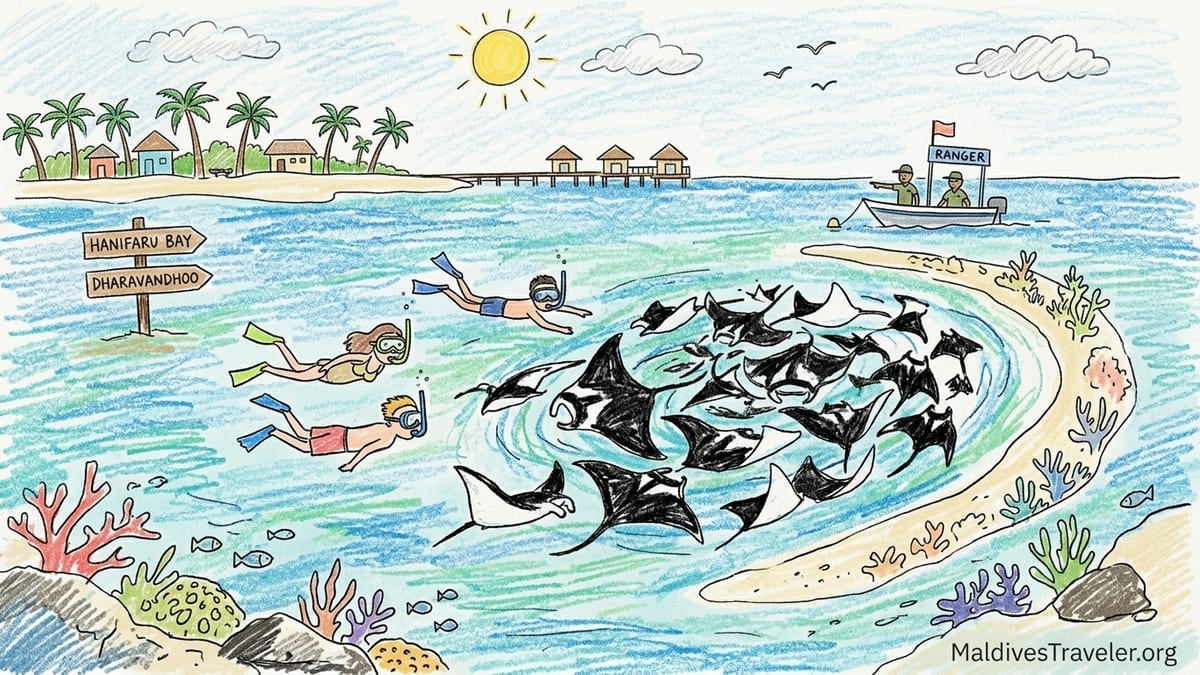
Where and What Is Hanifaru Bay?
Hanifaru Bay sits in the eastern side of Baa Atoll, in the central Maldives, a short boat ride from the local island of Dharavandhoo and several high-end resorts such as Milaidhoo, Anantara Kihavah and Soneva Fushi. On the map it looks unremarkable, a hook-shaped cut in the outer reef with a shallow sandy bottom. In the water, on a good day, it becomes one of the world’s largest known feeding aggregations of reef manta rays, with documented events of more than 200 individuals in the bay at once according to long-term Manta Trust research.
The site is part of the Hanifaru Marine Protected Area within the Baa Atoll UNESCO Biosphere Reserve. It is managed by Maldivian authorities with daily ranger presence during the season. The rules here are stricter than at almost any other snorkelling site in the country. That protection is exactly what allows mantas to continue using this small bay as a predictable feeding station year after year, and why Hanifaru has become the flagship natural attraction for the entire atoll.
From a visitor’s perspective, it helps to think of Hanifaru Bay not as a general snorkelling trip but as a very specific wildlife encounter in a very specific place. You are not booking a “Baa Atoll manta tour” in the abstract. You are booking a timed, regulated snorkel inside a narrow window of the southwest monsoon when mantas are likely to be present in this one reef inlet.
Manta Season at Hanifaru Bay in 2026
Two different calendars matter for planning a trip in 2026: the natural manta season and the official access season. The Maldives Manta Conservation Programme and Manta Trust report that reef mantas use Hanifaru primarily during the southwest monsoon from roughly May to December, with peaks when plankton is thickest. Long-term data from more than a decade of surveys show mass feeding events occurring repeatedly in this monsoon window, with the largest aggregations typically clustering around mid-season when winds, tides and plankton align.
Separately, the Maldives Protected Areas portal currently lists the official 2026 visitor access period for Hanifaru Bay as 1 May to 1 December. This is the window when licensed operators can bring tourists into the bay. Arrive in Baa Atoll in March or early April and you may find good diving in the atoll, but you will not be permitted to enter Hanifaru itself. Travel in late December and you may find occasional mantas using other sites, but the bay is scheduled to be closed to visitors by then.
Within that access period, most operators and researchers describe June to October as the core months for high-intensity manta action. In practice, that means if your absolute priority is to maximise your chances of encountering large groups, a trip between late June and early October will usually offer the best probability, with July, August and September commonly marketed by Baa resorts as “peak Hanifaru season.” May and November can still produce very good encounters, especially around strong tides, but sightings are more variable at the edges of the season.
When choosing specific dates, remember that winds and broad monsoon patterns shift from year to year. A late or weak southwest monsoon can push the most productive weeks later into the season. The safest strategy if you are planning far in advance for 2026 is to block several days in Baa Atoll during that June to October core and build manta hopes around that span, rather than counting on a single day in early May or late November.
Why Tides, Plankton and Weather Matter More Than the Calendar
The real magic of Hanifaru Bay lies not in the calendar month but in the fine-scale oceanography that concentrates food for mantas. Scientific work led by Manta Trust and other researchers shows that mass feeding events are tightly linked to tides and zooplankton density. The atoll’s flood tide pushes oceanic, plankton-rich water over the outer reef and into the cul-de-sac of Hanifaru, where the shape of the bay creates swirling eddies. These eddies trap zooplankton in the shallow sandy inlet, sometimes reaching densities high enough to trigger chain-feeding and cyclone-feeding behaviour by mantas.
Recent hydrodynamic modelling published in 2024 indicates that the strongest topographic eddies inside the bay tend to form partway through the flood tide and persist up to a couple of hours after high tide. That timing fits what guides see in practice: the best manta shows often happen just before or after high tide, particularly around spring tides at full and new moons, when tidal ranges are greatest and more plankton is flushed into the bay.
Weather plays a counterintuitive role. Visitors often hope for postcard-clear, glassy seas and cloudless skies. Those conditions are wonderful for general snorkelling visibility but not always ideal for mantas. The plankton soup they love often builds during more unsettled southwest monsoon weather, when wind-driven mixing and cloudy days keep productivity high. Guides on Dharavandhoo and Baa resorts frequently remark that some of the biggest manta aggregations of recent years unfolded on grey, choppy afternoons when many guests expected the trip to be cancelled.
From a planning perspective, this means it is worth staying flexible while in Baa Atoll. Rather than locking in a single date months ahead, speak with your guesthouse or resort’s marine biologist once you arrive. They will watch wind forecasts, tides and reports from ranger boats, then pick the day and time when conditions at Hanifaru look most favourable. A guest who gives their guide a week-long window to choose from has a much better chance of a memorable encounter than someone who insists on going at 10 a.m. on a particular Tuesday because the sky looks sunnier.
Dharavandhoo vs Resort Excursions: How to Base Yourself
Most visitors to Hanifaru Bay either stay on the local island of Dharavandhoo or base themselves at one of the surrounding private-island resorts in Baa Atoll. The atoll’s small domestic airport is also located on Dharavandhoo, which makes it the practical hub for many manta trips.
Choosing between Dharavandhoo and a resort is a genuine booking decision. On Dharavandhoo, you can stay in small guesthouses or boutique villas and join shared speedboat trips into the bay. These excursions are typically organised by local dive centres or dedicated manta operators that hold Hanifaru permits. Prices for a half-day snorkelling trip that includes the Hanifaru conservation fee often fall in the region of 80 to 150 US dollars per person, depending on whether you are in a group or chartering a private boat, and whether additional reef stops are included alongside the bay itself.
Resort-based trips work slightly differently. High-end properties such as Milaidhoo, Soneva Fushi, Anantara Kihavah, Amilla Maldives and others offer their own guided Hanifaru excursions for their guests only, often with an in-house marine biologist on board. In many cases, the conservation fee and a donation to manta research are bundled into a higher per-person excursion price. The boats can be more comfortable and the group sizes sometimes smaller, but you are paying premium resort rates for the convenience and extra service.
A few concrete scenarios help illustrate the choice. A couple staying a week at a mid-range guesthouse on Dharavandhoo in August 2026 might join two or three shared Hanifaru trips across their stay, adjusting dates to follow the best tides. Their total spend on manta excursions might be similar to a single private-boat charter from a luxury resort. By contrast, a family of four staying on a resort closer to the bay might value the simplicity of walking down the jetty, collecting pre-fitted snorkel gear and joining a small-group speedboat with a naturalist who knows every individual manta by name.
Permits, Conservation Fees and How Visits Are Managed
Hanifaru Bay is not a place you can visit independently. You must join a licensed operator that has received permission to enter the marine protected area, and they will arrange your permits on your behalf. Visitors do not apply for individual permits in advance; instead, resorts, dive centres and local guesthouses that hold agreements with the Baa Atoll Biosphere Reserve booking system reserve timed slots for their guests.
The Maldives government levies a conservation or management fee for each visitor entering Hanifaru Bay. Official regulations set this as a per-person charge collected by operators and passed to the authorities. Public documents list the fee in Maldivian rufiyaa, and many excursion descriptions for 2025 and 2026 still quote a per-head amount translated into approximately 30 to 50 US dollars once exchange rates and operator handling fees are included. Because exact rufiyaa amounts and collection methods can be updated, travellers should ask their hotel or dive centre what portion of their excursion cost is the conservation fee and whether any part is donated to research partners such as the Maldivian Manta Ray Project.
Daily visitor numbers, boat numbers and time in the water are all restricted. Rangers generally limit the number of snorkellers allowed in the bay at any one time and cap each group’s time in the water, often around 45 minutes. On days when mantas are present continuously, boats may wait their turn at the edge of the protected area, then rotate guests in and out under ranger supervision. Operators receive fines if they break the rules or allow guests to harass wildlife, so reputable guides take the briefing seriously.
As a guest, you will usually pay for your trip at your guesthouse or resort, sign a waiver and be briefed on the rules before boarding the boat. Once at the marine protected area, rangers may check the boat’s permit and log the number of people entering. The fee is then settled between your operator and the management authority. There is no ticket booth or pay-on-arrival system at sea, so do not expect to hand over cash directly to a ranger in the bay.
What Actually Happens on a Hanifaru Bay Trip
On the day, most Hanifaru Bay excursions feel similar whether you start from Dharavandhoo or a private resort. After a safety and behaviour briefing, you will motor 10 to 25 minutes to the bay, often with a marine biologist or experienced guide pointing out seabirds and scanning for manta wingtips breaking the surface. Boats are required to stop at a designated distance from the main feeding zone, and you will slide into the water from the side or stern under your guide’s direction.
If conditions are perfect and mantas are present in numbers, the transition from boat to water can feel overwhelming. The bay is shallow, usually between 5 and 15 metres deep, which means you will often see mantas looping beneath you from the moment your mask hits the surface. In the biggest mass-feeding events, lines of mantas form chains, barrel-rolling and cyclone-feeding in slow spirals through dense clouds of plankton. It is noisy, crowded and intensely exhilarating, with dozens of snorkellers trying to hold their line as these huge animals pass within a few metres.
Visits are time-limited. Guides typically monitor their watches and the ranger’s signals, then call guests back to the boat once their slot is over, even if mantas are still feeding. Many trips combine Hanifaru with a second snorkel on a nearby reef outside the protected zone, where you can relax into a quieter coral or turtle-focused swim that is not as tightly regulated.
What if there are no mantas? This is an important possibility to accept when booking. Even in peak season, feeding events at Hanifaru are tied to tides, winds and plankton. Long-term monitoring suggests that mantas are present and feeding in the bay on a substantial proportion of survey days in season, but certainly not every day. If rangers and guides find the bay empty or only sparsely used, they may shorten time inside and instead focus your trip on other nearby reefs. Operators usually will not offer automatic refunds for “no manta” days, because the boat work, permits and conservation fees still apply. When you book, ask clearly how your chosen operator handles low-sighting days so expectations are aligned.
Rules in the Water: Snorkelling Only, No Scuba or Fishing
One of the most crucial points about Hanifaru Bay is that scuba diving and fishing are completely prohibited inside the marine protected area. Early in Hanifaru’s history, divers were allowed to descend into the bay, but as visitor pressure increased the regulations were tightened. Today, only surface snorkelling is permitted, and rangers can remove operators from the booking system if they are caught allowing scuba gear in the bay.
The logic is simple. Tanks and bubbles change manta behaviour, and divers holding onto the sandy bottom risk blocking feeding lanes or accidentally kicking animals. Rod-and-line fishing or net use would directly undermine the site’s role as a protected feeding ground. As a result, any operator promising “Hanifaru scuba dives” in 2026 should be treated with caution. Legitimate dive centres in Baa Atoll will offer manta dives at cleaning stations and outer reefs elsewhere in the atoll, but they will not take tanks into Hanifaru itself.
Snorkelling rules are equally strict. You must swim, not stand, inside the bay, and touching, chasing or blocking mantas is banned. Guides will typically instruct you to keep at least three metres’ distance from animals and avoid diving down beneath them. The goal is to let mantas control the encounter. They often approach very closely of their own accord, sometimes passing less than an arm’s length away as they loop through plankton clouds, but that must be their choice, not yours.
Photography is allowed, including action cameras such as GoPros, but with etiquette. Flash is typically prohibited, and in crowded conditions you should avoid holding cameras at arm’s length into the path of animals or other snorkellers. Many marine biologists in Baa Atoll use guest photos for identification work, so well-composed but unobtrusive shots can contribute to science. Your guide may even suggest you focus briefly on getting a clear belly shot of one manta that can be matched to the long-term ID database.
Gear, Swimming Ability, Seasickness and Bringing Children
Standard snorkel gear for Hanifaru Bay includes a mask, snorkel and fins. Fins are strongly recommended rather than optional, because you may need to cover short distances quickly to keep up with moving feeding lines, and you must be able to adjust position without using your hands. Most resorts and Dharavandhoo guesthouses include basic gear in the excursion price, but serious snorkellers often prefer to bring their own well-fitted mask to avoid leaks and fogging at critical moments.
Buoyancy aids such as snorkelling vests or pool noodles are widely used, especially for guests who are not confident swimmers. Operators want you relaxed and calm at the surface. You do not need to be an athlete to enjoy Hanifaru, but you should be comfortable floating in open water without touching the bottom, and you should be able to breathe through a snorkel without panic while other people are close by. If you are nervous, tell your guide. They may suggest staying slightly to the side of the main group or assign a dedicated staff member to stay beside you.
Seasickness is often overlooked in the excitement of planning. The short run from Dharavandhoo or nearby islands can still feel rough in monsoon chop, and time spent bobbing in the bay while waiting for your turn can unsettle even sturdy stomachs. If you are prone to motion sickness, consider taking medication such as meclizine or other doctor-recommended remedies before departure, and avoid heavy, oily breakfasts. Real-world feedback from recent seasons suggests that guests who manage seasickness well tend to stay in the water longer and focus more on the animals rather than their own discomfort.
Children can visit Hanifaru Bay, and it is not unusual to see families with school-age kids on board. The key questions are swimming ability, comfort in a crowd and ability to follow instructions. A confident 10-year-old who loves snorkelling on the house reef and listens carefully at briefings can have an excellent experience. A fearful younger child who has never swum in deep water may find the noise, current and crowd overwhelming. Talk honestly with your operator about age limits, life jacket options and whether a private or semi-private trip might suit your family better than a large mixed group.
Managing Expectations: No Guarantees, Whale Sharks as a Bonus
Marketing images of Hanifaru Bay often show dramatic overhead shots of dozens of mantas swirling in clear blue water. Those days do happen, but they are not guaranteed, even in peak months. Long-term monitoring at the site shows that feeding mantas are present on a significant fraction of survey days in season, but with big swings linked to winds, tides and broader climate patterns such as the Indian Ocean Dipole. Some weeks will deliver repeated mass-feed events; others will bring scattered individuals or quiet days when mantas prefer deeper channels or cleaning stations.
This uncertainty is part of what keeps Hanifaru wild. If sighting probability ever reached 100 percent at a fixed time each day, pressure to increase visitor numbers would grow even stronger. Instead, management authorities and conservation groups repeatedly emphasise that mantas are free-ranging wild animals, not performers. When you book, treat mantas as the goal but not the entitlement, and view your conservation fee as support for protecting the site whether or not your particular slot coincides with a feeding event.
Whale sharks are an even more uncertain element. They do visit Hanifaru Bay, usually to feed alongside mantas during especially dense plankton events in the heart of the southwest monsoon. However, current conservation groups and operators are clear that whale sharks appear only occasionally compared with mantas, and there is no separate “whale shark season” at Hanifaru like there is in South Ari Atoll. If your primary dream is to swim with whale sharks, you should plan a separate trip to South Ari rather than relying on Baa Atoll.
If you are fortunate enough to encounter a whale shark at Hanifaru, treat it as a major bonus. The same no-touch, no-chase rules apply, often even more strictly, because whale sharks can be particularly vulnerable to harassment from large groups. In practice, guides will usually have guests spread out along the shark’s path and float quietly as it passes, rather than having everyone fin madly to keep up. The moment is calmer but no less special.
The Takeaway
Hanifaru Bay is the headline natural attraction of Baa Atoll and one of the most carefully managed wildlife experiences in the Maldives. For 2026, the key planning facts are clear. Official visitor access runs from 1 May to 1 December. Reef mantas most often gather from May to December during the southwest monsoon, with exceptional mass-feeding events most likely in the core June to October window when winds, tides and plankton align. Access is by guided snorkel only, with strict rules prohibiting scuba diving and fishing and enforcing limits on boats, people and time in the water.
Your main booking decisions are where to base yourself and how much flexibility to build into your schedule. Dharavandhoo offers relatively affordable guesthouses and frequent shared trips close to the bay, while high-end resorts provide more comfortable boats and on-board marine biologists at higher prices. In all cases, your operator will handle permits and conservation fees and will work within the ranger-managed slot system that keeps pressure on mantas as low as possible.
On the day, expect an intense, time-limited snorkel in shallow, sometimes choppy water, often alongside many other visitors. Bring or rent well-fitting fins and mask, consider seasickness medication and be honest with yourself and your guide about swimming ability, especially for children. GoPro and camera use is welcome if done respectfully, without blocking animals or other snorkellers, and without flash.
Most importantly, remember that wildlife can never be guaranteed. Some guests will see more than a hundred mantas cyclone-feeding around them. Others will see only a few gliding in from the blue, or none at all. A whale shark appearance is always a bonus rather than an expectation. Approach Hanifaru Bay as a chance to witness one of nature’s great gatherings if conditions align, and as an opportunity to contribute to protecting a globally important manta feeding site whether or not they decide to appear for you personally.
FAQ
Q1. When is the best time in 2026 to visit Hanifaru Bay for mantas?
The official access window is 1 May to 1 December 2026, with the highest probability of large manta aggregations generally between late June and early October during the heart of the southwest monsoon.
Q2. Can I scuba dive in Hanifaru Bay?
No. Scuba diving is prohibited inside Hanifaru Bay. Only surface snorkelling is allowed, and any operator offering scuba inside the bay is not following current regulations.
Q3. How much does a Hanifaru Bay trip cost?
Prices for guided snorkel trips that include the Hanifaru conservation fee typically range from about 80 to 150 US dollars per person from local islands, with resort excursions often higher due to private-boat options and added services.
Q4. Do I need to book Hanifaru Bay far in advance?
You should reserve accommodation in Baa Atoll early for peak months, but the exact excursion day is often best chosen once you arrive, so local guides can match your visit to favourable tides, weather and plankton conditions.
Q5. Is Hanifaru Bay suitable for children and weak swimmers?
Yes, if they are comfortable in deep water with a mask and snorkel, can follow instructions and use flotation aids. Discuss age limits, life jackets and group size with your chosen operator before booking.
Q6. What happens if there are no mantas on my trip?
Boats will usually still visit the bay, then focus on nearby reefs if mantas are absent. Fees and costs still apply, so refunds are not normally offered, which is why it is vital to accept that sightings are never guaranteed.
Q7. Can I touch or chase the mantas for a better photo?
No. Touching, chasing, blocking or diving down into the path of mantas is prohibited. The correct approach is to float calmly, keep distance and let mantas choose if they want to come close.
Q8. Do I need my own snorkelling gear?
Most guesthouses and resorts provide mask, snorkel and fins, but bringing your own well-fitting mask and preferred fins can make a big difference to comfort and confidence in sometimes busy, plankton-rich water.
Q9. How likely am I to see a whale shark at Hanifaru Bay?
Whale sharks do occasionally feed alongside mantas at Hanifaru during peak plankton events, but sightings are irregular. You should treat any whale shark encounter here as a bonus and not plan a trip expecting to see one.
Q10. Is clear, sunny weather better for Hanifaru manta trips?
Clear skies are pleasant for guests, but some of the best manta feeds occur on grey, breezy monsoon days when wind and tides concentrate plankton. Guides prioritise plankton and tidal conditions over postcard-perfect sunshine when choosing trip times.