


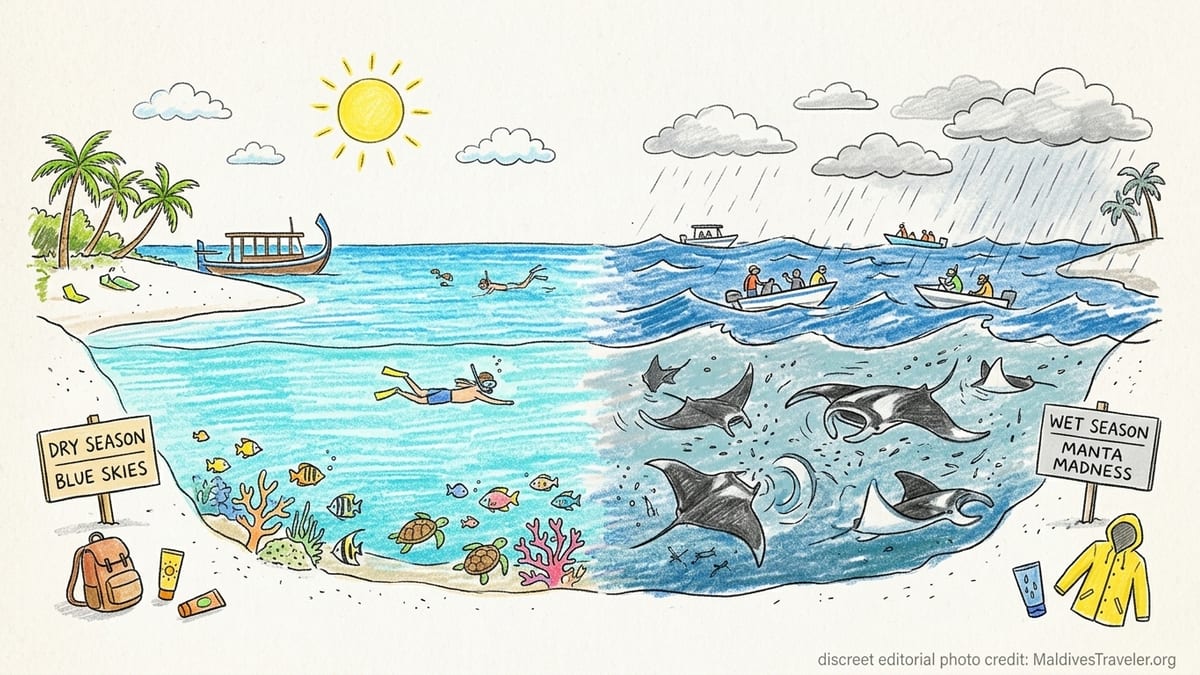
I landed in Baa Atoll in late August expecting rain and mantas, and the first hint that this trip would challenge every neat “best time to visit Maldives” chart came before the seaplane even touched down. The pilot pointed to a charcoal line of clouds marching in from the west and joked that this was why the manta rays were happy. Over the next eight days I kept daily notes on clouds, rainfall, wind, lagoon conditions, excursion cancellations, visibility and how often the sun punched back through the showers. What emerged was a clear pattern, and a paradox: the very southwest monsoon that UNESCO describes as Baa’s rainy season from roughly May to November is exactly what fuels Hanifaru Bay’s legendary manta feeding, while the drier spell around January to March delivers classic postcard Maldives weather at the cost of the atoll’s most famous wildlife.
Understanding Baa Atoll’s Unusual Seasonal Trade Off
Baa Atoll sits in the central western Maldives and is protected as a UNESCO Biosphere Reserve, with official documents describing its climate as a humid tropical monsoon system, marked by a rainy period from about May to November and a drier period between January and March. At the same time, manta researchers and operators working with Manta Trust and local rangers tie Hanifaru Bay’s main manta feeding season to that same southwest monsoon, when plankton is funneled into the small bay and surrounding channels. In other words, Baa’s most celebrated natural event takes place during the very months that conventional brochures warn you to avoid.
On my August trip, this seasonal conflict was not a theory. It was the daily reality of planning days around squalls and plankton maps instead of sunset cocktails on flawless white sand. The forecast from the Maldives Meteorological Service that week showed storms and heavy showers almost every day, something many recent visitors have also reported across the archipelago in what used to be cleaner “dry” and “wet” categories. On the ground, though, the pattern was more nuanced, and that nuance matters if you are deciding whether to prioritize mantas, beach weather, underwater visibility, budget or some compromise of all three.
The key is to stop asking “What is the best month for Baa Atoll?” and start asking “What is the best month for what I personally value most?” Because Baa is one of the few places in the Maldives where “best time” is genuinely different for manta chasers, for sunbathers, for photographers and for divers who care more about visibility than megafauna.
A Week in Baa Atoll in Manta Season: Day by Day Weather Reality
I stayed on a resort island within easy speedboat reach of Hanifaru Bay during the heart of the southwest monsoon. The resort’s daily bulletin, combined with my own notes, painted a picture far messier than a simple “rainy season” label. Across eight days, we had only one day of uninterrupted blue sky from dawn to dusk. On the others, clouds were present for four to eight hours, usually building up from late morning and often clearing again by late afternoon, so the lighting swung between gloomy grey and blazing, high-contrast sun several times a day.
Rain came in bursts rather than all-day deluges. On most days there were one or two showers lasting 10 to 30 minutes, usually accompanied by a sharp pick up in wind. Twice we had longer spells where it rained lightly but steadily for one to two hours. Only on one afternoon did heavy rain last for more than three hours, the kind of weather that pushes everyone into the library or spa. Even then, the late sunset was brushed with pink as the cloud deck broke apart. Air temperatures stayed in the high 20s Celsius, so nobody felt cold once they were out of the water, but deck chairs stayed damp and beach photography required patience.
Wind was the wildcard. Several mornings were almost glassy in the lagoon, with barely a ripple and visibility through the top few meters of water so clear that you could watch small reef sharks from the jetty. By mid-afternoon, especially on days when showers built up, winds increased into the 15 to 20 km/h range, kicking up a messy chop along the windward side of the island. The resort flagged these conditions carefully for guests in overwater villas, which can feel more exposed. Kayaks and stand-up paddleboards were sometimes paused for a few hours. Twice, half-day boat excursions not related to mantas, such as sunset fishing and sandbank picnics, were cancelled because the ride would have been unpleasant.
Underwater, the plankton that drew mantas into the atoll inevitably cut visibility. On the outer reef, scuba divers reported horizontal visibility of roughly 10 to 15 meters on the murkiest days and closer to 20 meters on the best, a far cry from the 30 meter “gin-clear” conditions that are common in the dry season. In exchange, there was life everywhere. Even on house reef snorkels between showers, I saw clouds of baitfish, hunting trevally and, on two mornings, a solitary manta cruising along a cleaning station outside the official Hanifaru trips.
Chasing Mantas: Why the Best Wildlife Season Is the Messiest Weather
Hanifaru Bay is a shallow, funnel-shaped lagoon on Baa’s eastern rim where tidal currents, driven by the southwest monsoon, push plankton into a confined space. Local guides, manta researchers and several recent travel and diving guides broadly agree that the season here runs from about May or June to November, with the highest probability of large aggregations between roughly July and October. Liveaboard itineraries and resort programs now time their Hanifaru-focused trips to match this window, often targeting neap tides in August and September for the biggest feeding events.
This means that if your primary goal is to be in the water surrounded by tens or even hundreds of manta rays, you need to travel at exactly the time when the weather is most volatile. On my week in late August, resort rangers logged mantas in Hanifaru Bay on five out of seven days where conditions allowed boats to go out, and on two of those days the aggregation size was estimated at more than 80 animals. Both of those peak days followed 24 hours of unsettled weather, with a mix of heavy showers and overcast skies. The calmest, sunniest day of the trip coincided with one of the quietest manta days, with only a handful seen at cleaning stations elsewhere in the atoll.
The experience itself reflects those monsoon realities. The boat ride to Hanifaru can be bouncy, with spray on windy days, and the bay is often under a blanket of grey cloud. Water clarity during my sessions varied from five to around ten meters. You are rarely going to get the crystal-blue, sun-dappled images you see on glossy posters. Instead, you are in a plankton soup of shifting shadowy shapes that suddenly resolve into enormous rays looping and barrel-rolling inches from your mask. On one session, rain started halfway through and a squall darkened the surface, yet the feeding below intensified as currents picked up.
In the evenings, guests who had come primarily for “Maldives weather” sometimes expressed disappointment. They had imagined sundowners on the sand with pastel skies, yet the best wildlife days began and ended under bruised clouds. Those who had booked specifically for mantas, including underwater photographers and families who understood the trade off, were ecstatic, even if their Instagram sunsets looked a little flat. For them, the slightly cooler air, periodic clouds and soft light made long hours on the water more comfortable, even if it meant more time under umbrellas between swims.
Dry Season in Baa: Blue Skies, Better Visibility and What You Lose
The same UNESCO summary and Maldivian climate data that identify May to November as Baa’s rainy monsoon also point to a drier monsoon between January and March, consistent with the broader Maldives pattern of a dry northeast monsoon in the first part of the year. On paper and, according to recent on the ground reports from resorts across the northern atolls, February and March still tend to offer the most reliable combination of sunshine, lower rainfall totals and calmer seas.
Speak to resort staff in Baa and to repeat visitors who come for beach time rather than mantas and you hear similar comments. In January to March, especially February, there are more full days where the sky stays bright blue from breakfast to sunset. Showers, if they come, are more often the short, 10 minute variety that barely interrupt a snorkel. Lagoons are calmer for longer stretches, making it ideal for paddleboarding, sandbank picnics and drone photography. Visibility on the outer reefs can push well beyond 25 meters, which transforms the feel of drift dives and deep wall dives, particularly for those who want wide angle reef scenes rather than close focus encounters.
The trade off is that Hanifaru’s mass manta gatherings are largely absent. Manta Trust and local ranger observations show that while individual mantas can be seen in the Maldives year round, the classic cyclone-feeding spectacles at Hanifaru are a feature of the southwest monsoon plankton dynamics. By January, many Baa-based liveaboards shift their focus to other atolls, and Baa resorts that operate peak-season manta programs in August and September often dial them back or redeploy boats to dolphin cruises and general snorkeling tours.
This does not mean there is no big life in the dry season. Reef sharks, turtles and schooling fish remain, and there are usually manta cleaning stations that can produce smaller-scale encounters. However, if your mental image of Baa Atoll is that iconic photograph of dozens of mantas spiraling together, January to March will almost certainly fall short, no matter how perfect the sky. Your compensation is the Maldives cliché delivered almost as advertised: powdery sand that stays dry all day, glittering turquoise shallows and reliably golden hour light for sunset cocktails.
Prices, Crowds and Value Across the Seasons
Weather and wildlife are only two sides of the Baa Atoll seasonal equation. The third is value. Northern Maldives travel specialists and booking platforms that track rates across dozens of Baa resorts consistently show that room prices tend to peak from late December through around mid April, particularly over Christmas, New Year and Easter. This aligns with European and Middle Eastern holiday calendars and with the traditional marketing of this period as “high season” for sunshine and calm seas.
During the southwest monsoon months, particularly May to June and again around September to early November, many Baa Atoll resorts apply shoulder or low season pricing. Several recent booking snapshots and industry guides point to reductions that can easily reach thirty to fifty percent compared to peak festive rates for the same villa category. For example, an entry-level beach villa that might price around a high four-figure nightly rate including taxes in late December at a well-known five star property can fall to the mid three-figure range in October when booked in advance, with local island guesthouses in Baa dropping even further into double or low triple digits per night excluding transfers.
That price curve matters if your budget is finite and you also want to include seaplane transfers, excursions and perhaps a few nights in Male or another atoll. To spend time in Baa during peak manta months without breaking the bank, some travelers now combine a high end resort that has direct access to Hanifaru Bay for three or four nights with a more moderately priced guesthouse on a local island before or after. The overall cost can still undercut a full week in the driest months, with the added bonus of manta potential. On the other hand, if you travel in February or March, you pay the weather premium, but you might save on manta excursion costs that you are unlikely to need.
How Baa’s Seasons Affect Different Trip Priorities
Once you accept that there is no single “best time,” the question becomes which months match your priorities. For mantas at Hanifaru Bay, the high probability window is roughly late June through early October, with many guides and operators quietly singling out August and September as a sweet spot, when the southwest monsoon is well established, plankton is abundant and both liveaboards and resorts concentrate their efforts around suitable tides. If you can roll with some unsettled weather, these are the months where you are trading blue-sky reliability for the chance of world class marine encounters.
For classic beach weather, the period from late January through March remains the frontline recommendation. This is when the northeast monsoon usually brings more consistent sunshine, lower rainfall totals and gentler winds to the northern atolls. It is also when the Maldives as a whole is busiest and priciest, something that is particularly true in Baa, where many properties position themselves at the top end of the market. You are unlikely to see manta super-aggregations at Hanifaru then, but you will see the Maldives that fills luxury brochures: bright, high-contrast colors, smooth sea conditions and day after day of usable light for lazing, swimming and photography.
For underwater visibility without the full high season price tag, the transitional months of December and April can work well. Oceanographic and meteorological data suggest these are changeover months between monsoons, and recent diver reports often describe a mix of good visibility, occasional showers and some wind. You may catch the tail end or very beginning of manta movements, but your odds of a textbook Hanifaru feeding frenzy are lower than in the core southwest monsoon months. Think of these as compromise options if your main priority is diving and you are happy with occasional big animals but not fixated on them.
Best value tends to sit in the shoulders of the rainy season. May to early June and late September to November usually bring significantly lower room rates, fewer people on sandbanks and more space on boats. Wildlife potential is still present, especially on the later side of the year when the monsoon is fully active, but the weather can swing from calm and bright to an entire day of showers. If you are flexible, enjoy dramatic skies for photography and care as much about budget as you do about conditions, these shoulder windows can be rewarding.
Making Sense of Unpredictability: Climate Change and Local Variations
Any discussion of “best time to visit” in the Maldives now has to acknowledge that climate patterns have shifted in recent years. Local staff and repeat visitors to multiple atolls, including Baa, report that in some years heavy rain has lingered into what used to be dry months, while other seasons have brought long spells of sunshine deep into the nominal wet monsoon. Instances of very wet weather during December and January and notably dry spells in May and June have been cited across resorts and guest reports, echoing observations that global climate change is making monsoon behavior less predictable.
On a practical level, this means even February cannot guarantee zero rain, just as August cannot guarantee a week of constant storms. During my own late August stay, the local island of Eydhafushi, which has long term climate records, showed that the preceding week had slightly below average rainfall for the time of year. Yet my own week still delivered multiple grey mornings. Conversely, guests arriving just after I left enjoyed three almost cloudless days in a row in what is supposed to be the heart of the rainy monsoon. The take away is that probability, not certainty, should guide your plans.
Baa also has micro-variations within the atoll. Resorts on the more exposed eastern rim, closer to Hanifaru, may feel wind and swell more strongly when the southwest monsoon is active, while islands tucked behind outer reefs sometimes experience slightly calmer lagoons and less chop on their main beaches. When comparing properties, it is worth asking how sheltered the house reef is in different seasons and whether the resort maintains multiple jetties or bays that allow boats to depart from the leeward side when weather worsens.
Above all, both weather and wildlife in Baa remain inherently unpredictable. Manta Trust emphasizes that even in peak season there can be quiet days at Hanifaru when conditions, tides and plankton simply do not align. Conversely, off-season encounters are not unheard of, especially at deeper cleaning stations. Any trip planned around a single natural phenomenon should build in at least a few extra days and a backup mindset that finds joy in reefs, sandbanks and local island visits if the mantas do not read the calendar.
The Takeaway: When I Would Personally Book Baa Atoll Again
After a week of trade offs in Baa Atoll, I came home with clear preferences that might help you decide. If my primary goal were to maximize the chance of a Hanifaru Bay manta aggregation like the ones I experienced, I would book again for the second half of August or the first half of September. I would stay on an island within quick speedboat reach of Hanifaru, accept the likelihood of several cloudy, windy afternoons, and schedule at least four to five full days on site to allow for cancelled trips or unproductive tides. My expectation would be unforgettable wildlife encounters in exchange for moody skies and modestly reduced underwater visibility.
If I were traveling with someone whose dream is classic Maldives beach weather, with long sunbathing sessions, calm turquoise lagoons and high odds of clear sunsets, I would choose late February or early March for Baa Atoll. I would budget for higher rates, factor in the cost of a seaplane transfer at its full seasonal price, and mentally downplay the likelihood of seeing manta cyclones. Instead, I would plan house reef snorkeling, sandbank lunches and perhaps a visit to a local island, treating any manta sightings as a pleasant surprise rather than an expectation.
For a trip focused on scuba diving visibility and photography of reefs rather than megafauna, I would look carefully at December or April, avoiding the busiest festive weeks if possible. These changeover months can offer very good visibility with some chance of dramatic skies and fewer crowds, especially in early December and late April. I would still ask any chosen resort or liveaboard how they adjust dive sites and boat operations across the calendar, since open-ocean atolls like Baa can respond quickly to wind.
Finally, if value were my main concern and I wanted a taste of everything Baa offers, I would aim for late September to mid October. By this point in the year, manta season is still active enough to give you a decent shot at Hanifaru, room rates at many properties have eased significantly from their winter peaks, and there is sometimes a lull in visitor numbers between European summer holidays and end-of-year breaks. I would pack with the expectation of mixed weather, using clear spells for snorkeling and sandbanks and embracing stormy afternoons as time for spas, cooking classes or simply watching thunderheads build over the Indian Ocean.
FAQ
Q1: Is August really the best month to visit Baa Atoll?
August is excellent for manta encounters at Hanifaru Bay, but it often brings cloudy skies, choppier seas and reduced underwater visibility compared with the dry season.
Q2: Will I definitely see mantas if I visit during peak season?
No season can guarantee manta sightings. Even in peak months, plankton, tides and weather have to align, so it is wise to stay several days and keep expectations flexible.
Q3: What months are best for classic sunny Maldives weather in Baa Atoll?
Late January through March usually offers the most reliable sunshine, calmer seas and better visibility, although brief showers can still occur at any time.
Q4: Is Baa Atoll worth visiting outside the manta season?
Yes. Even without Hanifaru aggregations, Baa offers healthy reefs, turtles, reef sharks, sandbanks and high-end resorts, especially appealing in the bright, dry months.
Q5: How many days should I spend in Baa Atoll if mantas are my priority?
Plan at least four to five full days in the atoll so you can work around any cancelled excursions, poor tides or temporary lulls in manta activity.
Q6: Are boat trips to Hanifaru Bay often cancelled because of weather?
During the southwest monsoon, some trips are cancelled when wind, swell or heavy rain make the ride unsafe or uncomfortable, so flexibility in your schedule is important.
Q7: What is underwater visibility like during manta season?
Visibility in manta season is often reduced by plankton, sometimes dropping to around 10 to 15 meters, which is poorer than the clear conditions typical in the dry months.
Q8: Is Baa Atoll much cheaper in the rainy season?
Many resorts and guesthouses lower rates in May to June and September to November, and reductions of around a third compared with peak festive periods are common.
Q9: Can I combine Baa Atoll with another atoll to balance weather and mantas?
Yes. Some travelers pair a few manta-focused nights in Baa with time in another atoll that may have calmer conditions or different seasonal wildlife patterns.
Q10: If I care about both mantas and beach weather, what is a good compromise?
Late September and early October can offer an effective balance, with ongoing manta activity, softer prices and a fair chance of mixed but often pleasant weather.