


When I booked a Baa Atoll escape in the Maldives for September 2024, I thought I had run the numbers carefully. Our thatch-roofed villa at a five-star private-island resort in Baa Atoll, booked on a breakfast-only rate, came to just under 1,900 US dollars per night including taxes. Pricey, yes, but it was a special trip for two and the stay itself looked almost all-inclusive in the glossy brochure images. By the time we flew home, our actual bill told a very different story. The room rate turned out to be barely half of what we ultimately spent.
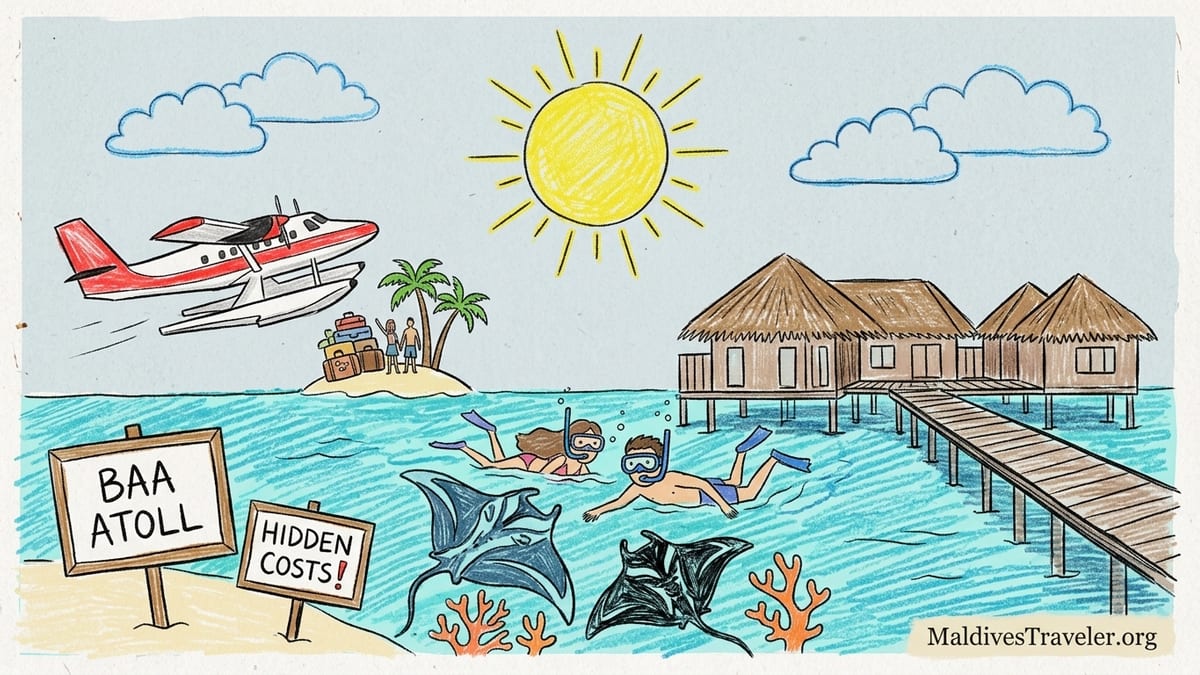
Why Baa Atoll Looks Cheaper Than It Really Is
Baa Atoll has a reputation among Maldivophiles as the place to go for manta rays at Hanifaru Bay, smaller boutique resorts and serious house reefs. It also often appears slightly cheaper than the splashiest names in North Male or Raa Atoll when you search room rates online. That was exactly what seduced me. For our stay, we chose Milaidhoo Island Maldives, a small, luxury resort in Baa, and found advance purchase over-water villa rates hovering around 1,500 to 1,700 US dollars per night before taxes for September 2024, plus the usual Maldives taxes and service charges.
On paper, it seemed straightforward. Pay the villa rate, add the standard 10 percent service charge and 16 percent GST that almost all Maldives resorts levy on top of quoted prices, and factor in a few hundred dollars for food and experiences. What I had not appreciated was how much of the real cost hides outside the room line on your confirmation. Transfers, meal plan upgrades, drinks, dives, manta excursions, spa treatments and service charges quietly stack up day by day until your checkout folio is almost unrecognizable compared with the headline nightly rate.
I also underestimated how little is truly optional in Baa if you want to experience the atoll properly. You cannot reach the resort without paying for a domestic flight or seaplane transfer. If you came for mantas, you will probably pay for at least one dedicated Hanifaru Bay or manta-focused excursion. If you are a diver, the best Baa sites are boat rides away, and those add cost quickly. The Instagram version of the Maldives leaves all of that out.
This article is my attempt to lay out our actual, itemized spending for a couple at a high-end Baa resort as of September 2024 and to show how much a five-night and a seven-night stay can realistically cost once you add everything in.
The Transfer Shock: Seaplanes and Domestic Flights
The biggest surprise on our invoice was not a bottle of wine or a splurgey spa treatment. It was the seaplane. Baa Atoll resorts are far enough from Malé that you cannot simply hop on a complimentary speedboat, and many properties are reached exclusively by private seaplane or by a combination of domestic flight and speedboat. Crucially, those transfers are almost always charged separately from the room bill.
In our case, Milaidhoo arranged our seaplane transfers on Manta Air from Malé’s seaplane terminal to Baa. For the 2024 to 2025 season, the resort informed us in writing that the return seaplane transfer was priced at just under 800 to 900 US dollars per person including taxes and service charges, depending on exact travel dates and any fuel surcharges. For a couple, that meant roughly 1,600 to 1,800 US dollars simply to move from the international arrivals hall to the resort and back. The fee was not included in our advance purchase villa rate.
Other Baa properties use slightly different models. A few pair a domestic flight to Dharavandhoo or a nearby local-airport island with a shared speedboat to the resort, which can bring the base transfer price down to around 400 to 600 US dollars per person return, but you then trade some of the seaplane charm for a more traditional hop. Either way, the transfer is a four-figure line item for two people once Maldives taxes are added, and prices are typically reviewed annually.
We felt the seaplane was worth it in terms of time and views, but it was an expense I had expected in principle and still underestimated in practice. I had loosely budgeted 1,000 US dollars total for transfers. The final cost was close to double that for two people in September 2024. For any serious Baa Atoll planning, transfer cost is the first number to pin down before you fall in love with a room category.
Accommodation and Taxes: What the Room Really Costs
Baa Atoll rates fluctuate with season, but for a small luxury island like Milaidhoo you can expect published nightly prices in the 1,500 to 2,500 US dollar range for a standard water or beach villa in shoulder months such as May, June and September, and higher in peak months around Christmas and New Year. We locked in an advance purchase over-water villa rate just under 1,600 US dollars per night, which felt indulgent but not totally outrageous for a once in a decade trip.
The first adjustment to make is tax and service. Most Maldives resorts apply a 10 percent service charge and 16 percent GST on top of almost everything. Our base room rate of around 1,600 US dollars grew to roughly 2,050 US dollars per night once those compulsory additions were applied, plus the nightly green tax. Over five nights, our villa portion of the bill for two people came to just over 10,000 US dollars. Over seven nights, the same rate would have put the room component at approximately 14,000 to 15,000 US dollars, assuming similar pricing.
That felt predictable. What surprised us more was how the same 26 percent stack of service charge and GST flowed through every other purchase. A 150 US dollar snorkel excursion appeared as nearly 190 US dollars by the time it hit the folio. A 25 US dollar cocktail crept into the low 30s. Individually the differences are small, but during a week in Baa, where almost all spending happens on the island, that layer adds thousands to the total bill.
If you are comparing resorts, ask for a pro forma for your dates that shows not just the base room rate but also the total including all mandatory charges. It sounds basic, but seeing a five-night stay displayed as 10,000 or 12,000 US dollars in total rather than “1,700 plus plus” per night is a useful reality check when you are still in the browsing stage.
Meal Plans and Real-World Consumption
Our biggest deliberate decision was to stick with breakfast only, rather than upgrade to half-board or an all-inclusive style package. Milaidhoo, like many upscale Maldivian resorts, prices meal plan upgrades per person per day, and in 2024 a typical shift from bed and breakfast to half-board at a five-star Baa property often meant adding roughly 150 to 250 US dollars per person per night to cover dinner, depending on inclusions and any restaurant credits. Full all-inclusive style packages, where available, climbed further.
Going in, I had assumed that all-inclusive would be the smart choice because the per-day supplement looks efficient when you picture three courses and several drinks. Once we tracked what we actually consumed, the math looked different. Breakfast was lavish and genuinely filling. We routinely skipped lunch or shared something small by the pool for around 35 to 50 US dollars plus taxes. In the evenings we ordered a starter and main or a main and shared dessert each, with water and one cocktail or glass of wine. Our nightly dinner bills for two, including taxes and service, usually landed between 250 and 320 US dollars.
Had we paid for half-board on top of breakfast for the same five nights, the upgrade alone would likely have totaled in the region of 1,500 to 2,000 US dollars for two, based on 2024 pricing bands. In our case, that would have been slightly more than we actually spent on dinners a la carte, because we are not heavy drinkers and often skipped dessert after the first few nights. An all-inclusive style package would have made sense only if we planned to drink multiple cocktails or glasses of wine daily, order a full three-course dinner every night and eat a proper lunch most days.
For our style of travel, breakfast-only plus a la carte dining turned out to be the right call. The expectation I had going in was that upgrading to half-board would be a no-brainer. The reality was that careful tracking of real consumption showed we would have been paying a premium for food we were not actually ordering. For heavier drinkers or families with teenagers, the calculation shifts, but it is worth doing the math with realistic numbers rather than assuming that all-inclusive automatically equals savings.
Alcohol, Diving, Manta Excursions and Spa
Where we did spend freely was on the activities that had brought us to Baa Atoll in the first place. During manta season, usually around June to November with a peak that can shift year by year, resorts across Baa run dedicated snorkel or boat trips focused on Hanifaru Bay and nearby cleaning stations. On our island, a shared Hanifaru-style manta excursion in September 2024 for two people cost just over 300 US dollars before taxes, edging toward 400 US dollars once service charge and GST were added. Private manta-focused charters pushed that figure far higher.
Diving prices were another pillar of the budget. Independent Baa dive centers and resort-based operations in 2024 often listed single boat dives in the 90 to 130 US dollar range per person before taxes and equipment rental, with small breaks for packages of 6, 10 or more dives. Adding in gear and taxes, two certified divers could easily spend 900 to 1,300 US dollars over the course of a week without doing anything especially extreme. The good news is that the quality of the sites we visited, particularly cleaning stations in Baa and nearby channels, really did justify that outlay.
Alcohol was more of a slow burn. Cocktails at our resort bars typically ran from 22 to 28 US dollars before charges, and wine by the glass started around the high teens into the 20s. We kept to one cocktail or glass of wine each most nights and a shared bottle of mid-range wine around 100 to 130 US dollars once during the stay. Over five nights, that pattern translated to approximately 600 to 700 US dollars on alcohol after taxes. It did not feel extravagant at the time, drink by drink, but the final tally was sobering.
The spa was our single most expensive optional indulgence. A standard 60-minute massage at a high-end Baa resort in late 2024 often priced around 170 to 220 US dollars before service charge and GST. We booked a couples treatment and one additional individual treatment, which brought our spa total for the stay to about 500 US dollars including taxes. This was an expense I fully expected before traveling, and the quality and setting of the treatments made it feel worthwhile, though it is one of the first areas I would trim if I were trying to bring a Baa trip in under a fixed budget ceiling.
Private Dinners, Watersports and Tipping
The genuine budget surprise of our stay was a romantic private beach dinner. The resort promoted it as a one-off splurge with a set menu and bottle of wine, and in the moment it felt too special to pass up. The base price for two in September 2024 was a little under 500 US dollars for a four-course meal and drinks, framed very much as an experience rather than simply a dinner. By the time service charge and GST were factored in, the total crept into the high 600s.
That one evening meal, as memorable as it was, cost roughly the same as two full normal dinners for two at the main restaurant. If I were planning again from scratch, I would budget for it explicitly rather than treating it as an add-on. It is a perfect example of how something that appears in the brochure as a single indulgence can quietly shape the bottom line of the whole holiday.
Watersports were a smaller but still noticeable line item. Non-motorised equipment such as kayaks and stand-up paddleboards was complimentary at our resort, but jet skis, parasailing, wakeboarding and longer boat-based sandbank picnics all carried fees. A 20-minute jet ski session for one person at a comparable Baa resort in 2024 typically ran around 120 to 150 US dollars before tax, and sandbank picnics or private sunset cruises often landed in the 300 to 600 US dollar range depending on inclusions. We limited ourselves to one modestly priced watersports session and a shared sunset cruise, spending around 400 US dollars all-in.
Tipping in the Maldives is personal, but in practice it added a few hundred dollars to our Baa Atoll budget. Many guests at high-end resorts choose to tip their villa host or butler, favorite waiters, spa therapists and dive guides in cash in addition to the 10 percent service charge already on the bill. Over a five-night stay, spreading 20 to 40 US dollars in cash to several staff members and leaving a larger envelope for the host easily reached 250 to 300 US dollars. It is a cost that did not surface in any marketing material, but one we were happy to bear given the standard of service.
What Our Baa Atoll Trip Actually Cost in 2024
To make these numbers as transparent as possible, here is how our spending for two adults in Baa Atoll at a five-star private-island resort shook out in September 2024. All figures below include the typical 10 percent service charge and 16 percent GST as applicable, and they are rounded for clarity. Exact prices will vary by resort and date, but this should offer a realistic ballpark.
For a five-night stay, our major costs were as follows. Accommodation for five nights in an over-water villa on a breakfast-only rate came to a little over 10,000 US dollars. Seaplane transfers for two people between Malé and Baa totaled around 1,700 US dollars. Food and non-alcoholic drinks outside breakfast added about 1,400 US dollars over the stay. Alcohol, mostly by the glass plus one bottle of wine, landed in the 600 to 700 US dollar range.
Activities and experiences built around the manta season and the reef came next. One shared manta-focused excursion for two, two local boat dives each, one sunset cruise and light watersports spending together ran to approximately 1,800 US dollars. Spa treatments added roughly 500 US dollars. The private beach dinner cost just under 700 US dollars. Cash tips and small discretionary spends such as souvenirs from the boutique added around 350 US dollars.
Altogether, our five-night Baa Atoll holiday for two in September 2024 cost in the region of 17,000 to 18,000 US dollars door to door once everything was converted back into a single currency. Of that, the room rate represented around 60 percent. The rest was transfers, food and drink, experiences and the tax and service multipliers layered over each line. Extrapolating the same pattern to seven nights, using the same nightly room rate and similar daily spending, pushes the total into the low to mid 20,000s for two people in the same season.
The important point is not the exact figure for one couple at one resort but the proportions. Even in an expensive destination like the Maldives, it is easy to focus on the villa price and forget that your real cost per day in Baa is that number plus transfers averaged over the stay, plus the sum of food, drinks and activities that realistically make up a manta-and-reef holiday. Seen through that lens, a competitively priced room can front a very expensive overall trip if everything else is left unbudgeted.
Where I Would Spend More Next Time, and Where I Would Cut
Looking back on our September 2024 Baa trip with a cold eye on the numbers, there are a few places where I would happily spend more on a return visit, and others where I would cut without feeling any loss. Top of my list for extra spending is the transfer. That might sound strange, given how much I have emphasized transfer costs, but the seaplane was a genuine highlight, and I would be prepared to pay a little extra for schedules that match my international flights comfortably, even if that meant arriving a few hours earlier in Malé or booking a day room.
I would also invest more in the core reason for visiting Baa Atoll in the first place. For us, that was the manta season and the reefs. On a future trip I would budget for at least one additional Hanifaru-style excursion, even at several hundred dollars a time, and commit to a slightly larger dive package rather than booking dives piecemeal. When I compare the memory of drifting through a channel ringed with schooling fish to another hour at the bar, there is no contest.
On the saving side, I would almost certainly skip the private beach dinner and use that money for an extra night instead. It was lovely, but the standard restaurant dinners were consistently excellent and came with plenty of atmosphere. I would also trim the spa bill down to one longer treatment rather than several shorter ones, and be more deliberate about alcohol. It is easy to treat 25 US dollar cocktails as part of the scenery, but two drinks per person per night over a week essentially equals the cost of another shared excursion once taxes are applied.
Finally, I would continue to avoid all-inclusive style packages unless we intended to eat and drink heavily. For light to moderate drinkers who are comfortable tracking their spending, breakfast plus a la carte is still a strong option in Baa, even at the top-end resorts, especially if you are willing to eat an early, generous breakfast and late dinner with only light snacks in between.
FAQ
Q1. How much should I budget for seaplane or domestic transfers to Baa Atoll in 2024 and 2025?
For a five-star private-island resort in Baa Atoll, a realistic budget for return transfers for two adults is between 1,000 and 1,800 US dollars, depending on whether the resort uses seaplanes or a domestic-flight-plus-speedboat combination and on the season. Seaplanes tend to sit at the higher end of that range, especially once the standard Maldives taxes and service charges are added.
Q2. Are half-board or all-inclusive meal plans worth it at Baa Atoll resorts?
They can be, but it depends heavily on how you actually eat and drink. If you enjoy a big breakfast, often skip lunch and have a moderate dinner with one drink in the evening, breakfast-only with a la carte dining can be cheaper than paying a set half-board supplement. All-inclusive plans usually make sense only if you plan to drink multiple alcoholic drinks daily and eat three full meals most days.
Q3. How expensive is alcohol at Baa Atoll luxury resorts?
In 2024, cocktails at high-end Baa resorts often range from the low 20s to high 20s in US dollars before tax and service, which pushes them into the low 30s once everything is added. Wine by the glass tends to start in the mid to high teens, and mid-range bottles usually sit around 100 to 130 US dollars on the final bill.
Q4. What does a typical manta or Hanifaru Bay excursion cost?
Shared manta-focused snorkel excursions from Baa Atoll resorts commonly price at around 150 to 200 US dollars per person before taxes and service charges. For two adults, that often becomes 300 to nearly 400 US dollars on the final bill. Private charters cost more but can offer more flexibility with timing and crowd levels.
Q5. How much should I expect to spend on diving in Baa Atoll?
Resort and local dive centers in Baa often charge around 90 to 130 US dollars per dive per person before equipment rental and taxes, with discounts for multi-dive packages. For two certified divers doing a handful of boat dives over a week, a budget of 900 to 1,300 US dollars including gear and taxes is reasonable.
Q6. What surprised you most about the costs beyond the room rate?
The seaplane transfers and the cumulative effect of taxes and service charges were the biggest financial surprises. Even though I knew transfers were not included in the room rate, I underestimated the total by several hundred dollars, and I did not fully appreciate how adding roughly 26 percent in service charge and GST to every drink, excursion and spa treatment would grow the final bill.
Q7. How much did your five-night Baa Atoll trip for two cost in total?
For our September 2024 stay at a five-star private-island resort in Baa Atoll, including five nights in an over-water villa with breakfast, seaplane transfers, food, drinks, diving, a manta excursion, one private dinner, spa treatments, watersports and cash tips, the total for two adults ended up in the region of 17,000 to 18,000 US dollars. A similar seven-night stay with comparable daily spending would likely land in the low to mid 20,000s.
Q8. Where would you cut costs on a future Baa Atoll trip without sacrificing the experience?
I would skip the private beach dinner, book fewer spa treatments, and limit alcohol to drinks that really add something to the evening rather than ordering by habit. I would also avoid unnecessary souvenir shopping at the resort boutique, since those purchases carry the same taxes and markups as everything else.
Q9. Where would you be willing to spend more money next time?
I would budget more for the core experiences that define Baa Atoll, particularly additional manta excursions during peak season and a slightly larger dive package to see more of the channels and cleaning stations. I would also pay for transfer timings that reduce waiting around in Malé, because travel days in and out of Baa can be long.
Q10. Is Baa Atoll only for very high budgets, or can you visit on less?
Baa Atoll is home to some of the Maldives’ most expensive resorts, but there are also guesthouses and simpler properties on local islands with much lower room rates and transfer costs. However, if you are aiming for a private-island, villa-style experience at a five-star resort similar to the one described here, it is sensible to plan around a total budget where the room rate is only half to two-thirds of your final spend, rather than the whole story.