


I have spent separate trips based in both Baa Atoll and South Ari Atoll, timing one visit around Hanifaru Bay’s manta season and another around South Ari’s famous whale shark corridor. Both experiences were exceptional, but they delivered very different kinds of marine encounters and trip logistics. If you are trying to decide between Baa and Ari specifically for mantas, whale sharks and diving, it helps to think less in terms of "best atoll" and more in terms of "which marine product fits my dates, budget and expectations".
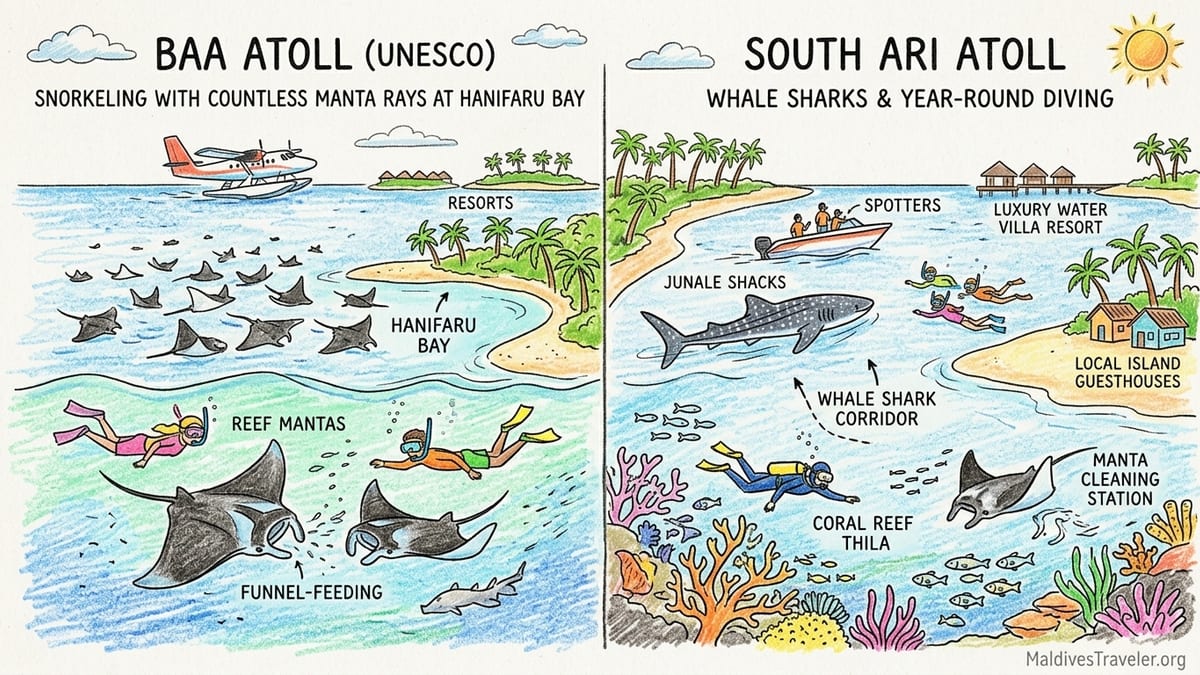
Baa vs South Ari in One Glance: Two Very Different Marine Products
In Baa Atoll, everything revolves around a single, extraordinary natural event: the seasonal manta feeding aggregations inside Hanifaru Bay, a small marine protected lagoon that sits within the Baa Atoll UNESCO Biosphere Reserve. When it is firing, usually between late May and November with a peak around August and September, you can find yourself drifting through clouds of reef mantas funnel-feeding just a few meters below the surface. The key point is that this spectacle is strictly snorkelling only inside the bay, and dive boats operate on nearby sites instead.
South Ari Atoll, by contrast, is less about one intense spectacle in a tiny area and more about a long, whale shark focused coastline backed by a mature dive-tourism infrastructure. The South Ari Marine Protected Area runs along the outer reef from roughly Rangali to Dhigurah and Maamigili and is one of the few places in the world where juvenile whale sharks are considered present year round. Operators based on islands such as Dhigurah, Dhangethi and Maamigili run daily whale shark trips, plus manta cleaning station runs in season, and a wide mix of dive sites at different depths and difficulty levels.
The result is that Baa feels like a biosphere reserve with a single headline act and a supporting cast of reef dives, while South Ari feels like a working dive corridor where whale sharks are the anchor species but not the only attraction. Neither model is inherently better. They simply suit different priorities, budgets and travel styles.
It is also important to acknowledge that Hanifaru’s mantas are strongly seasonal, while South Ari’s whale sharks are encountered all year, albeit with ups and downs in sightings. On my Baa trip in shoulder season we had one quiet Hanifaru outing and another when the bay exploded with dozens of mantas. In South Ari, I needed several outings across a week to get two solid whale shark encounters, each lasting only a few minutes at a time. Managing expectations about “guarantees” is crucial in both regions.
How Hanifaru Bay Really Works: Seasonality, Rules and What You Actually Do
Hanifaru Bay’s reputation can make it sound like a 24/7 manta soup where you simply turn up and jump in. The reality is much more structured. The bay lies inside a tightly managed marine protected area that forms a core zone of the UNESCO Biosphere Reserve. Boat access is controlled through a permit system, daily visitor numbers are capped, there are time limits in the water, and scuba diving is not allowed inside the bay. All visits are guided snorkel trips, usually arranged via your resort or a guesthouse on nearby local islands such as Dharavandhoo or Eydhafushi.
The manta season broadly runs from around May to November, linked to the southwest monsoon that pushes plankton into the funnel-shaped bay. Within that window, conditions vary by year, moon phase and tides. During my August visit, resorts were on standby for calls from rangers and researchers who monitor the bay. On days when mantas were spotted aggregating, staff knocked on doors in the late morning, and boats departed at short notice for a 20–40 minute ride. On one outing we arrived to perhaps twenty mantas circling calmly; on another, the bay filled with dozens of rays barrel rolling past each other in what locals often call “manta madness”.
Because the depth inside the bay is relatively shallow and diving is banned, the experience is intense but short and surface based. There is no hanging at 15 meters on a reef; you float on the surface, fin gently and point your head down. Rangers patrol to enforce a strict no-touch and no-chase policy, and guides keep people bunched so the mantas can continue feeding. Most trips gave us 45–60 minutes in the water, then we exited and returned to the resort. If you are a diver, you will do your actual scuba dives on nearby reefs, channels and cleaning stations, not inside Hanifaru itself.
Outside Hanifaru, Baa’s reefs and channels offer cleaning stations where mantas appear in smaller numbers, plus healthy coral bommies, turtles and reef sharks. On my non-Hanifaru days, we dived outer reef sites with modest current, schools of fusiliers and several cleaning stations where two or three mantas circled within comfortable photography range at 12–18 meters. These were classic boat dives with normal bottom times, very different in feel from the high-adrenaline scrum that Hanifaru can become at peak aggregation.
Inside South Ari’s Whale Shark Corridor: What To Expect Day to Day
South Ari’s whale shark offering is based on regular patrols along a clearly defined marine protected strip on the atoll’s outer reef. Guesthouses on Dhigurah and Dhangethi, as well as resorts such as LUX* South Ari Atoll, Vilamendhoo and Conrad Maldives Rangali Island, run half-day or full-day excursions that usually combine whale shark searching with reef snorkels or dives. Boats follow agreed guidelines about approach speeds and distances, and in-water behavior is regulated with rules against touching or blocking the animal’s path.
In practical terms, a typical whale shark excursion involved boarding a speedboat with around eight to twelve other guests and scanning the waterline along the reef for surface shadows, dorsal fins or signs of other boats. Some operators use spotters on the bow or even small aircraft-supported data shared by research programs when available. Once a whale shark was sighted, the captain positioned the boat ahead of the fish’s trajectory and gave a short countdown. Everyone slid into the water with masks and fins and finned hard to intercept the slow-moving giant as it passed.
Encounters were exhilarating but brief. On my best day, we managed roughly 15 minutes total in the water with a four to five meter juvenile, broken into several short drops as the shark surfaced repeatedly. On another day, we saw no shark at all despite hours of searching in calm seas. Guides made clear that even in South Ari, where research programs log hundreds of individual sightings per year, there are no guarantees on any given outing. This is where staying four to seven nights helps: you buy multiple shots at good conditions and cooperative animals.
Crucially, South Ari’s marine life is not limited to whale sharks. There are manta cleaning stations, especially active from about December to April when plankton concentrations build on the eastern side of the atoll, and a broad portfolio of dive sites featuring pinnacles, outer reef walls with steady current, and sheltered lagoons. Compared with Baa, my South Ari dives felt more varied in topography and fish life, though less focused on one marquee spectacle. Between morning boat dives, afternoon whale shark runs and night dives under jetties, it was easy to fill a week with mixed experiences.
Resort vs Local Island: Where I Stayed and How the Experience Changed
Both Baa and South Ari give you a choice between all-inclusive style resort islands and local islands with guesthouses. I tried one of each combination: an upscale resort in Baa paired later with a guesthouse in South Ari, and on a separate trip a mid-range local-island stay in Baa with a resort in South Ari. The feel of the manta and whale shark experiences changed significantly depending on where I was based.
In Baa, staying at a high-end resort on a private island meant Hanifaru trips were integrated into the daily schedule: staff handled permits and timing, and snorkel boats departed directly from the resort jetty. Prices for Hanifaru excursions were typically quoted as an add-on per person on top of the mandatory seaplane transfer, which could easily run several hundred US dollars per person for the round trip. When I later stayed on a local island such as Dharavandhoo, the seaplane cost was similar because it still used the same regional air connection, but daily life was cheaper. Hanifaru trips were organized through the guesthouse or a local dive shop, often with slightly smaller group sizes and more flexible bundles that combined Hanifaru with two-tank reef dives on other days.
In South Ari, my guesthouse stay on Dhigurah felt like a classic dive village experience. Whale shark excursions were posted on a chalkboard by the jetty, with approximate prices and next-day departure times. Transfers to Dhigurah involved a domestic flight from Malé to Maamigili followed by a short speedboat ride, which worked out slightly cheaper than the pure seaplane rides required by many outer atolls. Later, when I stayed at a resort like Vilamendhoo, the same whale shark corridor was just a longer speedboat run away, but the overall feel was more curated, with higher per-excursion prices balanced by comfortable boats, snacks, and well-organized briefings.
If you value barefoot local-island life and are willing to accept simpler rooms, guesthouses in both atolls can significantly lower daily costs while still giving you access to the same protected areas. If you prefer one-stop comfort with meals and excursions folded into a package, resort islands around both Baa and South Ari deliver, but you will feel the mark-up especially once you add seaplane or domestic flight transfers for two people.
Transfers, Costs and How “Remote” Each Atoll Feels
Logistics are where many travelers underestimate the difference between Baa and Ari. Baa Atoll is usually accessed via seaplane from Malé’s main international airport, landing on resort platforms or local island lagoons. Current round-trip seaplane transfers to Baa resorts often cost in the ballpark of several hundred dollars per person, sometimes more for ultra-luxury properties. The expense is built into most packages and appears on your final bill rather than being paid directly to the seaplane operator, but it is still real money that you need to account for when comparing atolls.
South Ari offers a bit more variety. Some resorts and local islands use seaplanes directly from Malé, priced similarly to Baa transfers. Others, particularly around Maamigili and Dhigurah, are reached via a domestic flight combined with a short speedboat leg. That combination can work out marginally cheaper while still keeping total travel time under an hour in the air plus a brief boat ride. At the budget end, there are occasional public ferries connecting atolls, but the schedules are infrequent and can involve overnight stops, so I only recommend them for travelers with significant time and patience.
In terms of remoteness, Baa’s UNESCO Biosphere Reserve status contributes to a feeling of being in a more protected, lightly developed region, even though the atoll itself hosts several well-known luxury brands. The landscape features uninhabited sandbanks, turtle nesting islands and channels where you may not see another dive boat all morning, especially outside school holidays. South Ari, particularly around the whale shark MPA, feels busier. On good visibility days I routinely saw five or more excursion boats fanning out along the reef, and when a shark was spotted, multiple vessels converged quickly.
This congestion does not automatically ruin the experience, but it does change the atmosphere. In Baa, even when Hanifaru was busy in the water, the rest of my week felt relatively quiet. In South Ari, the ocean often felt shared, especially during high season when European and Asian school holidays overlap. Your tolerance for other boats and snorkellers should factor into your decision if you dream of empty horizons.
Diving Style, Snorkelling Quality and Overall Marine Variety
From a pure diving perspective, both atolls deliver warm water, mostly gentle conditions and healthy coral patches, but they emphasise different styles. In Baa, many of my dives were on outer reefs and pinnacles within the biosphere reserve, focusing on manta cleaning stations, reef sharks, turtles and macro life among hard coral heads. Currents ranged from mild to moderate, and visibility was decent even during plankton-rich periods. Because Hanifaru itself is snorkel-only, serious divers should think of Baa as a manta-cleaning and reef-diving destination with the added bonus of one or two intense snorkel sessions if they time it right.
Snorkelling in Baa can be excellent straight from many resort house reefs, with turtles and reef sharks common. However, the gap between a quiet house-reef afternoon and a full Hanifaru aggregation is enormous. During my stay, there were days when the bay did not “go off” at all, and snorkelling remained confined to reefs and sandbanks. Travelers who dislike chasing specific events may actually enjoy that balance: you dive and snorkel normally and treat Hanifaru as a stunning possible extra rather than the sole point of the trip.
South Ari leans more clearly into a mixed dive-and-snorkel portfolio that is less dependent on a single location. Drift dives along the outer reef with steady current showcased big schools of snappers, jacks and occasional pelagic visitors. Interior thilas offered overhangs dripping with soft corals and glassfish. Whale shark outings were usually snorkel based, although some operators also arranged scuba dives when sharks remained deeper along the reef slope. Manta cleaning stations added another dimension in season, giving divers and snorkellers alike chances to see graceful rays circling fixed bommies.
For snorkellers, South Ari’s strength lies in the combination of shallow reefs, frequent excursions and the possibility of both whale shark and manta encounters within a single week. The trade-off is that whale shark time in the water is often short and comes with more boat traffic. If your idea of a perfect trip is slow, quiet snorkels on an uncrowded house reef, Baa may feel calmer. If you prefer active boat days chasing big animals and then hopping overboard on multiple reefs, South Ari will likely suit you better.
Seasonality, Crowds and Price Differences I Actually Felt
Seasonality is the backbone of this decision. My manta-focused Baa trip, scheduled for late August, fell right in the historical peak for Hanifaru aggregations. The atoll felt moderately busy, but boats were still able to coordinate time slots so that the bay did not exceed local capacity rules. Outside that core manta season, many Baa resorts remain open, focusing on reefs, turtles and occasional mantas, but you would be visiting more for general diving than for a near-guaranteed Hanifaru spectacle.
In South Ari, I timed one trip for February, when seas are often calmer, underwater visibility is good and both mantas and whale sharks are regularly reported. The area felt busy, especially on calm mornings when multiple resorts sent boats simultaneously. However, the whale shark program runs year round, and operators I spoke with noted only modest seasonal swings in encounter rates, with perhaps slightly higher success during calm, dry months and occasional dips during rough or rainy spells. The key for visitors is to stay enough days to ride out unlucky patches.
In terms of prices, Baa’s combination of seaplane-only access to many resorts and its UNESCO branding tends to place it at the higher end of the Maldivian spectrum. Seaplane transfers for two adults can easily add a substantial sum to a week’s bill, on top of nightly rates that skew luxury. South Ari offers more gradation, from simple guesthouses on Dhigurah and Dhangethi to five-star resorts that also charge steep transfer fees. On my own trips, a week in Baa at a mid-range resort ended up costing noticeably more than a week in South Ari split between a guesthouse and a four-star resort, even once I added multiple whale shark excursions.
The way each destination felt crowd-wise matched its pricing. Baa’s higher average cost acted as a natural filter, so even during manta season outside Hanifaru I often found dive sites quiet. South Ari’s broader price range drew a more diverse crowd, which meant fuller boats but also more energy in dive centers and on local streets. Whether that buzz feels invigorating or overwhelming will depend on your personality.
Who Each Atoll Suits Best and What I Personally Would Choose
If your dates are flexible and your absolute top priority is to be in the water with large numbers of mantas, Baa Atoll during Hanifaru season is hard to beat. The combination of a protected UNESCO context, strong management rules and years of research give you a structured way to interact with one of the world’s most impressive manta aggregations. You need to accept that it is snorkelling only inside the bay and that conditions are never guaranteed, but if you can travel between roughly June and October and budget for seaplane transfers plus at least a few days of standby time, Baa stacks the odds heavily in your favour.
If your dream revolves more around seeing a whale shark, even briefly, and you also want a varied week of diving across many kinds of sites, South Ari is the more pragmatic choice. The whale sharks do not pose for cameras, and you may need several excursions to get one really satisfying encounter, yet the year-round residency and density of operators means you can keep trying without rebuilding your itinerary from scratch. Add in manta cleaning stations in season and lively local islands, and South Ari becomes a well-rounded marine playground rather than a one-species gamble.
Crucially, I would not call one atoll universally better than the other. Baa is more specialised, expensive and season-dependent, delivering unforgettable highs when conditions line up. South Ari is more consistent, versatile and infrastructure-rich, offering many good days and occasional spectacular ones. On my own trips, the single most jaw-dropping moment was a 30-minute session drifting among dozens of mantas in Baa. The most satisfying overall week, however, came in South Ari, where I logged whale shark snorkels, manta dives, healthy reefs and relaxed evenings on a sandy local-island street.
Outside of Baa’s peak manta season, if I could only choose one atoll for a marine-focused holiday, I would personally pick South Ari. The year-round whale shark program, the diversity of dive sites and the ability to balance a few splurge nights at a resort with a longer, affordable stay on a guesthouse island fit how I like to travel. If my dates fell squarely in Hanifaru’s prime window, though, I would seriously consider structuring an entire trip around Baa, perhaps combining four to five nights there with a separate stint in a different atoll to hedge against bad weather days.
The Takeaway
Choosing between Baa Atoll and South Ari Atoll for mantas, whale sharks and diving is less about finding a winner and more about matching a very specific marine “product” to your own priorities, dates and budget. Baa’s headline experience is the seasonal, snorkelling-only mass manta feeding inside Hanifaru Bay, set within the broader context of a UNESCO Biosphere Reserve and supported by a network of quality reef dives and cleaning stations elsewhere in the atoll. It feels remote, carefully managed and, at times, almost surreal in its intensity.
South Ari’s strength lies in its established whale shark focus, combined with extensive dive-tourism infrastructure and a wider mix of marine encounters. You trade the possibility of hundreds of mantas overhead for the more incremental thrill of scanning the reef for a single whale shark shadow, knowing that even without a sighting, you will still have solid diving and snorkelling options. Its transfer routes are marginally more flexible, its price range wider, and its atmosphere livelier, especially around local islands and popular resorts.
If you are a traveler whose primary goal is a properly timed manta-focused trip, and you are willing to accept higher costs and build your itinerary around a several-month window, Baa Atoll is the more targeted choice. Plan for at least four to six nights during the core Hanifaru season, stay within practical boat range of the bay, and treat any non-Hanifaru dives as welcome extras. If, instead, whale sharks or a broader, year-round dive variety are your stronger priorities, then South Ari is the smarter call, especially if you like the idea of mixing local-island authenticity with a few nights of resort comfort.
For my own future trips, outside Baa’s core manta season I would choose South Ari almost every time. The combination of whale shark chances in all months, varied diving and more flexible price points suits the way I actually travel, rather than the way I fantasise about travelling when staring at photos of Hanifaru. When the calendar and budget align, though, I know I will be drawn back to Baa for another roll of the dice with the mantas.
FAQ
Q1. Is Baa Atoll or South Ari better if I want to see both mantas and whale sharks on one trip?
In season, Baa gives you very strong manta odds but only occasional whale sharks, while South Ari offers year-round whale shark chances and seasonal mantas. If seeing both is essential and your dates fall in late May to October, a split trip is ideal: a few nights in Baa for Hanifaru-focused manta snorkelling and the rest in South Ari for whale sharks and more varied diving.
Q2. Can I scuba dive inside Hanifaru Bay?
No. Hanifaru Bay is managed as a snorkelling-only site to protect the manta rays and the fragile environment. Scuba diving, anchoring and fishing are not allowed inside the bay. Divers based in Baa Atoll still have access to many nearby reefs and manta cleaning stations, but the famous mass feeding events are experienced from the surface with mask, snorkel and fins.
Q3. Are whale shark encounters in South Ari really guaranteed?
No operator can guarantee a whale shark sighting, even in South Ari. Research data suggests whale sharks are present in the area all year, but on any given day you may see several, one, or none at all. Staying at least four to seven nights and joining multiple excursions significantly improves your chances, but there is always an element of luck, weather and visibility.
Q4. Which atoll is more suitable for beginners or nervous swimmers?
Both atolls can work for beginners if you choose your base and operator carefully. In Baa, Hanifaru snorkels are guided, life jackets are common, and the bay is relatively sheltered, though the number of people in the water at once can feel overwhelming. In South Ari, whale shark snorkels sometimes involve faster entries and more finning to keep up. If you are nervous, look for operators that limit group size, brief clearly and offer dedicated support for less confident swimmers.
Q5. How many days should I stay in Baa to have a good chance of seeing mantas at Hanifaru?
During the core manta season from roughly June to October, four to six nights within easy boat reach of Hanifaru gives you a reasonable chance of at least one strong manta day, though nothing is guaranteed. Shorter stays of two or three nights can work if you hit perfect timing but leave less room for bad weather, tides or quiet days when mantas do not aggregate in the bay.
Q6. Is South Ari much cheaper than Baa Atoll?
South Ari tends to offer more budget flexibility because it has several local islands with guesthouses alongside high-end resorts, and some properties use domestic flights plus speedboats instead of pure seaplanes. Baa hosts a higher proportion of luxury resorts and often requires seaplane transfers, which can push up overall trip costs. That said, individual prices vary widely, so it is worth comparing specific properties in both atolls before deciding.
Q7. Can I visit both Baa and South Ari in a single Maldives holiday?
Yes, but you need to factor in extra transfer time and cost. There are no direct public links between the two atolls for tourists, so most itineraries route back through Malé and then out again by seaplane, domestic flight or speedboat. If you have 10 to 14 nights and a flexible budget, a combined Baa and South Ari itinerary can be an excellent way to hedge your bets on both mantas and whale sharks.
Q8. Outside Baa’s manta season, is it still worth going there instead of South Ari?
Outside the main Hanifaru window, Baa still offers solid reef diving, turtles, reef sharks and occasional mantas at cleaning stations, but you lose the region’s signature mass feeding spectacle. In that case, many divers and snorkellers will find South Ari’s year-round whale shark focus and wider mix of sites more compelling, especially if they are paying for costly seaplane transfers either way.
Q9. Do I need to be an experienced diver to enjoy either atoll?
No. Both Baa and South Ari are accessible to snorkellers and beginner divers. Many of the headline encounters, such as Hanifaru mantas and South Ari whale sharks, are snorkelling based. If you are newly certified, there are plenty of sheltered reef sites in both atolls where dive centers can conduct training dives and gentle fun dives, provided you are honest about your experience and comfort level.
Q10. If I can only choose one atoll and my dates are fixed in, say, February, which should I pick?
With fixed dates in a month like February, when Baa’s Hanifaru action is unlikely, South Ari is generally the more sensible choice. You will have access to the whale shark corridor, good visibility for diving, and a chance of manta cleaning station visits, all without relying on a seasonal event. Baa would still offer pleasant diving, but you would be missing its defining manta aggregation.