


On paper, Fulhadhoo looks like the Maldives dream on a budget: a long sandspit in Baa Atoll’s southern Goidhoo chain, a tiny village, a famous bikini beach and a cluster of affordable guesthouses instead of overwater villas. I went in thinking it might be overhyped by drone photos. After several days actually staying on the island, walking that beach at different tides and waiting out a storm or two, I came away with a more nuanced view of what Fulhadhoo really offers and who will love it enough to make the long speedboat ride north from Malé.
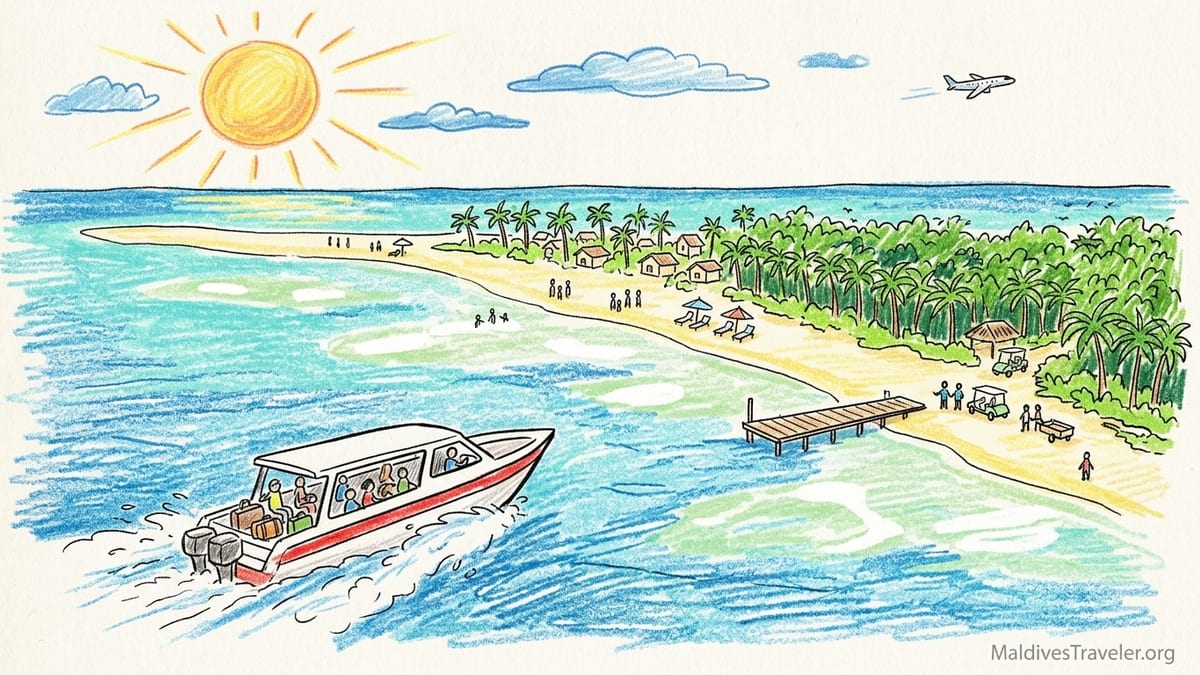
Getting to Fulhadhoo: The Long Speedboat North
Reaching Fulhadhoo begins at Malé’s airport jetty, where shared speedboats line up in the late afternoon for the run to the Goidhoo group of Baa Atoll. There is no public ferry that makes the journey practical for short trips, so almost every traveler arrives on a prebooked speedboat arranged through their guesthouse. My own transfer left just after 9:30 a.m., once everyone’s flight had landed and luggage was loaded, and headed northwest past resort islands and empty sandbanks.
The ride took a little under two hours in moderate seas, roughly matching the 2 hour timing quoted by local-island guides and guesthouses for the Malé to Fulhadhoo route. The cost, arranged through my guesthouse and paid in cash on arrival, was just under 70 US dollars each way per person, which is in line with current shared-transfer prices many Fulhadhoo properties list between about 60 and 80 US dollars. It is not cheap for a “budget” island, and it underlines one of Fulhadhoo’s realities: once you are committed to that boat, there are no easy or cheap last-minute changes.
For most of the journey the speedboat runs in open water with no shelter, so the ride quality is at the mercy of wind and swell. On my way out the sea was calm, and we made good time; on the way back, a squally morning in the southwest monsoon stretched the crossing, with the captain throttling back between whitecaps. If seasickness is a concern, this is a ride to do with medication and your main bag wrapped in something that can handle spray. There is no toilet on the shared boats I saw, and once you leave Malé there are no stops before the Goidhoo islands.
The upside is that when Fulhadhoo’s jetty finally appears, it feels satisfyingly remote. You pass Fehendhoo and Goidhoo, the two other inhabited islands in this small atoll-within-an-atoll, and then curve into Fulhadhoo’s harbour where a handful of guesthouse reps wait with golf carts or wagons. From the very first steps on the island, you sense how small the resident community really is and how completely the lagoon and beach dominate the horizon.
Staying on a Local Island: Guesthouses, Rooms and Real Costs
Fulhadhoo’s tourism scene is still compact. According to recent Ministry of Tourism lists, there are several registered guesthouses on the island, including long-established names such as Azoush Tourist Guesthouse, Village Hideaway & Spa, Palms Retreat and Three Heart Guest House, plus newer boutique-style properties like Island Luxury Fulhadhoo and Ahiva Village. Most sit on the village side of the island, with sandy lanes and coconut palms rather than direct beach frontage, though a few advertise short sandy paths straight onto the bikini beach.
I booked a midrange guesthouse rather than the newest boutique hotel. My double room, with breakfast included, worked out at roughly 90 US dollars per night including taxes when booked in advance shoulder season, which was consistent with the 80 to 130 US dollar range shown on major booking platforms for standard rooms in Fulhadhoo. The room itself was simple but comfortable: tiled floor, firm mattress, air conditioning that coped well with the humidity, a ceiling fan, a small wardrobe and a private bathroom with hot water supplied from a rooftop tank warmed by the sun.
There was no ocean view from my room, just a wall of greenery, but the trade-off was peace and deep shade. Wi-Fi was included and tested at around 10 to 20 Mbps down during quieter times of day, which was enough for calls and uploading photos but not comparable to resort-level speeds. Most guesthouses now share that same story: Wi-Fi is available and reasonably reliable, but it can slow noticeably in the evening when everyone is streaming or during bad weather when the signal drops.
In terms of value, the numbers stack up in Fulhadhoo’s favour if you compare with nearby resort islands in Baa Atoll where entry-level rooms routinely start several times higher. A couple can stay here, with breakfast and basic excursions, for less than the nightly rate of many four-star resorts. The catch is that the rest of your spending is largely confined to your guesthouse or one of a very small handful of cafés, and that limitation becomes very clear after a few nights.
The Bikini Beach: What It Really Looks Like at Different Tides
Fulhadhoo’s main draw is its bikini beach, a long, pale ribbon of sand running along the western side of the island away from the village. Online it appears in ranked lists of the world’s best beaches and in heavily edited drone photos that make the lagoon glow electric blue. Standing on the sand at eye level, the impression is different but still undeniably special. The lagoon shelves very gradually, and the sea here is a sequence of milky turquoise, light blue and deeper cobalt out near the reef line.
At low tide, especially on a calm day, the famous sandspit at the southern end of the bikini beach emerges clearly. The sea retreats tens of metres, exposing firm, rippled sand where you can walk ankle-deep far out into the lagoon. The water close to shore is then very shallow, sometimes only mid-calf for a long stretch, which is ideal for small children and nervous swimmers but not for anyone wanting to do long laps. Pockets of seagrass appear, and small rays sometimes cruise the shallows where the sand meets a darker band of coral rubble.
As the tide rises, the character of the beach changes. By mid-tide the lagoon is waist-deep just a few metres from shore and chest-deep further out. This was my favourite time to swim. The sand underfoot stays mostly soft, and in clearer patches you can float and look back at an almost unbroken line of forest. Unlike resort islands where sun loungers may be tightly spaced, here there is a surprising amount of empty sand between small clusters of guesthouse loungers and a few simple swings.
On full tide with a bit of wind, small waves start to break over the outer reef, and the lagoon can grow slightly cloudy with stirred-up sand. Strong swimmers can still enjoy it, but the sense of glassy perfection disappears. The width of the dry beach varies with the tide and season, yet even at its narrowest during my stay there was still space to walk without stepping into the vegetation. In places the high-tide mark reached almost up to the first row of bushes, while in others a wide section of powdery sand remained, particularly near the southern tip.
Swimming, Snorkelling and Mosquitoes: Everyday Realities on the Sand
Swimming depth was one of the practical questions I had before arriving. I found that for most of the bikini beach, especially the central section near where many guesthouses have their lounge chairs, the lagoon became waist-deep within 5 to 10 metres at mid-tide and chest-deep by around 15 to 20 metres. There is no dramatic drop-off immediately offshore; the deeper edge lies further out near the reef, beyond the comfort zone of weaker swimmers but easily reached by more confident ones, provided they watch currents and do not stray onto the exposed coral heads at very low tide.
Snorkelling straight from the bikini beach is possible but not spectacular compared with some other Maldivian islands closer to steep outer reefs. There are scattered coral bommies and patches of seagrass where you can see butterflyfish, parrotfish and the occasional turtle if you are lucky. For more serious snorkelling, most guesthouses organise boat trips to outer-reef sites and to nearby sandbanks in the Goidhoo group. Those excursions typically cost the equivalent of 30 to 60 US dollars per person, depending on distance and group size, and are another reminder that much of Fulhadhoo’s best marine life is boat-dependent.
On land, the experience alternates between blissful and mildly annoying depending on the wind and time of day. In the middle of a breezy afternoon, lounging on the bikini beach, I encountered almost no insects. After sunset back in the village, especially after rain, mosquitoes became noticeably active around the sandy lanes and shaded gardens. Guesthouses typically provide spray or coils in outdoor seating areas, but it is sensible to pack your own repellent and expect to use it each evening. Inside my room, the combination of air conditioning, closed windows and an occasional plug-in repellent kept bites to a minimum.
The overall beach width and space were a highlight. Even with several guesthouses now open, the bikini beach rarely felt busy. On some walks I saw fewer than a dozen people over a long stretch. For travellers used to resort islands where every patch of shade is occupied by a lounger, the sense of personal space here is one of Fulhadhoo’s biggest intangible luxuries, matched by the almost complete absence of motorised noise on the water.
Food, Cafés, Cash and Cards: What Daily Life Costs
The most practical difference between Fulhadhoo and a resort island appears at meal times. There is no row of independent restaurants along the beach. Instead, most visitors eat at their guesthouse, either on fixed meal plans or a small à la carte menu. In my case, breakfast was included, lunch was available but often skipped in favour of fruit or snacks, and dinner was offered as a set menu for around 15 to 20 US dollars per person, featuring grilled fish, rice, salads and Maldivian curries.
The quality of the food was generally good, with fresh tuna and reef fish appearing often and portions that left no one hungry. After several nights, however, the limited variety started to show. There might be one pasta dish, a chicken curry and a grilled fish option, alongside the inevitable rice and local side dishes. There are a couple of small cafés and tea shops in the village where you can get short eats, roshi, tea and bottled soft drinks for just a few dollars, but there is nothing resembling the restaurant choice of a busier island like Maafushi or a resort buffet with nightly themes.
On the money side, Fulhadhoo sits in an awkward middle ground. Prices are quoted in US dollars for rooms and excursions, but day-to-day spending on snacks or small items happens in Maldivian rufiyaa. My guesthouse accepted card payments for the room and larger bills using a portable terminal, and several of the larger properties advertise the same, but there is no bank or ATM on the island. That means you must arrive with enough cash, in rufiyaa or dollars, to cover any period when the card terminal goes offline or a smaller café only accepts cash.
Wi-Fi in public areas was usually strong enough to check balances, upload photos and call home, but it did drop occasionally during heavy rain. For anyone needing reliable connectivity, a local SIM bought at the airport in Malé and topped up for data is still advisable. Mobile data worked well along most of the beach during my stay, and 4G coverage allowed for remote work in a pinch, though latency could spike during storms.
Local-Island Rules: Alcohol, Swimwear and Quiet Evenings
Fulhadhoo is a fully inhabited local island, not a resort. That means it follows the same national rules that apply across Maldivian communities. Alcohol cannot be sold or consumed on the island, and there are no floating “party boats” offshore as exist near some larger local islands. If you are looking for sundowners on the sand or cocktails by the pool, Fulhadhoo is the wrong choice. Soft drinks, mocktails and fresh juices are the alternatives, often delicious but decidedly sober.
Swimwear is restricted to the designated bikini beach. In the village, on the harbourfront and along the internal paths you are expected to dress modestly, covering shoulders and knees out of respect for the local Muslim community. This aligns with the broader guidance for local islands in the Maldives, where guests are asked to think of themselves as visiting a conservative small town rather than a resort bubble. In practice, for me, this meant throwing on a T-shirt and longer shorts whenever walking back from the sea or heading to a café.
These rules did shape the holiday, though less as a burden and more as a reminder that you are somewhere real, not a private playground. The routine soon fell into a pattern: swim and sun on the bikini beach, cover up and stroll back through the palms, shower and then sit down to dinner at the guesthouse. Evenings were exceptionally quiet. After about 9:30 p.m. the village was largely dark, aside from a few lights at guesthouses and in the harbour. There are no bars, no organised entertainment, and limited public gathering spots for visitors beyond the dining areas and a few beach loungers under the stars.
For some travellers this calm will feel like a gift. For others, especially those used to live music, beach parties or even just late-opening cafés, the lack of options after sunset can be disappointing. I found myself reading more and going to bed earlier than at almost any other beach destination, partly because there was literally nothing else to do once dinner was over apart from a slow walk under a brilliant night sky.
What Disappointed Me: Boat Dependency and Limited Variety
Despite its beauty, Fulhadhoo is not a perfect island for every type of traveller, and a few frustrations stood out once the initial thrill wore off. The first was how dependent everything felt on boats. Want to snorkel on a more dramatic reef, visit a sandbank, search for dolphins or manta rays in wider Baa Atoll? Almost every experience involves booking a boat trip through your guesthouse. Those excursions are memorable yet add noticeably to the daily cost of a stay that initially seemed very affordable.
Weather made that dependency more apparent. During one squally afternoon, wind and rain closed in, and the sea outside the harbour grew choppy. Excursions were cancelled, and for the rest of the day there was little to do beyond watching the rain from the veranda and taking short walks under umbrellas. On a resort island you might retreat to a spa, a gym or covered lounges. On Fulhadhoo you are largely limited to your room, dining area and perhaps a small games corner with a few board games or table tennis.
Restaurant and activity variety also felt constricted compared with both resort islands and busier local islands. After four nights, I knew the entire dinner rotation at my guesthouse and had already sampled the limited café offerings in the village. There were no independent dive shops or tour kiosks to browse, only packages coordinated through the accommodation. That made planning simple but also meant less freedom to be spontaneous or to shop around for deals and different experiences.
Another small disappointment was that some of the heavily edited Instagram photos set unrealistic expectations. The bikini beach is genuinely beautiful, but in reality you will also see washed-up seagrass, the occasional plastic bottle along the high-tide line and scars on the coral from previous bleaching or storm damage. It is far from spoiled, particularly compared with more developed islands, yet it is worth arriving with realistic expectations rather than an image of untouched perfection.
The Upside: Space, Quiet and Lower Costs Compared with Resorts
Set against those frustrations are several reasons Fulhadhoo remains compelling. The first is the sheer amount of space and silence relative to cost. Even at busier times of year, guesthouse occupancy numbers remain tiny compared with a mid-size resort, and the beach easily absorbs everyone without feeling crowded. There were mornings when I walked the sandspit for half an hour without passing another person, something that would be difficult to replicate at a similar price point on a resort island.
The second is the chance to experience an inhabited island that still feels like a small community rather than a pure tourism product. Children played football near the harbour at sunset, fishermen unloaded modest catches, and the call to prayer drifted over from the mosque. You are reminded that this lagoon is home first and holiday backdrop second. That sense of place will appeal to travellers who value authenticity more than curated resort experiences.
Financially, the equation remains attractive within the context of Maldivian prices. A week in Fulhadhoo in a solid midrange guesthouse, including breakfast, some dinners and a handful of excursions, can undercut the cost of just three or four nights at a four-star resort in Baa Atoll when you factor in service charges and resort transfer fees. For long-stay travellers, digital nomads and couples happy with simple comforts, that difference makes the destination viable where a resort stay would not be.
Finally, the lack of nightlife and shopping, although a negative for some, is exactly what others seek. If your ideal evening is a quiet walk under palm silhouettes, a book on the terrace and the sound of surf in the distance, Fulhadhoo delivers in a way few resort islands can, precisely because there are fewer distractions competing with the natural setting.
How Many Nights Felt Right, and Who Should Choose Fulhadhoo
After staying long enough to experience both good and bad weather, multiple tides and the full rhythm of the island, five nights felt like the sweet spot for Fulhadhoo. That gave me time to settle into the pace, take several boat trips, enjoy unhurried beach days and still leave before the limited restaurant options and quiet evenings turned into real cabin fever. A shorter stay of two or three nights might feel rushed given the cost and time of the speedboat journey, while a stay much longer than a week would suit only those who are very comfortable with routine and minimal variety.
Fulhadhoo is a strong choice for couples who prioritise space and tranquillity over amenities, for budget-conscious honeymooners willing to trade alcohol and resort polish for a beautiful lagoon, and for photographers who want long, nearly empty stretches of sand to themselves. It also works for experienced independent travellers who have already visited busier local islands and now seek somewhere quieter, as well as for long-stay guests combining several islands within Baa Atoll and using Fulhadhoo as the “slow” chapter of their trip.
By contrast, travellers who should think carefully before booking include families with picky eaters who rely on varied buffets, anyone wanting reliable nightlife or socialising opportunities with other tourists, and those who value immediate access to a wide range of activities without having to sign up for boat trips. If daily snorkelling on a dramatic house reef is your priority, you may be happier on another island in Baa with steeper drop-offs closer to shore.
Perhaps the fairest way to see Fulhadhoo is as a local-island counterpart to the high-end resorts scattered elsewhere in the atoll. You get the same calibre of lagoon views and sand underfoot, at a fraction of the price, but you also accept more limitations and a more modest level of infrastructure. For travellers whose idea of luxury is time, space and quiet rather than thread counts and cocktail menus, that is an appealing trade.
FAQ
Q1. How long does the speedboat from Malé to Fulhadhoo take, and what does it cost?
The shared speedboat arranged through guesthouses usually takes around two hours each way in normal sea conditions, and recent rates are typically in the region of 60 to 80 US dollars per person per journey, paid either in cash or by card through your accommodation.
Q2. What are typical guesthouse prices on Fulhadhoo?
Standard double rooms in established Fulhadhoo guesthouses commonly range from about 80 to 130 US dollars per night including taxes and breakfast when booked in advance, with newer boutique-style properties sometimes priced slightly higher depending on season and facilities.
Q3. Is the bikini beach really as beautiful as the photos?
The bikini beach is genuinely striking, with very pale sand and a shallow turquoise lagoon, but at eye level you will also see natural seagrass, some coral rubble and occasional washed-up debris, so it feels more like a lived-in, wild beach than the perfectly edited drone images seen on social media.
Q4. How deep is the water for swimming off the bikini beach?
At mid-tide the lagoon near the central part of the bikini beach generally becomes waist-deep within about 5 to 10 metres from shore and chest-deep by around 15 to 20 metres, with deeper water and stronger currents found further out near the outer reef.
Q5. Are mosquitoes a problem on Fulhadhoo?
During breezy afternoons on the bikini beach mosquitoes are usually minimal, but after sunset in the village, particularly following rain, they become noticeable, so packing repellent and using it each evening is advisable.
Q6. Can I pay by card on the island and is there an ATM?
Many larger guesthouses on Fulhadhoo can process card payments for rooms and excursions via portable terminals, but there is no bank or ATM on the island, so visitors should bring enough cash in Maldivian rufiyaa or US dollars to cover smaller purchases and any periods when card systems may be offline.
Q7. Is alcohol available on Fulhadhoo?
No, Fulhadhoo is an inhabited local island that follows national rules, which means alcohol cannot be sold or consumed on the island and there are no offshore party boats; visitors should expect a completely dry stay.
Q8. What should I wear around the island, and where is swimwear allowed?
Swimwear, including bikinis and swim shorts, is only appropriate on the designated bikini beach, while in the village, at the harbour and along internal paths visitors are expected to dress modestly, covering shoulders and knees in line with local customs on Maldivian islands.
Q9. How reliable is Wi-Fi on Fulhadhoo?
Most guesthouses offer free Wi-Fi that is generally sufficient for messaging, browsing and video calls, though speeds can slow at busy times and during storms, so travellers who need more consistent connectivity often buy a local data SIM in Malé as a backup.
Q10. How many nights should I plan to stay on Fulhadhoo?
For most travellers, four to six nights strikes a good balance, allowing enough time to enjoy the beach and take a few excursions without the limited restaurant choice and very quiet evenings becoming monotonous, especially given the time and cost of getting there.