


I knew I was in trouble the moment the door of the Cessna Caravan slid open and the blue of Raa Atoll filled my entire vision. Skydiving in the Maldives had sounded almost dreamy when I booked my tandem at Ifuru Island, home to the country’s permanent skydiving drop zone. Standing at the edge of the aircraft, harness clipped to my instructor, it felt a lot less dreamy and a lot more real. This is what that jump over reef rings and lagoons was actually like, and what you need to know if you are tempted to follow.
Why Ifuru Island Has Become the Skydive Capital of the Maldives
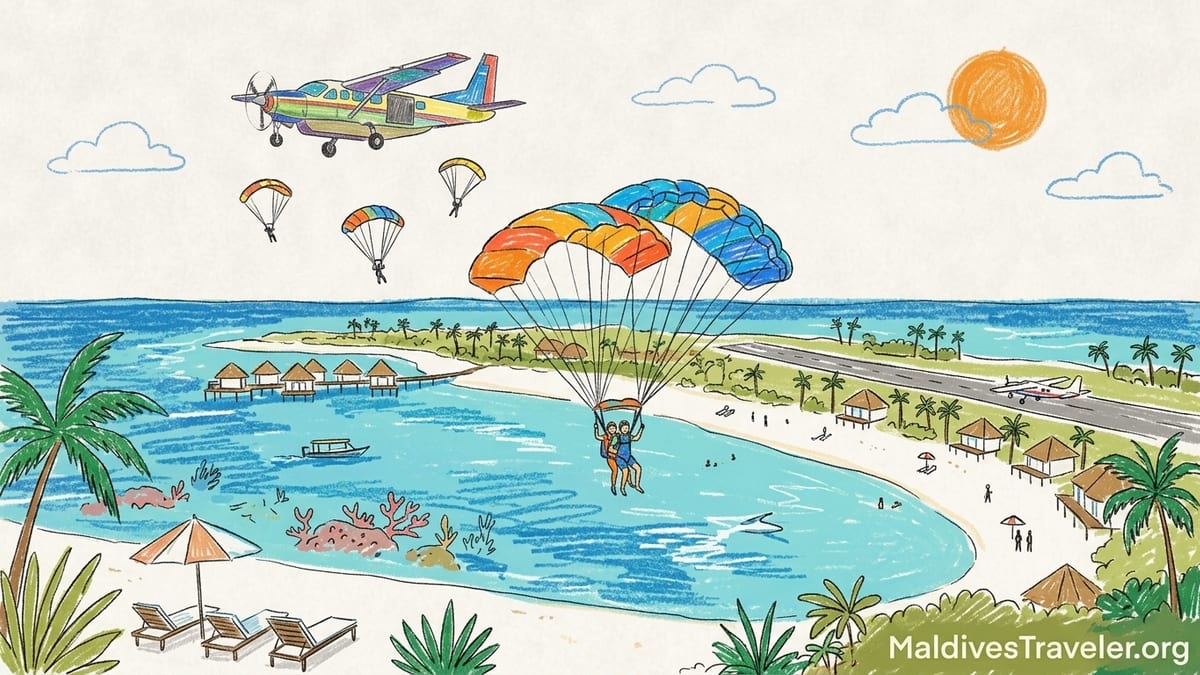
Ifuru Island in Raa Atoll is not just another Maldives resort with a one-off adventure option. It is built around its own private airport on the island, and that runway is what allows Skydive Maldives to operate here as a permanent commercial drop zone. The airfield sits just behind the villas and beach, so on some afternoons you can watch the Cessna Caravan power down the strip and climb out over the atoll while you are still wondering whether you will have the courage to book.
Skydiving in the Maldives used to be limited to short-lived events and demonstration jumps. Ifuru Island changed that by partnering with Skydive Maldives and skydiving specialists from Skydive Wasaga Beach in Canada to design a dedicated tandem operation, staffed by highly experienced international instructors and riggers. Press material from Visit Maldives describes Ifuru as the first permanent skydiving drop zone in the country, and both the resort and Skydive Maldives still promote it as the only place in the Maldives where skydiving runs as an ongoing program rather than a seasonal stunt.
Today, the operation focuses on tandem skydives for resort guests, local residents and work permit holders. The team is led by Canadian skydiver Leslie Farkas, who has logged more than six thousand jumps, the majority as tandem instructor. A master rigger with tens of thousands of pack jobs oversees the gear. For a traveler, the key takeaway is that this is not a casual side hustle. It is a stand-alone skydive center that just happens to be located in the kind of lagoon most people only ever see on honeymoon brochures.
The resort itself is an all inclusive property with sunset-facing villas strung along the western side of the island. You could easily spend a week here doing nothing more stressful than choosing between pool and beach. Yet the presence of a functioning runway, an on-site skydive hangar and the sight of parachutes spiraling down over the ocean give Ifuru a very different energy to a typical Maldives barefoot luxury retreat.
Booking, Prices and What It Really Costs
I booked my jump in advance directly through Skydive Maldives after confirming my stay at Ifuru Island. At the time of my visit in early 2025, the standard tandem from around 13,000 to 13,500 feet was advertised from 699 US dollars per person, plus 8 percent Maldivian goods and services tax. That base price bought the skydive itself, basic ground training, equipment, and a landing back on Ifuru’s airfield.
On top of that, there were several upgrade paths. One popular add-on was a beach landing, which routed the final part of the jump to touch down on the sand just a short walk from the resort’s bars, for an additional fee in the low hundreds of dollars. Further up the scale sat “secret island” and private-island options, with prices around or above four figures, pairing the skydive with a landing on a nearby uninhabited island, champagne, canapés and a short excursion before a boat ride back. Video and photo packages were priced separately, broadly in line with North American and European tandem operations, and could almost double the final bill if you opted for multi-angle footage.
The reality, by the time I added tax and a mid tier video package, was a bill that nudged close to 1,000 US dollars for a single jump. That aligns with what the resort markets as a premium, bucket list experience. It is not cheap even by Maldives standards, where seaplane transfers commonly run several hundred dollars. For many travelers, the price will be the deciding factor. The important thing is to go in with clear eyes about the costs rather than treating it as a casual add-on.
Booking terms were straightforward. I paid a deposit online and settled the remainder on site. The confirmation email clearly emphasized weather dependency and made it plain that jump times were approximate rather than guaranteed. The drop zone typically confirms your slot the evening before, once weather models and local forecasts are updated. During my stay, they contacted me by WhatsApp for any schedule tweaks, which made communication simple as long as I had Wi-Fi at the resort.
Health, Weight Limits and Paperwork You Actually Face
Check-in on the morning of my jump was familiar from other drop zones, but with a few Maldives-specific quirks. First came the waiver, completed on a tablet at the hangar beside the runway. It covered the usual territory: acknowledgement of risk, understanding that skydiving can lead to injury or death, and release of liability for the operator within local law. It took around ten minutes, longer because I actually read it.
Next was the health screening. Skydive Maldives follows broadly similar guidelines to many international tandem operators. You need to be at least 18 years old to sign your own waiver, or provide parental consent if younger, and you are expected to be in reasonably good health with no serious heart, lung or spine conditions. They asked specific questions about previous surgeries, epilepsy, and recent scuba diving. Because decompression sickness risk is a concern, the staff reinforced the standard warning not to skydive within roughly 24 hours of a significant dive, a real consideration at a resort where many guests arrive fresh from the dive center.
Weight limits came up early. At the time of my jump, the publicly listed maximum passenger weight was around 95 kilograms, or just over 200 pounds, with the caveat that body shape and harness fit also matter. This is not unusually strict when compared with tandem operations in North America, where limits commonly fall between 90 and 105 kilograms, but it does mean some travelers will be turned away. At check-in, they weighed me discreetly, including clothes and shoes. There was no shaming and the process felt routine, but it was clear that sneaking under the line would not be possible.
Medical certificates are not routinely required for healthy adults, but I watched one guest who had recently undergone knee surgery be asked to provide a doctor’s note by email before being cleared to jump. If you have any significant health consideration, bringing written medical clearance from home is wise. Island clinics are basic, and getting local sign-off on short notice is neither guaranteed nor cheap. The instructors I met erred on the side of caution, and they made no apology for that.
Training, Gear and the Aircraft Ride to Altitude
The formal training at Ifuru was concise but not rushed. My group of four tandem students spent around 20 minutes with an instructor under a shaded awning by the runway while a previous load was climbing to altitude. The briefing covered aircraft safety, the body position for exit and freefall, hand signals, and landing options. Each instructor then repeated the key points individually with their student, checking understanding and adjusting the harness for fit.
Gear was standard modern tandem equipment. I was fitted with a snug harness that felt closer to a backpack frame than a traditional climbing harness, with wide padded leg straps and chest straps. Once fully tightened, it was more reassuring than comfortable when standing, but in freefall the tightness made sense. I wore a soft helmet and goggles, and I was offered a lightweight jumpsuit to protect my clothes from the slipstream and any rough contact on landing. The tandem rig itself stayed with the instructor, who clipped me into the front attachment points only at the aircraft door after we had shuffled into position.
Our ride to altitude was a single engine Cessna Caravan, a workhorse turbine aircraft widely used in the skydiving world. Inside, bench-style seating ran along the cabin, with students and instructors facing the rear. The climb took around 15 minutes, giving plenty of time to watch Raa Atoll unfold beneath us. Through the open-slotted door and small windows I could see perfect turquoise circles of reef, white sand spits and the dark blue of deep channels. This was already more scenic than most sightseeing flights.
Noise is something many first time jumpers underestimate. Inside the Caravan it was loud, a mix of turbine thrum and slipstream, and conversation quickly shrank to shouts in each other’s ears. My instructor clipped my goggles to my wrist and tapped the altimeter on his hand, pointing at the needle sweeping past 8,000 feet. Somewhere above 10,000 feet he began tightening the harness straps linking us, pulling me back firmly against his chest. Whatever bravado I had left drained away with each pull on the webbing.
The Door, The Exit and How Much of the View You Really Notice in Freefall
We reached exit height a little above 13,000 feet. The red light by the door blinked, the pilot throttled back and the Caravan’s door slid open. Everyone in the aircraft turned toward brightness and sound. The atoll spread out below looked airbrushed: emerald reef rings around electric-blue lagoons, the thin white line of Ifuru’s runway, and distant hints of other islands blurred by haze. My instructor tapped my shoulder, signaled for me to shuffle toward the door and pivoted us so that my feet hung outside over empty sky.
This is the moment many first timers fear most, and Ifuru is no exception. My heart rate spiked, my mouth went dry and I became suddenly aware of every bump in the aluminum floor under my socks. The noise at the doorway was physical, a wall of rushing air that pressed at my cheeks and roared in my ears. My instructor counted down with a shout and gentle rock forward and back, and then there was a sudden, impossible feeling of being tipped out of the world.
Here is the honest part about the view. For the first three or four seconds of freefall, I barely saw anything. My brain was busy processing the shock of acceleration and the unnatural sensation of falling with nothing under my feet. Wind clawed at my jumpsuit at something close to 200 kilometers per hour, my cheeks stretched and any planned smile came out as a wild grimace. I knew intellectually that the atoll was beneath me, but in that initial rush the experience was pure sensation rather than sight.
After those first chaotic seconds, my awareness widened. My instructor had us in a stable belly to earth position, and the reef rings and lagoons resolved into something comprehensible again. It was still loud and intense, but I found myself able to track the curve of the atoll, the patchwork of blues in the lagoon and even a slow moving boat drawing a white wake behind it. Freefall lasted around 45 to 50 seconds. I probably spent half of that time consciously taking in the view, the other half simply existing inside the physical overload of skydiving. If you expect a full minute of calm sightseeing, you will be disappointed. If you go in understanding that you will get flashing, fragmented but unforgettable mental snapshots, you will not.
Canopy, Landing and What It Feels Like to Come Back to Earth
The opening of the parachute was a firm, welcome jolt. One second the wind was battering my face, the next my body curled briefly as the canopy grabbed air and slowed us to something more like a fast bicycle ride. The noise fell away to a background rush, like standing next to a busy coastal road. For most first timers, this is where you can finally breathe and begin to process where you are. Over Raa Atoll, it is also where the scenery finally becomes something you can linger on.
Under canopy, my instructor had me lift my goggles onto my forehead and encouraged me to look around. To our left, the line of Ifuru’s villas stepped along the beach in perfect sequence, their decks jutting toward the surf. Ahead, a scatter of low green islands sat inside a vast shallow lagoon, its colors shifting from milky aquamarine over sandbanks to almost cobalt where the reef dropped away. Beyond that, the Indian Ocean ran to the horizon in a slightly darker band of blue. I have jumped over farmland, desert and coastline in other countries, but I have never seen such sharp contrasts in color or such isolated geometry of reef rings as I did here.
We made a few gentle turns to show off the view, and then the reality of landing reclaimed attention. For standard airfield landings, Skydive Maldives prefers a seated slide on the grass. About 50 meters up, my instructor reminded me to pull my knees up so that my feet were in front of me and slightly off the ground. The touchdown itself was surprisingly smooth, a brief skid through soft grass and then stillness. My heart felt like it was trying to kick through my ribs, but I was laughing and slightly swearing at the same time, an odd cocktail of relief and exhilaration.
Those who book beach or private-island landings have a different last chapter. They touch down on sand rather than grass, then step out of their harness facing a line of palms and the ocean. I watched one such landing later that afternoon, complete with waiting staff and chilled drinks. It looked spectacular and undeniably photogenic, but the essential emotional arc was the same. Everyone walked away slightly dazed and grinning.
Weather, Cancellations and Why Flexibility Matters
Skydiving is intensely weather dependent anywhere in the world, and that reality is amplified in a tropical island nation. Over my four night stay at Ifuru, I watched early morning drizzle roll in without warning, strong upper level winds blow out planned loads, and humidity build into brief, heavy showers by mid afternoon. The staff monitor multiple forecasts along with their own observations and pilots’ reports. The decision whether to fly or hold is often taken load by load, not simply once per day.
In my case, my original afternoon slot was pushed to the next morning because of high winds at altitude. The team messaged me about two hours before check in to warn of the potential hold and gave me the choice of waiting at the hangar or automatically moving to the following day. I chose to move. Another couple on the same flight, who were leaving the island the next day, opted to wait, only to see their entire afternoon canceled when cloud thickened over the drop zone. They received a full refund for the jump fee at the resort front desk, but they left without having experienced the skydive.
Official communication from both Ifuru Island and Skydive Maldives emphasizes this weather dependency. If the operator cancels for safety or weather, they rebook you where possible or arrange a refund for the unused portion of your skydive. That sounds neat on paper, but for real travelers with tightly packed Maldives itineraries it can mean hard choices. If you have only one or two nights on Ifuru, there is a real chance you might not jump. If you build in three or four, your odds improve significantly, but nothing is guaranteed.
This unpredictability also affects video and photo packages. On my rescheduled morning, low scattered cloud meant that some freefall footage featured passing wisps of white rather than uninterrupted lagoon views. It still looked dramatic, but it was not the crystal clear brochure perspective. The instructors and camera flyers cannot control that, and they were candid about conditions before takeoff. Anyone expecting a perfectly choreographed social media clip may need to recalibrate their expectations or accept that they might walk away with a rain check instead of a reel.
The Costly Question: Was It Worth the Maldives Price Tag?
By the time I was back at the resort bar with a post jump espresso, the practical question was already forming. Had a single tandem skydive over Raa Atoll justified spending close to a thousand dollars, on top of an already expensive Maldives trip? On a purely rational spreadsheet, it is hard to argue that it did. I could have taken a scenic seaplane flight over multiple atolls for less, or added several dives on pristine reefs. Most skydives in other parts of the world cost half to two thirds of what I paid at Ifuru.
Yet value in travel is not always about rational accounting. What Ifuru offers is something that does not really exist elsewhere: a chance to freefall over classic Maldivian reef rings and lagoons, with a landing just a short walk from your room, while staying in a fully fledged resort that integrates the skydive into your holiday rather than making it a separate day trip. When I look at the still frames from my video, my body small against huge circles of turquoise and deep blue, it feels like a once only experience.
The fear component also shifts the calculus. I have done several tandems and a handful of solo jumps, but standing in the door over the Indian Ocean was more intimidating than stepping out over farmland or desert. The feeling of exposure was sharper, the sense of being very far from familiar ground stronger. That edge of fear, followed by the release under canopy and the surreal calm of floating above tiny islands, made this jump stand apart emotionally from my others.
If your budget is already stretched to cover flights, transfers and a few nights in an overwater villa, then adding Ifuru’s skydive might feel like too much. In that case, you are unlikely to regret skipping it, because the Maldives has other unforgettable experiences. But if you have financial room and skydiving sits on your life list, I would argue that this is one of the few places in the world where the premium is justified by the uniqueness of the setting.
Who Should Jump, Who Should Stick to Seaplane Views, and Would I Go Again?
Some people should absolutely book this skydive if they can. If you already know you enjoy heights or have skydived elsewhere and loved it, jumping over Raa Atoll is an extraordinary way to revisit the sport. Strong swimmers who are comfortable with open water might also find the idea of flying over the ocean particularly appealing. Photographers and videographers who thrive on unusual aerial perspectives will come away with images that are almost impossible to replicate from a plane window or drone.
There are also travelers for whom the Ifuru skydive is not a good fit. If you are deeply uncomfortable with turbulence or even modest height exposure, the emotional cost may outweigh the thrill, especially given the price. If your itinerary leaves you only one night on the island, your chances of weather disruption are significant and frustration is likely. Anyone approaching or exceeding the stated weight limit, or managing chronic health conditions like uncontrolled hypertension or heart disease, should take the operator’s medical screening seriously and not try to game the system.
Many visitors will be perfectly satisfied with seaplane views instead. Operators flying between Malé and various atolls often route over similar reef formations at 500 to 1,000 meters, and the windows on some domestic flights offer startlingly good photography opportunities. You will not experience freefall or the physical intensity of a skydive, but you will still see the islands and lagoons from the air, and you can do so sitting down with air conditioning and a camera in hand.
Would I jump at Ifuru again? If I found myself back in Raa Atoll with the budget and at least three days on the island, yes. I might choose a different package, perhaps a beach landing at sunset instead of the standard airfield touchdown, or a pared down option without video if I already had footage. I would still accept the weather risk and the cost in exchange for that particular combination of adrenaline and reef geometry. It is not an experience I would repeat every year, but as a once or twice in a lifetime indulgence, it earns its place.
The Takeaway
Skydiving at Ifuru Island is not simply strapping yourself to an instructor and ticking a bucket list box. It is participating in a relatively new chapter of Maldivian tourism, one that leans into adventure as much as relaxation. The permanent drop zone, the on island airstrip and the highly experienced international team behind Skydive Maldives combine to create a product that feels far more serious and professional than a casual resort extra.
The trade off is cost and uncertainty. Prices reflect both the complexity of running a turbine aircraft in a remote island setting and the exclusivity of the experience. Weather in the Maldives can and does disrupt operations, sometimes for an entire day, and no amount of planning can fully remove that variable. Travelers who book a skydive at Ifuru should do so aware that their slot might move or disappear altogether, even if the sun is shining on the beach.
For those who accept those conditions, the reward is a skydive unmatched elsewhere. The sight of Raa Atoll’s reef circles sliding beneath your feet in freefall is as surreal as it sounds. The gentle swing of the canopy against a backdrop of blue on blue is almost meditative after the roar of the exit. You return to earth a little saltier from the humid air, a little poorer in your bank account, but richer in a very particular kind of memory.
Ifuru’s skydive is not for everyone, and that is part of what makes it special. Some will quite reasonably choose seaplane photos, sunset cruises and coral gardens instead. Others will step to the edge of the Caravan door, heart pounding, and leave a small piece of their fear behind in the Maldivian sky.
FAQ
Q1. How much does a tandem skydive at Ifuru Island cost?
Prices for a standard tandem skydive at Ifuru Island have recently started around 699 US dollars per person, plus 8 percent local tax, with extra charges for video, photo packages and optional beach or private-island landings. Exact prices can change between seasons, so it is important to confirm current rates with the operator or resort before you travel.
Q2. What are the age and weight requirements for skydiving at Ifuru?
You need to be an adult to sign your own waiver, and anyone under 18 must have parental consent if accepted. The maximum passenger weight is typically around 95 kilograms or just over 200 pounds, although the final decision depends on body shape, harness fit and instructor assessment on the day. Guests close to the limit should check directly with Skydive Maldives before booking.
Q3. Do I need a medical certificate to jump?
Healthy adults usually do not need a formal medical certificate, but you must complete a health questionnaire covering issues like heart disease, epilepsy, serious back problems and recent surgery. If you have had surgery, significant illness or manage chronic conditions, bringing a doctor’s note that clears you for tandem skydiving is strongly recommended, as instructors may otherwise decline to take you.
Q4. Can I skydive if I have been scuba diving during my Maldives trip?
Skydiving after scuba diving carries a decompression sickness risk, so operators at Ifuru advise against jumping within roughly 24 hours of deeper or repetitive dives. If your Maldives holiday includes both scuba and skydiving, schedule the skydive first or leave at least a full day between your last dive and your jump, and always mention your recent dive history during check-in.
Q5. How long does the whole skydiving experience take?
On the day of your jump you should allow around two to three hours from check-in to landing. This includes signing waivers, the safety briefing, gearing up, waiting for your aircraft slot, a 15 minute climb to altitude, up to a minute of freefall and several minutes under parachute. Delays from weather or air traffic can lengthen the process, so it is wise not to book other fixed activities immediately afterward.
Q6. What happens if the weather is bad or my jump is canceled?
Ifuru’s skydiving operation is highly weather dependent. If winds at altitude, cloud or rain make jumping unsafe, the drop zone will place your booking on hold, attempt to move you to a later load or rebook you for another day. If you cannot reschedule, the unused jump fee is generally refunded, but you may still have paid for resort nights and transfers, which are separate from the skydive.
Q7. What should I wear for a tandem skydive in the Maldives?
Light, comfortable clothing that covers shoulders and thighs works best, such as a T-shirt and longer shorts or leggings, along with closed-toe shoes that can be securely fastened. The operator can provide a jumpsuit to go over your clothes, as well as a helmet and goggles. Avoid loose accessories, scarves and anything that could flap into your face or become tangled during freefall.
Q8. Is the freefall very scary, and will I actually see the scenery?
Most first timers find the exit and first seconds of freefall intense and disorienting, with strong wind noise and a powerful sensation of acceleration. After a short time the body adjusts and many people are able to look around and register the reef rings, lagoons and islands beneath them. You will not calmly sightsee for the entire freefall, but you are likely to come away with vivid mental snapshots of the atoll from above.
Q9. Can I bring my own camera or phone on the jump?
For safety reasons, tandem students are usually not allowed to take loose items such as phones or action cameras on the skydive, because they can slip from hands, strike the aircraft or interfere with the parachute. If you want footage, it is safer to book a professional video or photo package with a dedicated camera flyer or instructor mounted camera, even though it adds significantly to the cost.
Q10. How many days should I plan at Ifuru if I definitely want to skydive?
Because of weather dependency, planning at least three nights on Ifuru Island is sensible if skydiving is a priority. A longer stay gives the drop zone more flexibility to move your booking in response to wind or cloud, increasing the odds that you will jump. Arriving with only one available time slot carries a real risk that adverse conditions could prevent you from getting in the air at all.