


Before I started hopping between the northern atolls of the Maldives, I made what I now consider a classic first-timer’s mistake. Looking at the map, Raa and Baa Atolls appear almost interchangeable: neighboring rings of islands sprinkled with luxury resorts, both marketed with dreamy sandbanks, manta rays and lagoon sunsets. Early on, I assumed that choosing between Raa and Baa was mostly about finding the right deal at the right resort. After several trips, including repeat stays in both atolls, I now know that they deliver very different styles of Maldivian escape and should be sold to very different travelers.
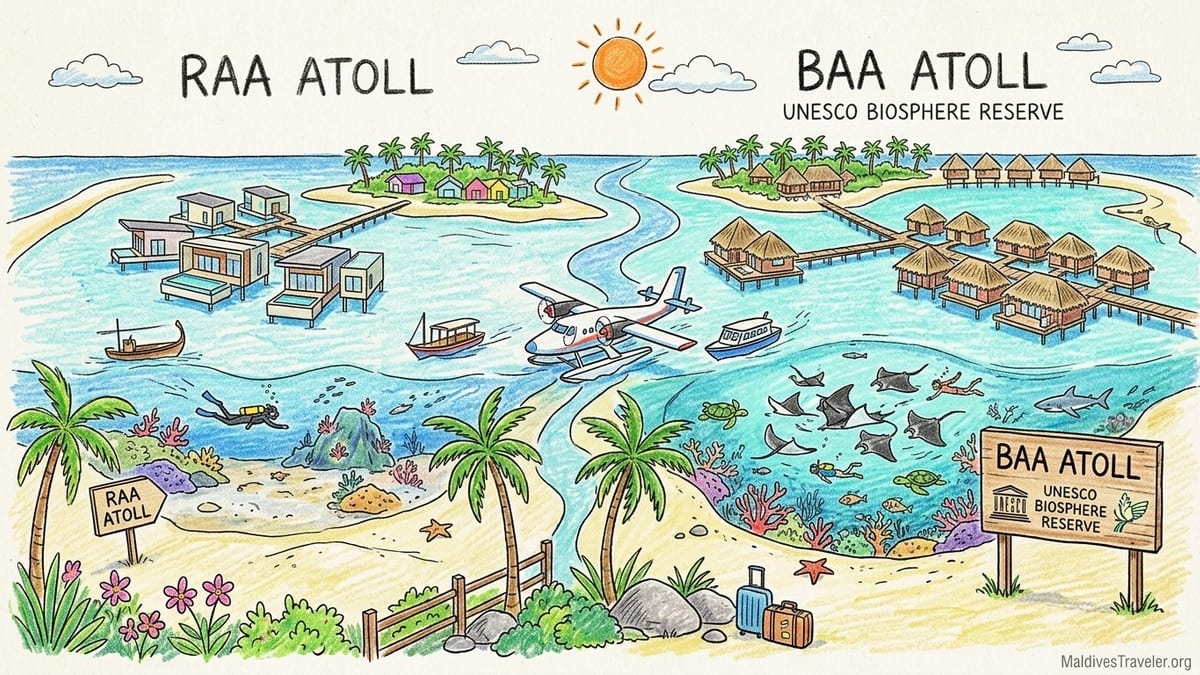
What I Assumed Before Visiting Raa and Baa
My first impression was shaped by glossy resort images and the way many international hotel brands talk about the “Maldives’ northern atolls” as if they were a single, loosely defined region. Raa and Baa sit close together geographically, both reachable by seaplane or domestic flight from Malé, both with a growing list of high-end resorts. On paper, it looked like a simple choice between individual properties, not atolls with distinct personalities. I expected similarly good reefs, similar chances to see manta rays and whale sharks, and broadly similar levels of development.
Marketing copy reinforced that impression. Brochures for Raa resorts casually referenced “easy access to famous manta sites” without always clarifying that Hanifaru Bay, the most iconic feeding aggregation zone for manta rays in the Maldives, is firmly inside Baa Atoll’s UNESCO Biosphere Reserve, not within Raa’s boundaries. At the same time, Baa resort websites leaned heavily into the UNESCO story, which I assumed might be more branding than real, on-the-ground difference.
What I expected, essentially, was two near-identical lagoon playgrounds separated more by logo than by landscape. I imagined Baa as perhaps slightly busier and pricier because of the UNESCO status and big-name resorts, and Raa as the lower-profile neighbor where you could quietly enjoy similar experiences for a little less. I went in prepared to write them up as variations on a theme.
Instead, the gaps between my assumptions and reality started appearing from the moment I boarded my first seaplane north, and they only widened as I moved between resorts, dive centers and local islands across several trips.
How the Two Atolls Really Differ Once You Are There
On arrival, the first difference shows in the sky. Flying into Baa during the day, the seaplane banks low over a tight cluster of resort islands, many of them with long jetties of overwater villas and clearly etched house reefs. The atoll has one of the Maldives’ strongest concentrations of high-end resort islands, from established names like Soneva Fushi and Coco Palm Dhuni Kolhu to newer luxury openings such as Avani+ Fares, and you feel that density as you look down on the lagoon. Yet once you land, the zoning is careful enough that you rarely see neighboring resorts from your sun lounger, so the density is visual from the air more than it is intrusive on the ground.
In Raa, the scatter of resorts is more recent and still noticeably thinner. Travel industry data and government reports over the last few years show Raa joining the top tier of atolls for luxury room inventory, but that growth has come from a wave of new-build properties rather than from long-established “old guard” resorts. On arrival, the islands feel a little farther apart, with large swathes of open reef and channel in between. Transfers often route via Ifuru’s domestic airport or longer seaplane runs, which gives a genuine sense of distance from Malé’s busier central atolls.
Underwater, Baa’s identity is shaped by its UNESCO Biosphere Reserve designation and the cluster of protected sites that surround Hanifaru Bay. The reefs around some of the top Baa resorts have had more years of diver traffic and bleaching to cope with, but the combination of marine protection measures and tidal plankton flows still supports concentrated marine life, from reef sharks to turtles and, in season, feeding manta rays in the channels. In contrast, Raa’s draw lies as much in its thilas and outer-reef dive sites, which many divers describe as feeling slightly more frontier-like and less trafficked, as in its house reefs.
Culture also presents differently. Baa has a number of inhabited local islands that are now firmly in the day-trip and guesthouse circuit from resorts, making it relatively easy to add a visit to a traditional community to a high-end stay. In Raa, the tourism growth curve has been steeper in just the last decade, so some local islands are still in earlier stages of tourism development, which can create more “unpackaged” experiences for travelers who want to see daily life beyond curated cultural nights at resort amphitheaters.
Where Raa Fell Short Compared With Baa
If your primary reason for going north is manta encounters, this is where expectations can be badly misaligned. Hanifaru Bay, the poster child for reef manta feeding in the Maldives, sits clearly within Baa Atoll’s protected area network and is managed under specific regulations issued by Maldivian authorities. These rules include a maximum number of snorkelers in the bay at any one time, time limits per visit and restrictions on divers entering the bay itself. During peak season, roughly June to November, Baa-based resorts and Dharavandhoo guesthouses run tightly scheduled trips that can be full weeks in advance.
Some Raa resorts promote seasonal manta excursions that use regional manta movements and cleaning stations outside Baa’s core protected sites. Those trips can be worthwhile, and there are legitimate manta cleaning and feeding areas north of Baa. But in practice, if you are picturing the iconic scenes of dozens of manta rays barrel-rolling in exceptionally shallow, bowl-shaped water under tightly controlled visitor rules, that is the Hanifaru Bay experience, not a Raa atoll outing. On my first Raa trip, guests at my resort were surprised to learn that a Hanifaru visit would require a separate domestic flight or long boat journey into Baa, with extra cost and time that had not been obvious when they booked.
In terms of marine protection identity, Baa’s head start is also hard to ignore. The atoll’s designation as a UNESCO Biosphere Reserve in 2011 followed formal assessments of its reefs, lagoons and mangroves, and many Baa resorts now integrate research partnerships, volunteer citizen science and structured educational talks into their daily programming. On stays at midrange and luxury properties there, I found marine biology staff visible, approachable and busy, not tucked away as an optional extra. By contrast, several Raa resorts I have visited are still building out that scientific and conservation presence; a few rely on visiting consultants or outsource interpretive work to dive centers rather than housing full-time marine teams.
Baa also tends to edge ahead for serious snorkelers who want very strong house reefs right off the beach. There are exceptions in every atoll, and bleaching has taken a toll across the country, but the best Baa house reefs around islands such as those hosting The Nautilus or Dusit Thani still offer steep drop-offs and reliable turtle, reef shark and schooling fish action a short fin from shore. In Raa, I have had good house-reef snorkels, but more often the real highlights required boat trips to thilas or outer walls. For travelers who like the freedom to mask up several times a day without signing up for excursions, that is an important distinction.
Finally, if you value depth of choice within a single atoll, Baa’s maturity is a structural advantage. On a ten-night trip, for example, you can pair a high-concept private-island resort like Soneva Fushi with a more conventional full-service property such as Royal Island or Reethi Beach, all within the same atoll and on similar transfer routes. In Raa, the resort mix is improving fast, but your spectrum is still narrower and more heavily skewed to modern, design-driven properties that opened within the last decade.
Where Raa Quietly Outperformed Baa
For all that, there are several areas where I would now actively steer certain travelers to Raa over Baa. The first is for those who prioritize new-build hardware and very polished all-inclusive concepts. Resorts such as Emerald Maldives Resort & Spa, Kudafushi, and Amari Raaya Maldives are part of a recent wave of investments that have given Raa an impressive concentration of fresh villas, generous entry-level room sizes and extensive included dining for the price point. When I compared like-for-like travel dates between new Raa properties and established Baa icons, nightly rates in Raa were often meaningfully lower for similar villa categories, especially under all-inclusive or premium-all-inclusive plans.
The second advantage is Raa’s sense of visual and social space. Although Baa’s resort zoning is intelligent, you are in a known hot spot where Hanifaru-focused traffic bumps up overall visitor numbers between about June and November. In Raa, even larger resorts frequently feel unrushed because the surrounding seascape is not funneling day boats into a single protected bay. When I stayed at a mid-sized Raa island with overwater villas, I could walk long stretches of beach without seeing more than a handful of other guests, and boat traffic in the channel stayed minimal outside of scheduled dives and excursions.
Underwater, Raa’s thila and channel diving delivered some of my most memorable northern Maldives dives. While Baa gives you density of life around well-known sites, Raa offers a slightly more exploratory character, with pinnacles that rise from deeper water, cleaning stations that feel less visited and drift dives where we rarely saw other groups. Local dive centers in Raa were frank that their reef recovery curves are still in progress after warm-water events, but they also pointed to areas where coral regrowth and fish biomass are responding quickly in the relative absence of heavy pressure.
There is also a cultural freshness to Raa that I came to appreciate over repeat visits. With tourism growth coming later here, collaborations between resorts and nearby inhabited islands are, in some cases, being designed from scratch rather than retrofitted onto established patterns. I have seen newer cultural programming that brings local craftspeople and musicians to resort spaces on their own terms, and excursions that spend more time talking about contemporary island life, fishing practices and education than simply walking past a mosque and a school for photos. For travelers interested in seeing how the Maldives is negotiating the relationship between luxury tourism and local identity now, rather than twenty years ago, Raa can be especially revealing.
Lastly, for guests connecting on late international arrivals or departures, Raa’s combination of seaplane services and domestic flights via Ifuru has quietly improved logistics. Baa still relies heavily on daytime seaplane transfers that are tied to daylight hours. In Raa, some resorts can now route guests via evening domestic flights plus short boat rides, which allows arrivals later than the classic Malé seaplane cut-offs. This may not matter to everyone, but if your international schedule is tight, the extra flexibility can reduce the need for overnight stops in the capital region.
Resort Density, Style and Price: What You Actually See and Pay
Looking purely at numbers, official Maldivian tourism reports and industry analyses consistently list both Raa and Baa among the top atolls for high-end resort inventory, though they still trail Kaafu, the atoll around Malé, in raw resort count. Baa’s stock skews toward established luxury and ultra-luxury brands operating on the classic “one-island-one-resort” model, including properties from Four Seasons, Anantara and several independent high-end operators. Nightly prices at these flagships can easily start in the high hundreds of US dollars in shoulder season and rise sharply in peak months.
Raa’s portfolio, by contrast, has grown most dramatically in the last five to ten years, with modern design, larger integrated kids’ clubs and wellness complexes, and aggressive all-inclusive plans as common selling points. Some of these resorts are affiliated with international chains; others are regional luxury or upper-upscale brands targeting families and couples who want cost certainty. On my own bookings and sample price checks, I have repeatedly seen strong value in Raa when comparing like-for-like villa sizes and meal plans. For example, a contemporary Raa all-inclusive resort may offer a spacious beach villa with multiple restaurant access under one fixed daily rate that undercuts a Baa property of similar standard where half board or bed-and-breakfast remains the default.
In terms of style, Baa’s long-established resorts often lean into “barefoot luxury” aesthetics that emphasize sand floors, natural materials and a sense of under-designed ease. Think palm-shaded pathways, thatch and timber, and open-sided lounges. Several have undergone sensitive refurbishments but still retain their original relaxed DNA. Raa’s newer builds, in contrast, feel more overtly polished. Expect cleaner architectural lines, larger glass surfaces, modern interior palettes and more purpose-built Instagrammable corners. Whether that is positive or negative depends on your taste; some travelers want exactly that contemporary feel, while others prefer the softer edges of older Baa properties.
Density on the ground also feels different. Because Baa’s most famous resorts are often full or near full in high season, shared spaces such as breakfast buffets, main pools and excursion sign-up desks can hum with activity even if villas are well spread out. In Raa, newer supply means that some properties are still building their repeat-guest base, and occupancy can be more variable. As a result, outside of the busiest holiday peaks, shared areas can feel notably quieter. On one February visit to a Raa resort with over one hundred villas, I routinely walked into restaurants at prime time without needing reservations, something that would be rare in several headline Baa properties on similar dates.
House Reefs, Diving and Snorkeling: Choosing the Right Underwater Focus
Both atolls offer quality underwater experiences, but they reward different priorities. If you picture your ideal day as waking up, stepping off your villa deck and drifting along a steep reef wall multiple times between breakfast and sunset, Baa is more likely to deliver that without added logistics. Several of its better-known resorts sit either directly on strong house reefs or within a few minutes’ dhoni ride of outer walls that host turtles, reef sharks and vibrant schooling fish. During my stays at Baa properties, I found it easy to snorkel independently two or three times a day while still fitting in dives or excursions.
Raa’s sweet spot, in contrast, lies in boat-access sites, particularly thilas that rise from deeper water and channel walls that channel currents. Dive operators based in Raa frequently highlight these sites in their briefings, noting that fish biomass and pelagic sightings can be excellent when conditions align. On a series of drift dives there, I logged grey reef sharks, eagle rays and swirling schools of fusiliers, with minimal overlap from other dive boats. For experienced divers who enjoy slightly longer boat rides and the feeling of exploring less-trafficked sites, this can be a strong selling point.
For casual snorkelers and young families, this distinction matters in subtle ways. In Baa, you can often have a fulfilling underwater experience without committing to scheduled excursions; a mask, fins and a sense of timing around tides are enough. In Raa, you are more likely to reach for the excursion board to tick off the best reefs and fish action. Some Raa resorts compensate by running frequent, sometimes complimentary snorkeling trips to nearby thilas, but that still introduces timetables and sign-ups into what some guests hope will be spontaneous swims.
Marine conditions are also in flux across both atolls due to warming events, and any blanket statements about “best reefs” risk being outdated quickly. On recent visits, I have seen sections of both Baa and Raa where hard corals are still in recovery but fish life remains healthy, as well as pockets of surprisingly resilient coral gardens. The difference is that Baa’s UNESCO status has driven more systematic monitoring and, in some cases, active restoration projects around resorts, whereas in Raa the conservation picture is more patchwork, varying by operator commitment rather than atoll-wide programs.
Transfers, Local Islands and Nature Identity
Getting to either atoll starts at Velana International Airport near Malé, but the onward journey shapes the psychological distance you feel from the capital. Baa is typically reached by a 30 to 40 minute seaplane hop or a domestic flight to Dharavandhoo followed by a short speedboat transfer. The seaplane ride is a spectacular introduction to the country’s geography, and many resorts build it into their sense of arrival. Schedules, however, are bound to daylight and subject to weather, so early-morning or late-night international connections can require an overnight in the Malé area.
Raa is a little farther out, but improvements at Ifuru domestic airport and the route network of seaplane operators have given travelers more options. Some Raa resorts now offer a choice between direct seaplane flights of around 45 minutes and domestic evening hops to Ifuru, with 20 to 40 minute boat rides to follow. In practice, that additional flexibility can be helpful for families trying to avoid extra nights in transit hotels or for travelers arriving late from Europe or North America.
Local island access and “real Maldives” experiences also play out differently. Baa’s inhabited islands have had longer to adapt to excursions and to run their own guesthouses, so visits tend to follow a fairly polished script: guided walks, handicraft stops, a café visit or two and time on a bikini beach where tourists can swim within local cultural norms. In Raa, I encountered a wider range of approaches, from more informal village tours where guides focused as much on current education and work opportunities as on tradition, to collaborations where local cooperatives supplied food, music or artwork direct to nearby resorts. For some travelers, that relative rawness is a plus; for others who prefer fully standardized, softly packaged cultural content, Baa may feel smoother.
When it comes to nature identity, Baa has an unambiguous headline: UNESCO Biosphere Reserve. That badge reflects not just Hanifaru Bay but a network of protected reefs, mangroves and island ecosystems, and it comes with ongoing monitoring and management plans. As a guest, you feel that in small ways: more educational signage, more structured briefings before wildlife encounters, and more frequent opportunities to join talks or citizen science activities. Raa, lacking that single unifying label, communicates its nature story more through individual resort initiatives, whether that is a house-reef restoration project, a partnership with a marine NGO or a focus on sea turtle conservation at a particular island.
Which Traveler Should Choose Each Atoll
After multiple trips, I have stopped thinking of Raa and Baa as rivals and started seeing them as answers to different travel questions. If you are a marine-life-focused traveler, particularly obsessed with manta rays and the idea of snorkeling among dense feeding aggregations, then Baa is the clearer fit. You will be closer to Hanifaru Bay during its main season and plugged into an atoll-wide network that has grown up around managing those encounters. You will also have a stronger concentration of established house-reef resorts to choose from if daily, independent snorkeling is central to your plan.
Baa is also where I would point travelers whose budget and expectations align with classic barefoot luxury and brand-name service. Honeymooners who want a polished but relaxed experience with serious food and wine programs, strong spa offerings and a sense of being in a protected natural environment will find multiple matches here. Experienced Maldives guests returning for a second or third time often gravitate to Baa because they know the marine life and service levels are reliably high and they are willing to pay for that certainty.
Raa, on the other hand, is where I now send travelers who prioritize value within the upper-upscale and luxury bands, who like the feeling of space and who are more drawn to diving and exploring than to ticking off a specific wildlife bucket list item. Families looking for contemporary villas, large kids’ clubs and comprehensive all-inclusive plans can often stretch their budget further in Raa without sacrificing comfort. Divers who enjoy thilas, channels and the sense of being slightly ahead of the curve in a developing luxury region tend to come back from Raa energized.
If your ideal Maldives trip includes a strong cultural component, the choice is more finely balanced. Baa’s longer tourism history has created smoother, more standardized local-island excursions, which are great if you prefer predictability. Raa’s shorter history in mass tourism has resulted in some more experimental and, to my eye, more nuanced collaborations, which will suit travelers who are comfortable with less scripted experiences and who value contemporary cultural conversations as much as heritage displays.
The Takeaway
The biggest lesson from my time in Raa and Baa is that neighboring atolls can deliver substantially different Maldives trips, even when the brochures look similar. Raa is not “Baa without UNESCO” and Baa is not “Raa with mantas added.” They sit side by side on the map but occupy different niches in the country’s tourism story. If you book Raa expecting daily access to Hanifaru Bay, or you pick Baa hoping for frontier-style diving and contemporary all-inclusive design at mid-range luxury prices, you are likely to be disappointed.
Instead of looking for a single winner, it is more useful to ask what kind of Maldives experience you want. For manta-focused wildlife encounters within a structured conservation framework, for dense but carefully managed luxury and for strong house-reef snorkeling, Baa is the more logical base. For newer high-end resorts, generous all-inclusive plans, a sense of space and exploratory thila and channel diving, Raa has a compelling edge. Both atolls are credible choices for a first or repeat trip; the key is to align your main goal with the atoll that actually supports it.
Viewed that way, the “right” atoll is less about prestige and more about fit. A couple planning a once-in-a-lifetime honeymoon built around marine biology talks and peak manta season probably belongs in Baa. A multi-generational family balancing budget, kids’ facilities and a desire to feel away from the busiest circuits will often be happier in Raa. Get that match right at the comparison stage, before you put down a deposit, and you are far more likely to step off the seaplane into the version of the Maldives you have been imagining.
FAQ
Q1. Is Hanifaru Bay in Raa or Baa Atoll?
Hanifaru Bay is inside Baa Atoll, within a protected area that forms part of the Baa Atoll UNESCO Biosphere Reserve. It is not in Raa Atoll.
Q2. Can I visit Hanifaru Bay easily from a resort in Raa Atoll?
Reaching Hanifaru Bay from Raa usually requires additional flights or long boat transfers via Baa, which add cost and time. It is far simpler to stay in Baa if Hanifaru is a priority.
Q3. Which atoll is better for strong house-reef snorkeling right off the beach?
Baa generally has the edge for house-reef snorkeling, with several resorts offering steep drop-offs and rich marine life just a short swim from shore.
Q4. Which atoll offers better value for modern luxury and all-inclusive plans?
Raa tends to offer stronger value for newer villas and comprehensive all-inclusive packages, especially at upper-upscale and entry-level luxury price points.
Q5. Are the dives in Raa Atoll as good as in Baa Atoll?
They are different rather than better or worse. Raa stands out for thila and channel dives that feel less trafficked, while Baa combines solid diving with easier access to marquee manta experiences.
Q6. How long are the transfers from Malé to Raa and Baa?
Seaplane transfers to Baa are typically around 30 to 40 minutes, while Raa can take about 45 minutes by seaplane or a combination of domestic flight and boat of similar total duration.
Q7. Which atoll should honeymooners choose?
Honeymooners focused on mantas, barefoot luxury and brand-name resorts often lean toward Baa, while those wanting newer design-focused properties and more inclusive pricing may prefer Raa.
Q8. Is one atoll noticeably more crowded than the other?
Baa has more long-established resorts and can feel busier in shared spaces during peak manta season, while Raa’s newer supply and wider spacing often create a quieter on-island feel.
Q9. Where will I find more developed cultural excursions to local islands?
Baa’s longer tourism history means its local-island excursions are generally more standardized, whereas Raa can offer more varied and sometimes less scripted cultural experiences.
Q10. If I am planning my very first Maldives trip, which atoll is safer to pick?
If your dream centers on manta rays and a classic Maldives image, Baa is the safer choice. If you prioritize budget stretch, new hardware and space, Raa can be an excellent first atoll.