


The photos of Vaadhoo’s “Sea of Stars” in Raa Atoll look almost unreal: shorelines that glow electric blue, waves that seem to carry galaxies to the sand. Those images have turned this small Maldivian island into a global search phenomenon. Yet the reality on the beach is far more nuanced. Bioluminescent plankton is wonderful, but it is also wild, unpredictable and often much subtler to the naked eye than social media suggests. This is what it was actually like to wait on Vaadhoo for a genuine sighting, night after night, until the water finally lit up.
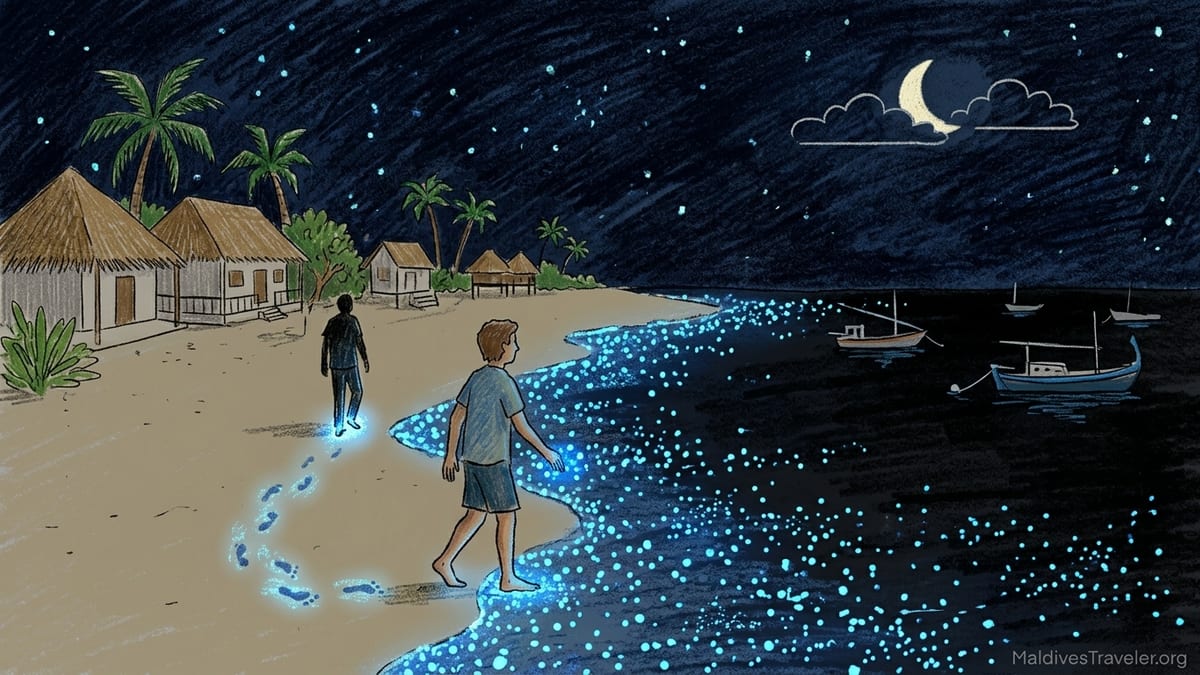
Why Vaadhoo Became the “Sea of Stars” Island
Vaadhoo is a low, sandy local island near the southern edge of Raa Atoll in the northern Maldives. It sits about 190 to 200 kilometers north of Malé and is connected to the rest of the atoll by public ferries and small speedboats, while nearby resorts use their own transfer launches. The island would once have been just another quiet fishing and family community if it were not for a set of long-exposure photographs that went viral almost a decade ago, showing its shoreline glowing in an intense neon blue.
Those images were real in the sense that they recorded bioluminescent plankton, but they were also products of specific camera settings and unusually strong blooms. When travel marketing picked them up, Vaadhoo was quickly labeled a place where you could simply “go and see the Sea of Stars.” Online guides began promising that the beach glows for much of the year and that visitors could reliably time their trip to catch it, often quoting vague seasonal windows without explaining how hit-and-miss the phenomenon actually is.
Marine guides in the Maldives now regularly try to correct those expectations. Bioluminescent displays around the archipelago are caused by microscopic dinoflagellate plankton, especially species such as Noctiluca scintillans, sometimes called sea sparkle. These organisms emit light when mechanically disturbed by waves, currents or footsteps in the shallows. Local reports consistently describe Vaadhoo as one of several islands where this happens, not the single guaranteed beach that much of the internet still implies.
By the time I arrived on Vaadhoo, every guesthouse owner and boat captain was used to the same question: “Will I see the Sea of Stars tonight?” Their answers were cautious. They pointed to recent nights when nothing at all had glowed and to others when the lagoon had sparked into life for just an hour, then faded as the tide turned or thin cloud drifted away from the moon.
Getting to Vaadhoo and Settling In
Reaching Vaadhoo involves at least two stages from Malé. The fastest route at the time of my visit was a domestic flight to Ifuru or another regional airport in northern Maldives, followed by a short speedboat run of around 15 minutes across the atoll to Vaadhoo’s small harbor. Local officials describe the island as lying just under 200 kilometers from the capital, with regular boat connections within Raa Atoll and at least one weekly link that runs all the way to Malé when seas are suitable.
Travelers on tighter budgets often choose a slower combination of the government-operated MTCC atoll ferry system and occasional chartered boats. Schedules can change with weather and demand, and some services do not run daily, so I planned a spare day at each end of my journey in case a crossing was canceled. On my arrival day the sea was calm, the northeast monsoon was still dominant, and the speedboat transfer from the domestic airport cost just under the equivalent of 40 to 50 US dollars per person when shared with other passengers.
Vaadhoo’s tourism offering centers on simple guesthouses rather than luxury resorts. The island had one registered guesthouse at the time of the most recent tourism statistics, and several small properties were either opening or in planning. Rooms tended to fall in the 60 to 120 US dollar per night range for two people including breakfast, depending on season, with optional paid dinners, snorkeling trips and sandbank picnics. The atmosphere was relaxed and residential. Children cycled along sandy lanes and fishermen worked from small boats; there were no overwater villas, branded beach clubs or formal dress codes.
This local-island setup shaped my Sea of Stars experience. There was no fixed “bioluminescence excursion” I could book in advance. Instead, my guesthouse hosts told me at check-in that they would watch the shoreline each evening. If they noticed brighter-than-usual sparks in the surf or heard from neighbors on another side of the island, they would knock on my door or call my local number, and we would walk to the beach together, torches switched off as soon as we cleared the last houses.
The Night It Finally Glowed: Exact Conditions
I stayed on Vaadhoo for six nights in late April, straddling the end of the dry northeast monsoon and the beginning of the transition toward wetter southwest winds. Out of those six nights, only one produced the kind of continuous glow that matched my mental picture of the Sea of Stars. Two others offered scattered sparks in the wash of small waves. The remaining nights were quiet, with nothing visible beyond the usual reflection of starlight on the black lagoon.
The strongest display came on my fourth night, on 27 April. The local tide chart taped up in the harbor office showed a high tide shortly before sunset and a falling tide through the evening. By around 9:30 p.m. the waterline had retreated, exposing a wider band of wet sand on the leeward side of the island where wave action is usually gentler. That strip became the canvas on which the bioluminescence appeared.
The moon was just past its last quarter. It rose late and stayed hidden behind a belt of broken cloud until almost midnight, which meant that from roughly 9:30 to 11:00 p.m. the beach was relatively dark. There were no bright resort lights on this side of Vaadhoo, only a few house bulbs partially shielded by palms. A light swell rolled into the lagoon, enough to churn surface water without creating breaking surf. Air temperature hovered around 28 degrees Celsius and there was only a faint onshore breeze.
The first hint of the glow was easy to miss. When my host stepped ahead of me, the wet sand in his footprints flashed pale blue for a blink and then disappeared. A few seconds later, a small wave collapsed near my ankle and fizzed with hundreds of pinpricks of light. Within fifteen minutes the entire length of the visible shoreline showed scattered patches of blue-white bursts where waves folded over themselves, particularly around bits of driftwood or small coral heads where the water was forced to swirl more vigorously.
What the Sea of Stars Actually Looked Like to the Naked Eye
Standing on Vaadhoo’s sand that night, the glow was real and unquestionably magical, but it did not resemble the photographs that first drew me here. To my eyes, the bioluminescence looked like a dense scatter of firefly flashes in the water rather than a continuous band of icy neon. Each burst was a tiny, distinct pin of light that appeared when a wave broke or when I dragged my foot gently through the shallows, then vanished almost instantly once the water calmed.
Along some sections of the beach, especially where the water skimmed very shallowly over smooth sand, the effect came close to a milky, streaked glow. This happened when a wave collapsed and then rolled back, carrying agitated plankton with it in a thin sheet. For a heartbeat or two, it looked as though a luminous outline traced the wave’s receding edge. Farther offshore, where the water was deeper and the swell had more energy, entire patches of the lagoon flickered in response to unseen movement, occasionally making it feel as though something vast was shifting just below the surface.
Long-exposure images compress and amplify those brief flashes. When a camera sensor collects light for ten, twenty or thirty seconds, every microscopic spark produced during that window is layered into the same frame. The result is the familiar, almost metallic ribbon of blue across the sand that dominates social media. Seen moment by moment with the naked eye, however, the Sea of Stars is a living, moving field of points that blink in and out of existence with each step and each wave, more like embers than like floodlighting.
That discrepancy matters for expectations. Some other travelers staying on the island during my visit were visibly disappointed on the first “glow night.” They had flown halfway around the world hoping for a beach that looked like a backlit advertisement. What they found was quieter and more subtle, beautiful in a different way. For me, seeing the individual organisms respond in real time to my footsteps and hand movements was more compelling than a static wall of color could ever have been.
Walking Through the Glow and Trying to Photograph It
The most immediately satisfying way to experience the bioluminescence on Vaadhoo was to interact with it gently. When I walked close to the waterline, each step into damp sand released a burst of scattered sparks around my toes, as though my footprints were briefly filled with crushed stars. Kicking at the very edge of a receding wave created a fan of light that arced outward and then fragmented as the droplets hit the surface again. Running a hand through the darkest parts of the shallows left a short-lived trail of blue behind my fingers that faded as quickly as it had appeared.
The brightness of each flash was strong enough for me to see individual grains of sand and tiny bubbles for a fraction of a second, but not so intense that it illuminated my whole body. If I looked back up the beach, I could see other guests as silhouettes only when they disturbed the water, briefly haloed by the sparks around their ankles. The deeper I went, the less pronounced the effect became, since the agitation of a step or hand movement was spread through a larger volume of water instead of being focused in a thin surface layer.
Photographing this was significantly more difficult than simply enjoying it. Using a mirrorless camera with a medium-wide lens, I ended up working mostly around ISO 6400 to 8000, at apertures between f/1.8 and f/2.8, with shutter speeds from 6 to 15 seconds on a stable tripod. Those settings produced images that looked much brighter and richer in color than what I could see unaided. When I tried to shorten the exposure to reflect my real-time impression more closely, the number of visible sparks dropped dramatically, and many frames showed only a few faint dots above black water.
Handheld smartphone pictures were almost impossible without visible noise and blur. Newer high-end phones did better in their dedicated night or long-exposure modes, but even then the shots exaggerated the continuity of the glow compared with what we witnessed on the sand. In practice, the most honest visual record of that night on Vaadhoo was a short video taken at a high ISO where single flashes appeared and disappeared across the frame in response to each incoming wave, rather than any of the still photographs we brought home.
Why Bioluminescence Cannot Be Guaranteed
After the excitement of that glowing night, the next evening on Vaadhoo was almost entirely dark again. The tide and approximate moon phase were similar, but a fresh wind had risen over the atoll, churning the lagoon and pushing small waves farther up the beach. My host suggested that stronger mixing may have dispersed the densest plankton patches, or simply moved them away from the visible shoreline. Whatever the reason, we saw only a few isolated sparks near bits of seaweed when we spent half an hour walking the beach with our torches off.
Marine biologists who work in the Maldives emphasize that several factors likely interact to create a strong bioluminescent display. These include the abundance of dinoflagellate plankton in the water, which in turn depends on nutrients and currents; the calmness of the sea, which lets organisms accumulate at the surface; the degree of darkness along the beach; and the precise timing of tides and local weather. Some tour operators suggest that the second half of the year, around the southwest monsoon, brings more frequent sightings in some atolls, while others report reliable flashes even in the classic dry season.
What there is not, at least so far, is a peer-reviewed scientific calendar that can tell you that Vaadhoo or any other Maldivian island will glow on a specific date. Local guides can talk about patterns they have noticed. For example, several people on Vaadhoo told me they tend to see stronger displays when the sea has been calm for a few days and when there is limited moonlight in the early evening. Yet those are correlations rather than guarantees. During my own late-April stay, two new arrivals who had spent a week at another island in the same atoll reported not seeing any bioluminescence there at all, despite following similar “new moon, calm sea” advice.
This uncertainty is not a flaw in the experience. It is simply the nature of a wild marine event. The Sea of Stars is not a show that the Maldives can switch on for visitors, and any brochure or blog that suggests otherwise is overselling it. Travelers who understand this and build flexibility into their itineraries are far more likely to leave satisfied, whether they encounter a blinding bloom or only a few scattered firefly flashes at the edge of their torch beam.
Listening to Local Knowledge vs Generic Internet Advice
One of the most useful practical lessons from my time on Vaadhoo was that asking local hosts about recent nights mattered far more than following general claims from search results. Before I traveled, I read guides that named whole months as the “best time” to see the Sea of Stars and implied that Vaadhoo’s beach glows on most calm evenings within that window. None of those sources listed which year their observations came from or whether the author had stayed on the island for more than a night or two.
In contrast, my guesthouse owner had a mental ledger of every significant glow in the previous few weeks. He could say, for example, that the beach had lit up strongly twice in the ten days before my arrival, once around a higher tide just after sunset and once closer to midnight when the moon dipped behind thicker cloud. He also knew which stretch of shoreline tended to collect the densest water when the wind came from a particular direction, and he was ready to arrange a small boat if reports came in of plankton accumulating on the far side of the island where there was no easy footpath.
On my second day he casually mentioned that the water looked “too green” in the shallows for a strong glow that night, meaning that the daytime color suggested different suspended material dominating the mix. That evening we walked out to check anyway but agreed within ten minutes that nothing was happening. When the conditions improved two nights later, it was the hosts who sensed it first from the unusual brightness in breaking waves and moved quickly to call guests out of their rooms.
This kind of nuanced, real-time reading of the sea cannot be replaced by generic internet advice, however confidently written. If you want to maximize your odds of seeing plankton glow on Vaadhoo or anywhere else in Raa Atoll, it is worth choosing accommodation whose staff are used to watching for the phenomenon and are honest about how often it does not appear. In practice, that can matter more than whether you visit in one shoulder month or another.
Is the Sea of Stars Worth Planning a Raa Atoll Trip Around?
After nearly a week on Vaadhoo with just one truly outstanding glow, I left convinced of two things. First, the Sea of Stars is worth experiencing if it happens while you are in Raa Atoll. There was a genuine sense of awe in watching the shoreline light up under our feet, especially knowing that each flash represented a living organism responding instantly to a disturbance. Second, structuring an entire Maldivian itinerary around the hope of that one moment is a risky use of both money and time.
Raa Atoll offers plenty to justify a visit regardless of whether the beach glows. On my non-bioluminescent nights I joined a dusk fishing trip with local crew, drifted over coral gardens on a snorkel excursion, and spent long afternoons under palms at the island’s public bikini beach. Nearby resort islands market their own versions of Maldivian luxury, while local islands give a quieter, culturally grounded experience. Air connections to the regional airports serving Raa are improving, and the network of guesthouses continues to grow, often at lower nightly rates than comparable properties in more famous atolls.
Seen in that light, the Sea of Stars is best approached as a bonus rather than a goal. If you are already interested in Raa Atoll for its reefs, slower pace and relative lack of crowds, then choosing Vaadhoo or another island where locals keep an eye out for bioluminescence makes sense. You might be lucky, as I was, and stand on a sandbank where every wave writes a temporary constellation at your feet. You might also spend a week under dark, clear skies and see nothing at all beyond the Milky Way overhead, which is its own kind of reward.
The important thing is to travel with an understanding that nature does not work to our schedules. On Vaadhoo, the Sea of Stars arrived once, unexpectedly, on a warm April night when the tide, wind, moon and invisible drifts of plankton all happened to align. For me, the waiting and the uncertainty were part of what made that single glowing shoreline feel so extraordinary.
The Takeaway
Vaadhoo’s Sea of Stars is real, but it is not a nightly spectacle that travelers can book as they would a sunset cruise or a dive. During my stay in late April, six nights on the island produced one strong glowing event, two marginal ones and several evenings where the beach was perfectly dark. The display that finally appeared depended on a specific combination of factors: a falling tide in the late evening, sheltered water on the leeward side of the island, relatively calm seas after a few quiet days, limited artificial light and a late-rising moon filtered by cloud.
What I actually saw bore only a passing resemblance to viral images. To the naked eye, the Sea of Stars on Vaadhoo looked like countless independent flashes that traced the movement of waves and footsteps, most visible where water skimmed thinly over sand or swirled around small obstacles. Long-exposure photography amplified and smoothed that into brighter ribbons of blue, but the most memorable part of the experience was standing barefoot at the edge of the lagoon and watching the shore come alive, spark by spark, in direct response to our presence.
Logistically, reaching Vaadhoo requires at least one domestic transfer and some tolerance for schedule changes, with speedboat and ferry options that vary in cost and frequency. Staying in a simple local guesthouse puts you in daily contact with hosts who understand the sea and can tip you off when conditions look promising. Their recent, on-the-ground observations proved far more accurate than any search result proclaiming fixed “best dates.”
If you are drawn to Raa Atoll solely in pursuit of the Sea of Stars, it is important to accept that you might leave without ever seeing it. If you are drawn to Raa for its calmer pace, reefs, and local-island atmosphere, and treat bioluminescent plankton as a wildcard gift, then Vaadhoo can be a deeply rewarding place to spend a week. In the end, that brief hour on a glowing shoreline felt less like the fulfillment of an internet promise and more like an unscheduled encounter with something wild and fleeting, which is precisely what keeps it so compelling.
FAQ
Q1. Can I see the Sea of Stars on Vaadhoo every night?
Not reliably. During my six-night stay, only one night produced a strong continuous glow, two had scattered sparks and the others showed no visible bioluminescence at all.
Q2. What time of night is best for seeing the glow?
On the night of my strongest sighting, the glow peaked between about 9:30 and 11:00 p.m., as the tide fell and before the moon rose high enough to brighten the beach.
Q3. Do I need a new moon to see bioluminescent plankton?
A very dark beach helps, and new moon periods often provide that, but my experience and local reports show that glows can occur under partial moonlight if other conditions are favorable.
Q4. How hard is it to photograph the Sea of Stars?
It is challenging. I needed a tripod, high ISO, a wide aperture and multi-second exposures to capture the effect, and the resulting photos looked brighter and more intense than what I saw with my eyes.
Q5. Is it safe to walk and swim in glowing water?
In normal concentrations, the plankton responsible for glowing beaches in the Maldives are considered harmless to swimmers, and I experienced no irritation from walking and paddling in the shallows.
Q6. How should I choose dates if I want the best chance of seeing the Sea of Stars?
There is no guaranteed date. Some local operators suggest calmer periods with less moonlight and times when currents concentrate plankton near shore, but you should treat any timing advice as a way to improve odds, not a promise.
Q7. Is Vaadhoo the only place in the Maldives where beaches glow?
No. Vaadhoo is the most famous, but guides and travelers regularly report bioluminescent plankton on other islands across multiple atolls when conditions align.
Q8. Should I book a trip to Raa Atoll only for the Sea of Stars?
It is risky to plan a trip solely for this phenomenon. It is better to visit Raa for its reefs, quieter islands and local atmosphere, and consider the Sea of Stars a fortunate bonus if it appears.
Q9. Are local guesthouses better than resorts for seeing bioluminescence?
Local guesthouses on islands like Vaadhoo often have staff who live there year-round and watch the shoreline nightly, which can make it easier to hear quickly about a developing glow.
Q10. How can I increase my chances once I am on Vaadhoo?
Talk to your hosts about recent sightings, be ready to go out on short notice, walk to the darkest beaches on the leeward side of the island and stay out for several evenings rather than relying on a single night.