


Raa Atoll delivers the classic Maldives fantasy of pale lagoons and castaway islands, but getting there is very different from booking a simple speedboat resort near Malé. Transfers are longer, more complex and significantly more expensive, and the choice between a seaplane or a domestic flight to Ifuru Airport plus speedboat can change which resort is the better value for your dates. Understanding how these routes work, what they cost and how they interact with your international flights is essential before you lock in a nonrefundable stay.
Why Raa Atoll Transfers Work Differently
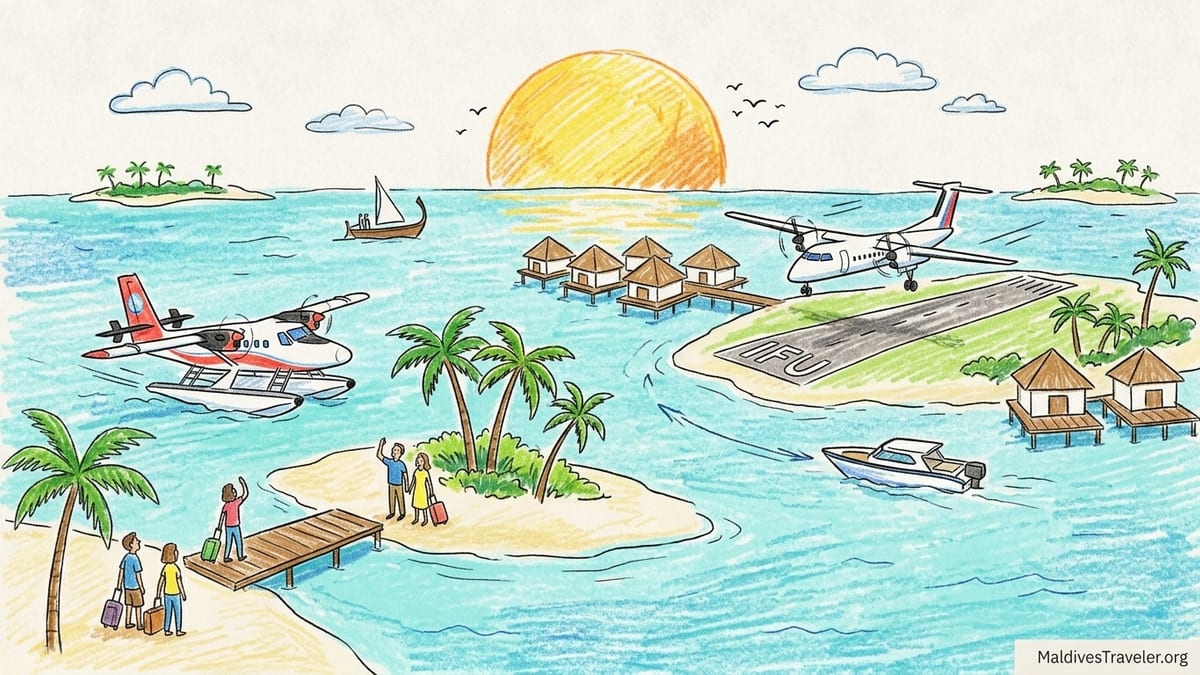
Raa Atoll lies in the northern Maldives, roughly 150 to 180 kilometres from Malé, so speedboats from the international airport are not practical in the way they are for nearby atolls such as North Malé or South Malé. Resorts in Raa rely on either a direct seaplane from Malé’s seaplane terminal or a domestic flight to Ifuru Airport, on the atoll’s northern rim, followed by a speedboat. Travel time from Velana International Airport to a Raa resort is usually about 40 to 50 minutes by seaplane, or about 35 to 45 minutes on a domestic flight to Ifuru plus a 15 to 45 minute speedboat ride, depending on the island’s location.
This extra step matters because transfer prices are not trivial compared with the room rate. Recent pricing examples for domestic flight plus boat combinations at Maldivian resorts show that two adults can easily spend around 1,000 US dollars of the total bill just on internal transfers for a three night stay, with similar ranges reported for properties using Ifuru Airport. That is before adding children or excess baggage, and before the 10 percent service charge and 17 percent tourism tax that now apply to most services in the Maldives.
Another key difference is timing. Resorts close to Malé can accept guests arriving almost any time of day because their speedboats run day and night in normal conditions. Raa Atoll, by contrast, is constrained by seaplane daylight rules and the limited number of scheduled domestic flights into Ifuru. If your international flight lands late in the afternoon or at night, you may be forced to overnight near Malé or choose a resort that uses the domestic route rather than a seaplane only transfer.
Because of these variables, the “cheapest room” in Raa is often not the best overall deal once transfers for a couple or family are added. Comparing one resort that uses a seaplane and another that uses a domestic flight and speedboat is really comparing two entire travel systems, each with different pros and cons.
How Seaplane Transfers to Raa Atoll Work
Most seaplane transfers in the Maldives are operated by Trans Maldivian Airways or Manta Air, using 15 to 19 seat aircraft that depart from a dedicated seaplane terminal a short shuttle ride from Velana International Airport. For Raa Atoll, a seaplane typically takes about 40 to 50 minutes from Malé to resort platforms, depending on routing and whether the aircraft makes stops at other islands.
Seaplanes operate only in daylight for safety reasons, because they take off and land on the ocean rather than on a lit runway. In practice, this usually means flights begin from shortly after sunrise and finish by late afternoon, so both the aircraft and crew can return to base before dark. Operators and resorts commonly advise that international arrivals should land in Malé no later than about 15:00 to 15:30 if guests want a same day seaplane connection to a resort in a northern atoll such as Raa. Arrivals later than this are often routed to an airport hotel or guesthouse for the first night, with seaplane departure the following morning.
Baggage allowance on seaplanes is more restrictive than on many long haul flights. Trans Maldivian Airways currently allows a total of 25 kilograms per paying passenger, typically 20 kilograms of checked baggage plus 5 kilograms of hand luggage. Extra weight is charged per kilogram and is subject to service charge and taxes, and there is usually no additional allowance for infants. Cabins are small, with limited space for hand luggage, so even carry on roller bags may be taken from you and placed in the rear of the aircraft before boarding.
On arrival in Malé, resort or airline staff meet seaplane guests just outside customs, assist with check in for the domestic leg and transfer them by shuttle to the seaplane terminal. Many higher end resorts offer access to a branded or partner lounge with soft drinks, snacks, showers and Wi Fi while you wait. Depending on the time of day and aircraft rotations, waits of one to three hours are not unusual, especially if you land early morning before your resort’s first allocated seaplane window.
How the Ifuru Domestic Flight plus Speedboat Route Works
Ifuru Airport, with the code IFU, is a domestic airport serving the northern part of Raa Atoll. It is connected to Malé by scheduled flights on Maldivian and sometimes other carriers, with a published flying time of roughly 35 minutes from Velana International to Ifuru. Unlike seaplanes, these domestic flights operate on a conventional runway and can land and depart after dark, which opens up more arrival options for guests whose international flights reach the Maldives in the afternoon or evening.
From Ifuru, resorts arrange speedboat transfers to their islands. For properties on the northern and central side of Raa Atoll, such as those branded for couples or families with relatively short distances from the airport, this boat leg can be as little as 15 to 30 minutes. For islands further south within the atoll, or on its outer rim, the ride might be closer to 45 minutes. The exact timing will depend on sea conditions and the route on the day, but it is usually far shorter than a direct speedboat would be all the way from Malé.
Domestic flights generally offer a slightly higher baggage allowance than seaplanes, closer to what regional jets allow within South Asia, although each airline sets its own rules and surcharges for excess kilograms. Resort documentation for guests travelling via Ifuru often specifies that excess baggage is charged per kilogram with a fixed US dollar rate plus tourism tax, and payment is typically collected at the airport. Families carrying strollers, camera equipment or dive gear should check the fine print carefully before departure.
One important operational difference is schedule rigidity. Seaplanes are often scheduled dynamically on the day based on resort occupancy and loads, while domestic flights through Ifuru follow published timetables, with perhaps one or a few rotations daily depending on season. That makes domestic connections more predictable but also means that a missed or delayed international flight can have knock on effects if the last Ifuru rotation for the day has already gone.
Real Resort Examples and Transfer Cost Comparisons
To understand how this plays out when you shop for a holiday, it is useful to look at real resort patterns. Several well known Raa properties north of Malé use seaplane transfers exclusively, advertising journey times of about 40 to 50 minutes by air from the capital. Others give guests a choice between seaplane and the Ifuru route, sometimes with promotional offers that bundle domestic flights into the room rate for longer stays, or allow discounted upgrades to seaplane.
Ifuru Island Maldives itself, a premium all inclusive resort in Raa, highlights in its conditions that the island is reached by domestic flight or seaplane from Malé, with transfers compulsory to book through the resort. Its terms detail that excess baggage on the domestic leg is charged per kilogram in US dollars plus the current 17 percent tourism goods and services tax set by the Maldives Inland Revenue Authority. Public offers in late 2026 include complimentary return domestic flights for two adults on stays of seven nights or more up to a defined seasonal cutoff, while shorter stays list a per adult round trip transfer charge in the mid hundreds of US dollars.
Examples compiled across the Maldives for domestic flight plus speedboat combinations, including resorts reached through Ifuru, show a typical share of around 1,000 to 1,100 US dollars of a three night stay for two adults being attributable purely to transfers when priced separately. For a Raa resort with a nightly room rate just under 1,000 dollars on a premium all inclusive plan, these internal flights and boats can therefore account for roughly a third of the total bill on a short break, and considerably more on lean season specials where room rates drop faster than fixed transfer costs.
It is also increasingly common for Raa resorts to adjust transfer pricing between adults and children. A seaplane upgrade from domestic flight might be quoted at one figure per adult and a somewhat lower figure per child aged between 2 and 11 years, with infants under 2 sometimes travelling free on the parents’ lap except for mandatory taxes. Families should check the cut off ages, because one child ageing into the “adult” bracket between booking and travel can change the total significantly.
How Transfers Can Turn a Cheaper Room into a More Expensive Holiday
Because transfer charges in Raa Atoll are largely fixed per person regardless of room type, they can skew the value equation in surprising ways. Consider two hypothetical offers checked on the same dates. Resort A in Raa quotes a beachfront villa at 850 US dollars per night on an all inclusive plan but uses a seaplane transfer priced around 500 to 600 dollars per adult for a return trip. Resort B, also in Raa, offers a room at 950 dollars per night on a similar plan but includes complimentary domestic flights from Malé for two adults on stays of seven nights or more.
If a couple books three nights at Resort A, their room cost will be about 2,550 dollars before tax, and the return seaplane transfers can add roughly 1,000 to 1,200 dollars, taking the pre tax total to somewhere near 3,600 to 3,800 dollars. At Resort B, the three night room cost is about 2,850 dollars before tax, but transfers for a short stay may still be charged at around 1,000 dollars for two adults if the complimentary flight offer applies only to longer visits. In that case, Resort B ends up slightly more expensive overall despite having a higher nightly rate, because transfer policies and promotions differ.
For families the effect is even more pronounced. Imagine parents travelling with two children aged 8 and 12. Some resorts will charge the 8 year old at a child transfer rate and the 12 year old at the adult rate. If the return transfer is, for example, 500 dollars per adult and 350 per child plus tax, the family spends around 1,700 dollars on internal travel alone. Suddenly a rival resort whose nightly room price looks higher at first can make more financial sense if it offers reduced or bundled transfers for children, or if the domestic flight plus speedboat route is significantly cheaper than a similar length seaplane trip.
This is why it is risky to filter search results only by base room price without expanding the transfer section. On some booking engines the room appears attractively discounted while a separate line or note reveals that transfers are chargeable at fixed per person rates, not yet included in the total. A savvy Raa Atoll booking compares full stay cost, including boat and air transfers for everyone in the travelling party, not just the nightly rate per villa.
Daylight Rules, Waiting Time and Weather Delays
When choosing between a seaplane and the Ifuru domestic route, it helps to understand the operational constraints. Seaplanes in the Maldives are daylight only. Although on rare occasions flights can be scheduled in the late afternoon, routine operations typically cease before sunset to ensure aircraft and crew return to base in Malé. That means if your international flight lands after mid afternoon, the chances of making it to a seaplane only Raa resort the same day drop sharply.
Domestic flights, on the other hand, can land at Ifuru after dark because they use a lit runway. A couple arriving into Malé at 19:00 might still be able to connect to a later evening domestic flight and a short speedboat transfer, where seaplane guests in the same situation would have to budget for an overnight at the airport or a nearby island. The trade off is that domestic flights follow fixed schedules, so if the last rotation has already departed by the time you clear immigration and luggage claim, you may still have to wait until morning.
Waiting time in Malé also plays differently for each mode. Seaplane passengers often spend their layover in resort branded lounges or at a shared facility managed by the seaplane operator. Facilities can include comfortable seating, refreshments and showers, and some luxury resorts emphasize this part of the journey as an extension of the guest experience. Domestic passengers largely use the main domestic terminal facilities, which can be busy at peak times and may have more limited lounge options depending on airline and ticket type.
Weather affects both systems. Strong winds, heavy rain or poor visibility can delay or cancel seaplane departures, because low flying aircraft on water are particularly sensitive to sea state and cloud base. Domestic jets and turboprops are generally more resilient but can still face disruptions in severe storms. When such issues occur, resorts are responsible for co ordinating rebooked transfers, but compensation for lost nights is normally governed by the resort’s terms, which often state that the hotel is not liable for weather or operational delays in third party transport.
Arrival Time Decision Tree for Malé
Because transfer options to Raa Atoll link so closely with your international flight’s landing time, it helps to think through a simple arrival time decision tree when planning. If you land in Malé in the morning, for example between 07:00 and 11:00, you will almost always be able to reach a Raa resort by seaplane the same day, assuming your resort uses that mode and there is no exceptional weather. After clearing immigration and baggage, you are met by resort staff, taken to the seaplane terminal, and likely depart within a few hours.
For early afternoon arrivals, roughly between 11:00 and 15:00, the picture becomes more nuanced. Seaplane guests can still often reach their resorts the same day if flights and weather co operate, but they are closer to the operational cutoff, especially if their resort is not the first stop on a multi island route. In this window, some travellers prefer to choose a Raa resort that also accepts transfers via a domestic flight to Ifuru, because that route remains available into the evening and provides a fallback if seaplane slots are tight.
For late afternoon or evening arrivals, such as flights landing after about 15:30 to 16:00, seaplane only resorts in Raa usually mean a compulsory overnight in or near Malé, with transfer the following morning. If your schedule or budget makes this unattractive, focusing your search on Raa properties that use the domestic flight plus speedboat route becomes sensible. Provided there is an evening Ifuru flight, you might still be on your chosen island before midnight.
On the outbound leg, similar principles apply. Resorts and seaplane operators typically recommend that guests departing Malé on morning international flights leave their islands very early, sometimes at dawn, to allow for transfer times and check in. Domestic flights offer more flexibility for those departing later in the day, but still require you to build in buffer time at Velana Airport for security formalities. Always share your full flight details with the resort well in advance, and ask them to propose a realistic transfer plan before you finalize bookings.
Why You Should Never Book an Independent Flight to Ifuru
With Ifuru listed as a domestic destination served by Maldivian and other carriers, some travellers consider booking their own tickets from Malé to Ifuru, thinking they might save money compared with resort organized transfers. For Raa Atoll resorts this is almost always a mistake. Internal flights and speedboat legs are tightly integrated with resort operations and are usually arranged on block space or charter arrangements that assume guests are on specific flights and boats.
If you book a separate domestic ticket to Ifuru without the resort’s approval, several problems can arise. First, the resort may not schedule a speedboat to meet your independently chosen flight time, especially if it falls outside their usual transfer windows or would require running a boat for only your party. Second, the resort may still charge you their standard transfer fee for the boat leg or for a package that includes the domestic flight, leaving you paying twice. Third, if there are schedule changes or weather disruptions, you will not benefit from the resort’s coordinated rebooking process and may find yourself stranded at the airport or paying high last minute rates.
Resort terms and conditions often state explicitly that all transfers must be arranged through the property and are mandatory. They also make clear that the resort is not responsible for unused nights caused by guests missing pre arranged transfers due to self booked domestic tickets or late international flights. In Raa Atoll, where choices of route and timing are more limited than near Malé, this integrated system is designed to avoid exactly the sort of fragmentation that independent bookings introduce.
The safest practice is to view the resort’s quoted transfer as part of the package cost of visiting Raa. If you are unhappy with the quoted amount or routing, it is better to choose a different resort or even a nearer atoll, rather than try to work around the established logistics by piecing together your own internal flight itinerary.
The Takeaway
Getting to Raa Atoll is not as simple as stepping onto a shared speedboat from Malé, and these logistical differences have real implications for budget, timing and even which resort is right for you. Seaplanes deliver the iconic “Maldives from the air” experience and place you on the sand in around 40 to 50 minutes from the capital, but they are restricted to daylight, carry tighter baggage limits and command some of the highest per person transfer prices in the country.
The domestic flight plus speedboat route through Ifuru Airport opens up more arrival times, particularly for afternoon and evening flights into the Maldives, and can sometimes work out cheaper on a per person basis, especially when resorts bundle domestic tickets into promotional packages or offer reduced rates for children. However, it introduces an extra leg, relies on fixed timetables and may mean a more functional rather than scenic transit experience.
When deciding between Raa resorts, treat transfers as a central part of the purchase, not an afterthought. Compare the total cost of your stay for everyone travelling, including all internal flights and boats with taxes and service charges, and overlay that against your international flight times to see which combination actually works. In some cases, paying a little more for a room at a property with smarter transfer pricing, child discounts or bundled domestic flights will yield a lower overall bill and a smoother journey than chasing the absolute lowest nightly rate.
Above all, resist the temptation to improvise your own domestic flights to Ifuru without written confirmation from the resort. In a remote atoll like Raa, the resort controlled transfer ecosystem is what keeps thousands of guest movements running smoothly each season. Working within that system, and choosing it carefully, is the best way to make sure your first glimpse of Raa Atoll is from a plane window or boat deck, not from an airport bench.
FAQ
Q1. How long does it take to reach Raa Atoll from Malé by seaplane?
Most Raa Atoll resorts reached by seaplane are about 40 to 50 minutes flying time from Malé, depending on routing and whether the aircraft stops at other islands.
Q2. What is the baggage allowance on Maldives seaplanes to Raa?
Trans Maldivian Airways currently allows a total of about 25 kilograms per paying passenger, usually 20 kilograms checked and 5 kilograms hand luggage, with excess charged per kilogram.
Q3. Can I arrive in Malé at night and still reach my Raa resort the same day?
If your resort is seaplane only, late evening arrivals usually mean an overnight near Malé. If the resort uses a domestic flight to Ifuru plus speedboat and there is an evening departure, same day arrival may be possible.
Q4. Are transfer costs to Raa Atoll included in my hotel rate?
Policies vary. Some resorts quote room prices without transfers and add a separate mandatory per person charge, while others bundle domestic flights or offer complimentary transfers for longer stays or specific offers.
Q5. Do children pay full price for Raa Atoll transfers?
Many resorts discount transfers for children, for example offering lower seaplane or domestic flight rates for guests aged 2 to 11, while charging adult prices from 12 years upward. Exact brackets and discounts differ by property.
Q6. How does bad weather affect seaplane and Ifuru domestic transfers?
Strong winds or low visibility can delay or cancel seaplanes more readily because they land on water, while domestic flights are somewhat more resilient but can still face disruption in severe storms.
Q7. Is the domestic flight plus speedboat route to Raa cheaper than a seaplane?
It often is, especially when resorts bundle domestic tickets into offers, but not always. Real world examples show around 1,000 to 1,100 US dollars of a short stay for two adults can still go on domestic plus boat transfers.
Q8. Should I book my own domestic flight to Ifuru to save money?
No. Resorts typically require that all transfers are arranged through them. Self booking can leave you without a boat connection, expose you to double charges and complicate rebooking if schedules change.
Q9. How early should I land in Malé to comfortably connect to a seaplane for Raa?
Arriving in the morning is ideal. Resorts and operators often recommend landing by about 15:00 to 15:30 at the latest if you hope to reach a Raa seaplane resort the same day.
Q10. How do I compare total costs between two Raa Atoll resorts?
Add up the full stay cost for your travel dates, including the room, all transfer charges for every guest, and applicable taxes and service charges, then compare those totals rather than just the nightly room rates.