


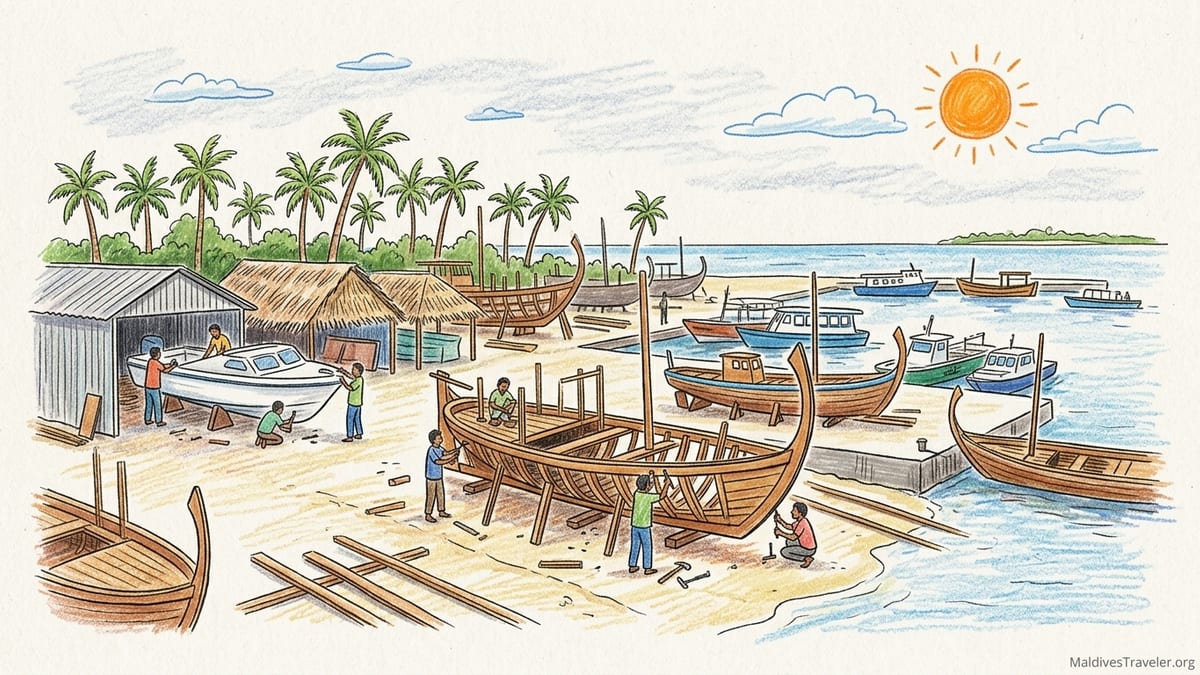
On paper, Alifushi is a small inhabited island in Raa Atoll, notable for little more than a line or two in guidebooks about “traditional boatbuilding.” In reality, stepping into its working dhoni yards feels like walking into the beating mechanical heart of the Maldives. The resin, diesel and sawdust cling to your clothes; the thud of mallet on timber drowns out the surf. Here, far from the polished stillness of private resort islands, the country’s maritime lifeline is carved, planed and laminated into existence in full view of everyday island life.
Finding My Way to Alifushi’s Boatyards
Alifushi sits at the northern tip of Raa Atoll, administratively part of what the charts call Northern Maalhosmadulu. On maps it looks like a tiny curved dash at the edge of the reef, surrounded by resort names that dominate most Maldivian marketing. Yet for generations, this has been one of the country’s key islands for building traditional dhonis and, increasingly, modern fishing vessels and speedboats. Official descriptions still highlight Alifushi as a center of domestic boatbuilding and repair rather than tourism, and that difference is obvious the moment you arrive.
Reaching Alifushi today typically involves a domestic flight to Ifuru Airport, which serves this part of Raa Atoll. From Malé’s international airport, flights to Ifuru run on local carriers that operate small turboprop planes. Schedules and fares change often, but as a ballpark, a one-way domestic sector to Ifuru can cost in the low hundreds of US dollars, similar to other Maldivian domestic routes. From Ifuru, you continue by sea: a pre-arranged speedboat transfer if your guesthouse has organized it, or a place on a local workboat heading across the channels.
The second leg is where the landscape starts to shift from the air-conditioned anonymity of airports to the textures of working island life. On the day I travelled, I joined a fiberglass dhoni that carried sacks of rice, gas cylinders, and a handful of commuters moving between islands in the atoll. There were no welcome drums or chilled towels. Instead, deckhands in rubber sandals moved methodically around us, coiling lines and checking the engine housing while passengers quietly watched the flat horizon.
Approaching Alifushi itself, I noticed first not beaches, but silhouettes: the unfinished bows of boats rising above the tree line, white fiberglass hulls propped on cradles, and the occasional skeleton of a large wooden fishing vessel. The harbor was busy with traffic from fishing dhonis, resort supply boats and local ferries. This was clearly an industrial island in Maldivian terms, one where the slipways and workshops are as defining as mosques or schools.
Entering a Working Yard: Permission Before Photographs
Visitors sometimes imagine “traditional boatbuilding” as an open-air museum. Alifushi’s yards are the opposite. These are active industrial spaces, where workers handle power tools, heavy timbers and hazardous materials like resin and solvents. That reality matters for safety, respect and photography. Before setting foot in a yard, I walked first to the island council office and then to the guesthouse owner who had arranged my visit. Both emphasized the same point: do not simply wander into any workshop pointing a camera. Ask.
The yard I eventually visited sat along the lagoon side of the island, behind a low line of coconut palms. There was no gatehouse or ticket booth, just a sandy track leading into a wide, cluttered space of half-built hulls and metal sheds. At the edge, under a strip of shade, the owner and master carpenter greeted me, accepted the council letter I carried, and verbally confirmed that I could enter, take specific photographs, and speak with workers as long as I stayed clear of active construction areas and did not interfere.
This ritual of permission changed the tone of the visit. Instead of feeling like a curious stranger sneaking into a photogenic place, I was a guest in someone’s workplace. The owner pointed out where not to step, warned me that resin fumes would be strong inside certain sheds, and asked me not to photograph faces without checking first. On a nearby scaffold, two men paused their sanding for a moment to glance over. One gave a quick nod; the other went back to his work, clearly less interested in being part of a travel article than in finishing the hull before the weather turned.
For travelers used to resorts where almost every corner is curated for Instagram, this can feel unfamiliar. Yet on Maldivian local islands, and especially in industrial spaces like Alifushi’s yards, entry and photography should always be requested rather than assumed. Boatbuilders here are not a show put on for tourists; they are skilled workers on tight deadlines, building the vessels that supply resorts, carry schoolchildren, and support the national fishing fleet.
Timber, Fiberglass and the Smell of Work
As I walked deeper into the yard, the air thickened with layers of smell that told the story of both tradition and change. Near one corner, stacks of rough-sawn timber, some coconut wood, some imported hardwood, perfumed the shade with a sweet, earthy scent. Further in, the sharper chemical tang of polyester resin and fiberglass dominated, seeping out of a low-roofed shed where a new speedboat hull was being laid up by hand.
Alifushi’s reputation was built on wooden dhonis. Historically, Maldivian builders used coconut timber for hull planks and frames, shaping each piece by eye without formal drawings. Sources on Maldivian maritime heritage still describe how a master carpenter would direct apprentices plank by plank until the distinctive long, low hull and upturned prow took form, a process that could take two months or more for a fishing dhoni of around 15 to 20 meters. Wooden dhonis remain part of the scene in Alifushi, often visible as hefty skeletons of ribs and keel under temporary tarpaulins.
But the island has also moved decisively into modern materials. Inside the resin-scented shed, a team of men in masks and long-sleeved shirts worked over a partially completed fiberglass hull. They were not using an automated production line; instead, they moved along the mould with hand-held rollers, pressing resin into fiberglass mat in overlapping sections. Power tools hummed intermittently, but much of the labor remained manual. One worker explained, shouting over a compressor, that fiberglass had become the material of choice for resort guest transfer boats and dive dhonis because it was lighter and required less maintenance than timber in the long run.
The contrast between the two zones of the yard was striking. In the wooden section, you heard the slow, rhythmic thump of a mallet fitting a plank, the rasp of a hand plane, and the occasional shout of measurements in Dhivehi. In the fiberglass sheds, the soundtrack was harsher: the whine of grinders, the hiss of sprayed gelcoat, and the slap of resin-soaked cloth. In both, the work was physical, noisy and continuous, usually running through the hotter parts of the day despite the intense heat.
Hull Shapes, Hand Tools and the Rhythm of Craft
Before seeing Alifushi’s yards in person, I had seen dhonis only as silhouettes: low in the water, with their gently curved prows and extended sterns carrying nets or tanks of scuba divers. Up close in the yard, the complexity of their shape became obvious. The classic Maldivian dhoni hull curves in two directions at once, with a fine entry at the bow, a broad working deck amidships, and a stern designed to sit comfortably in choppy seas. The lines are not just aesthetic choices; they evolved over centuries to suit local fishing grounds and monsoon swells.
In the wooden section of the yard, a half-finished hull rested on heavy wooden blocks. Its ribs formed a repeating arch pattern, and planks were being steamed and bent into place along the lower strakes. The tools scattered nearby were a mixture of old and new: hand saws with dulled handles, chisels sharpened repeatedly on simple stones, alongside electric planers and cordless drills. A younger worker stood astride a plank with a long-handled hand plane, the blade set fine, sending thin curled shavings of coconut wood onto the sand.
When I asked how much of the work was still done by eye, the master carpenter smiled and gestured down the length of the hull. He described how older builders had never used formal blueprints, relying instead on rules of thumb and measurements learned from their own teachers. In recent years, naval architects and government agencies have introduced more standardized designs and safety regulations, especially for larger fishing vessels. Yet much of the fairing, fine shaping and final adjustments still depend on experienced eyes and hands rather than computer screens.
Even in the fiberglass sheds, which might appear more “modern,” this tradition of skilled handwork continued. Workers trimmed cured hulls with angle grinders guided by chalk lines; others hand-sanded surfaces for painting. While moulds provide a base shape, the finishing, fitting of internal frames, and installation of mechanical systems still required a high degree of judgment. I saw no sign of fully automated assembly. Instead, the yard felt like a continuum from purely traditional craft to adapted industrial practice, all compressed into a sandy rectangle between lagoon and village.
Apprentices, Family Knowledge and What Remains Handmade
One of the most revealing parts of visiting Alifushi was watching how knowledge moved around the yard. It did not flow from whiteboards or printed manuals, but in short, constant exchanges between older men and teenagers standing at their shoulders. When a young apprentice struggled to fit a plank against the curve of a rib, the master stepped in, adjusted the clamping points, and showed him where to shave a few millimeters. The correction took seconds; the lesson would likely be repeated many times until it became second nature.
Written sources on Maldivian dhoni building often emphasize this apprenticeship model, describing how skills pass within families and close-knit communities of craftsmen. That pattern was visible here. Several workers shared surnames or were introduced as cousins or brothers. One teenager told me that his father and grandfather had both built boats in Alifushi, and that although he had finished school, he preferred the yard to a desk job in Malé. He expected to learn fiberglass techniques as well as traditional timber work, seeing both as necessary for future employment.
Despite the presence of power tools, a surprising number of components remained handmade. Wooden frames and knees were still cut and shaped individually. In the engine bay of a near-complete fishing vessel, I saw custom brackets and supports being fabricated from metal plate with simple welders and grinders. Even on fiberglass boats, interior wooden joinery, cabin doors and wheelhouse details were being built piece by piece, not bought as standardized modules.
This balance between handwork and mechanization also shapes the pace of the yard. Building a mid-sized fishing boat from timber and modern fittings can still take several months from keel laying to launch, depending on complexity and workload. Fiberglass hulls shorten some stages, but outfitting, engines, electronics and safety gear still require specialized labor. For the workers I spoke with, this time was not a romantic throwback to simpler days; it was simply the practical reality of building durable boats in a remote island nation where importing fully finished vessels is expensive.
Staying on a Local Island: Guesthouses, Dress and Daily Life
Spending the night on Alifushi instead of returning immediately to a resort was essential to understanding how different a working island feels. Official guidance on Maldivian “local islands” makes it clear that these are inhabited communities first and tourist destinations second. Guesthouses operate under national regulations, but they exist alongside schools, mosques, boatyards and family homes, not in isolation from them. There are no beach bars serving cocktails, and by law alcohol is not sold on inhabited islands. That reality alone creates a dramatically different mood to resort stays.
The guesthouse where I stayed was a modest two-story building a short walk from the harbor, with simple tiled rooms, air conditioning and private bathrooms. Rates on comparable local islands often range from roughly 40 to 100 US dollars per night for a double room depending on season, including breakfast. On Alifushi, prices are shaped partly by its industrial focus: most visitors are Maldivians connected to the marine trades rather than foreign tourists, so there is less pressure to provide infinity pools or elaborate buffets.
Dress and behavior on Alifushi follow the norms for Maldivian local islands rather than resort islands. Official tourism guidelines and island notices emphasize modesty in public spaces. For women, that generally means covering shoulders and knees when walking through the village, wearing loose dresses, skirts or trousers rather than swimwear or revealing tops. Men are expected to avoid going shirtless or wearing very short shorts in the streets. Swimwear is reserved for designated beaches if the island has set aside such an area; if not, even swimming should be done in clothing that respects community standards.
As a guest, that meant planning clothing differently than on a resort. I wore long, lightweight trousers and short-sleeved shirts in the streets and the yard, carrying a scarf that could cover shoulders near the mosque. Around sunset, the island felt more like a small town than a holiday destination. Children cycled along the sandy lanes, men sat on joali benches near the harbor discussing fuel prices and fishing conditions, and the call to prayer threaded through the sound of generators and distant boat engines. No one paid much attention to my presence as long as I behaved respectfully and asked before taking close-up photographs.
Transport, Logistics and the Reality Behind Resort Supply Chains
Seeing the boatbuilding process in Alifushi also reshaped how I understood resort life elsewhere in the Maldives. On resort islands, transfer boats and dive dhonis appear as sleek, anonymous services: you step aboard, are handed a cold towel, and glide across the lagoon. What is rarely visible is where these boats are built, repaired and maintained, or how much industrial effort lies behind the image of effortless luxury.
Alifushi helps fill in that missing chapter. Many of the vessels ferrying guests to five-star resorts in Raa and neighboring atolls begin life here or in similar yards, assembled by crews who will never set foot in an overwater villa. Engine blocks arrive by cargo dhoni, craned onto slipways, and lowered into open hulls by sheer physical labor aided by basic lifting gear. Navigational electronics are wired into panels inside half-finished wheelhouses that, a few weeks later, will carry honeymooners to spa appointments.
Logistics to reach Alifushi mirror, in a more stripped-down form, the same network that keeps resorts supplied. Domestic flights connect atolls to Malé; cargo and passenger boats knit individual islands together across long distances. Timetables can shift due to weather and demand, and government-run ferries and private speedboats operate under different pricing and booking systems. Guesthouses on local islands typically help visitors arrange these legs, and on working islands like Alifushi, boatbuilders themselves sometimes offer advice, since their livelihoods depend on the same routes.
For travelers planning such a visit, it is important to allow for flexibility. While resort transfers are often bundled and guaranteed as part of a package, getting to a local island may involve aligning domestic flight schedules, local ferry days and daylight hours for safe navigation. Weather in the southwest and northeast monsoon seasons can affect crossings, and industrial islands do not adjust their schedules to suit tourist convenience. That unpredictability is part of the experience; it situates you in the same transport reality Maldivians live with every day.
The Maldives Beyond Water Villas
Standing in the shadow of a half-built hull in Alifushi, I thought of the stock images that dominate Maldives advertising. Most show an aerial view of overwater villas arranged like petals around a sandy island in a turquoise lagoon. They rarely show the engine bays, timber stacks, fiberglass moulds and welding sparks that make the entire tourism system possible. Visiting Alifushi does not contradict the beauty of that lagoon image, but it complicates and enriches it.
Here, the Maldives emerges not as a pure leisure destination, but as a working archipelago with a deep maritime culture. The traditional dhoni shape, refined over centuries of fishing, still underpins many modern vessels, even when they are built in fiberglass and powered by diesel engines. Boatbuilding skills are not museum pieces; they are evolving crafts passed on to young apprentices who expect to support families, pay rising fuel costs and adapt to new safety standards.
This side of the country also reveals different economic relationships. On a resort island, you mostly meet staff in service roles: waiters, dive guides, housekeeping teams. On Alifushi, you meet people who design, build and repair the physical infrastructure of movement. Conversations revolve around hull efficiency, weather windows for launches, and the challenge of sourcing quality materials. When I mentioned a well-known resort dhoni I had photographed earlier in my trip, one worker recognized it immediately as a boat built in a neighboring yard and launched from this very lagoon.
For me, the most powerful lesson of the visit was understanding how layered the Maldivian experience can be. A single chain of events might start in a timber stack in Alifushi, continue through an engine test on a dusty slipway, and end as a quiet moonlit crossing with champagne flutes clinking on the deck of a resort transfer boat. Seeing the start of that chain on an inhabited island forces you to confront the labor, materials and risks that remain unseen when you only experience the polished surface.
Why Alifushi Appeals More to Cultural Travelers Than Honeymooners
Not every visitor to the Maldives will want, or need, to spend time in a place like Alifushi. Couples on short honeymoons, focused on private pools and curated experiences, may find the island’s working atmosphere jarring. There are no white-linen beach dinners set up under fairy lights on the sand, and no spa menus waiting in your room. Noise from the yard can travel across the island during the day, and the smell of resin or diesel may drift on the breeze depending on wind direction.
Yet for travelers who care about understanding the places they visit, Alifushi offers something rare in the Maldives: a chance to connect directly with the country’s maritime culture in action. Cultural travelers might spend a morning in the yard, an afternoon walking the village lanes, and an evening talking with guesthouse hosts about how life has changed with the growth of resorts in the surrounding atolls. They are likely to find more value in a conversation about hull design or fishing seasons than in a turn-down service with rose petals.
The island’s limited tourism infrastructure can actually be an advantage for this kind of visitor. With only a small number of guesthouses and no resorts, interactions tend to be more straightforward and less choreographed. You might eat home-style Maldivian meals of fish curry and rice in a simple dining room instead of a buffet pavilion, and your boat transfers will probably be shared with locals moving for work or family reasons rather than reserved exclusively for foreigners.
Crucially, Alifushi encourages a mindset of participation rather than consumption. To visit respectfully, you need to learn the local dress code, ask permission in the yard, adapt to non-tourist schedules and accept that some areas are off-limits for safety or religious reasons. These constraints are not inconveniences for cultural travelers; they are part of what makes the experience meaningful, providing a clearer sense of how Maldivians live beyond resort perimeters.
The Takeaway
My time in Alifushi’s boatyards taught me more about the Maldives than any number of sunsets viewed from an overwater villa. Watching dhoni hulls take shape, seeing apprentices guided by older craftsmen, and understanding how fiberglass sheds sit alongside traditional timber work revealed a country that is both deeply rooted and constantly adapting. It reminded me that the Maldives is not just a chain of luxury brochures, but an archipelago of working communities whose skills keep the entire system afloat.
For travelers willing to trade polished predictability for industrial noise and resin-stained sand, Alifushi offers a window into that reality. It is a place where you can trace the lines of a dhoni from keel to bow with your own hands, feel the heat of a tropical workday rather than the cool of a resort pool, and leave with a more grounded respect for the people whose craft carries visitors, supplies and fish across these waters every day.
In the end, that is why Alifushi is likely to resonate more with cultural travelers than with conventional honeymooners. It asks more of you: more curiosity, more flexibility, more willingness to be a guest in someone else’s world rather than the center of a curated experience. In return, it offers something increasingly rare in global tourism, and particularly rare in the Maldives. It shows you how the country actually works beneath the surface of its most famous images, one hand-shaped hull at a time.
FAQ
Q1. Do I need special permission to visit the boatyards in Alifushi?
Yes. The boatyards are working industrial areas, not tourist attractions. You should first speak to your guesthouse host or the island council to request permission and arrange an introduction to a yard owner. Entering without consent or wandering around with a camera is discouraged, both for safety and out of respect for the workers.
Q2. Can I freely take photos and videos inside the boatyards?
No. Photography should be treated as a privilege, not a right. Always ask the yard owner or supervisor before shooting, respect any areas that are off-limits, and avoid close-up images of workers without their clear consent. Some yards may allow wide shots of hulls and tools but prefer that faces and detailed workshop setups are not shared publicly.
Q3. How do I get to Alifushi from Malé?
Most visitors fly from Malé to Ifuru Airport on a domestic carrier, then transfer by boat to Alifushi. Your guesthouse can usually help coordinate the boat leg, which might be a shared speedboat, a charter arranged through local contacts, or a place on a workboat. Schedules and prices change often, so confirm both the flight and boat timing in advance and allow buffer time for weather delays.
Q4. Are there guesthouses on Alifushi suitable for foreign travelers?
Alifushi has a small number of licensed guesthouses that primarily serve Maldivian visitors connected to the marine trades but are generally able to host foreign travelers as well. Expect simple, clean rooms with air conditioning, private bathrooms and basic meal options rather than resort-level amenities. It is best to communicate directly with the guesthouse about your expectations, possible yard visits and transfer arrangements before you book.
Q5. What should I wear on Alifushi and in the boatyards?
On the island, modest clothing is expected. Men should wear at least knee-length shorts and a T-shirt, while women should cover shoulders and knees with loose dresses, skirts or trousers. In the yards, closed shoes or sturdy sandals are advisable, and lightweight long sleeves and trousers offer protection from sun and resin. Swimwear is only appropriate on a designated beach area, if the island has one, and never in village streets or workspaces.
Q6. Is it safe to walk around the boatyards?
You can move safely around the yards if you follow local guidance. Surfaces may be uneven, and there can be nails, offcuts, tools and open engine bays underfoot, so you need to watch where you step. Always follow the paths indicated by workers, stay clear of heavy lifting and power tools, and avoid climbing onto hulls or scaffolding unless specifically invited and supervised.
Q7. Will I see only traditional wooden dhonis being built?
No. While Alifushi is known historically for wooden dhoni construction, today you are likely to see a mix of timber and fiberglass work. Wooden fishing dhonis and repair projects still exist, but many new resort transfer boats, fishing vessels and speedboats are built in fiberglass using hand-laid techniques. Visiting gives you a chance to see how traditional hull shapes coexist with modern materials and regulations.
Q8. Can I buy or commission a boat directly from Alifushi?
In principle, yes. Alifushi yards build boats for Maldivian fishing companies, resorts and private owners, and some are open to commissions from abroad. However, commissioning a vessel is a complex business decision that involves specifications, regulatory compliance, financing and export logistics. It is not something that can be arranged casually during a short visit, but you can certainly start conversations and learn what would be involved.
Q9. How does a stay on Alifushi compare with a resort holiday?
An Alifushi stay is almost the opposite of a resort experience. There are no alcohol sales, no organized entertainment and no private beaches. Instead you get early-morning calls to prayer, the sound of tools in the boatyards, conversation with local families and a stronger sense of the country’s working life. Comfort levels are simpler, but the cultural insight is far deeper, which is precisely what attracts many cultural travelers.
Q10. Who is Alifushi best suited for as a destination?
Alifushi suits travelers who are curious about maritime culture, comfortable with basic accommodation and respectful of local customs. It is a good fit for people who already plan to visit Maldivian local islands and want to understand how dhonis and other vessels are built and maintained. It is less suited to those seeking all-inclusive luxury, nightlife or a conventional honeymoon atmosphere centered on privacy and resort services.