


On a humid afternoon in Raa Atoll, as children cycled past with schoolbooks balanced on their handlebars, I stepped through a low coral-stone gateway on Meedhoo and felt my idea of the Maldives tilt. I had come to see a building UNESCO describes as part of the Maldives’ serial Tentative List of coral-stone mosques, a Friday mosque believed to date to around 1705 and still used for daily prayers. I left feeling that the country’s story was written not only in turquoise lagoons and overwater villas, but in chiselled reef stone, aging timber beams and weathered tombstones layered with script and memory.
Finding Meedhoo’s Living Coral-Stone Heritage
Meedhoo sits in Raa Atoll, a quieter northern atoll better known to many Maldivians for boatbuilding than for tourism. From Malé I flew to the small airport at Ifuru, then joined a shared speedboat arranged by my guesthouse. The forty-minute ride skimmed past resort jetties and uninhabited islets before we eased up to Meedhoo’s modest harbor, where concrete quay walls framed a tight cluster of houses, a school and a football pitch that doubles as the village’s social hub after sunset.
Unlike resort islands, Meedhoo does not announce its heritage with signboards or ticket booths. The Old Friday Mosque is folded into the life of the village, a few sandy lanes back from the harbor. When I arrived, the call to prayer had just faded from loudspeakers, and men in sarongs drifted away from the newer mosque nearby. With help from my guesthouse owner, who called a member of the island council, we arranged to meet the caretaker later in the afternoon, between prayer times.
This human chain of introductions is how most visitors will experience Meedhoo’s mosque. There is no published visiting schedule, and non-Muslim visitors should not assume they can simply walk in. On Raa Meedhoo, the council and mosque caretakers act as informal gatekeepers for this UNESCO-recognised site. In practice, that meant a short conversation on a shaded bench, a greeting in Dhivehi, and a gentle reminder that the building is first and foremost a place of worship, not a museum.
By the time we walked toward the mosque compound, school was out and the lanes had filled with village life. Teenagers leaned on motorbikes, women in hijab chatted on doorsteps, and younger children trailed us with curious glances, used to seeing visiting teachers, NGO workers or relatives from Malé but not many foreign tourists. It was in this very ordinary atmosphere that Meedhoo’s extraordinary coral architecture finally came into view.
Arranging Respectful Access and What to Wear
Access to Meedhoo’s Old Friday Mosque is informal but not casual. My guesthouse owner first checked that the mosque committee was comfortable receiving a non-Muslim visitor that day and that no religious classes were in session. He used a local prayer time app to avoid the five daily prayers and Friday noon prayers, when the mosque is at its busiest. Once the caretaker agreed, we settled on a short visit of around twenty minutes to look at the exterior, the wells and the cemetery, with the option of stepping inside only if it felt appropriate at the time.
Dress was part of the conversation from the start. On local islands in the Maldives, visitors are expected to keep shoulders and knees covered away from designated bikini beaches. For a mosque visit, the standard is more conservative. I wore a loose long-sleeved cotton shirt and light trousers; my female travel companion added a scarf to cover her hair and chose a long, non-clingy dress. The caretaker nodded approvingly. The rule of thumb he offered was simple: if you would feel overdressed on a resort beach, you are probably dressed about right for a mosque and its surroundings.
Before entering the mosque compound, we removed our shoes at the low coral-stone threshold, leaving them with a scattered collection of plastic sandals used by regular worshippers. Barefoot on the sand, the transition felt immediate. The caretaker asked us to keep phones on silent and to avoid walking in front of anyone who might be praying in the courtyard or inside. Photography was another careful negotiation. Exterior shots of the building and the wells were fine, he said, as long as we did not photograph worshippers. Interior photography, however, would require explicit verbal permission and no flash.
These constraints shape how you experience Meedhoo. You are not buying a ticket to an attraction; you are being allowed to witness a space that belongs to the community. The small courtesies matter: greeting people with “Assalaamu alaikum,” stepping aside for elders, and accepting that on some days, if there is a funeral or a religious lecture, a visit simply may not be possible. The reward for that patience is the chance to stand close to coral masonry that has anchored this community’s spiritual life for more than three centuries.
First Impressions of a Coral-Stone Masterpiece
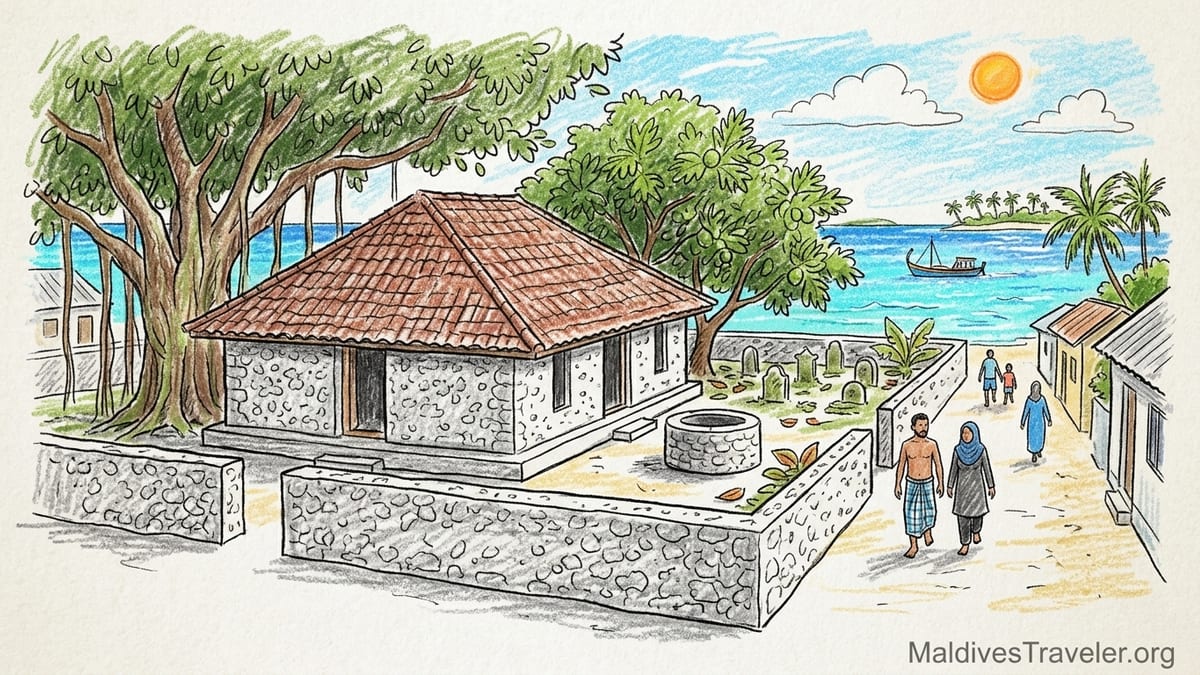
From a distance, the Old Friday Mosque does not dominate the skyline. It sits low and solid behind a shallow boundary wall, shaded by breadfruit and banyan trees. Only as you step closer do you realise that the pale, almost chalky walls are not plastered concrete but blocks of fossilised coral, cut from ancient reef and fitted together with astonishing precision. UNESCO’s description of the site as part of the Maldives’ coral-stone mosque tradition suddenly felt tangible, almost tactile.
Walk along the wall and patterns emerge. Each block is roughly rectangular yet no two faces are quite the same. Tiny pitted holes reveal where living coral polyps once grew. In some courses the masons have alternated smoother and more textured stones to create a subtle banding effect. Corner joints meet in tight tongue-and-groove connections, a dry-stone technique that has allowed the mosque to stand through storms, salt spray and the slow, invisible movement of an atoll’s coral sand foundation.
The roof of Meedhoo’s Old Friday Mosque adds another distinctive layer. Scholars note that it is the only surviving example among the Maldives’ coral-stone mosques that still carries traditional clay tiles rather than modern corrugated metal. Up close, these tiles are heavy, hand-shaped rectangles fired to a muted earthen red and arranged in overlapping rows. Between them, time has seeded small ferns and strands of moss, a soft green fringe against the disciplined geometry of tile and stone.
Compared with the rendered concrete mosques built across the Maldives in recent decades, often painted bright white or pale green, Meedhoo’s mosque reads as quieter and more grounded. There are no neon signs or loudspeaker towers on its roof. Its loudspeakers have been mounted discreetly nearby, leaving the building itself to communicate in the language of proportion, texture and age.
Inside the Prayer Hall: Timber, Lattice and Calligraphy
When we arrived the caretaker confirmed that the prayer hall was empty and that a brief, respectful visit inside would be acceptable. We stepped over the raised coral sill and into a cool, dim space lined with mats. The first sensation was olfactory: a mix of clean woven reed, old timber and the faint saltiness that pervades all Maldivian buildings close to the sea. Eyes adjusted slowly, revealing the low, richly worked interior that scholars of Indian Ocean Islamic architecture praise as uniquely Maldivian.
Supporting the tiled roof is a system of heavy timber beams and pillars, believed to be local hardwood, darkened and smoothed by time. Instead of bare beams, many are carved with shallow, repeating patterns. Above head height, carved timber lattice screens infill wall openings, filtering Maldives light into thin, geometric shafts. The effect is practical, keeping the prayer hall ventilated and less oppressive in the tropical heat, but also quietly theatrical as dust motes float in and out of sunlit rectangles.
Along one wall a band of calligraphy runs at eye level, carved directly into coral-stone panels and stained a darker tone. The caretaker explained that the inscriptions include Quranic verses and donor names. Some letters are softened at the edges, but the flow of script is unmistakable, tying Meedhoo into wider currents of Arabic calligraphic art even as the materials and construction techniques remain intensely local. Near the mihrab niche that indicates the qibla, carved floral motifs echo patterns found on old Maldivian lacquerware and wooden chests.
Photography inside was not allowed during my visit, a restriction I accepted without protest. The absence of a camera forced a different kind of seeing. I found myself counting the number of beam bays, tracing the mortise-and-tenon joints where timber slotted into coral, and noticing how the floor level of the prayer hall sat slightly raised above the surrounding sandy courtyard, a practical buffer against flooding during heavy rains.
The Cemetery, Wells and Everyday Sacred Landscape
Stepping back outside, we crossed the courtyard to the old wells. These are integral to the mosque complex recognised on UNESCO’s Tentative List: circular coral-stone shafts edged with worn rims where centuries of worshippers have drawn water for ablutions. Today many Maldivians use piped water, and on Meedhoo plastic taps and hoses have been added alongside the wells. Yet the stonework remains, a reminder that this island’s relationship with fresh water and the aquifer below the sand has always been precarious.
Beyond the wells lies the cemetery, enclosed by the same low coral wall that shapes the mosque compound. Tombstones here are varied: some low and simple, others taller with elaborately carved finials, indicating the graves of religious scholars or local dignitaries. A few are grouped within small coral-stone enclosures, like miniature mausoleums, their surfaces etched with Arabic script and dates that islanders interpret for visitors when asked. The caretaker spoke quietly about a respected imam whose grave still attracts visitors who come to recite prayers beside the mossy stone.
In contrast to the manicured lawns of many heritage cemeteries elsewhere, Meedhoo’s graveyard feels almost wild in places. Sea almond leaves carpet the sand, and low shrubs press against leaning tombstones. Children step gingerly among the graves on their way to and from the mosque, a daily reminder that on a small island, the boundary between the living and the dead is physically narrow and emotionally present. This proximity underlines why Meedhoo’s Old Friday Mosque is a living site: funerals still start here, and families still trace their lineage through the inscriptions on these stones.
The whole complex sits within the ebb and flow of village sound. During my visit, roosters crowed from a neighboring yard, and somewhere beyond the wall a power saw whined as carpenters worked on a fishing dhoani. That juxtaposition of sacred and everyday is part of the site’s authenticity. The mosque has never been frozen as an exhibition; it remains embedded in Meedhoo’s working landscape.
Coral Architecture in a Changing Maldivian Built Environment
Understanding Meedhoo’s Old Friday Mosque means placing it against the backdrop of how the Maldivian built environment has changed. Historically, island houses and public buildings were constructed from coral stone and timber, with palm-thatch or clay-tile roofs. Over the twentieth century, however, reinforced concrete, steel and imported roofing sheets replaced coral building on almost every island, both for cost reasons and to protect living reefs from further quarrying.
Today, UNESCO and Maldivian heritage authorities highlight that only a handful of coral-stone mosques remain in good condition nationwide. They are clustered in Malé, Fenfushi, Ihavandhoo, Isdhoo and Meedhoo. On Meedhoo itself, you can see the contrast in a single glance. Just beyond the old mosque’s coral wall, newer structures rise in rendered concrete, painted in pastel blues, pinks or bright white that catch the tropical sun. Their edges are crisp, but their surfaces lack the subtle variation of weathered coral.
Walking through the village you notice small traces of coral heritage reused: an old block forming the corner of a garden wall, or a carved piece serving as an informal step. Locals were frank about the change. One council member mentioned that earlier generations saw coral as a free, abundant building material. Today, with widespread awareness of reef fragility and environmental law restricting extraction, few would consider cutting new coral blocks, even if they could. The Old Friday Mosque’s stonework is now valued precisely because it is part of a finite, irreplaceable legacy.
This does not mean that coral extraction in the past should be romanticised. The caretaker was clear that quarrying living reef in the twenty-first century would be unthinkable. Instead, Meedhoo offers a case study in how a community can steward existing coral-stone structures through careful repair, selective replacement with compatible materials and regular use. Conservation teams who have surveyed the mosque in recent years try to balance the need for structural reinforcement with respect for original techniques, sometimes introducing hidden modern supports while leaving the visible coral surfaces untouched.
Getting to Meedhoo and Moving Through the Village
Reaching Meedhoo requires more planning than booking a package to a resort. At the time of my visit, the most straightforward route from Malé was to take a domestic flight to Ifuru or Dharavandhoo, then continue by island speedboat. Schedules and prices change frequently, so I relied on my guesthouse to confirm boat times and arrange seats, paying the fare in cash directly at the harbor. One leg of the journey cost the equivalent of around the price of a simple dinner for two at a Malé café, a reminder that local transport in the Maldives, while not always convenient, can be relatively affordable once you unlock the right contacts.
There was no formal tourism kiosk at Meedhoo’s harbor, but the guesthouse owner met us with a small pickup to collect bags. Within minutes we were walking along sandy lanes lined with low walls and fruit trees. Shops were small and functional, selling packets of biscuits, bottled drinks and phone credit. The sensory difference from a resort was striking: no piped music, no infinity pools, just the sounds of radios, children and the sea.
Moving through the village as a visitor requires a different rhythm. Locals dress conservatively, and while visitors are not expected to wear the same styles, covering shoulders and knees in public areas is important. Swimwear is reserved for designated beaches away from the village center. Alcohol is not available on local islands, and public displays of affection are muted. On Meedhoo, I found that a simple “assalaamu alaikum” greeting and a willingness to ask permission before photographing people or private spaces were enough to open doors to conversation.
The mosque visit itself slotted into this broader experience of village life. We timed our walk to arrive at the compound between the midday and late-afternoon prayers, using the caretaker’s guidance rather than a fixed timetable. Afterwards, we lingered at a nearby café, where a plate of hedhikaa, small Maldivian snacks like fish-filled pastries and coconut frittters, cost less than a coffee on a resort island. Listening to locals talk about the island’s boatbuilding history and the pride they take in the old mosque’s UNESCO recognition added human context to the carved coral blocks I had just admired.
How Meedhoo Reframed Maldivian History for Me
Before Meedhoo, my mental map of Maldivian history was weighted toward Malé and a handful of famous names. Coral-stone mosques were something I associated with the capital’s Friday Mosque, a building often photographed and written about. Standing in Meedhoo’s Old Friday Mosque, however, I realised that this architectural tradition was not an isolated marvel but part of a wider, island-spanning practice that drew on local reef ecology, woodworking skills and Indian Ocean trade networks.
UNESCO’s Tentative List description emphasises that the coral-stone mosques of the Maldives represent a building tradition with no direct parallel elsewhere. Seeing Meedhoo in the flesh translated that abstract statement into physical evidence. The tongue-and-groove joints between coral blocks, the clay-tile roofline and the integration of wells and cemetery into a single coherent ensemble revealed an indigenous architectural language far more sophisticated than the “simple island mosque” label sometimes suggests.
Equally important was the continuity of use. Many historic religious buildings around the world are now museums. In Meedhoo, men still gather here five times a day to pray, and boys still learn to recite the Quran under the same roof beams that sheltered their great-grandparents. The cemetery continues to grow. That living continuity reframed my understanding of Maldivian heritage as something that is negotiated daily, not just preserved behind glass or in government files.
Finally, learning that coral extraction for new building is no longer acceptable shifted the way I read the mosque’s fabric. Each carved block is not just a relic of past craftsmanship but a reminder of a time when the environmental cost of such work was not fully understood. In a country now on the front line of sea-level rise and reef bleaching, Meedhoo’s Old Friday Mosque quietly teaches that cultural heritage and natural heritage are intertwined. Protecting one means acknowledging the limits of what can be repeated. For me, that insight turned a beautiful old building into a lens on the Maldives’ past and its uncertain future.
FAQ
Q1. Can non-Muslim visitors enter Meedhoo Old Friday Mosque?
Non-Muslim visitors may sometimes be allowed to enter with permission from the mosque caretakers or island council, but access is not guaranteed and depends on prayer schedules and community comfort. Most visitors can expect to see the exterior, wells and cemetery, and should accept that on some days interior access will not be possible.
Q2. How should I dress to visit the mosque and village?
Wear modest, loose clothing that covers shoulders, chest and knees in the village, and more conservative dress at the mosque. Men should avoid sleeveless shirts; women are advised to wear long skirts or trousers and bring a scarf to cover their hair before entering the mosque compound.
Q3. Do I need to arrange a guide, or can I go alone?
There is no formal guiding service at the mosque, but it is strongly recommended that you coordinate your visit through a local guesthouse or the island council. They can introduce you to the caretaker, help avoid prayer times and translate any instructions so your visit remains respectful.
Q4. Is photography allowed at Meedhoo Old Friday Mosque?
Photography rules are strict. Exterior photos of the building and wells are usually acceptable if you avoid photographing worshippers, but interior photography requires explicit permission from the caretaker and must never use flash. Always ask before raising your camera, and be prepared to leave it in your bag inside the prayer hall.
Q5. How can I get from Malé to Meedhoo in Raa Atoll?
Travel typically involves a domestic flight from Malé to a nearby airport such as Ifuru or Dharavandhoo, followed by a speedboat to Meedhoo arranged through your accommodation. Because schedules and fares change regularly, the most reliable approach is to let your guesthouse confirm current options and reserve seats ahead of your arrival.
Q6. Are there entrance fees or tickets for the mosque?
There was no formal entrance fee at the time of writing, as the mosque is a functioning place of worship rather than a commercial attraction. Some visitors choose to make a small, discreet donation to the mosque fund via the caretaker or council, but this should never be treated as a payment for access.
Q7. What is special about Meedhoo compared with other Maldivian mosques?
Meedhoo Old Friday Mosque is one of a small group of coral-stone mosques on UNESCO’s Tentative List and is noted for its surviving clay-tile roof, coral-stone walls, timber interior and integrated wells and cemetery. It represents a rare intact example of a building tradition that has almost vanished from everyday Maldivian construction.
Q8. Is coral still used as a building material on the island?
No, quarrying living reef for new construction is no longer acceptable practice in the Maldives because of environmental impacts and reef protection measures. Meedhoo’s coral-stone mosque survives as a historic structure, and conservation work now focuses on preserving existing stonework rather than extracting new coral.
Q9. When is the best time of day to visit the mosque?
The most suitable times are usually mid-morning or mid-afternoon, well away from the five daily prayers and Friday noon prayers. Exact times change slightly each day, so rely on local advice or a prayer time app, and always confirm with the caretaker or your guesthouse before walking to the mosque.
Q10. Can I combine a visit to Meedhoo with staying on a resort?
Yes, some travelers base themselves on a nearby resort or another local island and arrange a day trip to Meedhoo, while others stay in simple guesthouse accommodation on the island itself. In either case, coordination with local hosts is essential for arranging transport and ensuring your mosque visit fits respectfully into daily island life.