


We took our two children to Raa Atoll in the Maldives because the brochures made it look like the ultimate family upgrade: two-bedroom villas, kids’ clubs, free-child offers and endless shallow lagoons. What surprised us was not that our kids loved the sand and the fish. They did. What caught us off guard were the practical problems between the airport and that perfect family photo: the extra flights, the waiting, the heat, the safety worries and the small ways all-inclusive life can grind when you are thousands of miles from home with young children.
Understanding the Journey: Long-Haul Plus One More Flight
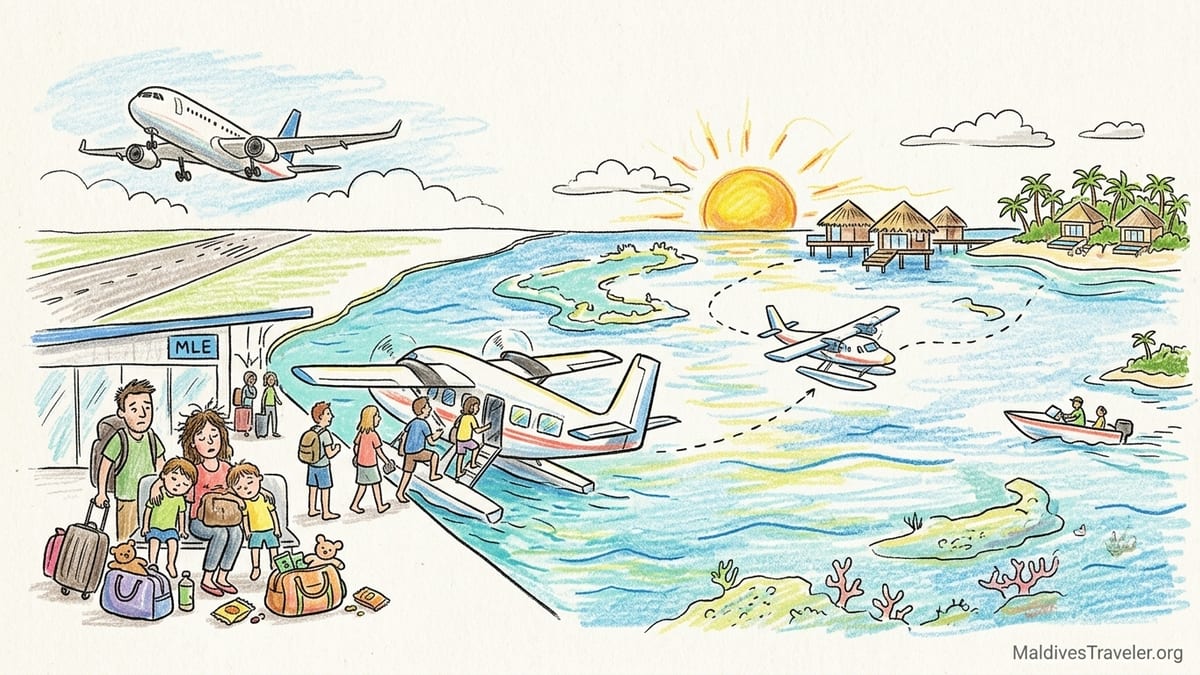
Our trip began with an overnight long-haul into Malé, landing shortly after 8:00 in the morning. On paper that sounded ideal: arrive, clear immigration, connect straight onto a seaplane and reach our resort in Raa Atoll before lunch. In reality, everyone had slept badly on the flight and we were only halfway through the journey. Reaching most Raa resorts means one more transfer, either a seaplane from Malé’s dedicated terminal or a domestic flight to an atoll airport such as Dharavandhoo or Ifuru followed by a speedboat. Resort websites mention this, but they often underplay how tough that extra leg feels with tired children and hand luggage full of soft toys and snacks.
Seaplanes in the Maldives operate only in daylight, with last scheduled services in the afternoon to ensure planes and crews are back in Malé before dark. Resorts usually confirm exact timings the day before, after seeing all international flight arrivals. That meant we could not lock in a firm connection time in advance, and because several guests on “our” seaplane arrived later than we did, we spent close to three hours in the lounge waiting with two jet-lagged children who could not understand why the holiday still had not really started.
On other routes into Raa, the alternative is a domestic flight on a regular turboprop to a small regional airport and then a speedboat ride. Travel advisers sometimes present this as more predictable, because domestic flights can operate after dark, but it still adds at least one more boarding, more gate time and more waiting. By the time we finally stepped on the island, door-to-door travel from Europe had taken around 20 hours, which is a crucial planning detail for any parent thinking “the Maldives is only one flight and a seaplane hop.”
If we were doing it again with children under eight, we would strongly consider an overnight near Malé at the start, or choose flight times that land very early in the morning to maximize our chances of being on one of the first seaplanes out to Raa. Losing one night on the main resort may feel expensive, but for younger kids it may be the difference between arriving shattered and arriving just tired.
Daylight Seaplane Constraints and Managing Dead Time With Kids
The seaplane itself was unforgettable for our children: barefoot boarding, turquoise lagoons from the window, a landing that felt like a gentle water ride. The challenges came before and after that high point. Because seaplane schedules are finalized less than 24 hours in advance and clustered in daylight hours, families are often left with long gaps between international arrivals or departures and their allocated domestic flight. On our return, our resort booked us onto a mid-morning seaplane for an evening international departure. That preserved a safe cushion for any weather delays but left us with six hours to fill at Malé airport with two restless children.
The seaplane terminal lounge at Malé is better equipped than a basic waiting room, and many Raa Atoll resorts have their own branded lounges with drinks and snacks. The problem is that most families arrive already exhausted. After an overnight flight, our kids oscillated between sugar highs from the complimentary biscuits and mini meltdowns when another delay announcement appeared on the screen. There is limited space for children to burn energy, and jet-lagged toddlers running in circles in a departure lounge quickly push everyone’s patience, including their parents’.
Leaving Raa, the daylight restriction again meant we had to give up most of our final day on the island. Our last seaplane opportunity was late morning to guarantee the plane and crew could complete their run and return by daylight. That felt like wasted villa time, especially when you are looking at a bill of several thousand dollars for the week. Families often underestimate how much of a Maldivian holiday is spent in transit rather than on the beach, and in Raa you are far enough from Malé that there is no quick workaround.
The best tactic we found was to pack a dedicated “airport survival bag” just for the children. Ours had sticker books, small figurines, downloaded shows on a tablet, child-sized headphones, a change of easy-to-access clothes and a thin travel blanket. We also put a couple of new, small surprise toys in there and only produced them when delays were announced. Having something fresh to reveal turned what could have been a meltdown into a distraction at least twice.
Heat, Sun and Safety: Overwater Villas With Young Children
Raa Atoll’s luxury marketing leans hard on overwater villas, including two-bedroom options that are advertised as ideal for families. We booked a family overwater villa because the idea of everyone sleeping above a lagoon sounded magical. It was magical at times. It also proved far more stressful than any brochure suggests. Our deck had low railings and a gate to the steps into the water, but there was no way to completely childproof the space. Our youngest could have climbed over the rail if she had really tried, and there was a constant risk that an impulsive dash would end in a tumble into deep water.
We ended up keeping the sliding doors locked almost all the time and never felt we could fully relax unless everyone was inside. That constant low-level vigilance wears on parents, especially when combined with jet lag. We spoke with another family in Raa whose resort had a similar layout and who said they would only book a beach villa until their children were strong swimmers and old enough to reliably follow safety rules. After experiencing it ourselves, we would agree.
The sun in the Maldives, especially in exposed overwater locations, is harsher than many visitors expect. The glare off the white sand and pale decking effectively doubles the intensity. Even with factor 50 reef-safe sunscreen, UV protective swim shirts and wide-brimmed hats, our children went a little pink on the first day, when we had underestimated how quickly they would burn between 10:00 and 14:00. There is usually no natural shade on an overwater deck, only an umbrella or canopy, and kids inevitably wander out of it chasing fish and watching reef sharks cruise below.
For safety and comfort, if we were returning to Raa with children under about nine, we would choose a two-bedroom beach villa rather than an overwater one. The ability to step directly onto a soft, shallow beach is a genuine advantage for families. It also allows children to play semi-independently within a defined area, allowing parents to sit under a palm tree within line of sight rather than standing guard on a deck with a sheer drop to the sea.
Medical Realities: Remote Islands and Limited Facilities
Raa Atoll is served by local health centers on inhabited islands and by resort clinics on many private islands. In recent years, the Maldivian government has been upgrading facilities in the region, including plans to enhance services at Dhuvaafaru in Raa to hospital status and the establishment of health centers such as Vaadhoo and Aarah within the atoll. On paper, this network means there is always at least basic medical care somewhere in reach. In practice, when you are a parent watching a child spike a fever on a tiny island, it feels far away.
Our resort offered a small onsite clinic staffed by a doctor who could handle common issues and coordinate with larger hospitals if a serious case arose. That reassurance counted, but the clinic was not a pediatric emergency department. Language was occasionally a barrier, and there were limits to what could be done on-site beyond initial assessment, basic medication and arranging a transfer to a facility on a nearby inhabited island or, in heavier cases, to Malé’s main hospitals by speedboat and domestic flight.
We had one anxious night when our youngest developed a high temperature and stomach upset. The doctor examined her, gave us rehydration salts and paracetamol and told us what to watch for. Everything turned out fine, but we spent several hours mentally rehearsing how a nighttime medical evacuation might work. The distance from a fully equipped hospital becomes very real in those moments. Parents of children with chronic conditions or severe allergies should discuss contingency plans with the resort in advance and ensure travel insurance explicitly covers medical evacuation from remote islands.
One useful lesson was to pack more of our familiar children’s medicines than we originally thought necessary, including fever reducers, oral rehydration sachets, anti-itch cream for bites, a digital thermometer and any prescription medications in more than the exact number of doses for the trip. Prices for basic over-the-counter drugs at resort boutiques were higher than at home, and they did not necessarily stock the exact brands or formulations we rely on.
Food Fatigue, Babysitting Limits and Rainy-Day Reality
Most Raa Atoll family resorts sell themselves on generous all-inclusive packages that bundle buffet meals, snacks and many drinks into the nightly rate. On one level this works beautifully for families. We did not have to sign a bill every time the kids wanted a juice or ice cream, and the predictability of three included meals a day helped keep costs under control. However, by day four the repetition of the buffet began to wear thin for the adults, while the children rotated through the same handful of “safe” foods and grew bored.
Resorts in Raa that offer both buffets and à la carte restaurants often charge supplements or limit how many specialty dinners are included in an all-inclusive plan. Recent price ranges for similar resorts in the Maldives show buffet dinners valued around the equivalent of 80 US dollars per adult and 40 dollars per child under 11, with upgraded all-inclusive packages adding another daily fee per person. That kind of pricing context explains why many families fall back on the buffet most nights, even when they are tired of it: they simply do not want to add several hundred dollars to an already expensive week.
Babysitting sounded, on paper, like our safety valve. Our resort promoted a kids’ club from ages four to twelve and private babysitting at an hourly rate. What we discovered only after booking was that in-club supervision was only included for toilet-trained children above a certain age. Under-fours could attend only with a parent, and babysitting for toddlers had to be arranged separately with limited time slots. That meant we did not get quite the couple time we imagined, especially in the evenings, because babysitters were in high demand and there were strict cut-off times before midnight.
Then there was the weather. The Maldives is a tropical destination with a dry and a wetter monsoon season rather than a simple “sunny year-round” profile. During our stay in Raa we had three consecutive days of heavy showers and gray skies. It remained warm, and there were occasional sunny breaks, but swimming in the rain lost its novelty quickly for the children. The kids’ club was invaluable but filled up, and some outdoor activities were canceled. We ended up grateful we had packed card games, coloring books and downloaded films, because the resort boutique sold limited indoor entertainment at premium prices.
Excursions, Age Minimums and Setting Expectations
Another area where glossy brochures need a reality check is excursions. Raa Atoll is rich in marine life, and resorts promote dolphin cruises, turtle snorkel trips, sandbank picnics and sunset fishing. Many of these excursions enforce minimum ages for safety or insurance reasons. At our resort, the dolphin cruise accepted children of any age with lifejackets, but snorkeling trips required kids to be strong, confident swimmers and older than eight. Motorized water sports such as jet skis either excluded children entirely or only allowed them as passengers on specific routes.
Our older child could join basic snorkel activities but our younger one could not, which led to a few awkward moments at the excursions desk and some disappointment when older kids in other families signed up for things they were not allowed to do. In the end we divided and conquered: one parent stayed ashore building sandcastles while the other took our older child on the dolphin cruise. That worked once, but for a week-long stay it would have been frustrating to repeat too many times.
Another detail to clarify before booking is lifejacket availability for small children and infants. Our resort had vests in various sizes, but not every design fit our smaller child perfectly, and we were pleased we had brought a snug-fitting swim vest from home. Some parents we met were relying entirely on resort gear and spent precious holiday time hunting for the right size or adjusting straps before each activity.
The theme running through all of this is not that excursions in Raa are unsuitable for families. When they worked, they were fantastic. A calm-afternoon dolphin cruise turned into our children’s standout memory of the holiday. The more accurate lesson is that parents should not assume every advertised excursion is available to every child listed under a generic “kids welcome” line. Ask detailed questions about age minimums, swimming ability requirements and whether there will be child-specific alternatives on days when the main trip is off-limits.
What Worked Exceptionally Well For Our Family
For all the stresses of travel, there were aspects of staying in Raa Atoll with children that were almost impossibly good. The complete absence of traffic is one. On our island there were no cars and only the occasional electric buggy shuttling luggage. That transformed the daily rhythm with kids. We could let them toddle along sandy paths without the constant urban reflex of grabbing a hand at each curb. Our younger child learned to ride a small balance bike along the palm-lined paths while fruit bats flapped overhead at dusk. That level of freedom is hard to replicate in many mainstream beach destinations.
Easy beach access was another major success. When we moved from the overwater villa to a two-bedroom beach villa for our final nights, the difference for family life was immediate. We could step from our terrace onto powder-soft sand and then into a warm, shallow lagoon without needing lifejackets or complicated plans. The water in Raa’s lagoon stayed waist-deep for many meters, with minimal surf, which allowed our children to paddle and float with us nearby but not hovering anxiously. Tiny reef fish darted around their ankles, and small blacktip reef sharks cruised past in the distance, prompting more fascination than fear.
The kids’ club, despite its age constraints, was a highlight once our older child settled in. The staff learned the children’s names within a day, and activities went beyond generic face painting. On different days they tried Maldivian drumming, simple cooking sessions, treasure hunts along the beach, and marine life talks where they learned the difference between types of rays and reef fish. For parents, the chance to drink a coffee on the deck or do a short snorkel session while knowing the children were safely occupied for a couple of hours was worth a great deal.
The simplicity of all-inclusive living also worked. Not having to sign for every juice or snack removed a lot of low-level friction, and we did not need to spend mental energy on whether another round of ice creams would blow the budget. Once we accepted that buffet repetition was part of the deal, the trade-off felt reasonable. For many families, especially with fussy eaters, the ability to let children choose familiar foods at each meal without scanning a price list can transform the mood of the holiday.
The Takeaway: When Raa Atoll Becomes Genuinely Easy
After a week in Raa Atoll with our two children, our conclusion is not that the region is a poor choice for families. It is that Raa rewards a particular family profile and level of preparation. For us, the tipping point when it all felt genuinely easy was when our older child reached about eight and our younger one around six, both able to swim short distances unaided, follow safety rules and cope with long travel days without meltdowns. Below that age range, parents carry a heavier load of vigilance around water, sun and transitions.
If we could plan the same trip again knowing what we know now, we would prioritize a two-bedroom beach villa over an overwater option. The romance of waking above the lagoon was not worth the constant low-level fear of a child navigating a slippery deck with a direct drop to deep water. Beach villas still give easy access to the sea, but with more gradual boundaries and the possibility of sitting under shade while the children potter at the water’s edge.
One widely advertised family feature that mattered far less than we expected was the sheer size and complexity of the kids’ club. Before traveling, we pored over lists of activities and opening hours, worrying whether one resort’s kids’ club looked “better” than another’s. On the ground, what counted most was warm, engaged staff and clear age policies, not the number of themed playrooms. Our children spent far more time building sandcastles, swimming in the lagoon and spotting hermit crabs than in any indoor play space.
For parents weighing whether to spend several thousand dollars on a family holiday in Raa Atoll, the final question might be this: are your children old enough, and your travel style calm enough, to treat the long journey and small frustrations as part of the adventure rather than as a series of crises? If so, Raa can deliver the postcard promise of clear water, safe sandy shallows and screen-free days. If not, it may be worth waiting a couple more years or choosing an atoll closer to Malé for a first Maldivian test run.
FAQ
Q1. Is Raa Atoll suitable for families with toddlers?
Raa Atoll can work for toddlers, but parents shoulder significant extra responsibility around water safety, sun exposure and long transfer days. For very young children, we would lean toward a closer atoll or be prepared for a more hands-on, less relaxing trip.
Q2. How long does it really take to reach a Raa Atoll resort from Malé?
Including immigration, seaplane or domestic check-in, lounge waiting time and the onward flight or boat, most families should expect 3 to 5 additional hours after landing in Malé, sometimes more if connections are not aligned.
Q3. Are seaplane transfers safe for young children?
Seaplanes are a routine part of Maldivian life and operate under strict regulations, but cabins are noisy and space is tight. Children need to wear seatbelts and sometimes ear protection. Parents should be ready for heat during boarding and the absence of toilets on many short flights.
Q4. Should families choose a beach villa or an overwater villa in Raa?
For children who are not yet strong swimmers, we would recommend a two-bedroom beach villa. It allows easy access to shallow water and sand without the constant risk of a sudden drop into the lagoon from a deck.
Q5. What medical support is available on Raa Atoll islands?
Many resorts in Raa have small clinics with a resident doctor or nurse, and there are government health centers and hospitals on inhabited islands in the wider region. Serious cases, however, may require evacuation to larger hospitals in Malé, so comprehensive travel insurance is essential.
Q6. How child-friendly are the food options at Raa Atoll resorts?
Buffet-heavy, all-inclusive plans usually include plenty of simple options like pasta, rice, grilled chicken and fruit that most children accept. Parents may find the selection repetitive after several days, and à la carte alternatives often come with supplements.
Q7. Do kids’ clubs in Raa accept babies and toddlers?
Most kids’ clubs in Raa focus on children aged four and above who are toilet-trained. Younger children often need a parent present or a separately booked babysitter, so it is important to confirm age rules before relying on club hours.
Q8. What happens if it rains for several days during a family stay?
Rainy spells are common in the wetter months. Resorts typically move activities indoors and lean on kids’ clubs, but families should bring their own small games, crafts and downloaded films because onsite shops may have limited, expensive options.
Q9. Are excursions like dolphin cruises and snorkeling trips suitable for all ages?
Many excursions impose minimum ages or swimming-ability requirements. Dolphin cruises are usually the most inclusive, while guided snorkel trips and motorized water sports tend to be restricted to older, confident swimmers.
Q10. At what age is a Raa Atoll holiday likely to feel genuinely relaxing for parents?
In our experience, the balance shifted around ages six to eight, once both children could swim short distances, cope with longer travel days and understand safety instructions near water and boats.