


Raa Atoll has quietly become one of the Maldives’ most interesting destinations for experienced divers. While its resorts market sunsets and overwater villas, specialist dive operators talk instead about submerged pinnacles, overhangs, canyons and cleaning stations. This guide focuses on what those divers care about: how Raa’s underwater topography actually dives, where mantas and sharks are often found, how currents behave through the seasons, and what level of experience you need to enjoy it safely.
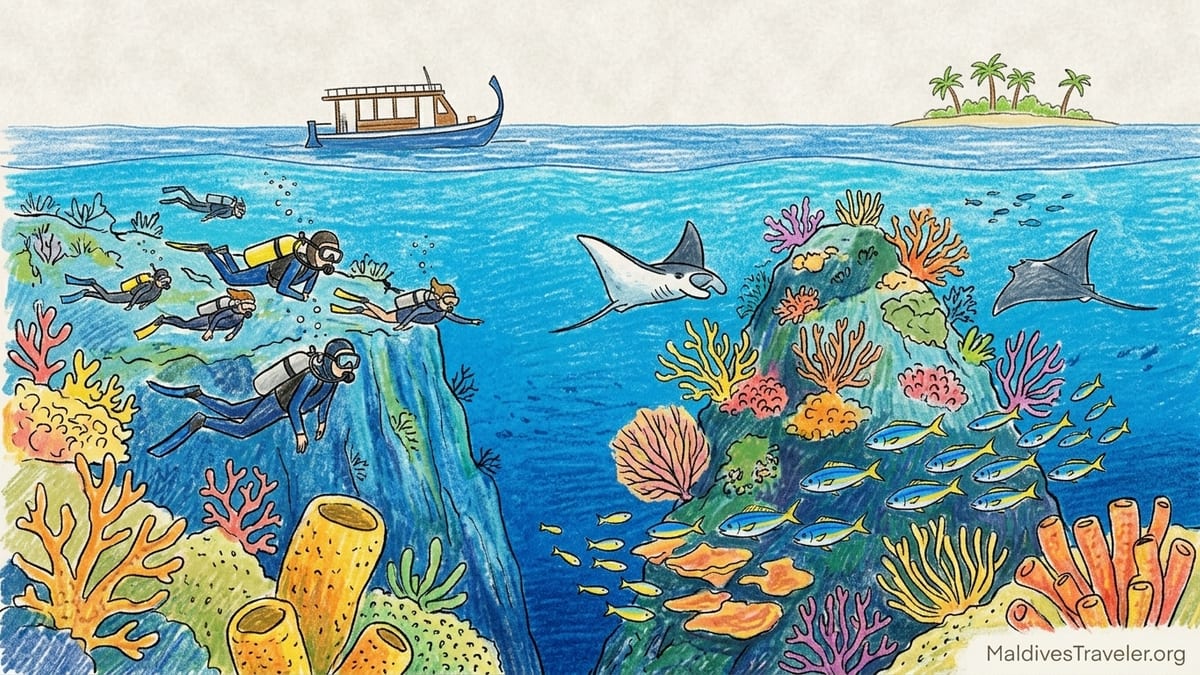
Understanding Raa Atoll’s Dive Topography and Seasons
Raa Atoll sits in the northern Maldives and is recognised among dive professionals for its concentration of thilas (submerged pinnacles), farus (reef ridges), walls and channels that funnel current and marine life. Unlike some atolls that are famous for one headline site, Raa’s appeal lies in how many of its reefs share similar features: stepped drop-offs, cave-like overhangs, soft coral gardens and sandy saddles where rays, turtles and schooling fish gather. PADI and other training agencies highlight the region as a suitable classroom for advanced training because divers can practice current management, buoyancy around overhangs and mid-water ascents on real but controlled Maldivian sites rather than on a single showpiece reef.
Seasonality matters. Raa experiences the same broad monsoon pattern as the rest of the Maldives: a generally dry northeast monsoon from about December to April, and a wetter, more plankton-rich southwest monsoon from roughly May to November, with November and April as transition months. Regional guides and local operators report that from December to around March, seas on Raa’s eastern and southern sides are often calmer, with visibility regularly in the 20 to 30 metre range on the clear-water side. Later in the year, when the southwest monsoon picks up, wind and swell can increase, visibility may drop in planktonier water, and some of the most interesting manta encounters happen on exposed cleaning stations that face the prevailing flow.
For trip planning, this means the December to April window is usually the safest bet for mixed-experience groups who value calm seas, stable surface conditions and bright, blue-water photography. A family staying at a resort such as Dhigali or Reethi Faru during February, for example, can often combine shallow house-reef dives with a few boat trips to nearby thilas in relatively gentle seas. More experienced divers who are comfortable with stronger current might target the shoulder or southwest-monsoon months instead, when cleaning stations like Kottefaru Bodu Thila and seasonal corners around Maamunagau or Sola can see regular manta traffic in nutrient-rich water, at the cost of choppier crossings and more variable visibility.
Throughout this guide, treat site descriptions as indicative rather than absolute. Depths and currents can change significantly from one tide and monsoon phase to the next, and many operators in Raa adjust their daily program based on live current checks. Before you book a package, it is worth emailing at least one local dive centre, such as the on-site teams at Dhigali Maldives, InterContinental Maldives Maamunagau Resort or Reethi Faru, and asking how specific sites are diving in the current season.
Manta Ray Experiences and Cleaning Stations
Raa does not have the global name recognition of Baa Atoll’s Hanifaru Bay, but a growing body of specialist reporting singles it out as one of the Maldives’ more consistent manta ray regions. Operators based around islands like Maamunagau, Kottefaru and nearby sandbanks describe a network of feeding and cleaning sites on both the northeast and southwest monsoon sides of the atoll. Research-based travel guides outline a pattern in which manta activity in Raa clusters around the northeast monsoon from roughly December to April on some reefs, while other stations on the more exposed edges show peaks into the wetter months when plankton levels rise. This dual seasonality means mantas are a realistic possibility for much of the year, but never a guarantee on any individual day.
Named manta spots in current dive literature include Kottefaru Bodu Thila and Sola Corner, both described by resort dive teams as shallow cleaning stations with coral heads at around 12 to 15 metres where reef mantas circle slowly while cleaner wrasse work on their gills. At Kottefaru, Dhigali’s dive centre notes that a “wet-season” pattern brings more mantas between roughly June and November, while Sola Corner, on a different flank of the atoll, tends to peak in the drier December to March period. Another area of interest is Maamunagau, where the InterContinental resort has promoted its proximity to known feeding sites and where independent manta researchers have previously documented seasonal concentrations linked to monsoon-driven plankton flows.
From a diver’s perspective, most manta dives in Raa are accessible to Open Water divers, with typical working depths in the 10 to 18 metre range and the action often on top of or just off the reef plateau. What complicates them is current. Cleaning stations are productive precisely because water movement delivers plankton and oxygen, and several Raa operators mention that they occasionally request negative entries on outgoing-tide dives when the flow is strong. That means rolling in with little or no air left in your BCD to avoid being swept away at the surface, then inflating slightly once you are descended and stable. Divers without experience in negative entries should discuss this at the briefing and can usually opt for a more conservative giant-stride and quick descent if the group and conditions allow.
A realistic expectation is essential. Even at well-known Raa cleaning stations, mantas are not present on every dive. One week in March might bring multiple encounters with five to ten rays looping over the same block of reef, while another week in January at the same resort sees only fleeting silhouettes in the blue. Dive guides on Kottefaru Bodu Thila sometimes break a dive into a static period on the sand at 14 metres hoping for mantas, followed by a tour of nearby coral and fish life if none appear. It is wise to book at least two or three dedicated manta-focused dives spread across your stay, especially if you are visiting in a shoulder month such as late November or early April when monsoon patterns can still be shifting.
Shark and Pelagic Dive Objectives
Raa does not offer the very high-adrenaline pelagic action of far-southern atolls like Fuvahmulah, but it is a solid destination for divers who want regular encounters with reef sharks, eagle rays, Napoleon wrasse and schooling trevally. Dive guides frequently single out thilas and outer walls such as Thiling Faru, Dhigali Thila and Fuggiri Wall as the places where current converges and larger fish patrol. At Thiling Faru, descriptions mention grey reef and whitetip sharks working the up-current corner at depths of roughly 18 to 30 metres, sometimes joined by eagle rays gliding along the edge and dogtooth tuna dashing in from mid-water.
Dhigali Thila, which appears both in general Maldives dive references and on resort fact sheets, is described as having its top at around 10 metres, dropping to about 30 metres, with canyons and caves cut into the sides. Dhigali’s own dives team highlights strong current here, and promotional material recommends the dive primarily for experienced divers. The site’s southern overhangs, starting around the mid-twenties in metres, are known for soft corals and schooling snappers, while the sand at the base can hold stingrays and resting sharks on quieter tides. Fuggiri Wall, by contrast, is often dived as a more linear drift along a near-vertical reef that falls quickly beyond recreational depths, with grey reef sharks appearing in the blue and batfish, groupers and fusiliers close to the wall.
For shark-focused travelers, this translates into a requirement for at least Advanced Open Water certification or equivalent, along with comfort at 25 to 30 metres and in moderate to strong current. On a typical morning two-tank trip from a resort such as Dhigali, the first dive might be a deeper, current-dependent site like Dhigali Thila or Kudathulhaadhoo Thila, while the second is a shallower reef or giri more suitable for less experienced buddies. Local regulations in the Maldives generally limit tourist diving to a maximum of 30 metres, and many centres in Raa will enforce more conservative limits during periods of strong current.
It is also important to manage expectations about species. Reef sharks at Raa’s thilas are seen far more often than rarer animals such as hammerheads, tiger sharks or whale sharks, which are associated with different parts of the country. Divers who book Raa primarily for mantas and classic Maldivian reef scenes, then treat any pelagic surprise as a bonus, are rarely disappointed. Those whose sole goal is a specific shark species may be better served by a dedicated central or southern atoll itinerary and can consider Raa as a quieter, more all-round alternative.
Coral Gardens, Overhangs and Macro Life
Although Raa’s reputation rests heavily on thilas and current-swept corners, several of its most rewarding dives for photography and relaxed exploration are coral and overhang sites with moderate current and complex structure. PADI and independent writers emphasise that Maldivian thilas often carry dense soft corals and gorgonian fans on the faces that take the current, with caves and ledges underneath that shelter soldierfish, squirrelfish and glassfish. This pattern is clearly visible on Raa sites such as Kudathulhaadhoo Thila, where Dhigali’s dive fact sheet describes boulder corals and southern overhangs at around 24 metres, and on Reethi Thila, a shallower reef popular with macro enthusiasts.
Current specialist descriptions of Reethi Thila highlight a sandy reef flat that begins in the low teens in metres and slopes down through coral blocks that are home to mantis shrimp, nudibranchs, octopus and cleaner shrimp. Here, the “big ticket” fauna may be a cruising turtle or a distant eagle ray, but the main attractions are the textures and smaller residents: clownfish in anemones, leaf scorpionfish on sponges, moray eels in crevices. Photographers often request to dive the site at slack or mild current, which allows for slow, careful finning around the bommies without being pushed off the reef.
Overhang-heavy reefs, including parts of Fenfushi Giri and Madi Gaa, reward slightly more experienced divers with good buoyancy control. Some of these dive sites have overhangs at 18 to 25 metres that are large enough to swim into while staying close to the entrance and natural light. Inside, walls can be carpeted with soft corals, sea fans and sponges, making them ideal for wide-angle shots when sediment is low. However, guides often stress that divers should avoid penetrating too far under any ledge, both to minimise fin damage to fragile growth and to manage entanglement and silt risks. A torch is highly recommended, not only for safety but also to restore colour at depth.
For macro-focused trips, it is worth asking prospective Raa dive centres which sites in their rotation are best suited to small life and whether they schedule them deliberately at particular states of the tide. Some teams group these gentler reefs into late-morning or afternoon dives when current has eased after a stronger early-morning deep or drift dive. While Raa will not rival dedicated muck destinations for rare critters, its mix of nudibranchs, shrimps, crabs, blennies and juvenile reef fish can easily fill a memory card over a week-long stay, especially if you repeat the most intricate sites under different light.
Beginner, Training and Gentle Reef Dives
Despite its reputation for current, Raa Atoll offers a surprising number of sites suitable for new or less confident divers, along with sheltered lagoons and house reefs that work well for Open Water training. Resorts such as Reethi Faru, Dhigali and several others promote their shallow inner-reef systems as accessible to complete beginners, and published activity sheets from properties like InterContinental Maldives Maamunagau list PADI Discover Scuba Diving sessions that start in confined water before a supervised lagoon or house-reef dive. These controlled environments typically sit in the 5 to 12 metre range, with sand patches for skills and easy exits to the jetty or beach.
On the boat-diving side, sites that local guides class as “reef” or “giri” rather than strict thilas or channels tend to offer the easiest conditions. Fenfushi Giri, for example, is described as a shallow-topped giri at Raa’s southern edge, with pretty anemone overhangs and a maximum depth that keeps most of the interesting scenery within Open Water limits. An operator might use Fenfushi Giri for a first open-ocean dive after lagoon training, or as the second dive on a two-tank morning after a deeper thila that only the more advanced divers on the boat join. Another often-cited beginner-friendly area is Fainu Corner, which some sources describe as a relaxed drift along a moderately sloping reef that allows divers to stay in the 10 to 18 metre band while still seeing turtles, schooling fusiliers and occasional rays.
For families or couples who are mixing diving with other activities, these gentler reefs make it possible to log enjoyable dives without committing to the more serious currents of Raa’s advanced sites. A realistic week for a new Open Water diver might include four to six boat dives to easy reefs and thilas, interspersed with snorkelling and perhaps a night dive on the house reef, rather than chasing every deep or challenging site advertised. When you contact dive centres before travelling, describe honestly how many logged dives each person has, how comfortable they feel with free descents in mild current, and whether anyone prefers to stay shallower than 18 metres. This helps the centre place you on suitable boats and may influence which section of Raa they recommend you stay in.
Pricing in Raa is similar to many Maldivian resort atolls. Recent activity lists from five-star properties in the region suggest that a single guided boat dive, excluding equipment rental, often falls in a broad band between the equivalent of 80 and 130 US dollars, with discounts for ten or more dives. Course packages such as PADI Open Water or Advanced Open Water are commonly sold as all-inclusive bundles of theory, confined-water and open-water dives, and may include equipment. Exact figures vary widely with resort category, so treat these numbers as order-of-magnitude examples only and confirm current rates directly with your chosen operator.
Drift Diving, Currents and Negative Entries
Currents are an integral part of the Raa Atoll experience, particularly for divers targeting sites such as Madi Gaa, Thiling Faru, Dhigali Thila and other outlying thilas and corners. Many of these reefs sit in or near channels where the atoll lagoon exchanges water with the open Indian Ocean. When tide and monsoon direction align, flow along these structures can become brisk, turning the dive into a thrilling drift along walls and over saddles. On other days, the same site may be almost slack, suitable even for less experienced divers. This variability makes real-time decision-making by local guides crucial.
A typical advanced drift on a Raa thila might begin with a live-boat negative entry, especially if the surface current risks separating divers from the reef. The crew positions the dhoni or speedboat up-current of the site, counts down, and everyone rolls in together, deflating their BCDs so they sink promptly to the planned depth, usually in the 10 to 18 metre range at the reef shoulder. Once on the lee side or at the up-current corner, divers can inflate slightly, stabilise, and then ride the flow along the reef, watching sharks, rays and schooling fish that face into the current.
Because these dives can involve depths in the mid-twenties to around 30 metres, mid-water ascents and sometimes blue-water safety stops away from the reef, operators in Raa generally expect participants to hold at least Advanced Open Water certification or equivalent and to have recent experience in current. If you have fewer than 30 logged dives, it is wise to build up slowly with several easier reefs before attempting the most exposed thilas. Some centres also schedule “current checks” on a site during a first dive of the day and then decide whether to bring less experienced guests back later when the tide has turned or slackened.
Concrete examples help illustrate the range of conditions. Kudathulhaadhoo Thila, featured in Dhigali’s dive literature, starts around 15 metres, drops beyond 30 metres and has overhangs on its southern side that light up with soft corals when current is present. The same site can be a gentle cruise over the top on one tide, and a full-on hook-in drift on another, when divers use reef hooks at the up-current corner to stay in place while schools of anthias, fusiliers and trevally swirl in front of them. Madi Gaa and Thiling Faru are often described in similar terms: rewarding when dived correctly, but serious enough that guides may turn the boat around if they deem the flow too strong or the group under-experienced.
For intermediate divers who want to improve their drift skills, Raa can be an excellent classroom. Several resorts encourage visitors to combine an Advanced Open Water or specialty course such as Drift Diver or Deep Diver with a week’s stay, using easy thilas and outer reefs early in the week before stepping up to more challenging corners. When considering such training, make sure the instructor-to-student ratio is low, ideally not more than four students per instructor on current-prone dives, and that the shop is willing to adjust the schedule if conditions spike unexpectedly.
Night Diving and After-dark Wildlife
Night diving in Raa Atoll tends to focus on house reefs and protected inner walls, although some operators occasionally schedule boat night dives to sheltered thilas or farus when conditions allow. These dives usually take place in the 8 to 18 metre range, making them accessible to Open Water divers who are comfortable in the water and have already done a few daylight dives on the same site. The emphasis is on behaviour rather than big animals: parrotfish sleeping in mucus cocoons, hunting morays, decorator crabs and bioluminescent plankton flashing in the dark water.
House reefs at resorts such as Reethi Faru and Dhigali are particularly popular for first-time night divers because entry and exit points are clear, surface swims are short and orientation lines or markers may be set up. Dive centres typically require a guided night dive before they allow guests to explore independently with a buddy, and they provide briefing details such as maximum penetration distance along the reef, turn pressure and time, and what to do if current strengthens. Having your own primary and backup torch, plus a small light on your tank or mask strap, is strongly recommended even when rental gear is available.
Wildlife expectations should again be realistic. While nurse sharks and rays sometimes appear on Raa’s night dives, there is no single site in the atoll that reliably reproduces the dense nurse shark aggregations seen on certain eastern Maldives reefs. Instead, think of Raa night dives as a chance to focus on smaller animals and eerie coral textures under artificial light. Photographers often switch to macro setups and look for shrimps on sea whips, sleeping turtles tucked under ledges or basket stars unfurling on gorgonians. In some months, especially around the southwest monsoon when plankton can be thicker, simply switching off all torches for a minute and waving your hands to stir up bioluminescence can be as memorable as any big-animal sighting.
For those training towards PADI Advanced Open Water or equivalent, a night dive is often one of the required or elective adventure dives. Raa’s combination of resort house reefs and gently sloping inner walls makes it relatively straightforward for instructors to stage these dives in a controlled manner. Before you sign up, confirm that the dive will be held on a site with which you are already familiar from daytime dives, and that the maximum planned depth fits comfortably within your recent experience.
Is Raa Atoll Right for Your Certification Level?
One of the recurring questions from travelers is whether Raa Atoll is a good place to learn to dive, or whether it is better suited to already-certified divers looking to log more advanced dives. Based on current information from resort dive centres and independent diver reports, the answer is that Raa can work for both, but for different reasons and with different expectations.
If you plan to take an Open Water course in Raa, you will most likely train through a resort-based PADI or SSI centre. Activity sheets from high-end properties in the atoll show full-course offerings alongside Discover Scuba Diving and refreshers. Confined sessions usually happen in sheltered lagoons or pools, followed by open-water dives on the house reef or a nearby, very gentle site. This setup is perfectly adequate for earning a first certification, particularly if you value calm, clear, warm water and the convenience of walking from your villa straight to the dive centre. The trade-off is cost: resort-based courses in the Maldives are often significantly more expensive than equivalents in places like Thailand, Indonesia or Egypt, and you may find that staff availability and schedules are tuned around holiday timelines rather than long, intensive courses.
Already-certified divers arguably gain the most from Raa’s distinctive underwater topography. Open Water divers with around 10 to 20 logged dives can enjoy sheltered reefs, easy thilas, manta cleaning stations in mild current and house-reef night dives, all within their 18 metre limit or only slightly deeper under instructor supervision during an Advanced course. Advanced Open Water divers and above, especially those with nitrox certification, can take fuller advantage of deeper thilas such as Dhigali Thila, Kudathulhaadhoo Thila, Madi Gaa and other outer reefs where the main action is in the 20 to 30 metre band and dives are sometimes shorter due to depth and current.
As a rule of thumb, if your primary objective in visiting Raa is to enjoy its famous thilas, drift dives and overhangs rather than to learn the basics of scuba, it may make more sense to complete your Open Water course at home or in a cheaper training destination, arrive certified and rested, and then use Raa to build experience and perhaps take a focused Advanced or specialty course. On the other hand, if budget is less of a concern and you like the idea of combining a honeymoon or family holiday with learning to dive in warm, clear Maldivian water, Raa’s resort infrastructure and gentle house reefs make it a comfortable, if premium-priced, classroom.
Whichever path you choose, be candid with your chosen dive centre about your comfort level, any long breaks from diving and specific goals such as mantas, sharks, drift experience or macro photography. The better they understand your objectives and limits, the more precisely they can match Raa’s varied portfolio of dive sites to the experience you want to have.
The Takeaway
Raa Atoll is not the Maldives’ loudest diving destination, but for those who care about underwater structure, currents and the interplay of big animals with thilas and overhangs, it is one of the most interesting. PADI materials and specialist dive guides consistently highlight the atoll’s concentration of submerged pinnacles, caves, drop-offs and coral-covered walls, along with a healthy cast of reef sharks, rays, turtles, Napoleon wrasse and macro life. Seasonality matters, with clearer, calmer northeast-monsoon conditions from roughly December to April and more plankton-rich, sometimes rougher southwest-monsoon waters later in the year that can fuel manta activity on exposed cleaning stations.
By organising your trip around objectives rather than chasing an arbitrary “top 10 sites” list, you can make the most of what Raa offers. Manta fans can schedule several dives on stations such as Kottefaru Bodu Thila or Sola Corner in the appropriate season, knowing that nothing in wildlife can be guaranteed. Shark and pelagic enthusiasts can focus on deeper thilas and outer walls like Thiling Faru, Dhigali Thila and Fuggiri Wall, while photographers and newer divers concentrate on coral gardens, overhangs and macro-rich reefs such as Reethi Thila and Fenfushi Giri. Night dives on house reefs and gentle drifts along inner walls round out the portfolio.
Crucially, Raa is an atoll where dive conditions can swing quickly with tide and monsoon, and where the most rewarding sites often demand advanced confidence with current, negative entries and mid-water ascents. That does not make it exclusive, but it does argue for honest self-assessment, thoughtful choice of dive centre and a willingness to change plans if currents strengthen. If you bring that mindset, and if you work with local guides who know when to dive which site, Raa Atoll can deliver a week of diving that balances challenge and comfort, signature Maldivian scenery and the quiet pleasure of exploring reefs that still feel, in places, pleasantly under-publicised.
As you plan, remember that all specific site notes and seasonal patterns are subject to change. Before finalising an itinerary, contact at least one Raa-based dive centre, ask how Madi Gaa, Thiling Faru, Fuggiri Wall, Reethi Thila, Kottefaru Thila, Dhigali Thila and any local manta cleaning stations are diving in the current season, and be prepared to let their local knowledge refine the details of where and when you roll in. The reward for that flexibility is a richer, more accurate experience of one of the Maldives’ most quietly compelling dive atolls.
FAQ
Q1. When is the best time of year to dive Raa Atoll?
From roughly December to April, during the northeast monsoon, Raa typically offers calmer seas and clearer water, which many travelers find ideal. Later in the year, especially from June to November, conditions can be windier and more plankton-rich but may bring increased manta activity at certain cleaning stations. Always confirm current conditions with a local dive centre before you travel.
Q2. What certification level do I need for Raa’s signature thilas?
Most of the well-known thilas and outer walls, such as Dhigali Thila, Madi Gaa and Thiling Faru, are best suited to Advanced Open Water divers or equivalent, comfortable at depths of 25 to 30 metres and in moderate to strong current. Open Water divers can still enjoy easier reefs and some shallow thilas but may be excluded from the more exposed sites until they gain additional training and experience.
Q3. Can I learn to dive (Open Water) in Raa Atoll?
Yes. Several resort-based PADI and SSI centres in Raa offer full Open Water courses, using pools or lagoons for confined sessions and house reefs for training dives. This provides warm, clear, relatively calm water, though at a higher price than many non-resort destinations. It is a comfortable but premium place to learn, especially if you are already planning a resort stay.
Q4. Are manta ray sightings guaranteed in Raa?
No. Even at established cleaning stations like Kottefaru Bodu Thila or Sola Corner, manta rays are never guaranteed. Seasonal patterns and plankton levels make sightings more likely in certain months, but any individual dive can pass without mantas. Plan multiple manta-focused dives and treat every encounter as a bonus rather than an entitlement.
Q5. How strong are the currents, and will I need to do negative entries?
Currents on Raa’s outer thilas and corners can be strong, particularly when tide and monsoon align, and guides sometimes request negative entries on advanced dives to prevent the group from drifting off the reef. Less exposed reefs and house sites, on the other hand, may have only mild current. If you are not comfortable with negative entries or fast drifts, discuss this with your dive centre and ask to start with gentler dives.
Q6. Are Raa’s dive sites suitable for underwater photographers?
Yes. Wide-angle photographers can enjoy manta encounters, sharky corners and soft-coral overhangs on thilas like Kudathulhaadhoo Thila and Dhigali Thila, while macro shooters find nudibranchs, shrimps and small reef fish on sites such as Reethi Thila and Fenfushi Giri. Visibility is often best from December to April, but plankton-rich months can bring atmospheric hazy light and feeding behaviour.
Q7. How many dives should I plan for a one-week stay?
For a balanced holiday, many divers in Raa plan around 8 to 12 dives over a week, for example one two-tank trip every other day plus a couple of house-reef or night dives. Very enthusiastic divers sometimes log 15 or more dives in seven days, but conditions, budget and non-diving companions may all influence your ideal number.
Q8. What kind of marine life can I expect apart from mantas and sharks?
Raa’s reefs host turtles, Napoleon wrasse, eagle rays, stingrays, schooling fusiliers, jacks and snappers, as well as healthy coral gardens with anemones, clownfish, morays, octopus and various crustaceans. Macro life includes nudibranchs, shrimps and crabs, particularly on coral blocks and overhangs. Exact species and densities vary by site and season.
Q9. Is nitrox useful for diving in Raa Atoll?
Yes. Many of Raa’s more interesting sites have key features in the 20 to 30 metre range, so diving on nitrox can provide more no-decompression time and an added safety margin when used within proper limits. Several resort dive centres offer nitrox fills or nitrox certification, though availability and pricing differ, so it is wise to confirm in advance.
Q10. How do dive prices in Raa compare to other destinations?
Dive prices in Raa generally reflect Maldivian resort rates. Recent examples from five-star properties suggest single boat dives often fall in a broad range around 80 to 130 US dollars before equipment rental, with course packages priced higher. This is more expensive than many land-based dive destinations in Southeast Asia or the Red Sea, but comparable to other luxury-island settings. Always request an up-to-date price list from your chosen resort or dive centre.