


I landed in Raa Atoll on 6 July 2024 with a suitcase full of resort wear and a weather app promising “sun with scattered showers.” Ten days later, flying back to Malé on 16 July, my camera roll told a more complicated story: 3 days with at least six solid hours of rain, 2 days of on‑and‑off showers that never fully cleared, and 5 days where the sun won more than it lost. This was the southwest monsoon in real life, not as described in brochure language, but as it actually feels when you have paid luxury prices and the sky turns stubbornly grey.
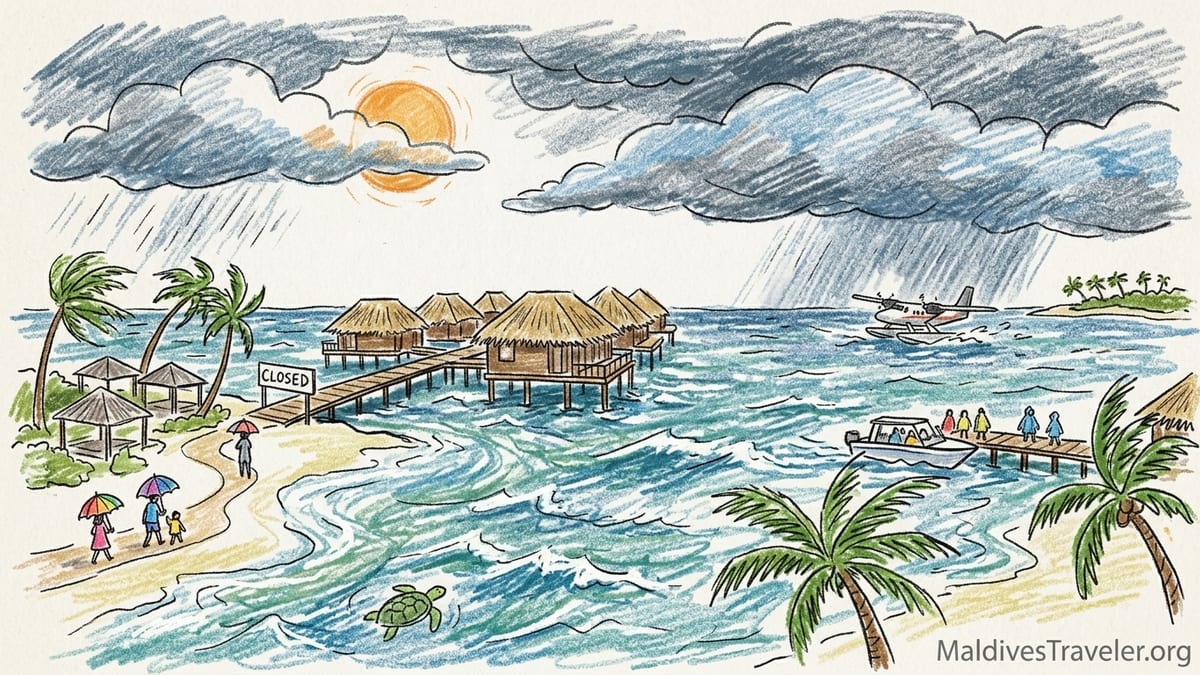
Setting the Scene: Hulhangu Season in Raa Atoll
Raa Atoll sits in the northern half of the Maldives, which tends to catch the wetter side of the southwest monsoon, known locally as Hulhangu, between roughly May and November. Maldives climate data describes this as the wet, windier part of the year, with southwesterly winds more dominant from May to October and a general wet season from April to November in the north of the country. In practical terms, that means a higher chance of cloud, showers and choppy seas compared to the drier northeast monsoon months from about December to March.
For my own trip, I chose 6 to 16 July 2024 because resort prices in Raa Atoll were significantly lower than in February. One resort that had been quoting around 1,350 US dollars per night plus taxes for a Sunrise Overwater Villa in late February was offering the same villa in early July from about 780 to 850 US dollars per night on selected dates, sometimes bundled with complimentary half board and seaplane transfer discounts. The saving for a ten‑night stay was in the region of several thousand dollars, enough to cover international flights from Europe in economy plus a couple of nights in Malé.
What no search result can tell you with certainty is what those “increased chances of showers” will look and feel like when you are actually on an island. That part only becomes clear when you start counting real rainy hours instead of percentages on a chart.
Ten Days, A Notebook And A Very Real Rain Tally
I arrived in Raa Atoll on the afternoon of Saturday 6 July 2024, after a seaplane hop from Malé, and I kept daily notes of the weather from that first sunset to my departure on Tuesday 16 July. Out of those 10 calendar days, 3 were what I would call truly rainy: at least six consecutive hours where outdoor plans were essentially written off, with steady rain or repeated heavy downpours and low grey cloud.
On those three days, I logged around 7 to 9 hours of meaningful rain each. One day saw rain begin around 10.30 in the morning and not really stop until near sunset, with only brief lulls that never tempted anyone back to their sunloungers. Another day brought an intense thunderstorm just after lunch that shut down the pool deck, followed by squally showers through the afternoon and early evening.
Two further days were what I would call broken or mixed: short, sharp showers of 10 to 30 minutes several times, separated by one to three hours of bright or hazy sunshine. Over those days I counted around 2 to 3 hours of rain in total each, but spread out enough that you always felt slightly cautious about starting anything that needed consistently clear skies, like a long photoshoot or a sandbank picnic.
The remaining 5 days were, by most people’s holiday standards, “good weather” with perhaps a sunrise shower or an isolated late‑afternoon squall that lasted less than half an hour. The sunshine ratio on those days was comfortably above 70 percent by my own rough estimate, and the UV index remained intense whenever the sun broke through. In other words, I did not endure a wall‑to‑wall washout, but the rain that did arrive had real consequences.
When The Sea Gets Angry: Transfers And Excursions In Wet Season
The weather’s first real impact came before I had even arrived in Raa Atoll. Earlier that week, the Maldives Meteorological Service had issued rough weather advisories connected with the southwest monsoon, warning of strong winds and choppy seas in northern atolls. On my travel day, the operator kept the seaplane schedule but warned of potential delays. The 45‑minute hop was safe but noticeably bumpy, with patches of low cloud and enough crosswind on landing that several passengers gripped the armrests more tightly than they might have in February.
During my stay, there were two days when the resort’s speedboat transfers to nearby sandbanks were cancelled outright. On both occasions, whitecaps had built up across the lagoon and the channel beyond, and staff explained that the combination of wind direction, wave height and limited shelter in certain passages made it uncomfortable for guests and awkward for crew. Guests who had booked private sandbank breakfasts were offered rebooking or refunds, but honeymoons do not always come with spare days to reschedule.
Ocean excursions also took a hit. A manta ray trip scheduled for 9 July was postponed to the following afternoon due to poor visibility and rougher seas outside the atoll. The marine biologist showed us satellite charts and local readings suggesting reduced clarity at known cleaning stations, which would have turned the experience into glimpses of ghostly shadows rather than the clear‑water encounter people imagine from social media. When we finally went, conditions were acceptable but not postcard perfect, with visibility around 8 to 10 metres instead of the 20‑plus metres that are possible in the clearer season.
Even on relatively calm days, the open‑ocean side of the atoll felt more boisterous than during a previous February trip elsewhere in the Maldives. Beach villas on exposed stretches of sand had a steady onshore breeze that kicked up small but insistent waves, which looked dramatic in photographs but made stand‑up paddleboarding noticeably more effort and less relaxing. The lagoon closer to the island’s lee side remained swimmable, but nobody pretended it was “lake‑like” or glassy every afternoon.
Cloud, Colour And Underwater Visibility
One of the subtler surprises of Hulhangu season in Raa Atoll was how much cloud alters the famous blue‑on‑blue palette. On fully sunny days, the lagoon shifted through electric turquoise, pale mint and deep cobalt, exactly as in the brochures. On overcast mornings, however, the same waters took on a steely or milky tone. Standing on the jetty on 11 July at 9 a.m., with an unbroken layer of high grey cloud, the lagoon still looked beautiful, but it lacked that almost unreal glow that people fly halfway around the world to see.
This matters more than you might think. Drone photographers who had timed their flights for early morning found that they were capturing elegant but muted images. Staff suggested waiting for mid‑afternoon, when in this particular week breaks in the cloud were more common. In practice, the best colour that week often appeared between about 2 p.m. and 4.30 p.m., when gaps opened in the cloud deck and shafts of full sun hit the reef edge, briefly restoring the famous Maldives neon.
Underwater, things were just as variable. On the clearest day, the house reef offered around 15 metres of visibility, with healthy coral blocks, reef fish and the occasional turtle clearly visible from the surface. Following a night of heavy rain and wind on 8 July, the next morning’s snorkel felt completely different. Visibility dropped to an estimated 5 to 7 metres, with suspended particles and a slight greenish tint close to shore where runoff from the island mixed with lagoon water.
The resort dive centre adjusted accordingly. Scheduled morning dives after stormy nights were sometimes switched to more protected sites or pushed later in the day to allow sediment to settle a little. Divers reported that pelagic species like tuna and jacks were still present, but wide‑angle reef photography lost some of its sparkle. Macro and close‑up work, however, remained rewarding, since small subjects such as nudibranchs and shrimps are less affected by reduced horizontal visibility.
Life On A Windy Jetty: Overwater Villas In The Monsoon
Overwater villas are one of the great Maldives fantasies, and in Raa Atoll they often stretch in elegant curves into the lagoon. During the southwest monsoon, their orientation to the wind becomes a tangible factor in day‑to‑day comfort. My villa faced roughly west‑southwest, which meant that on windier days the deck took the brunt of the gusts.
On the calmest days, the overwater experience matched the marketing: barely a ripple around the stilts, only gentle lapping sounds and open‑air dinners on the deck. On 3 of the 10 days, though, the wind rose high enough that the resort pre‑emptively closed the outdoor umbrellas and recommended bringing cushions indoors. At night, the combination of wind whistling around the wooden structure and slightly more vigorous wave slaps under the deck created a soundtrack that some guests found atmospheric and others described to staff as “a bit restless.”
The practical inconveniences added up in small ways. Room service staff sometimes struggled to keep plates covered during the walk along the exposed jetty. Outdoor bathtubs on the lagoon side turned into splash zones during gusty showers, with raindrops blowing in sideways. On one particularly stormy late evening, the resort temporarily shut the furthest section of the jetty for around an hour, asking guests in those villas to remain inside while staff checked for any loose fixtures.
If you crave guaranteed stillness and absolute silence, that version of Hulhangu might feel like a compromise. If you enjoy weather watching, it can be fascinating to sit on the covered part of the deck and see squalls roll across the horizon, the line of rain visible as a moving curtain under darker clouds.
The Emotional Cost Of Grey Skies At Luxury Prices
Perhaps the most honest part of any rainy‑season account is not the number of millimetres that fell, but how it feels emotionally when clouds dominate the sky you have paid so much to see in blue. On my trip, I noticed a clear pattern: on the three fully rainy days, there was a quieter, flatter mood at breakfast and the pool bar, despite the same service and amenities.
Couples who had saved for a milestone anniversary seemed particularly affected. One pair I spoke to had booked a five‑night stay from 7 to 12 July and happened to draw two of their only full days as almost total washouts. They had planned a private sandbank dinner and a professional photo session at sunset, both of which were cancelled or heavily curtailed. The resort did its best, offering indoor alternatives and partial refunds, but there is no perfect substitute for a Maldivian sunset when you imagined a fiery sky and glassy water and received grey cloud and drizzle instead.
There is also the subtle frustration of indoor time in a place designed for outdoors living. All‑inclusive cocktails taste different when consumed under a thatched‑roof bar with rain sweeping across the lagoon instead of under a clear golden evening sky. Even practical details, like wet swimwear never quite drying on a shaded terrace, contribute to a low‑level sense of compromise.
Yet it is important to be clear: not every wet‑season trip is dominated by these feelings. Tropical weather is inherently variable. Another couple at the same resort, arriving as I left on 16 July and staying until the 22nd, might well have experienced a run of mostly sunny days. That is the gamble at the heart of Hulhangu travel. Meteorological patterns can describe increased probabilities, but they cannot offer guarantees for a specific week months in advance.
The Upside: Prices, Peace And Dramatic Skies
If the story ended with frustration, nobody would book Raa Atoll in the rainy season. The reality is more nuanced, and the benefits I experienced were significant. The first was financial. Taking my July 2024 dates instead of peak February meant a nightly rate reduction of hundreds of dollars at several resorts I tracked, along with added value like complimentary breakfast and dinner or up to 40 percent off seaplane transfers for stays over a certain length. One family saving close to 5,000 US dollars on accommodation alone told me plainly that they would “accept a few grey days” in exchange.
The second upside was quiet. Even in a popular Raa Atoll resort with over 100 villas, the main pool area felt half full at most in the middle of the day. Snorkel trips that might carry 10 to 12 guests in high season sometimes departed with only 4 or 6. The spa could accommodate same‑day bookings, and popular activities like sunset dolphin cruises did not book out days ahead, giving more flexibility to work around passing showers.
Then there was the drama of the weather itself. Not all monsoon skies are flat grey. Several evenings produced towering cloud formations lit pink and orange by the setting sun, with curtains of rain visible many kilometres away but never reaching the island. One late afternoon, a rainstorm tracked just north of the resort, painting double rainbows across a dark background while the beach remained dry. Photographers on the island agreed that these contrasted scenes were more interesting to shoot than the uniform, cloudless sunsets that dominate the dry season.
The sea remained warm throughout, with surface water temperatures around the high twenties Celsius, so even during light rain it was perfectly comfortable to swim. On mixed days, a popular routine emerged: morning snorkel under high cloud, lunch under cover while a shower passed through, then a bright, steamy window of sunshine in mid‑afternoon for pool time or paddleboarding.
Managing Expectations: How To Plan A Raa Atoll Wet‑Season Trip
Planning intelligently for Raa Atoll during Hulhangu is less about trying to “beat” the rain and more about building in room for its surprises. One practical step is to look at flexible cancellation or date‑change policies when you book, especially if you are targeting shoulder months like late May, June or early November, when patterns can swing either way. Some high‑end resorts in Raa Atoll now allow changes up to a certain number of days before arrival for a fee or offer low‑season promotions with slightly more lenient terms than peak season.
On arrival, treat the daily forecast as a guide, not a script. My notes show that some of the week’s best sunsets arrived on days the forecast app had summarised as “rain with thunderstorms.” Localised showers meant the island itself sometimes stayed dry while cells passed over nearby channels. Pay more attention to how the sky looks hour by hour than to a gloomy icon fixed on your phone screen.
It also helps to diversify your idea of a “good day.” On one of my rainiest mornings, I booked a long spa treatment followed by an extended Maldivian cooking class in the resort’s covered garden pavilion, emerging to find that the sky had lightened and the deck was dry enough for a barefoot walk at golden hour. Indoor or semi‑indoor experiences such as wine tastings, barista workshops, marine‑biology talks and yoga in a covered pavilion come into their own in wet season and can feel less like second‑best options and more like part of the main event.
Finally, choose your room category with the season in mind. If the idea of wind on the jetty worries you, a beach villa set in lush vegetation may offer a more sheltered, cocooned feel during Hulhangu, with less exposure to gusts and easier access to the main island facilities during showers. If you absolutely want an overwater villa, consider the orientation: on some islands, certain jetties face more into the prevailing wind while others are partially protected by the island’s shape.
The Takeaway
After ten days in Raa Atoll from 6 to 16 July 2024, my conclusion is not that the rainy season is “bad” and the dry season “good.” The reality is more conditional. In that specific window I counted 3 genuinely rainy days, 2 mixed days and 5 that many travellers would call close to ideal, with warm sunshine, blue lagoons and only brief interruptions. The costs were real: cancelled or postponed excursions, rougher seas on certain routes, duller colours at times and the emotional dip that accompanies a holiday day written off by continuous rain.
The benefits were just as tangible. Lower nightly rates and generous wet‑season offers made an otherwise unreachable five‑star resort feasible. The island was quieter, service felt more personal and the dramatic interplay of light, cloud and sea created moments I never would have captured in the uniformly clear February sky. The sea stayed warm, the house reef stayed alive with turtles and reef fish, and most days still delivered several hours where the Maldives looked exactly as it does in the brochures.
Who, then, should accept the Hulhangu gamble in Raa Atoll, and who should pay more for the statistically drier months? If you are travelling for a once‑in‑a‑lifetime honeymoon, with no realistic prospect of returning, and your absolute top priority is the highest possible chance of blue skies day after day, you may want to stretch your budget for late December to March or the transitional period around late November and April. You are not buying a guarantee, but the historical odds are more in your favour.
If, on the other hand, you are value conscious, flexible, and prepared to adapt when the sky does not cooperate, Raa Atoll in the rainy season can be richly rewarding. Go into it armed with honest expectations, not brochure promises, and you may find that the mix of lower prices, empty beaches, dramatic clouds and the simple luxury of warm rain on your skin adds up to a version of the Maldives you did not know you wanted.
FAQ
Q1. Exactly how many rainy days did you have in Raa Atoll and when?
From 6 to 16 July 2024 in Raa Atoll, I experienced 3 fully rainy days with at least six hours of continuous or near‑continuous rain, 2 mixed days with around 2 to 3 hours of scattered showers, and 5 mostly sunny days with only brief showers.
Q2. Does it rain all day, every day in Raa Atoll during the southwest monsoon?
No. Even in the heart of Hulhangu, many days are a patchwork of sun and showers rather than non‑stop rain. On my ten‑day trip in July, only three days were largely written off by continuous or repeated heavy rain.
Q3. How did the rainy season affect prices at Raa Atoll resorts in practice?
For my July 2024 dates, sample overwater villa rates at a five‑star resort in Raa Atoll were roughly several hundred US dollars per night lower than quoted February rates, with added wet‑season offers such as half‑board upgrades and reduced seaplane transfer costs.
Q4. Were boat and seaplane transfers actually disrupted by weather on your trip?
Yes. Seaplane flights operated but with some bumpiness and warnings about possible delays. Two planned speedboat excursions to sandbanks were cancelled due to choppy seas and safety concerns, and one manta excursion was postponed by a day.
Q5. How bad was underwater visibility in the rainy season around Raa Atoll?
Visibility varied from around 15 metres on the clearest days to roughly 5 to 7 metres after a night of strong wind and heavy rain. Dive staff sometimes shifted sites or schedules to work around the worst conditions.
Q6. Is it still worth booking an overwater villa in Raa Atoll during Hulhangu?
It can be, but expect more wind and occasional spray around the villas, especially those facing into the prevailing southwesterly winds. If you prefer calmer, more sheltered conditions, a beach villa under vegetation may suit you better in wet season.
Q7. Can families with children enjoy Raa Atoll in the rainy season?
Yes, provided you plan for some indoor or covered activities such as kids’ clubs, cooking classes and spa time, and accept that certain water sports or boat trips might be cancelled on rough or stormy days.
Q8. Are there benefits for photographers visiting Raa Atoll in the wet season?
There are. While you may get fewer flawless blue‑sky days, you gain dramatic cloudscapes, rainbows, contrasting light and moodier seascapes that can be more visually interesting than uniformly clear conditions.
Q9. If my top priority is clear turquoise water colour, should I avoid the rainy season?
If your main goal is consistently neon‑bright lagoon colour from sunrise to sunset, the drier months from about December to March and some transitional weeks often give you a better chance than the core monsoon period. In wet season you will still see those colours, but not every day and not all day.
Q10. Who is the rainy‑season gamble in Raa Atoll best suited to?
The gamble suits travellers who value lower prices, quieter islands and are comfortable building flexible plans around changeable weather. Those who need the highest probability of blue skies for a once‑in‑a‑lifetime celebration may prefer to invest in the drier season instead.